
An acqui hire occurs when a company acquires a startup primarily to gain access to its team and expertise rather than its existing products, revenue, or customer base. Instead of recruiting individual specialists over several months, the buyer gains an established group with experience working together. For startup founders, this can create an opportunity to provide financial returns to shareholders, secure employment for team members, and continue developing technology within a larger organization.
Within Startup Exit and M&A, talent driven acquisitions represent a distinctive transaction model because the primary source of value is human capital. The buyer may have limited interest in operating the original business but considerable interest in retaining its engineers, researchers, product specialists, or leadership team. This changes how the transaction is negotiated and how its financial benefits are distributed.
Understanding an acqui hire requires separating the purchase of a business from the employment opportunities offered to its team. A transaction may include acquisition proceeds, signing bonuses, retention payments, and equity awards in the acquiring company. These components serve different purposes and can produce very different outcomes for founders, employees, and investors. This guide explains how talent driven acquisitions work, how their value is determined, and what founders should consider before accepting an offer.
What Is an Acqui Hire?
An acqui hire is a transaction primarily motivated by the buyer's desire to recruit a startup's employees. The term combines acquisition and hiring, although its legal structure can resemble other forms of corporate acquisition.
The acquiring company may purchase the startup's shares, acquire selected assets, or complete a merger. Some arrangements focus on hiring the team while separately obtaining technology rights or compensating the startup for facilitating the transition.
For example, an artificial intelligence startup may have developed a highly skilled research team without establishing a sustainable revenue model. A larger technology company could value that team's experience more than the startup's commercial operations. Bringing the researchers into an existing organization may accelerate development that would otherwise require extensive recruitment.
This does not mean every talent driven acquisition involves a struggling startup. A commercially successful business may also receive an attractive offer because its employees possess specialized knowledge that is difficult to obtain elsewhere.
Why Companies Acquire Startup Teams
Recruiting experienced specialists can be expensive and time consuming. Individual recruitment also creates uncertainty about whether new employees will work effectively together. Acquiring an established team can address both challenges when its members already share technical knowledge, operating practices, and product experience.
A buyer may pursue this strategy to accelerate research, address a shortage of technical expertise, or establish a new product division. The value can be especially significant when employees possess complementary skills that would be difficult to assemble through conventional hiring.
An existing team may also bring knowledge that is not fully captured in documentation or intellectual property records. Its experience solving technical problems, managing infrastructure, and delivering products can support the buyer's future development plans.
However, acquiring a team does not guarantee that its previous performance will continue. The new working environment, available resources, leadership structure, and employee incentives can affect productivity after the transaction.
Acqui Hire Versus Traditional Acquisition
The primary distinction between a talent driven acquisition and a conventional business acquisition is the buyer's motivation. A traditional buyer may evaluate a startup based on its revenue, customer relationships, intellectual property, and future cash flows. A talent focused buyer places greater emphasis on the people responsible for developing and operating the business.
The legal structure may be similar in both cases, but the negotiations often differ. A conventional acquisition may prioritize business continuity and financial performance. A talent driven transaction may instead depend heavily on employment agreements and the willingness of specific individuals to join the buyer.
The financial distribution can also differ. In a conventional sale, a substantial portion of the consideration may be allocated to shareholders. In a talent focused transaction, employment compensation and retention incentives can represent a significant part of the overall economic package.
The distinction is not always absolute. A buyer may value both the startup's employees and its technology, making the transaction a combination of talent acquisition and strategic asset acquisition.
How Acqui Hire Deals Are Structured
Talent driven transactions can involve several arrangements depending on what the buyer wants to obtain. Some buyers purchase the company and retain its employees, while others acquire selected technology and negotiate individual employment offers.
A share acquisition allows the buyer to obtain ownership of the existing company. An asset acquisition can focus on specific intellectual property, equipment, or other business resources. Some transactions combine technology licensing with employment arrangements without transferring ownership of the entire startup.
The appropriate structure depends on the startup's obligations, intellectual property rights, employee agreements, and applicable laws. Founders should understand which assets and liabilities remain with the original company and whether additional steps will be required to discontinue its operations.
The following table compares common approaches and their implications for founders.
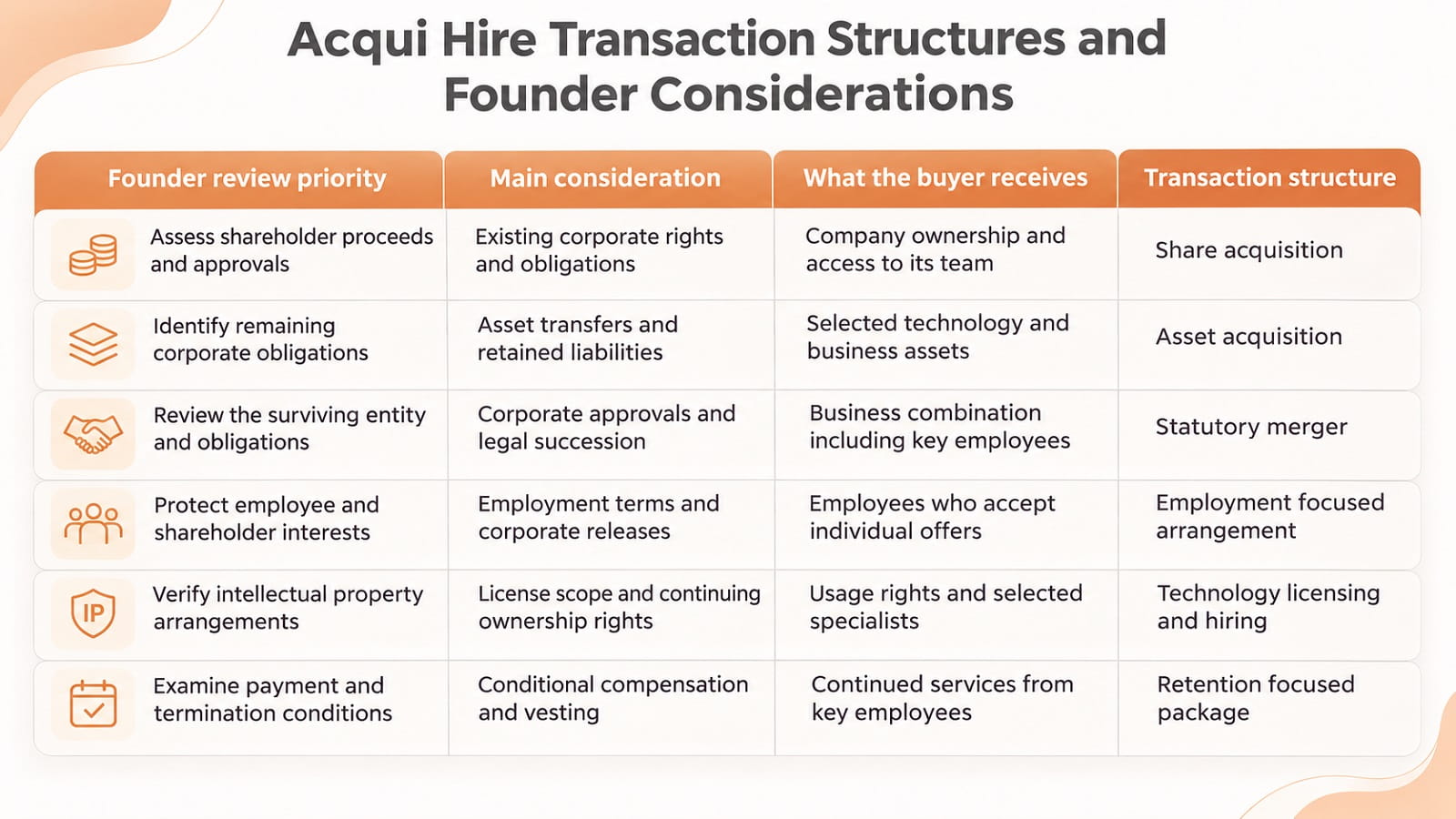
These approaches can overlap. An asset acquisition may include employee retention packages, while a share acquisition may require certain team members to accept new employment agreements before closing. Founders should evaluate the complete arrangement rather than assume that a transaction label determines its financial or legal consequences.
How Talent Driven Acquisitions Are Valued
The value of an acqui hire depends largely on the importance of the team to the buyer's commercial objectives. Conventional financial measures may remain relevant, but they are not always the principal basis for determining the offer.
A buyer may examine employee experience, technical expertise, leadership capabilities, and the difficulty of recruiting comparable specialists independently. Teams that have successfully worked together on complex products may possess additional value because their collaboration reduces the time required to establish an effective operating group.
The buyer may also consider the cost of delaying a strategic project. If an organization needs specialized researchers to develop an important technology, acquiring an established team could be economically preferable to completing a lengthy recruitment process.
Nevertheless, there is no reliable universal valuation per employee. Compensation levels, talent scarcity, competing offers, intellectual property rights, and the buyer's strategic priorities can all affect negotiations.
Founders should focus on the actual value their team provides and the economic structure of the offer rather than relying on broad industry valuation estimates.
What Happens to Founders and Employees?
The employment arrangements are often central to the transaction. A buyer may offer founders and selected employees positions within an existing business division or establish a new team around their expertise.
The founder's future responsibilities can change substantially. An entrepreneur who previously controlled product strategy, hiring, and operating decisions may become an executive reporting to the buyer's management.
Employees may also receive different responsibilities, salaries, benefits, and equity incentives. Some may benefit from access to greater resources and career opportunities, while others may prefer the independence and working environment of the original startup.
Importantly, not every employee is guaranteed an offer. The buyer may only require particular specialists, creating uncertainty for other team members. Founders should establish how those employees will be treated and whether the startup can satisfy its remaining employment obligations.
Understanding Employee Retention Packages
Retention packages are designed to encourage selected employees to remain with the acquiring company after the transaction closes. They may include cash bonuses, equity awards, or other forms of compensation that become payable over a specified period.
A buyer might offer a retention bonus that is paid in installments over two years. Employees who leave before satisfying the agreed conditions may lose some of the unpaid amounts.
Equity awards can create a similar arrangement through vesting requirements. Employees gain rights to the awards as they complete specified periods of service or satisfy other conditions.
Founders should examine how these provisions operate if the buyer terminates employment, changes the employee's responsibilities, or discontinues the relevant project. The agreement may provide different outcomes depending on the circumstances of departure.
The value of a retention package should therefore be evaluated in relation to its conditions rather than treated as guaranteed compensation at closing.
Acquisition Proceeds Versus Employment Compensation
One of the most important aspects of a talent driven acquisition is distinguishing payments for ownership from payments for future employment.
Acquisition consideration is paid for the company, its shares, or its assets. The distribution depends on the transaction structure and the contractual rights of shareholders. Employment compensation, in contrast, is typically paid to individuals for accepting positions, continuing their employment, or satisfying specified performance conditions.
This distinction can significantly affect investor returns. A transaction involving substantial compensation for retained employees may provide considerably less value to shareholders than its combined economic package suggests.
The allocation also deserves careful legal and accounting review. Founders who negotiate personal compensation while participating in decisions about selling the company may face conflicts of interest. Appropriate disclosure, independent review, and necessary corporate approvals can help address these concerns.
A Practical Acqui Hire Example
Consider NexusForge Technologies, a fictional startup developing artificial intelligence infrastructure. The company has assembled a team of 12 employees with experience building specialized software systems.
A larger technology company wants to employ the founder and engineering team to accelerate development of its own products. It proposes a share acquisition combined with individual employment agreements.
The total potential economic package is $10 million. However, only $3 million represents the purchase consideration attributable to existing shareholders. The remaining $7 million consists of signing bonuses, future cash retention payments, and equity awards for employees joining the buyer.
For simplicity, assume all necessary corporate approvals are obtained and the employment arrangements are genuinely separate from the share purchase consideration.
Calculating the Financial Distribution
NexusForge has preferred shareholders entitled to an illustrative $2 million nonparticipating liquidation preference in the qualifying sale. Assume they elect to receive this preference rather than convert into ordinary shares.
The remaining $1 million in acquisition proceeds is distributed to ordinary shareholders. Separately, employees receive the compensation specified in their new employment agreements.
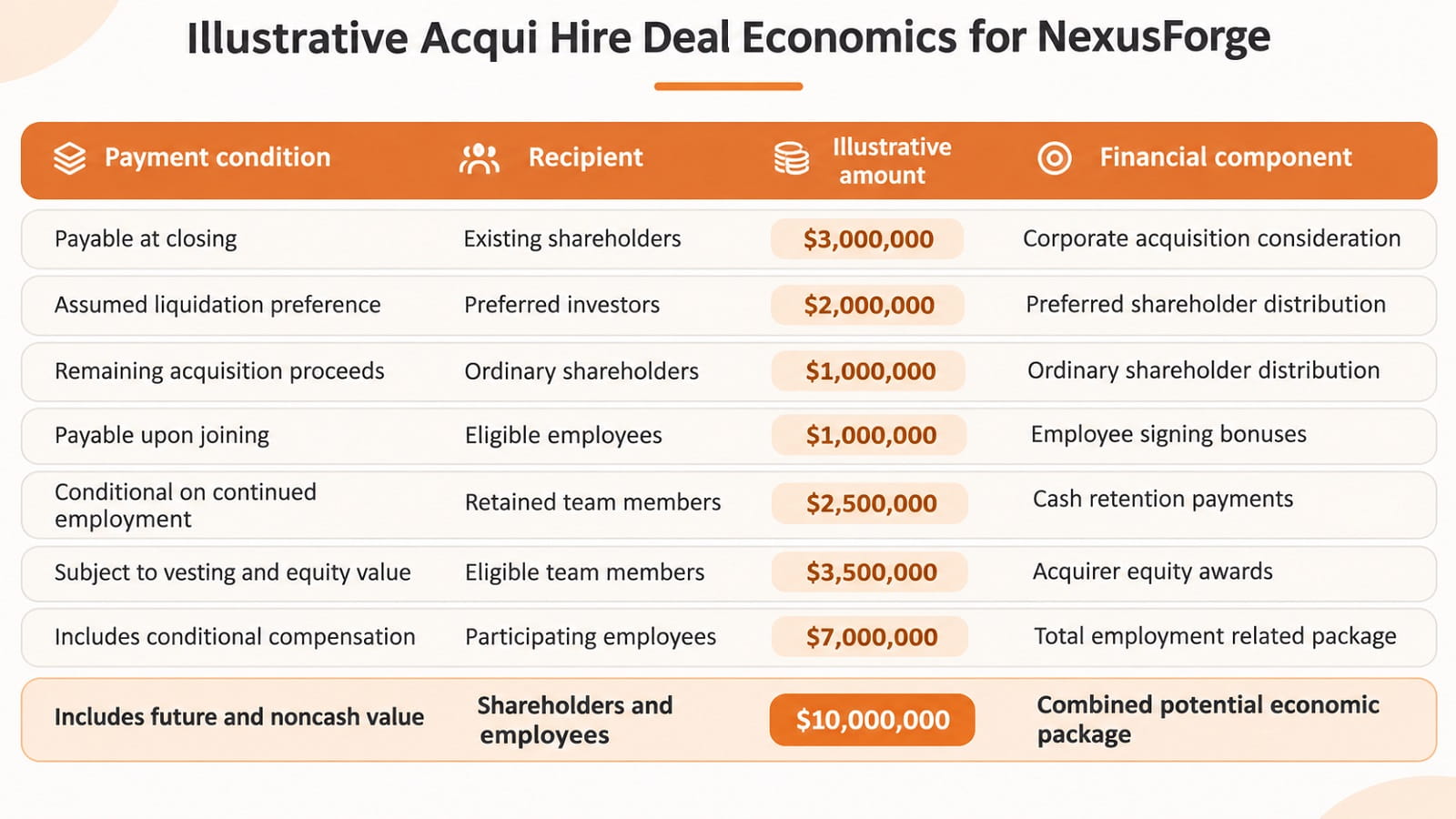
Under these assumptions, the amount available to existing shareholders is $3 million, not $10 million. The preferred shareholders receive $2 million, leaving $1 million for ordinary shareholders. The employment package is separate and includes substantial amounts that are not immediately available. Its eventual value depends on employment conditions, vesting requirements, and the value of securities awarded by the buyer. The example excludes taxes, transaction expenses, and other potential adjustments.
What the Example Means for Founders
NexusForge's founder should assess the financial return from selling existing shares separately from the compensation associated with joining the buyer.
Receiving a valuable employment package may provide significant personal benefits, but those benefits do not necessarily improve the returns of investors who are not joining the acquiring company.
The founder must also consider the certainty of future payments. A compensation package that depends on several years of employment may be less attractive than its stated amount suggests if the future role or working environment remains uncertain.
What Happens to Investors in an Acqui Hire?
Investors may receive a complete return of their original investment, a partial recovery, or no meaningful proceeds. The result depends on the purchase consideration available to shareholders and the rights attached to their securities.
Preferred investors may hold liquidation preferences that influence the distribution of acquisition proceeds. If the purchase price is relatively low, those preferences can leave limited amounts for ordinary shareholders.
Investors generally do not participate in employment compensation unless they are independently eligible under the relevant agreements. A large retention package offered to the founder should not automatically be interpreted as value available to the investor group.
Clear communication during negotiations is therefore important. Investors should understand how the proposed consideration is allocated and why the buyer considers particular employment incentives necessary.
Intellectual Property and Product Ownership
Although the team may be the buyer's primary objective, intellectual property can remain important. Employees may need access to existing software, research, or technical documentation to continue their work effectively.
The transaction should establish whether intellectual property is purchased, licensed, or retained by the original company. These arrangements must be consistent with existing ownership rights and contractual obligations.
Founders should also determine whether the buyer intends to continue supporting the startup's original product. Some buyers integrate the technology into existing services, while others discontinue the product and redirect employees toward different projects.
The treatment of customer data, software licenses, support commitments, and confidential information requires separate attention. Hiring the people who created a product does not automatically transfer every legal right associated with that product.
What Happens to the Startup After an Acqui Hire?
The future of the original company depends on the transaction structure and the buyer's plans. In a share acquisition, the startup may continue existing as a subsidiary even if its original operations are eventually discontinued.
An asset transaction may leave the selling company responsible for contracts, liabilities, and other obligations that were not transferred. Management may then need to wind down the remaining business.
This process can involve addressing customer commitments, employee termination obligations, creditor claims, tax filings, and corporate dissolution requirements.
Founders should establish who will be responsible for these activities and whether sufficient financial resources remain available. Moving the core team into a new organization does not automatically eliminate the responsibilities of the original company.
Reverse Acqui Hire and Alternative Talent Transactions
The term reverse acqui hire is sometimes used to describe arrangements in which a larger company recruits founders and key employees while separately negotiating access to technology or other rights, rather than purchasing the entire startup.
These arrangements may leave the original corporate entity operating with fewer employees, different leadership, or a reduced business scope. Existing shareholders may retain ownership of that entity.
The structure can provide flexibility, but it also creates questions about the allocation of value, treatment of remaining employees, and viability of the original company.
Competition authorities may examine certain talent and technology arrangements depending on their substance and competitive effects. Avoiding a conventional share acquisition does not automatically remove regulatory obligations.
Founders should obtain appropriate legal advice and evaluate the practical consequences for all parties before proceeding.
When an Acqui Hire Makes Sense for Founders
A talent driven acquisition may be attractive when the startup has developed valuable expertise but faces limited opportunities to continue growing independently. Joining a larger company can give the team access to capital, infrastructure, and commercial resources.
It may also be suitable for a successful startup whose founders want to work on larger technical challenges. In this situation, the attractiveness of the transaction may depend as much on future responsibilities and career opportunities as on immediate financial returns.
However, the arrangement may be unsuitable when the buyer offers weak shareholder proceeds, uncertain employment conditions, or inadequate protection for employees who are not retained.
Founders should compare the proposal with realistic alternatives, including continued operations, additional financing, a conventional acquisition, or an orderly closure. The preferred option should reflect the actual interests of shareholders and employees rather than the perceived prestige of completing a transaction.
Final Thoughts
An acqui hire offers a distinctive route for realizing the value of a startup's team and expertise. Unlike transactions focused primarily on commercial performance, these arrangements often place greater importance on employment opportunities, retention incentives, and the future contribution of key individuals.
Founders should evaluate acquisition proceeds separately from employment compensation. They must also understand the treatment of investors, intellectual property, remaining employees, and corporate obligations.
A successful talent driven acquisition should provide a clear financial arrangement and a practical transition for the people involved. The quality of the outcome depends not only on the amount offered, but also on the certainty of payments, fairness of the allocation, and opportunities available to the team after closing.
FAQ
What Is an Acqui Hire in a Startup?
It is a transaction primarily intended to recruit a startup's employees and obtain their expertise rather than acquire the business solely for its commercial operations.
Is an Acqui Hire the Same as an Acquisition?
It can use conventional acquisition structures, but its principal motivation is obtaining talent. Other acquisition transactions may place greater emphasis on revenue, products, assets, or customer relationships.
How Much Is an Acqui Hire Worth?
There is no universal valuation. The amount depends on employee expertise, buyer demand, competing offers, technology rights, transaction structure, and employment arrangements.
Do Founders Make Money From an Acqui Hire?
They may receive proceeds from selling shares, employment compensation, or both. Their actual financial outcome depends on ownership rights, transaction terms, and compensation conditions.
What Happens to Employees After an Acqui Hire?
Selected employees may receive employment offers from the buyer. Their roles, compensation, and benefits depend on individual agreements. Other employees may not be retained.
Do Investors Receive Returns From an Acqui Hire?
Investors may receive proceeds allocated to their securities under the transaction agreements. Employment compensation paid to the acquired team generally does not form part of their shareholder distribution.
Does an Acqui Hire Mean a Startup Has Failed?
No. Although talent acquisitions can offer an alternative to closing a struggling business, successful startups may also attract buyers seeking specialized teams.
What Happens to the Original Startup Product?
The buyer may continue, integrate, license, or discontinue the product, depending on its strategic objectives and the technology rights obtained through the transaction.

Mobina Khanki
Venture & Funding Writer at PinerookMobina Khanki covers venture capital, startup funding, fundraising, and startup finance for Pinerook, focusing on founders and investors.
 Seen first.