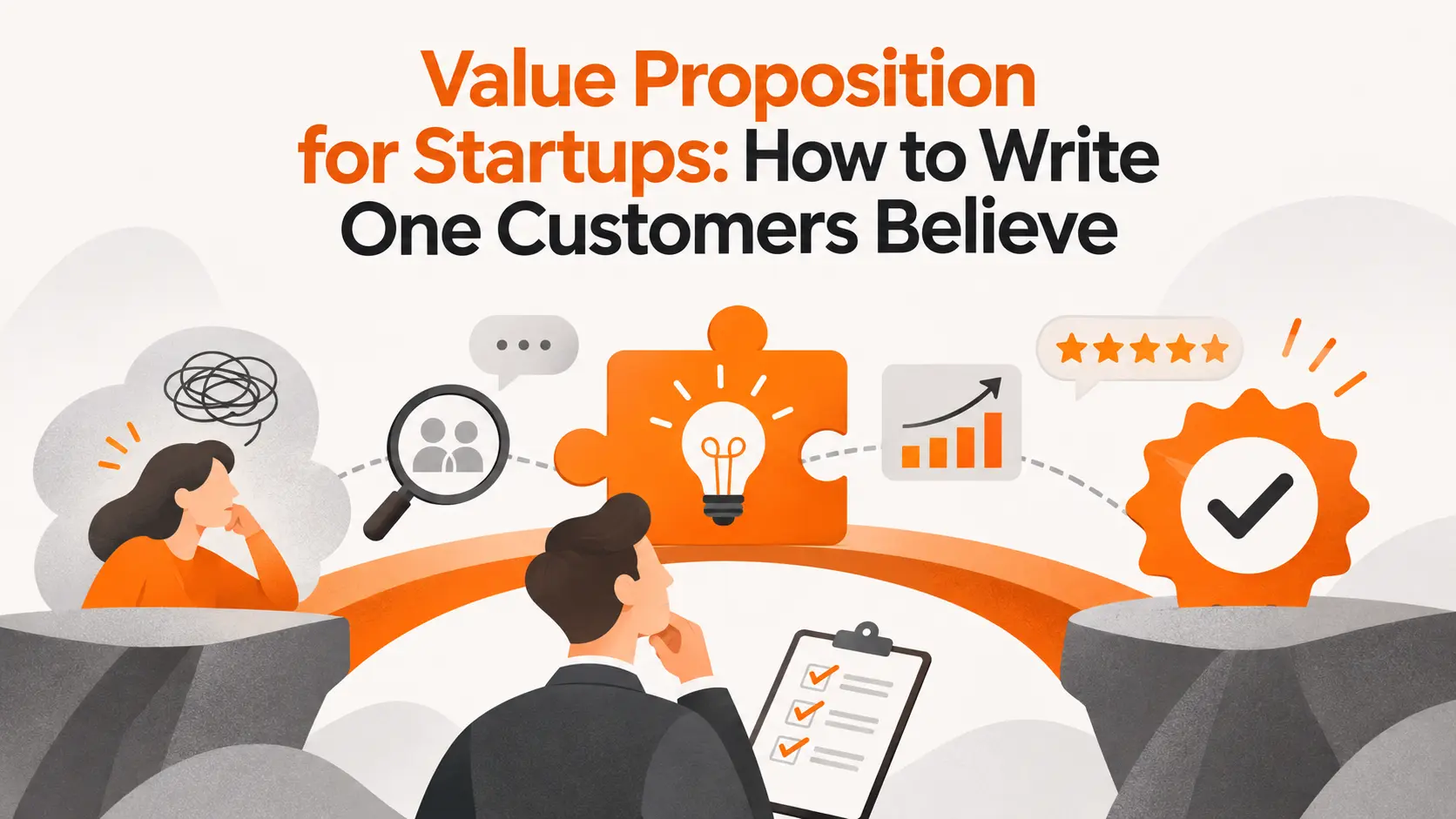
A startup value proposition explains who benefits from a product, which important problem it addresses, and what outcome makes the offer worth considering. The strongest version does not rely on grand claims. It makes a specific promise that a buyer can understand, compare with their current approach, and verify through evidence.
For founders preparing to reach their first customers, a clear value proposition gives the broader Go to Market Strategy for Startups a concrete message to test in sales conversations, landing pages, and product demonstrations. It should describe customer value before listing features, while remaining narrow enough that the startup can actually deliver on the promise.
What Is a Startup Value Proposition?
A value proposition is a concise explanation of the relevant benefit a specific customer receives from choosing an offer. It connects a customer problem to a useful outcome and explains why the offer is credible. It is not simply a slogan, a mission statement, or a catalogue of product capabilities. A slogan can be memorable without explaining anything. A value proposition should help the reader decide whether a product deserves closer consideration.
For an early startup, the value proposition is best treated as a testable hypothesis. Founders may believe that customers care most about speed, but interviews may reveal that predictability, lower risk, or fewer manual checks matter more. The statement must therefore change when better customer evidence emerges. Its purpose is not to sound polished at all costs. Its purpose is to make the intended value understandable and test whether that value motivates action.
The Four Parts of a Useful Value Proposition
A specific customer and situation
Begin with a customer who is dealing with a recognizable situation. A description such as businesses of all sizes makes the claim hard to evaluate, because different buyers have different priorities. A more useful starting point might be finance managers at small software companies who reconcile subscription payments manually each month. The statement does not need to contain a demographic profile, but it should make clear who is expected to care.
A costly or urgent problem
Next, name the friction the customer already experiences. This could be lost time, avoidable errors, delayed decisions, missed opportunities, or a stressful handoff. Describe it in the customer’s language rather than internal product terminology. A founder who says fragmented workflow orchestration may be describing the technology accurately while failing to communicate the actual pain of repeatedly copying data between systems.
An outcome the customer can recognize
Translate the benefit into a result that the buyer understands. Fewer missed invoices, shorter preparation time, faster approval, or a more reliable audit trail are more useful than a generic claim of improved efficiency. A numerical promise can be compelling when it is supported by an appropriate test, but invented precision damages credibility. If the startup lacks measured results, use a specific qualitative outcome and clearly describe its intended value.
A reason to believe the promise
Finally, connect the claim to supporting proof. This could be a product demonstration, documented workflow, verified pilot results, an independent evaluation, or a credible explanation of how the feature removes the identified friction. In a new business, the evidence may be limited. That is a reason to design a focused test, not to manufacture testimonials or treat an internal estimate as a proven customer outcome.
A Practical Value Proposition Template
A useful working template is: For [specific customer] who [important problem], [product] helps [desired outcome] by [credible mechanism or distinctive benefit]. Unlike [current approach], it [relevant advantage]. This is a drafting aid, not a fixed formula that must appear verbatim on a website. A public facing statement can be shorter once the founder has established the audience, outcome, and evidence.
Consider an illustrative startup called LedgerPath, which helps a small finance team review payment records. A weak version reads: LedgerPath is an innovative platform that transforms financial operations. The statement offers little information about the buyer, the task, or the result. A stronger draft reads: LedgerPath helps finance teams at growing subscription businesses identify payment mismatches in one review workspace, reducing the manual effort of checking records across separate systems. Unlike spreadsheet based reviews, the product brings unmatched transactions into a shared queue. These are hypothetical product claims offered to demonstrate the writing method, not verified performance results.
Notice that the stronger draft does not say the company is the best or fastest. It gives the buyer a concrete way to understand the offer and ask for proof. The product team can show the review queue, observe how a finance manager uses it, and determine whether the promised benefit is meaningful enough to justify adoption.
Build the Claim From Customer Evidence
Start with actual examples of the job customers are trying to complete. Ask prospects to describe the last time the problem occurred, what triggered it, how they handled it, who was involved, and what the failure or delay cost them. Specific past behavior is generally more informative than asking whether they would like a hypothetical product. It also reveals the workarounds and competing priorities that influence a purchasing decision.
Separate the language customers use from the language the startup uses. A customer might say the team spends Friday afternoon checking numbers across three reports. The founder might describe the same issue as reconciliation inefficiency. Both can be valid descriptions, but the first may communicate urgency more clearly. Record the wording, then ask followup questions about frequency, consequences, and what would make the work meaningfully easier.
Prioritize the benefits that recur across interviews and match the product’s actual strengths. A long list of benefits tends to blur the promise. A focused statement can lead with one meaningful outcome and support it with a secondary advantage. If different buyers consistently value different outcomes, write separate variants and test them with the relevant groups rather than forcing every buyer into a single broad claim.
Value Proposition Evidence Checklist
Use the following table to turn the draft into a set of claims that can be examined. The evidence column is especially important because a plausible sounding statement is not yet a verified customer benefit.
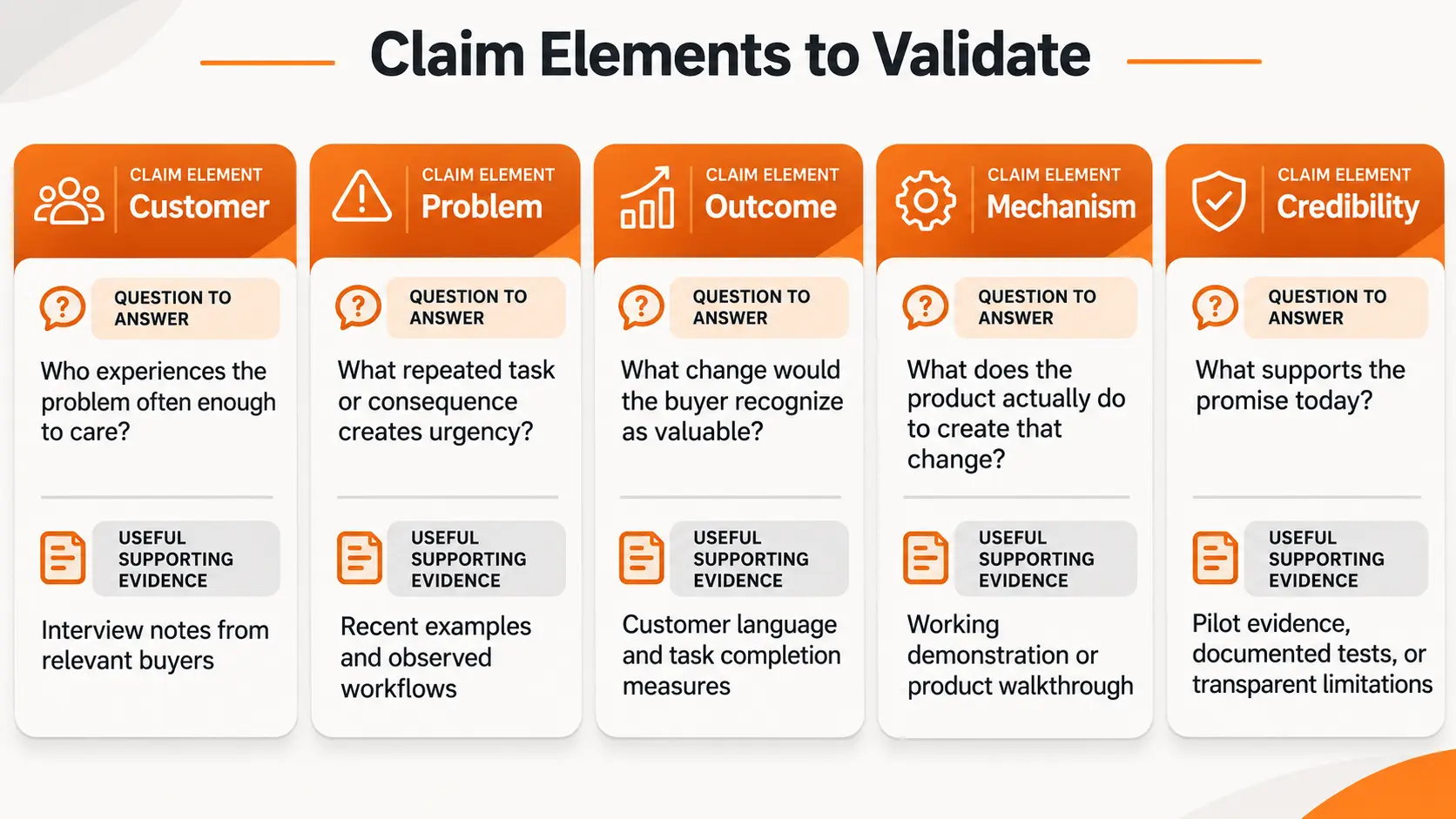
The checklist is not a scorecard that automatically proves the message works. A founder might have strong evidence of the problem but weak evidence that the proposed solution is the preferred one. In that case, the appropriate next step is a product test rather than a stronger marketing claim. Evidence quality matters more than how neatly the worksheet is completed.
Test Whether Customers Understand and Value the Message
Begin with a comprehension test. Show a prospective customer the value proposition without a full sales explanation and ask what they think the product does, whom it serves, and why it could matter. If they consistently misinterpret the benefit, rewriting the copy may be more useful than adding more website sections. Do not lead the respondent by explaining what the statement was supposed to mean before hearing their interpretation.
Next, test relevance. Ask when they last encountered the problem and whether the proposed outcome would have changed their decision. A buyer might understand the statement perfectly yet find the issue too infrequent to prioritize. This distinction prevents founders from confusing clear communication with demand. Compare reactions among prospects who have experienced the problem recently and those who have not.
Then examine willingness to take a meaningful action. Depending on the product, that might mean agreeing to a realistic product demonstration, sharing sample data for a pilot, requesting a proposal, or starting a trial. Visits and positive comments are weaker signals than steps requiring time, attention, or organizational commitment. Track the quality of the prospect alongside the action; a large response from people who are not likely buyers can create a misleading sense of traction.
When testing alternate messages, change the stated benefit rather than changing the audience, traffic source, design, and call to action simultaneously. Otherwise, it becomes hard to explain what caused any difference. Small startup samples rarely support confident statistical claims, but carefully documented interviews and comparable tests can still reveal clear objections, misunderstandings, and repeated preferences.
Value Proposition vs Product Positioning
A value proposition and a positioning strategy influence each other, but they answer different questions. A value proposition explains the outcome that makes the offer worthwhile for a customer. Product positioning establishes the competitive context in which that customer should understand the product, including the available alternatives and the category in which the offer belongs. A startup can have an appealing benefit yet create confusion by positioning the product in the wrong category.
For example, a product could promise to reduce manual payment checks. That is its customer benefit. Whether it competes with accounting software, a spreadsheet workflow, or an outsourced finance service is a positioning question. This article concentrates on identifying, wording, and testing the customer benefit. Competitive category decisions belong in the dedicated Product Positioning Strategy article, while customer selection and market sizing remain separate topics.
Common Mistakes That Weaken Startup Value Propositions
The first mistake is leading with technologies instead of customer outcomes. Saying that a product uses advanced automation tells buyers how it may work, but not why they should change their current behavior. Technology can strengthen the reason to believe only after the desired result is clear. The second mistake is using benefits that cannot be distinguished or tested, such as seamless, revolutionary, or world class without an explanation of what the customer gains.
Another mistake is making a promise for every audience. Different groups can face the same task with different urgency and decision criteria. A claim written to satisfy everyone may satisfy nobody. Start with a clearly defined use case, establish whether the claim is true, and expand only when evidence supports it. A final mistake is treating the statement as permanent. As product capabilities and customer learning change, the message should be revisited, with prior versions and test outcomes recorded rather than forgotten.
How Founders Can Use the Proposition Across Customer Touchpoints
Once a credible statement emerges, repeat its core meaning consistently across the homepage, sales introduction, demonstration, onboarding explanation, and product description. Consistency does not require identical wording everywhere. A landing page may lead with the desired outcome, while a sales conversation expands on the problem and the mechanism. The underlying promise should stay recognizable so buyers do not receive contradictory explanations from different parts of the company.
Product teams should also use the statement as a discipline for evaluating features. If the promised value is faster identification of mismatched payments, features that make that task more reliable deserve attention before unrelated additions. This does not replace a product roadmap or guarantee demand. It gives the team one practical question: does this work improve the outcome we have promised to the customers we intend to serve?
FAQ
What is a value proposition for a startup?
It is a concise, testable explanation of the important customer outcome a startup offers, for whom it matters, and why the claim is credible.
How long should a value proposition be?
Long enough to communicate the buyer, the relevant problem, and the outcome clearly. One or two sentences can work, but clarity matters more than an arbitrary word count.
Is a value proposition the same as a slogan?
No. A slogan aims to be memorable, while a value proposition explains a specific reason a customer might choose an offer.
How do I write a value proposition before launch?
Start with observed customer problems and a realistic intended outcome. Label unverified performance claims as hypotheses, then use interviews and product tests to gather evidence.
What makes a value proposition convincing?
A recognizable problem, a concrete result, understandable language, and proof appropriate to the strength of the claim.
How often should a startup update its value proposition?
Review it when customer evidence, product capability, or the purchasing context changes. Revisions should follow learning rather than a calendar alone.

Mohsen Avid
Founder & Editor, PinerookMohsen Avid is the founder of Pinerook, covering entrepreneurship, startup strategy, digital business, and the decisions behind building new ventures.
 Seen first.