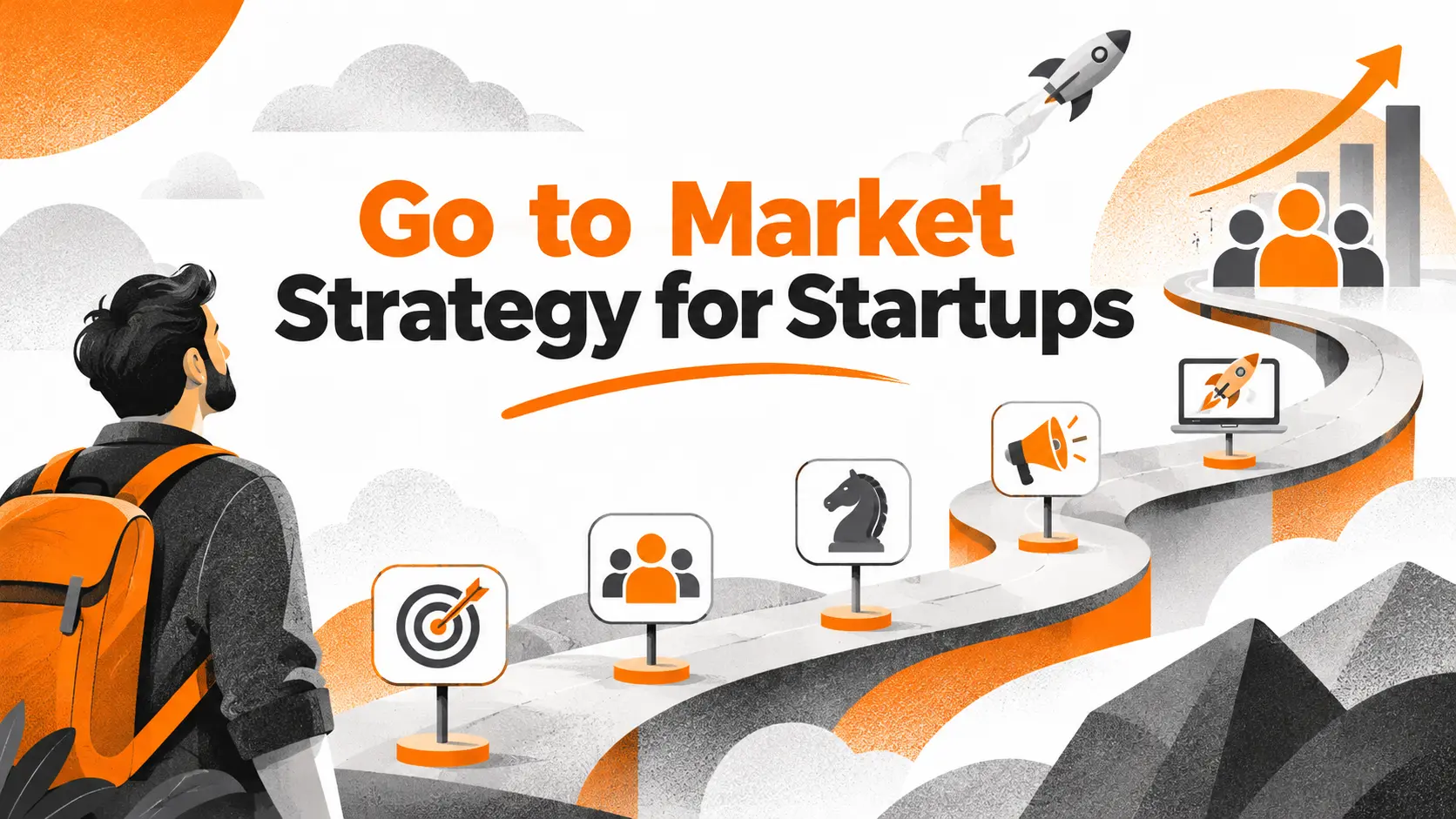
What Is a Go to Market Strategy for Startups?
A go to market (GTM) strategy is a set of decisions about which customers a startup will serve first, why those customers should choose its product, how the company will reach and convert them, and what evidence will justify further investment. It connects product value to an actual buying or adoption process. A usable strategy names a specific market, a testable offer, a feasible route to customers, clear ownership, and the conditions under which the team will continue, adjust, or stop.
For a startup, the purpose is not to produce an impressive launch deck. It is to reduce uncertainty before committing scarce money, hiring capacity, and founder attention. A company can build useful technology and still fail to generate traction if the initial audience cannot be reached, the promised benefit is unclear, or the purchase requires more effort than customers are willing to invest. GTM makes those assumptions explicit and gives a small team a way to learn from real behavior.
Go to Market Strategy vs Marketing Strategy vs Product Strategy
These terms overlap in daily work, but they answer different questions. Product strategy determines which customer problem to solve, the product capabilities needed, and the choices the company will not pursue. Marketing strategy shapes awareness, demand, and communication over time. GTM specifies how a particular product or offer enters a particular market and moves from discovery to adoption or purchase. It includes marketing, but also sales, onboarding, commercial terms, support capacity, and measurement.
A product can have a credible roadmap and a polished marketing website without having a credible route to its first paying customers. Likewise, a successful first launch does not establish a permanent acquisition system. A founder should treat GTM as a focused commercial hypothesis that changes as the evidence improves, while maintaining consistency with the broader product and company strategy.
Start With Readiness, Not a Launch Date
Before choosing campaign channels, confirm that the product can deliver a meaningful outcome to a clearly identifiable user. The threshold is not perfection: early startups often enter the market with a narrow product and manual onboarding. The threshold is that the team can explain the problem, demonstrate the value, complete the basic delivery promise, and support customers through the first use. Otherwise, promotional activity may amplify a product or service failure instead of revealing market demand.
Write down the assumptions most likely to invalidate the proposed launch: whether the problem is urgent, who controls the budget, how customers currently solve it, what implementation friction exists, and which legal or operational constraints affect delivery. Separate facts obtained from interviews, pilots, and observed behavior from estimates made by the founding team. A strategy built on untested assumptions is still useful, provided its first priority is testing them rather than pretending they are settled.
Choose a Beachhead Market and a Buyer You Can Reach
The first market should be narrower than the total market opportunity. A cybersecurity startup might eventually serve every mid sized business but begin with regional healthcare providers facing a specific reporting requirement. The narrower segment gives the founder a clearer problem, more comparable sales conversations, and a repeatable way to learn. Expansion becomes easier to evaluate after a defined initial segment shows genuine adoption.
An Ideal Customer Profile (ICP) is most useful when it describes observable conditions rather than an aspirational demographic. For a business to business product, include company characteristics, the job or workflow affected, a buying trigger, the likely budget owner, and reasons a prospect would not qualify. For consumer businesses, include the occasion of use, existing alternative, urgency, and reachable audience. A list of attractive industries is not evidence that customers in those industries will purchase.
Startup Market Segmentation turns that broad picture into competing entry choices. Instead of treating segments as fixed categories, compare them by problem intensity, access to decision makers, ability to deliver a strong first outcome, purchase friction, and the speed at which the startup can collect valid feedback. The right first segment is not necessarily the largest or richest. It is the one where the team has a plausible path to learning whether its offer deserves to exist.
Position Against the Customer’s Actual Alternative
Competitors are not limited to businesses with similar features. The real alternative may be a spreadsheet, a freelancer, a larger platform already in use, an internal team, or doing nothing. When a founder understands why customers tolerate the status quo, they can define a benefit worth switching for. That requires studying customer language and constraints, not collecting a long list of rival features.
A Product Positioning Strategy connects a defined buyer and problem to the category in which the offer should be understood. Positioning should make the product legible immediately, including the situation where it is useful and the trade off it makes. A specialized tool might win by integrating with an existing process and reducing implementation time rather than claiming to be the most powerful solution. That is a meaningful commercial position even when its feature count is smaller.
The Value Proposition for Startups should convert that position into a claim customers can evaluate. Replace vague promises such as “work smarter” with the task improved, the effort or delay reduced, and the conditions under which the benefit occurs. Do not present forecast percentages as proven results. When outcomes have not been measured, phrase the claim as a hypothesis and test it in customer conversations, a pilot, or a limited paid offer.
Decide How the Customer Will Buy and Receive Value
A go to market motion describes how interest becomes a customer relationship. Product led motions allow users to experience value through self service; sales led motions involve conversations, demonstration, procurement, and tailored implementation; partner led motions use another organization to provide access or trust. Many startups combine approaches, but each extra motion creates complexity. The choice should reflect purchase risk, time to value, customer expectations, and the team’s delivery capacity.
For instance, a low priced workflow tool with an obvious self service setup may be poorly served by a long consultation process. A regulated enterprise product that requires security assessment and integration may not convert through a frictionless trial alone. The key question is not which motion looks modern, but which buying process the intended customer will reasonably complete. Customer interviews should verify who uses the product, who approves it, who pays, and who can block the purchase.
Select Channels Based on Evidence, Not Popularity
Go to Market Channels are the specific routes through which the startup can reliably reach the selected customer and begin a meaningful buying conversation. Possible routes include direct outreach, search, industry communities, partners, events, marketplaces, referrals, and a product’s own sharing loop. The optimal choice depends on where customers already look for solutions, the team’s credibility in that environment, the time needed to reach a buying decision, and the cost of running an interpretable test.
At the first stage, one primary route and one controlled secondary experiment are usually easier to learn from than a simultaneous presence everywhere. The founder should record the intended audience, the offer, the message, the expected customer action, the test cost, and the observation window before launching activity. Traffic or impressions alone are not proof of channel fit; a credible route produces customers who are qualified, can receive value, and show genuine willingness to proceed.
Match the GTM Motion to the Buying Situation
The following comparison is a decision aid rather than a fixed rule. A startup may deliberately start with a more manual approach to learn and automate it later.
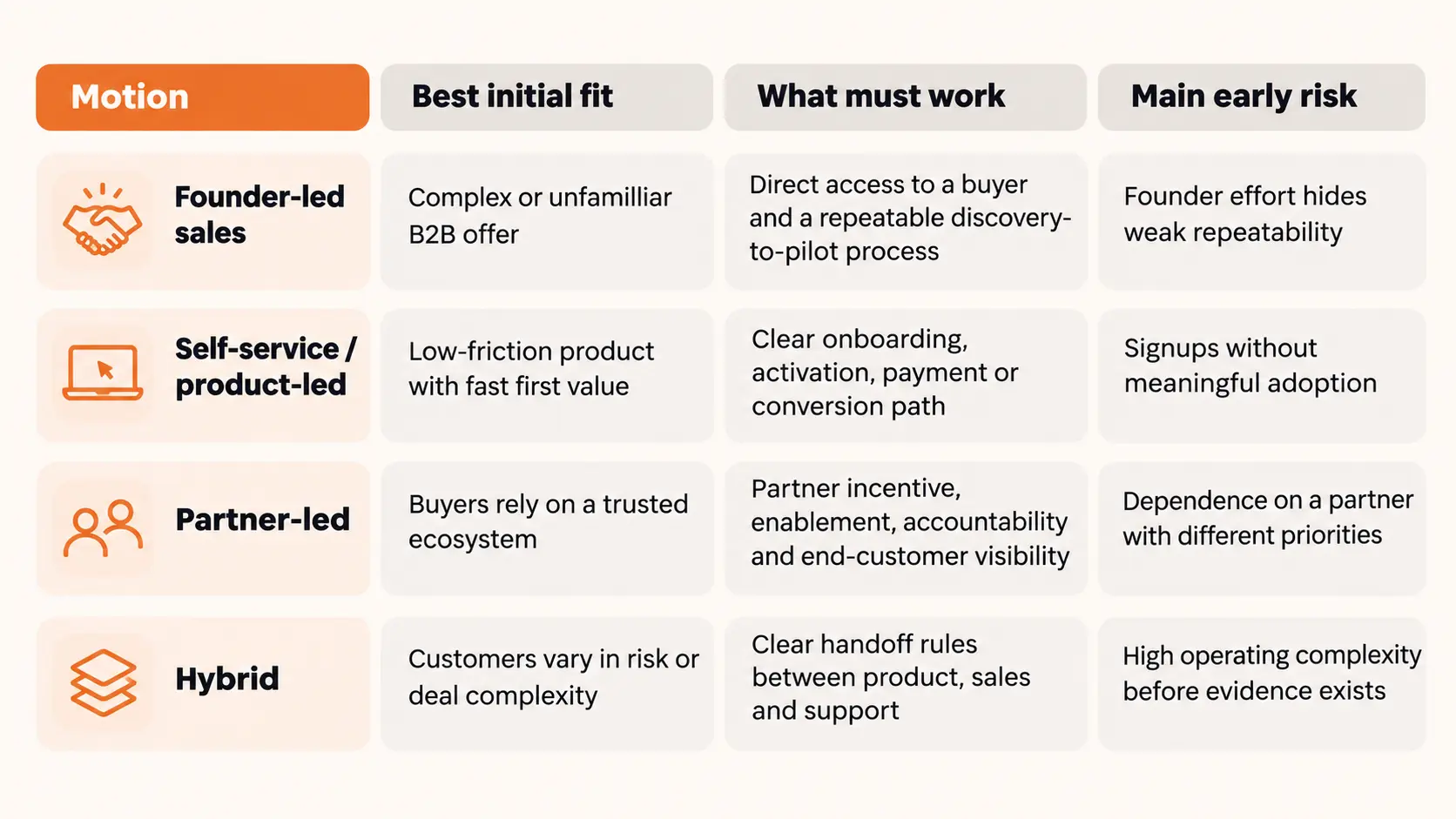
Treat these options as hypotheses about customer behavior. A product led path may still require founder conversations to understand why users do not activate, while a sales led path can benefit from a trial or interactive demonstration. Avoid hiring an entire acquisition team before the original motion has produced enough repeatable evidence to explain what new hires should reproduce.
Build a Small, Executable GTM Plan
A Go to Market Plan should be short enough to guide weekly decisions and specific enough that its results can be assessed. Name the chosen buyer, triggering problem, alternative, product promise, acquisition motion, first channel, conversion action, available budget, owner, and review date. Add the smallest measurable outcomes that distinguish customer curiosity from actual progress. A one page plan with clear assumptions is more useful than a large presentation that no one updates.
Consider a fictional startup offering appointment follow up software to independent dental clinics. Its first target could be clinics with three to ten chairs where missed appointments create measurable scheduling gaps. The buyer may be the practice owner while reception staff use the product daily. The initial promise is not “AI powered clinic operations”; it is a simpler follow up workflow that staff can adopt without replacing scheduling software. The founder could test direct outreach and referrals through clinic consultants before committing to paid advertising.
The startup should define the pilot outcome before recruiting clinics: staff actually complete a follow up workflow, the clinic continues using it, and the owner confirms that the value justifies the price. If demonstrations are plentiful but pilots fail, messaging or targeting may be less important than implementation friction. If pilots succeed but deals stall, the buyer, budget authority, or commercial structure may need reconsideration. The example is illustrative; its sequence is useful because each decision follows observable evidence.
Launch in Phases, Not in One Big Announcement
A Startup Launch Strategy works best when it separates learning from amplification. A limited design partner or beta phase can uncover onboarding problems and sharpen the proposition. A controlled public launch tests whether the buying path works outside close founder relationships. Only when delivery and conversion are coherent should the team widen acquisition. Publicity can create attention, but a launch is commercially meaningful only when the startup can respond to that attention and move suitable customers toward value.
A 90 day structure can keep a small team honest without implying that every startup should reach the same revenue level in three months. Define success criteria from the actual sales cycle and customer behavior. A consumer application may observe activation in days; a complex enterprise offer may need longer to observe a signed purchase. Use weekly reviews to catch operational issues, but avoid declaring a strategy successful or unsuccessful before its relevant customer actions could reasonably occur.
An Evidence Based First 90 Days
This example sequence maps actions to decisions. Dates are planning windows, not universal performance benchmarks.
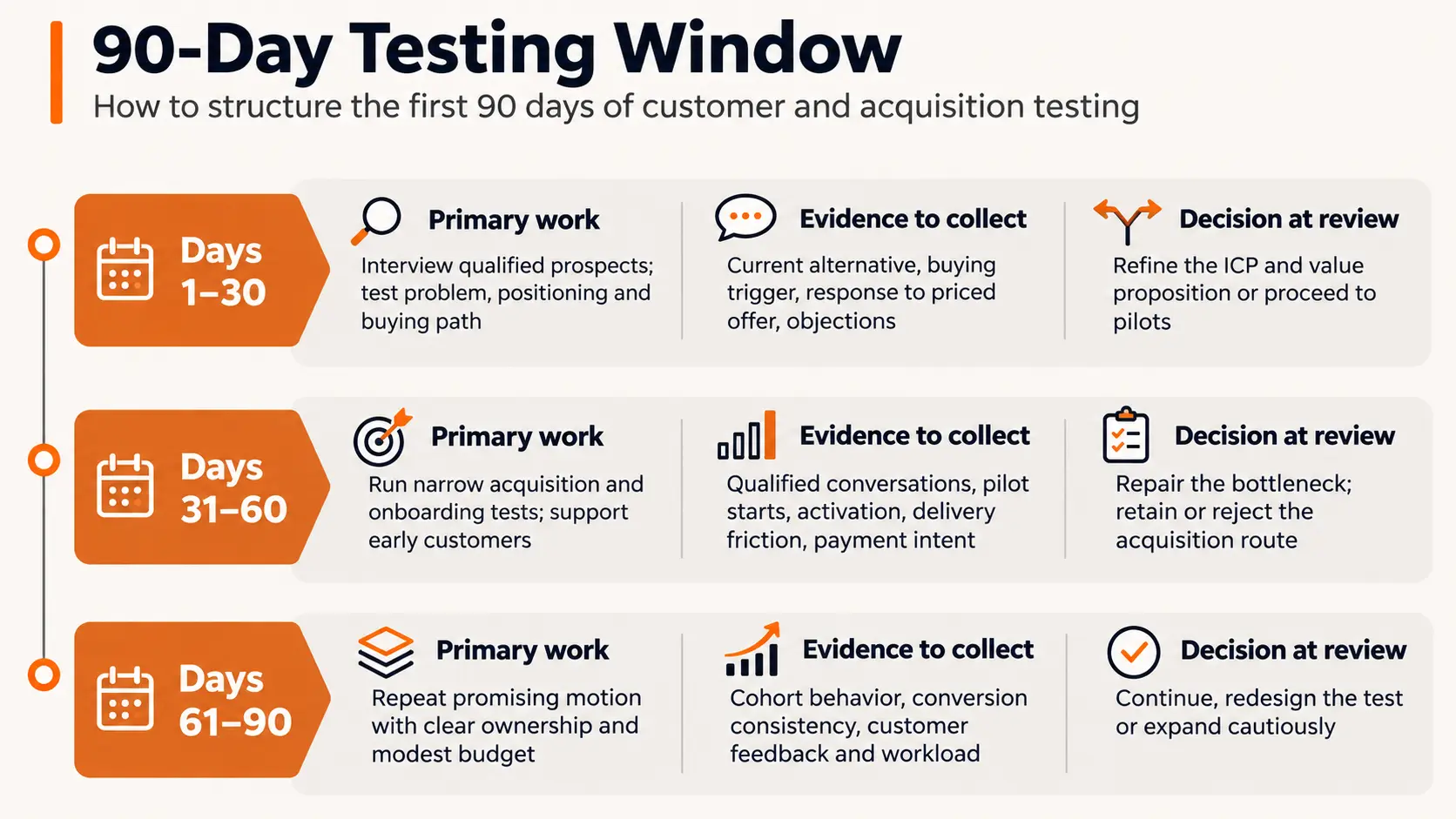
The sequence matters more than any arbitrary target. A founder who observes strong engagement but no purchasing authority has learned something different from a founder who closes a few deals that require unsustainable customization. The review should state what has been demonstrated, what remains uncertain, and what resources the next experiment will consume. That discipline stops a noisy launch from becoming an expensive, unexamined growth plan.
Measure Progress With a Few Decision Useful Signals
Go to Market Metrics should follow the customer’s path rather than the dashboard a tool happens to provide. Start with qualified opportunities, the share that take the intended next step, time to initial value, conversion to a real commercial commitment, and repeat usage or retention where relevant. Always define the denominator, time window, and segment. Ten pilots out of ten qualified conversations mean something different from ten pilots out of a thousand untargeted website visits.
Financial efficiency still matters, but a GTM pillar does not need to reproduce the calculation of customer acquisition cost, lifetime value, or unit economics. Those measures are best interpreted in their dedicated financial context. In the GTM review, use them as constraints: is the acquisition route becoming affordable, is demand tied to a repeatable customer type, and can the company deliver without increasing bespoke work for every sale? A positive conversion metric does not excuse poor retention or unreliable delivery.
Build a simple evidence log for every experiment: audience, message, channel, spend or effort, observation period, customer action, notable objections, and the founder’s decision. Compare like with like. A conversion gain after changing the target customer and the offer at the same time cannot establish which change caused it. When sample sizes are small, report individual customer evidence and uncertainty rather than giving false precision to percentages.
Know When to Adjust and When to Scale
A failed initial channel is not automatically proof that the market is wrong. Distinguish failure to reach appropriate buyers from failure to persuade them, failure to deliver value, and failure to retain customers after delivery. Each pattern points to a different problem. If qualified buyers consistently recognize the pain but cannot complete procurement, address purchase friction. If the wrong audience keeps responding, reconsider segmentation and channel. If paying customers do not use the product, revisit the promise and first use experience.
Scale should follow evidence of repeatability, not a single successful campaign. Ask whether another team member could use a documented process to reach similar buyers and deliver similar outcomes without extraordinary founder intervention. Ask whether the next cohort behaves like the first and whether support demands remain manageable. Some startups deliberately continue founder led selling because learning is still valuable; others add channels only after their primary route has become predictable enough to justify more expense.
Common Go to Market Mistakes Founders Can Avoid
The most common mistake is describing the target market so broadly that the team cannot make a focused offer. A second is discussing product features before understanding the customer’s real alternative. A third is investing in several channels before producing an interpretable signal from any of them. Founders also confuse public launch activity with qualified demand and count free registrations as evidence of willingness to pay. These errors make growth look larger while making the underlying decision weaker.
A subtler mistake is copying a well known company’s distribution tactic without its original context. A community motion that emerged from years of trust may not be reproducible by a new company in six weeks. An enterprise sales model built for high value contracts may be uneconomic for a low priced product. The more useful lesson from successful companies is how their market, buying behavior, product experience, and route to customers fitted together, not the superficial choice of a particular channel.
The Founder’s GTM Decision Checklist
Before allocating the next tranche of attention or budget, a founder should be able to answer in plain language: Who is our first customer? What makes the problem urgent now? What do they do instead? Why is our offer credible? How will they discover and buy it? What must happen before they experience value? What observation would cause us to change the plan? If these answers are still guesses, the next task is an experiment. If they are supported by consistent customer behavior, the next task may be a controlled expansion.
The central principle is that go to market strategy is a learning system with commercial consequences. Start narrowly, document the assumptions, choose a realistic buying path, observe actual customer decisions, and expand only when the evidence warrants it. That approach makes GTM useful before the startup has a dedicated sales or marketing department and keeps it useful as the company matures.
FAQ
What is a go to market strategy for an early stage startup?
It is a focused plan explaining which customers to pursue first, what value to offer them, how to reach and convert them, and what evidence will determine the next investment. It should be testable rather than a generic brand or marketing statement.
How is a GTM strategy different from a marketing plan?
A marketing plan concentrates on communication and demand generation activities. GTM also covers the initial market choice, customer buying process, sales or self service motion, launch operations, onboarding and commercial validation.
Do startups need product market fit before creating a GTM strategy?
No. Early GTM work can help test whether the product solves an urgent problem for a reachable buyer. Founders should avoid scaling acquisition aggressively before there is sufficient evidence that the target customer receives and continues to value the product.
How many acquisition channels should a startup use at launch?
There is no universal number. An early team often learns more from one well designed primary channel test and a limited secondary experiment than from many simultaneous activities. The choice depends on customer behavior, the buying cycle, and available resources.
How long should a startup test its GTM strategy?
The test must be long enough to observe the customer actions that matter. A 90 day plan is a useful organizing tool, but an enterprise purchasing process may take longer than a self service activation test. Set the observation window before judging outcomes.
What indicates that a startup is ready to scale its GTM motion?
Repeatable access to qualified buyers, consistent progress toward purchase or adoption, reliable delivery of the promised outcome, and manageable operating economics are stronger signals than campaign reach alone. Founders should verify those patterns across comparable customer cohorts.

Mohsen Avid
Founder & Editor, PinerookMohsen Avid is the founder of Pinerook, covering entrepreneurship, startup strategy, digital business, and the decisions behind building new ventures.
 Seen first.