A technology roadmap for startups is a practical plan that shows which technical capabilities a business needs next, why they matter, and what must happen before the team can deliver them. It connects company milestones to engineering work without pretending that every feature or delivery date can be predicted. For a small team, its real value is deciding what deserves limited time and money now.
A broader technology strategy for startups defines the principles behind technology choices. The roadmap puts those choices in order. It helps founders, product leaders, and engineers agree on what to do first, what to postpone, and which assumptions need testing before the next commitment.
What a Startup Technology Roadmap Should Include
A product roadmap explains the customer problems a company intends to solve and the value it hopes to deliver. A technology roadmap makes the enabling work visible: integrations, reliability, data, security, internal systems, and technical dependencies. A sprint backlog is different again. It contains the detailed tasks engineers use to execute the plan.
A useful roadmap should identify the business outcome, the current constraint, the capability required, the work that must happen first, the person accountable, and the evidence that will show progress. It does not need a long list of frameworks or a calendar full of tickets. If a proposed initiative cannot be connected to a meaningful outcome or risk, it probably belongs in the idea backlog rather than the active roadmap.
Start With a Business Milestone, Not a Feature List
Consider a software startup that wants more trial users to become paying customers. “Rebuild the platform” is not a useful roadmap objective. “Help more trial accounts complete setup and reach their first useful result” is. The second statement points toward customer behavior that can be measured and a problem that can be investigated.
Before promising a new dashboard or database migration, the founder should ask where customers actually get stuck. If users abandon the setup process when inviting teammates, improving that step may create more value than an ambitious infrastructure project. The roadmap should follow the evidence about the bottleneck, not the team’s favorite solution.
Translate the Milestone Into Technical Work
Describe the constraint before choosing a solution
Write down what is preventing the business outcome today. The constraint might be a broken integration, slow setup, unreliable releases, missing permissions, or insufficient visibility into user behavior. Include the evidence behind the diagnosis. “Customers report failed imports in support tickets” is more useful than “our infrastructure is outdated.” This keeps the conversation open to several possible fixes instead of turning the first suggestion into a commitment.
Put dependencies in the right order
Some work cannot succeed until a less visible capability exists. A guided setup experience may depend on reliable event tracking. A partner integration may require stable authentication and error handling. A larger customer contract may require access controls before a feature can be deployed. Map these dependencies before assigning dates. Otherwise, the roadmap promises visible features while hiding the work required to make them dependable.
Define what successful delivery will prove
Every major initiative needs a completion test that matters beyond shipping code. For onboarding, that might be setup completion, time to first value, or fewer support requests. For reliability work, it could be a lower incident rate or faster recovery. Decide what will be measured before the work begins. Shipping a capability is an output; changing the business or operating result is the reason to fund it.
A Practical 90 Day Technology Roadmap Example
Imagine a small business software company that has early paying customers but loses many trial accounts during setup. Its next milestone is to improve activation without expanding the engineering team.
A simple roadmap could look like this:
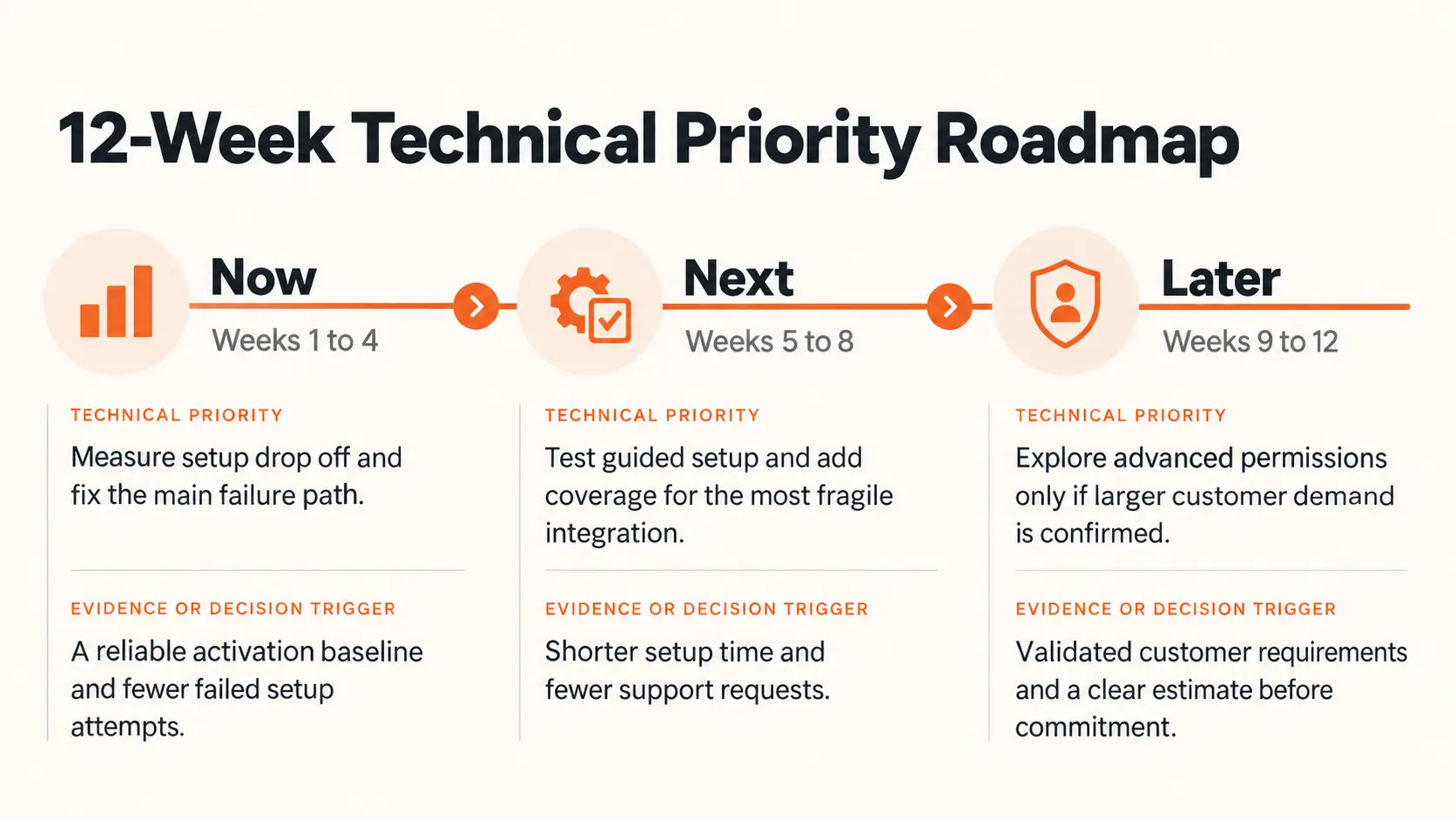
Notice what the plan leaves out. It does not commit to a new architecture, a mobile app, or an enterprise feature simply because those ideas sound impressive. The later initiative stays conditional. If onboarding improves but larger customers do not appear, the team can spend its next cycle on a more valuable constraint.
Prioritize Work Against Capacity and Risk
Founders often receive competing requests from customers, sales, investors, and engineering. The loudest request should not automatically win. Compare proposed work using business impact, strength of evidence, urgency, dependencies, delivery effort, and the cost of delaying it. A security issue that exposes customer data may require immediate attention even when it creates no visible new feature.
Technical maintenance deserves a place when it is causing slower releases, repeated incidents, or meaningful risk. It should not be treated as an automatic percentage or ignored until something breaks. The founder’s question is practical: what happens if this work waits, and is there a smaller intervention that reduces the risk? This makes tradeoffs explicit without turning the roadmap into a debate over engineering preferences.
Separate Commitments From Possibilities
A roadmap becomes misleading when every item is presented as a promise. Use three levels of confidence. Now contains work the team has evidence and capacity to undertake. Next contains priorities that look valuable but still depend on results or available resources. Later holds options that are worth watching, not dates the company has already committed to.
This distinction matters in investor updates and customer conversations. An enterprise prospect asking for single sign on does not automatically justify building it. First establish whether the requirement is real, whether it unlocks a credible commercial opportunity, and what other work would be delayed. Label a discovery decision as discovery rather than quietly turning it into a delivery commitment.
Assign Ownership and Review the Evidence
The founder should own the business outcome. A technical lead should assess feasibility, sequencing, and operating risk. Product or customer facing colleagues should bring evidence about actual user needs. Even if one person holds several roles, each initiative needs a clear decision owner so priorities do not change through informal requests.
Review the roadmap at a regular interval that fits the team, often monthly, and whenever material facts change. Ask whether the original constraint still exists, what the last cycle proved, which dependencies have moved, and whether a planned item should advance, shrink, or disappear. Keep a short record of significant changes and the reason for each one. A roadmap that adapts to evidence is useful; one that changes every week without explanation is not.
The Next Decision Matters More Than the Perfect Plan
A startup does not need a polished technology roadmap covering several years. It needs a credible view of the next milestone, the technical work that enables it, and the assumptions that could change the sequence. Start with one business constraint, name the owner, show the dependencies, and define the evidence that will justify the next investment. The roadmap can become more detailed as the company earns greater certainty.
FAQ
Does a startup need a technology roadmap before product market fit?
Yes, but it should be light. Before product market fit, the roadmap is mainly a way to sequence experiments, essential product capabilities, and basic reliability work. A short Now, Next, Later view is often more useful than a detailed annual plan.
How is a technology roadmap different from a product roadmap?
A product roadmap focuses on customer problems and product outcomes. A technology roadmap covers the technical capabilities and dependencies needed to deliver those outcomes safely and reliably. They should inform each other rather than become disconnected plans.
How far ahead should a startup plan its technology?
Plan far enough to reveal major dependencies and likely investments, but keep detailed commitments close to the present. The less certain the customer demand or technical approach, the more the roadmap should describe options and decision triggers instead of fixed dates.
Who should own the technology roadmap without a CTO?
The founder remains accountable for business priorities, while a trusted engineer, technical lead, or adviser can validate feasibility and risk. The important part is that ownership is explicit and technical choices are reviewed against customer evidence and available resources.
How often should a startup update its roadmap?
A monthly review is a reasonable starting point for many small teams, with earlier updates when a major customer requirement, incident, or funding constraint changes the plan. Update it because the evidence changed, not simply because the calendar moved.

Mohsen Avid
Founder & Editor, PinerookMohsen Avid is the founder of Pinerook, covering entrepreneurship, startup strategy, digital business, and the decisions behind building new ventures.
 Seen first.