A startup launch strategy is the sequence of decisions that takes a product from limited customer testing to a wider market release without exposing the business to avoidable risk. It defines what must work before the announcement, who should receive access first, how the team will manage the release, and which customer responses will determine the next step. For a new company, the launch should create useful evidence as well as attention.
Within a broader Go to Market Strategy for Startups, the launch is the moment when assumptions about the offer meet actual customer behavior. A founder may already know the target audience and the likely route to buyers, but still needs to decide when access should expand, what to do if onboarding fails, and whether early interest reflects durable demand. Treating these questions as release decisions makes the launch more manageable than treating it as a single publicity event.
What a Startup Launch Strategy Should Accomplish
A launch should make a credible product available to a defined group and create an observable path from first interest to meaningful use. That is different from announcing that development has finished. A startup can attract attention and still leave customers unable to register, understand the value, complete setup, or obtain support. If the release cannot deliver the promised first outcome, promotion only makes the gap more visible.
The practical outcome of a launch is a decision. Should the founder open access to more people, improve a broken experience, revise the promise, or pause the release? These choices require an agreed view of what a customer must be able to accomplish. A founder of a workflow product might define success as a new user completing one essential process with little assistance. A company selling to enterprises might instead require a buyer to complete a pilot and obtain the necessary internal approval.
Separate Launch Strategy From Launch Planning and Marketing
The launch strategy determines the sequence and conditions under which the startup exposes its product to the market. A launch plan then assigns owners, tasks, deadlines, and a practical budget. Marketing creates awareness and invites people into the release. These activities need to work together, but they should not be confused. A detailed task list does not resolve the strategic question of whether a product is ready for a larger audience, and a busy campaign is not evidence that customers received value.
That distinction prevents this work from duplicating a general market entry plan. By the time the launch begins, the startup should have a working view of its initial customers, the problem being addressed, and a plausible first route to reach them. The focus now shifts to readiness, controlled exposure, customer experience, release operations, and the judgment required after the first wave of users arrives.
Choose the Right Type of Launch
Private pilot for concentrated learning
A private pilot invites a small group selected because their circumstances match the problem the product is meant to solve. Access is limited and the founder can observe work directly, including where people misunderstand instructions or depend on manual assistance. The purpose is not secrecy or exclusivity. It is to identify whether the core experience works under realistic conditions before a public audience depends on it.
Limited public release for realistic demand
A limited public release opens the product beyond friendly users while preserving a manageable amount of operational exposure. The startup may restrict new accounts, serve one geography, offer a narrow use case, or invite customers in batches. This stage is useful when the team needs to observe how people behave without personal guidance, whether support questions are predictable, and whether the initial promise attracts the intended customers.
Broader launch after delivery becomes dependable
A broader announcement is appropriate when the team can handle demand, explain the offer clearly, and support new users through the first meaningful outcome. It can include a public website, direct communication with existing prospects, product communities, media outreach, or partner announcements. The company does not need perfect software, but the essential experience should be reliable enough that additional attention will not overwhelm it.
A staged release is not mandatory for every business. A narrow service business may begin with several paying customers and expand through referrals without a public launch day. Conversely, a product facing formal procurement or regulatory review may need additional security and legal checks before any meaningful access can begin. The sequence should reflect the actual risk of the offer, not a fashionable launch formula.
Set Readiness Conditions Before Choosing a Date
Start with the product promise. Can a member of the intended audience understand what the offer does, gain access, and complete the primary task? Test the full path rather than isolated features: invitation or purchase, account creation, data entry, the first result, and any payment or cancellation step. If customers require a live demonstration to achieve the advertised outcome, record that as a limitation rather than assuming everyone will eventually understand.
Then test the operating conditions around the product. Confirm basic reliability, data handling, pricing accuracy, billing behavior, support coverage, and a process for restoring service if an important component fails. A startup dealing with sensitive customer data may require independent security review or legal approval appropriate to its jurisdiction and industry. No amount of launch publicity can substitute for meeting relevant obligations.
Readiness also includes being able to recognize what happened. The team should know how it will observe account creation, failed setup, completion of the first useful task, and requests for assistance. Instrumentation does not need an elaborate analytics platform, but the records should make it possible to separate a product failure from a marketing or sales issue. Before the date is locked, someone should attempt the experience as a new customer without insider knowledge.
Use Release Gates Instead of Blindly Following a Calendar
A calendar gives the team focus, but a release gate gives it a reason to proceed. Define the evidence or operating conditions needed to move from each phase to the next. The table below offers a compact framework for an early software startup. Each condition must be adapted to the consequence of failure and the speed of its customer buying process.
Launch readiness and decision gates
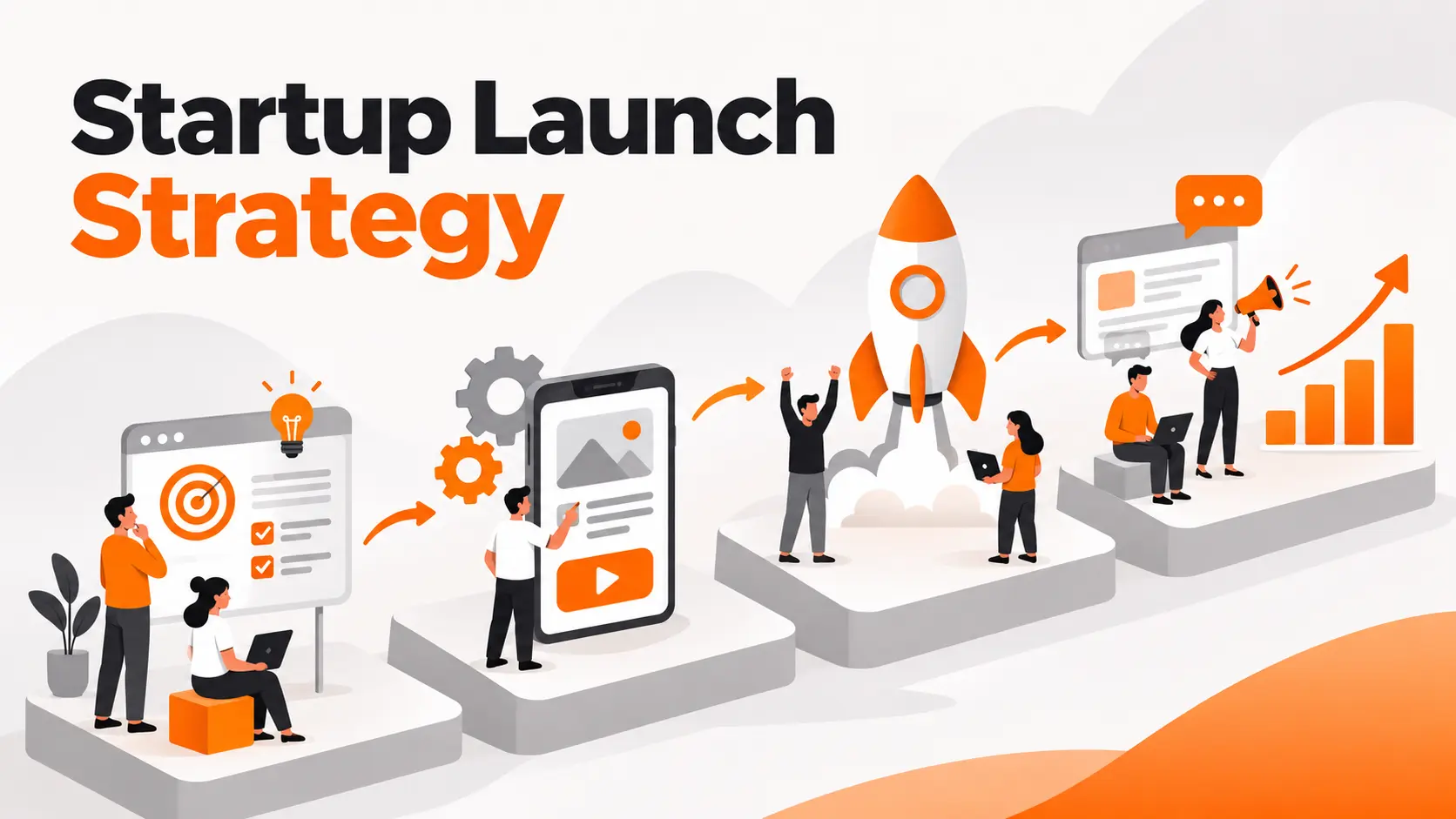
A practical startup launch sequence with a decision at every stage.
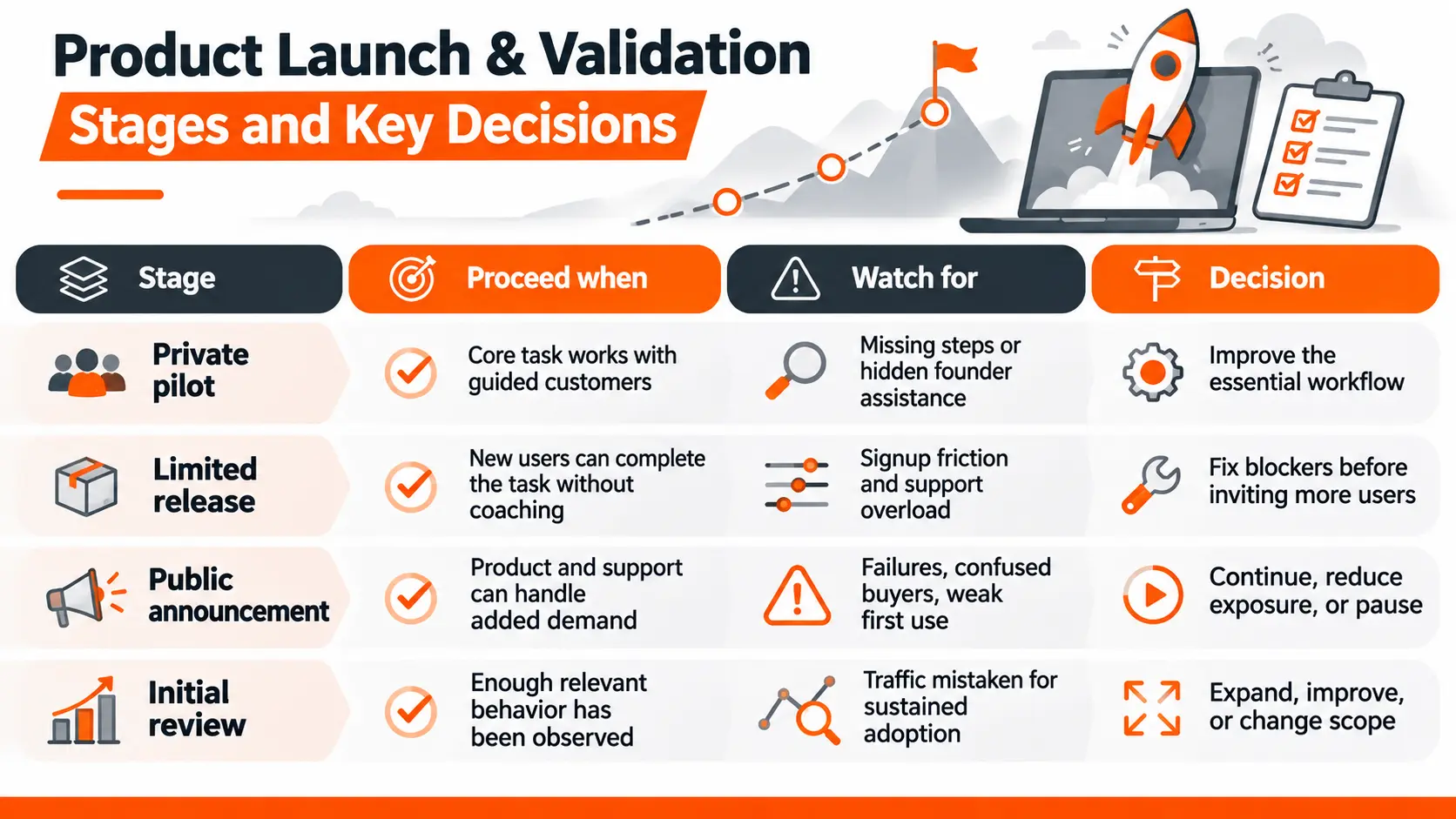
These gates are not universal benchmarks or a promise that a particular launch will succeed. A small pilot may reveal strong customer interest but fragile onboarding; the appropriate response is to improve delivery before broad promotion. A public release may run smoothly yet attract the wrong buyers; the founder should revisit the invitation or audience before paying for more exposure. The sequence keeps release decisions tied to evidence rather than to a date announced weeks earlier.
Prepare the Offer and the First Customer Experience
The launch message should say who the product is for, which problem it addresses, what the customer can accomplish, and what happens next. Avoid a long feature catalogue that makes the reader infer the benefit. A useful release page can explain one concrete situation, show the product performing its central task, answer the main adoption objection, and offer one clear action. If availability is limited or a feature is unfinished, describe the restriction accurately.
Prepare the experience after that action with equal care. A founder may spend days refining an announcement while leaving the first customer without instructions, sample data, confirmation that a request succeeded, or a clear route to support. Welcome messages, setup guidance, and an accessible explanation of the first useful outcome are part of the launch itself. If the team expects manual onboarding, make that process explicit and ensure somebody can deliver it.
Existing design partners can help check clarity, but their familiarity may conceal problems. Ask someone who has never seen the product to read the page and try the essential workflow without coaching. Observe where they hesitate and what they misunderstand. Correct failures that block the promised outcome before investing in wider reach. Cosmetic improvements can follow once the essential journey is dependable.
Coordinate the Release Without Building a Large Launch Team
A small startup still needs clear responsibility. One person should own the release decision, one should know how to resolve product incidents, and one should coordinate customer communication and support. The same founder may hold several roles, but each responsibility should be explicit. An unowned problem becomes more expensive when new customers arrive in a short period. Create a way for the team to raise an urgent issue and agree who can pause further invitations.
Before launch day, prepare the materials that are easiest to get wrong under pressure: the final landing page, email copy, demonstration, short support answers, billing checks, and an internal description of known limitations. Rehearse the path from announcement link to first successful use. If several teammates need to review something, set a final approval point so that the release does not depend on simultaneous last minute edits.
Choose the date partly according to who can be available. Releasing just before a holiday, during a technical migration, or while the core team is unavailable makes incidents harder to contain. If the startup uses a platform with its own publication rules, verify those rules directly. A launch on Product Hunt, for example, benefits from genuine participation and prepared product materials, but visibility on a platform should never replace the company's own delivery and follow through.
Run Launch Day as a Customer Operations Event
On launch day, the founder's job is not simply to publish posts. Watch the first customer journey and respond to real problems as they emerge. Confirm that visitors reach the correct page, the signup or purchase process works, and people can obtain the first result promised by the product. Keep a short incident record with the issue, its effect on customers, the person handling it, and the decision to continue or pause promotion.
Respond to questions where they arise rather than answering only those that look favorable. Prospects may reveal an unexpected objection, a confusing term, or an integration requirement the team overlooked. Record these observations in a shared place. If an outage or critical failure prevents new customers from receiving value, stop inviting additional users until the team can provide a responsible remedy. Protecting trust is more valuable than maintaining a planned posting schedule.
A public launch can produce a burst of attention with very little purchasing intent. This is why the team should follow whether the right people proceed through the product experience instead of celebrating impressions or leaderboard positions alone. The purpose of the announcement is to introduce a credible solution to suitable people, not to maximize an isolated traffic chart.
Interpret the First Week Without Confusing Noise With Demand
The first review should separate audience quality from product experience. If people are arriving from the wrong professional groups, the issue may be targeting or the message attached to the announcement. If suitable prospects understand the value but abandon registration, inspect the signup process. If they complete onboarding but never return, interview them about whether the task mattered enough to repeat. Each outcome leads to a different next action.
Use a small set of observable signals relevant to the product: suitable prospects who arrived, people who started the intended action, customers who completed the first valuable task, and those who came back or made a commercial commitment. Report the period and the size of the group. A handful of users cannot support strong claims about conversion rates, but individual interviews and session observations can still reveal important failures.
Follow up personally with people who tried the product, especially those whose experience did not match the promise. Ask what they expected, where they stopped, and whether they found another way to solve the problem. Avoid changing every part of the offering after a single negative comment. Look for patterns that explain a decision, and keep exceptional cases visible without pretending they represent the entire market.
A Startup Launch Example With Realistic Decision Points
Consider a fictional startup that helps independent property managers coordinate maintenance requests. The founders have interviewed managers and built a basic workflow to collect requests, assign repairs, and record updates. They could announce the product widely, but they know that an incomplete request might leave a tenant waiting and damage the manager's confidence. Their launch strategy therefore starts with a controlled pilot involving three property managers who already understand the proposed workflow.
During the pilot, the founders observe that managers complete request entry successfully but contractors often fail to confirm receipt. Instead of purchasing ads, they improve the notification and confirmation process. A second small group then tests the revised workflow without founder assistance. Only when managers can follow a request from submission through acknowledgment does the team invite a broader audience. This progression protects users while exposing the exact operational problem that a public campaign might have hidden.
When the wider release begins, the founders monitor completed workflows and repeat use, not merely account registrations. Several visitors sign up but turn out to manage residential leases rather than the intended small commercial properties. That information suggests a problem with audience selection in the announcement, while feedback from qualified managers reveals genuine improvement in the core experience. The fictional example shows why launch decisions should distinguish acquisition noise, product friction, and evidence of customer value.
Common Launch Mistakes That Create Avoidable Costs
The most expensive mistake is treating a date as proof of readiness. A founder publicly commits to an announcement, then ignores defects because the countdown has become part of the story. Another is confusing community applause with a durable customer relationship. Attention can open a door, but it does not demonstrate willingness to use or pay for the product. A third is releasing more features to compensate for unclear value, thereby creating additional paths for users to become confused.
Other mistakes are operational. Startups forget to test billing in the production environment, underestimate support demand, leave known limitations unstated, or collect feedback without deciding who will review it. Teams can also respond too quickly to every launch comment, turning a coherent product into a collection of one person requests. A disciplined process records the feedback, tests its relevance, and makes changes according to the intended customer and the startup's capacity.
Decide Whether to Expand, Improve, or Pause
At the end of the initial release period, write a short decision memo. State which audience received access, what the team promised, whether the customer could obtain the intended outcome, which operational issues emerged, and what evidence supports the next step. Expanding is appropriate when the experience is dependable and suitable customers show repeatable progress. Improving is appropriate when there is interest but an identifiable friction point prevents value. Pausing is appropriate when the product cannot safely deliver its core promise.
This is the central discipline of a startup launch strategy: make each increase in visibility conditional on the company's ability to serve the next group of customers. Successful launches are not defined by a flawless announcement day. They are defined by the useful learning and customer relationships that continue after the initial attention fades.
FAQ
What is a startup launch strategy?
It is the approach a startup uses to decide when and how to release a product, which customers should receive access first, what must be operationally ready, and which customer responses determine whether the launch expands or changes course.
Is a startup launch strategy the same as a go to market plan?
No. A go to market plan coordinates the broader commercial activities, including ownership, budget, and milestones. Launch strategy focuses on release readiness, controlled exposure, customer experience, launch operations, and what the team should do after observing initial demand.
Should a startup launch before the product is perfect?
Often yes, provided the product can reliably deliver an honest and useful initial outcome to its intended users and meets relevant safety, privacy, and legal requirements. Releasing early should mean learning with a narrow scope, not exposing customers to avoidable harm.
What is the difference between a soft launch and a public launch?
A soft launch limits the audience or scope so the team can observe real usage while controlling operational risk. A public launch makes the offer more broadly accessible and may involve larger announcements. A startup can use both in sequence or choose another approach appropriate to its business.
How long should a startup launch last?
There is no universal duration. The announcement may happen on one day, but the evaluation period must be long enough to observe a meaningful customer action. A simple consumer tool can provide early evidence quickly, while an enterprise product may require a longer pilot or purchasing cycle.
How do you measure whether a startup launch succeeded?
Start with whether suitable customers could access the product and complete the promised first task. Then examine qualified interest, meaningful activation, relevant commercial commitments, recurring use, and support problems. Compare results with goals agreed before release and avoid treating publicity alone as proof of demand.

Mohsen Avid
Founder & Editor, PinerookMohsen Avid is the founder of Pinerook, covering entrepreneurship, startup strategy, digital business, and the decisions behind building new ventures.
 Seen first.