Product led growth loops are repeatable mechanisms in which existing users create opportunities for additional users to discover, experience, or adopt a product. A customer shares a useful report, invites a colleague, or publishes an artifact that another person can use. When some of those recipients become active users and repeat the same behavior, the output of one cycle becomes the input of the next. The startup can generate additional demand without starting every acquisition effort from zero.
Within a broader Product Led Growth for Startups strategy, a growth loop connects genuine customer value with a repeatable path to adoption. The challenge is not to persuade everyone to invite friends. It is to identify an action that users already have a reason to perform, make the experience valuable for the recipient, and verify that the resulting users continue to use the product.
How Product Led Growth Loops Work
A loop starts with an eligible participant who has experienced enough value to take a meaningful action. That action introduces someone else to the product or creates an asset that attracts another user. The recipient then needs to complete a useful task and become capable of repeating the same action. A shared document is not a complete loop if recipients can only read it and never begin a useful workflow of their own.
The input and output must represent comparable units. If the starting input consists of active organizations, the output should be newly active organizations rather than individual employees invited into an existing account. Inviting employees can still produce valuable account expansion, but it should be recorded as a different mechanism. This distinction prevents a growing workspace from being mistaken for new customer acquisition.
A loop does not have to operate independently of marketing or sales. Many products require an initial stream of customers from search, partnerships, or direct outreach. A useful loop can make those customers more productive as sources of future adoption even when it cannot generate enough new participants to sustain itself without additional acquisition.
Growth Loops vs Traditional Funnels
A funnel describes how a group progresses through a sequence of stages, such as visiting a site, creating an account, and completing a valuable task. It is useful for measuring conversion and identifying where people abandon the journey. A growth loop asks an additional question: does the outcome of that journey help generate the next group of participants?
Consider a scheduling product. A visitor creates a booking page, shares it with a client, and completes a meeting arrangement. A funnel can measure the conversion from visitor to active scheduler. A loop also tracks whether the client discovers the scheduling tool through that interaction, creates a booking page of their own, and shares it with someone else. The funnel still provides essential diagnostic information within the loop.
This is why a referral button alone is insufficient. If existing customers send invitations but the recipients have no reason to adopt the product, acquisition has not become regenerative. A loop requires a closed relationship between the original action and the next eligible participant.
Types of Product Led Growth Loops
The best mechanism depends on the work customers already perform. Collaboration products have different opportunities from private analytics tools or software that publishes content to a public audience. Choosing a popular mechanism without considering the actual workflow can create unnecessary friction.
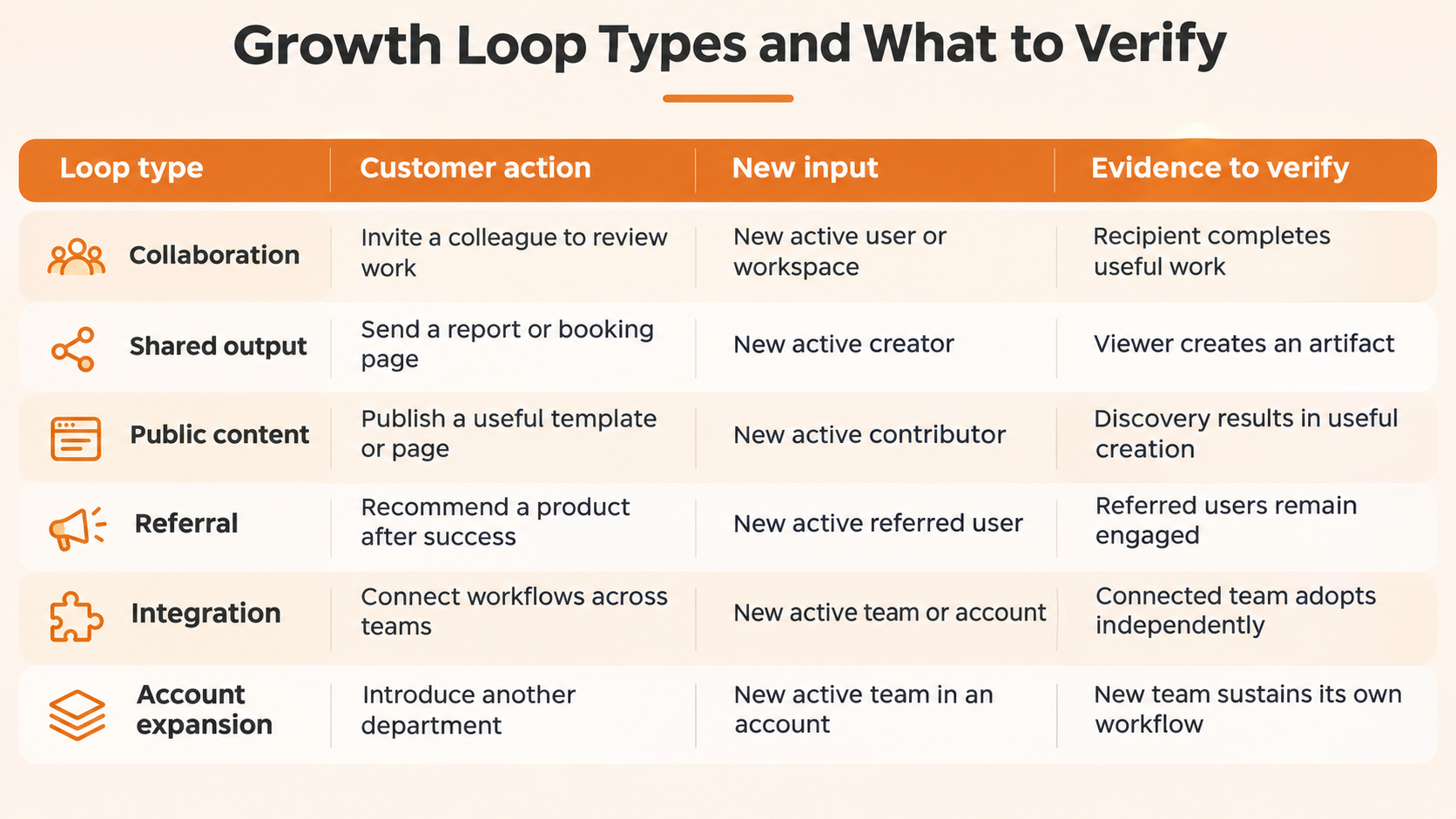
These mechanisms are not interchangeable. Public content may generate new accounts, while collaboration often increases adoption within an organization. A product can support both, but the team needs separate attribution and success criteria. The appropriate choice is the one that delivers a useful outcome to both the person initiating the action and the person receiving it.
Choose a Loop That Fits Existing Customer Behavior
Start by observing customers who use the product repeatedly. Ask what happens after they finish a task, who receives the output, and whether another person needs to participate. Look for behavior that occurs without a growth prompt. Customers who already export a report and email it to colleagues may reveal a stronger opportunity for sharing than customers who ignore a generic referral program.
The next step is to define the recipient experience. Someone receiving a report should be able to understand why it was shared, access the appropriate information, and decide whether the product is relevant to their own work. Do not require account creation just to read something that could safely be viewed without registration. If identity verification is essential for security, explain why access is restricted.
Figma provides a concrete example of a product feature with potential for collaborative discovery: users can share design files and prototypes through links or invitations, with configurable permissions. These capabilities create opportunities for other people to experience a product through work already being performed. They do not, by themselves, prove the size or profitability of any particular acquisition loop.
Some products should avoid external sharing altogether. A confidential financial analysis platform may find a better growth opportunity through approved organization access or an integration that supports another department. When the product has no natural sharing behavior, investing in conventional acquisition may be more rational than manufacturing an artificial loop.
Map the Smallest Repeatable Cycle
Define the starting participant, the action that creates exposure, the recipient, the meaningful adoption event, and the condition that makes the new user eligible to repeat the action. A reporting tool might start with a report creator, continue through sharing and recipient access, and finish when a previously unregistered recipient generates a useful report of their own.
Every stage should have an observable event and a responsible owner. The team should distinguish an invitation sent from one delivered, an opened report from a completed workflow, and an account created from an account that has gained genuine value. Record a stable event identifier and, where appropriate and permitted, a source identifier that connects the recipient to the originating activity.
Attribution requires particular care when someone receives several invitations or discovers the product through search before joining. Assign a consistent rule for crediting a new participant only once, keep a record of other known exposures, and report unattributed conversions separately. The resulting figure describes the measured contribution of the loop under that rule, not proof that every attributed user would otherwise have remained unaware of the product.
Measure Loop Yield and Cycle Time
A simple acquisition loop yield divides newly active participants attributed to an eligible starting cohort by the number of participants in that starting cohort. The unit and observation window must be consistent across both sides of the calculation. Counting registered users as outputs while counting active users as inputs inflates the apparent performance.
Suppose 100 active customers are eligible to share a report during a given observation period. Forty share with at least one new recipient, and their reports reach 120 distinct people who are not already users. Of those recipients, 36 create an account and 18 complete a meaningful report of their own within 14 days of exposure. Assuming the identity and attribution rules are consistent, the observed yield is 18 divided by 100, or 0.18 newly active users per eligible starting user.
The signup conversion among recipients is 30 percent, while the activation rate among those who signed up is 50 percent. These measures answer different questions. The yield of 0.18 incorporates both the likelihood of existing users sharing and the subsequent effectiveness of the recipient journey. All figures in this example are hypothetical, not an industry benchmark.
A yield below one does not imply that the mechanism is worthless. If new participants generate the same yield in subsequent cycles, each generation adds a smaller group of users. Starting with 100 eligible users, a constant yield of 0.18 would imply roughly 18 new active users in the next generation and about three in the generation after that. The calculation assumes comparable behavior, sufficient opportunity, and no overlapping recipients. Real loops rarely maintain such stable conditions.
A yield above one can indicate a mechanism capable of producing a larger next generation under the measured conditions. It does not guarantee unlimited growth. Audience saturation, declining participation, repeated exposure to the same recipients, and changing customer quality can reduce future output. In an expansion loop, the available number of departments inside each account also creates a natural ceiling.
Cycle time describes the elapsed time between the starting event and the new participant becoming eligible to repeat the action. Report the median for completed cycles alongside the proportion of cycles that complete within a defined window. Looking only at fast successful cycles can make a deteriorating mechanism appear healthier than it is. A shorter median is useful only if completion and subsequent customer value remain strong.
Diagnose Where a Growth Loop Breaks
When few eligible customers share an output, first determine whether sharing is relevant to their task. If it is valuable but difficult, improve the action itself. If customers have no reason to share, a larger invitation banner is unlikely to create meaningful demand. Other weaknesses emerge after the recipient enters the journey. Access problems, unclear permissions, slow loading, or an irrelevant call to action can prevent a genuinely interested recipient from continuing.
In the illustrative reporting example, 84 of the 120 recipients do not sign up, and half of the 36 signups never create a useful report. The first gap may reflect limited relevance or friction in discovery. The second may indicate a difficult setup or an incorrect understanding of the product. Interview a small sample from both groups before assuming which problem deserves engineering time.
A founder should also compare retained usage among users acquired through the loop with retained usage among comparable users from other channels. If the loop produces an unusually large share of accounts that never return, increasing exposure could add support and infrastructure costs without creating a lasting customer base. The goal is qualified adoption that can create further value, not the largest possible number of invitations.
Improve the Loop With Controlled Experiments
Choose one bottleneck and specify the expected change before releasing an improvement. A product team might test whether allowing recipients to preview a permitted report before registration improves the share of eligible users who create a meaningful report of their own. The primary outcome should be newly active participants per starting user, while access errors, complaints, and retained usage serve as safeguards.
Where possible, assign the experiment at the workspace or account level rather than mixing variants among coworkers who share the same experience. Interactions between participants can otherwise contaminate the comparison. Allow enough time for recipients to complete the target workflow, and avoid comparing a mature group with a group that has only just entered the observation window.
At a small startup, a randomized test may not have enough participants to support a reliable conclusion. In that case, combine direct observation with a limited pilot, state the uncertainty, and avoid treating ordinary changes in demand as the effect of the new design. A narrow experiment that reveals a specific obstacle can still be useful even when it does not establish a precise causal estimate.
Protect Customer Trust and Loop Economics
A growth mechanism must respect the expectations of both customers and recipients. Use clear permissions, intentional sharing, appropriate privacy controls, and transparent referral terms. Do not automatically message address books, make confidential artifacts public, or require invitations to unlock unrelated features. Track abuse, unwanted messages, support requests, and security incidents alongside growth performance.
The business also needs to account for the cost of operating the mechanism. Assume that the 18 newly active users in the earlier example required $270 in incremental delivery, support, and referral costs attributable to that cohort. The observed cost per newly active user would be $15. This is not the cost per paying customer, because some users may never purchase. Nor does it include every fixed cost of building the sharing feature. Founders should compare the relevant incremental costs with expected contribution from the resulting customers, using conservative assumptions.
A mechanism deserves additional investment when it improves customer outcomes, creates observable new adoption, and remains financially and operationally manageable as participation increases. If sharing produces little customer value or introduces unacceptable risks, the correct decision may be to redesign the mechanism or stop it entirely.
Product led growth loops work when useful product behavior creates the opportunity for another meaningful customer experience. The strongest mechanism is not necessarily the most viral. It is the one that fits the natural workflow, generates new qualified participants, and can be improved without weakening the experience that made customers willing to share in the first place. Start with one observable loop, measure its yield and timing, and expand only as the evidence supports it.
FAQ
What is a product led growth loop?
It is a repeatable growth mechanism in which product usage generates opportunities for new participants to experience value and repeat the same behavior.
Are growth loops the same as viral loops?
No. Viral loops focus on users bringing in additional users. Growth loops can also involve useful published content, integrations, or expansion within existing accounts.
What is a good growth loop yield?
There is no universal target. Yield depends on the unit, audience, cycle duration, and customer economics. A value below one can still support other acquisition channels profitably.
How do you calculate a viral coefficient?
For a simple invitation mechanism, multiply the average number of distinct eligible recipients per starting user by the share of those recipients who become new active users. Define the time window and exclude duplicates.
Can a B2B SaaS product grow without a viral loop?
Yes. Direct sales, search, partnerships, and expansion can all support growth. A loop is useful only when it fits the product and the customer workflow.
When should a startup scale its growth loop?
After observing consistent meaningful adoption across mature cohorts, reasonable operating costs, and acceptable customer trust and retention outcomes. Improve weak steps before increasing exposure.

Mohsen Avid
Founder & Editor, PinerookMohsen Avid is the founder of Pinerook, covering entrepreneurship, startup strategy, digital business, and the decisions behind building new ventures.
 Seen first.