A private startup does not have a share price that updates every trading day. Still, a fall in technology stocks can influence what venture investors are willing to fund, how much they expect a future exit to return and how long founders may need to remain private. A rising stock market can change those expectations too, but it does not guarantee a fundraising boom.
Understanding macroeconomics for startups means tracing those connections to actual business decisions. The relevant question is not whether the Nasdaq is up today. It is whether conditions for raising capital, selling a company or financing further growth have changed enough to affect your next milestone.
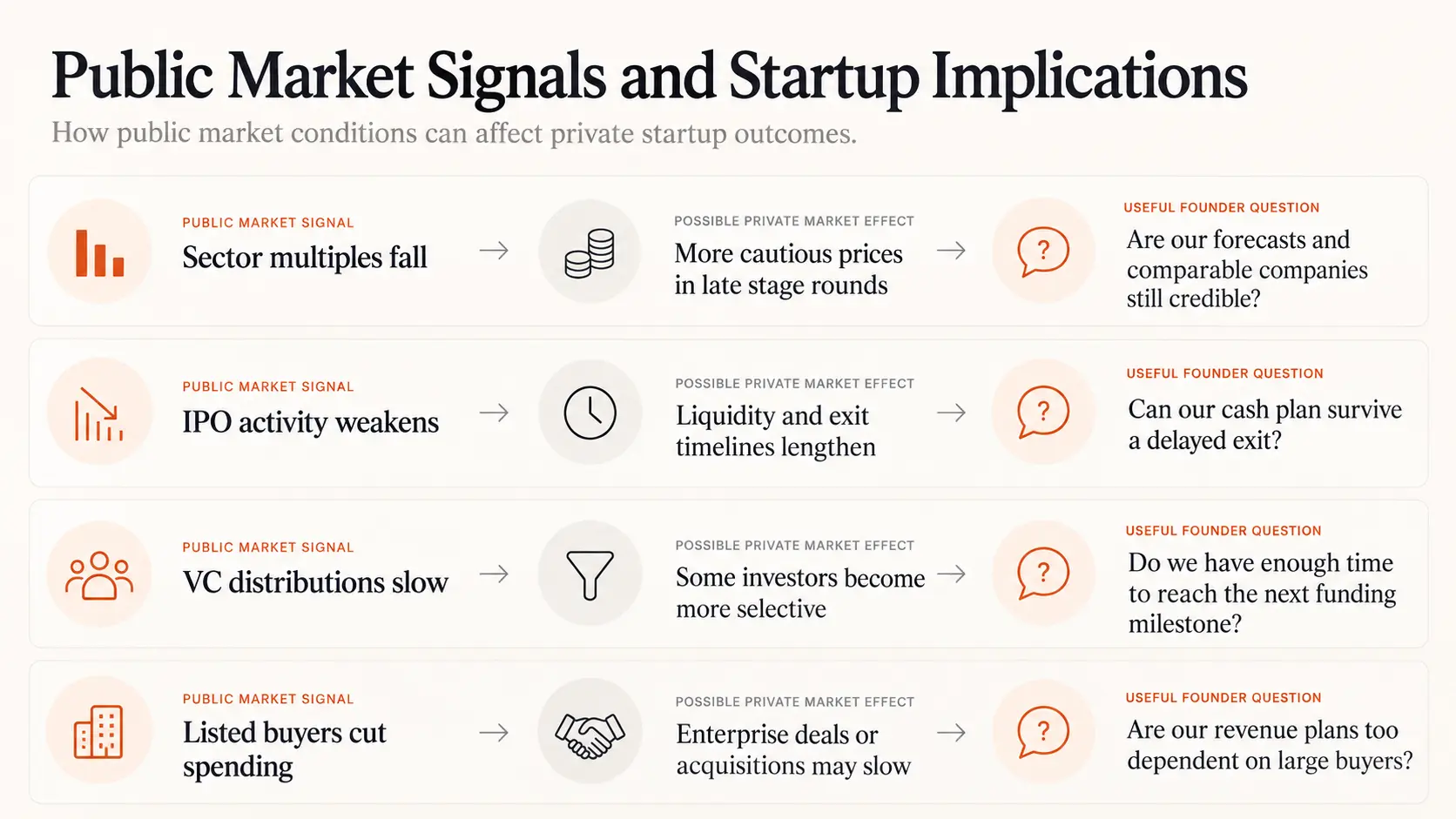
Four Ways Public Markets Influence Private Startups
Public valuations change investor reference points
Investors often compare a private company with publicly traded businesses in a similar sector. If listed software companies trade at lower revenue multiples, investors may reassess the price they are prepared to pay for a later stage software startup. That is a reference point, not an automatic formula. Growth quality, margins, customer concentration and the rights attached to private shares still matter. The effect is usually stronger for mature startups with measurable revenue than for a young company still validating its product.
The IPO window shapes exit expectations
An initial public offering is one way investors and employees may eventually gain liquidity. When public investors are reluctant to buy new listings, companies can delay IPO plans or face tougher pricing and disclosure expectations. Venture investors may then assume that capital will be tied up for longer. The US Securities and Exchange Commission describes public offerings as a potential source of capital and liquidity, but also notes the substantial reporting obligations and costs involved. A weaker IPO window can therefore influence private funding decisions well before a startup is ready to list.
Investor liquidity influences future fundraising
Venture firms typically need successful exits to return capital to the institutions and individuals backing their funds. Delayed exits can reduce distributions and complicate fundraising for new venture funds, although established firms may still have substantial capital available to invest. Carta reported stronger private fundraising in 2025 alongside persistent liquidity constraints. This is why record investment in a narrow group of startups does not necessarily mean that the broader fundraising environment has become easy.
Public companies influence acquisitions and demand
Listed businesses are also potential customers, partners and acquirers. Changes in their share prices, borrowing conditions or earnings outlook can affect acquisition budgets and willingness to pay for smaller companies. Publicly traded customers may postpone software purchases or demand faster returns on spending when investors emphasize profitability. These channels can matter to an early stage startup even if it is years away from an IPO of its own.
The important market signal depends on the decision the founder needs to make.
Why Startup Stage and Sector Matter
For a pre seed founder, daily market fluctuations rarely justify changing the product roadmap. Customer validation, retention and the ability to reach a useful milestone usually matter more. At Series B or later, comparisons with public peers and the prospect of an eventual exit can influence investor discussions much more directly. Sector matters as well: a profitable business software company and a research intensive biotech company face different timelines, comparables and potential public investors.
The same distinction applies to market direction. A broad stock index can rise while the group of public companies most relevant to a startup remains weak. Founders should examine a small set of genuinely comparable businesses instead of assuming that a headline index represents their market.
A Founder Scenario: When the Exit Timeline Moves
Imagine a later stage startup planning a major growth round on the assumption that it could pursue an IPO in roughly two years. Public companies in its category then face weaker demand, and comparable listings become difficult to price. The startup still has growing revenue, but an investor now wants to see a longer cash runway and a more credible path to sustainable margins before committing to the round.
The founder cannot reopen the IPO market. The controllable response is to prepare a second funding scenario, reduce spending tied to speculative expansion and identify a business milestone that remains valuable even if the company stays private for another year. Market conditions change the financing plan, not necessarily the customer problem the company exists to solve.
Which Public Market Signals Deserve Attention?
Start with how a relevant group of listed companies is valued relative to revenue, earnings and cash flow, and whether that pattern has persisted beyond a few volatile sessions. Next, look at the number and performance of recent IPOs in the same sector. Finally, consider whether the venture firms you may approach are still making investments at your stage and whether strategic buyers are expanding or conserving cash.
None of these signals should be read alone. Strong IPO performance in one industry does not prove that another industry has an open listing window. Similarly, a rise in private fundraising volume can be concentrated in a handful of unusually large deals. Founders need sector and stage context before changing their plans.
What Founders Can Do Without Predicting the Market
Build a financing plan that works under more than one exit timeline. Keep enough flexibility in hiring and discretionary spending to protect a material milestone if the next round takes longer than expected. When fundraising, explain business fundamentals using retention, margin quality, recurring demand and cash requirements rather than assuming investors will pay whatever public peers recently commanded.
For companies approaching a late stage round, revisit investor expectations and possible exit routes with the board before time pressure removes negotiating leverage. For early stage teams, use public market information as context rather than a substitute for talking to customers. The goal is not to forecast stock prices. It is to avoid building the company around a capital market assumption that can change.
Final Thoughts
Public markets affect private startups indirectly through investor benchmarks, the availability of exits, venture liquidity and the behavior of large customers and acquirers. Those connections are real, but they are not uniform across every startup. Founders who understand which channel matters to their own business can update funding assumptions without allowing daily market volatility to dictate their operating strategy.
FAQ
Do stock market declines always reduce startup valuations?
No. Public comparables can influence private pricing, especially in later stages, but sector differences, company performance, investor competition and financing terms can outweigh a broad market move.
Does a stronger IPO market guarantee more venture funding?
No. More successful listings can improve expectations for liquidity, but investment may still be concentrated in a few industries or mature companies. Early stage funding follows its own selection criteria.
Should a seed stage founder track stock indices every day?
Usually not. A periodic review of relevant sector signals is more useful than daily market monitoring. Customer demand, runway and progress toward the next milestone deserve more attention.
How can founders prepare for a prolonged IPO slowdown?
Consider an extended private company timeline, test the cash plan against slower fundraising, and keep alternative financing or strategic options open. Avoid assuming an exit will happen on a fixed date.

Masoumeh Jahangard
Markets & Economy Writer at PinerookMasoumeh Jahangard covers markets, economic trends, and business conditions for Pinerook, focusing on how they affect startups and growing companies.
 Seen first.