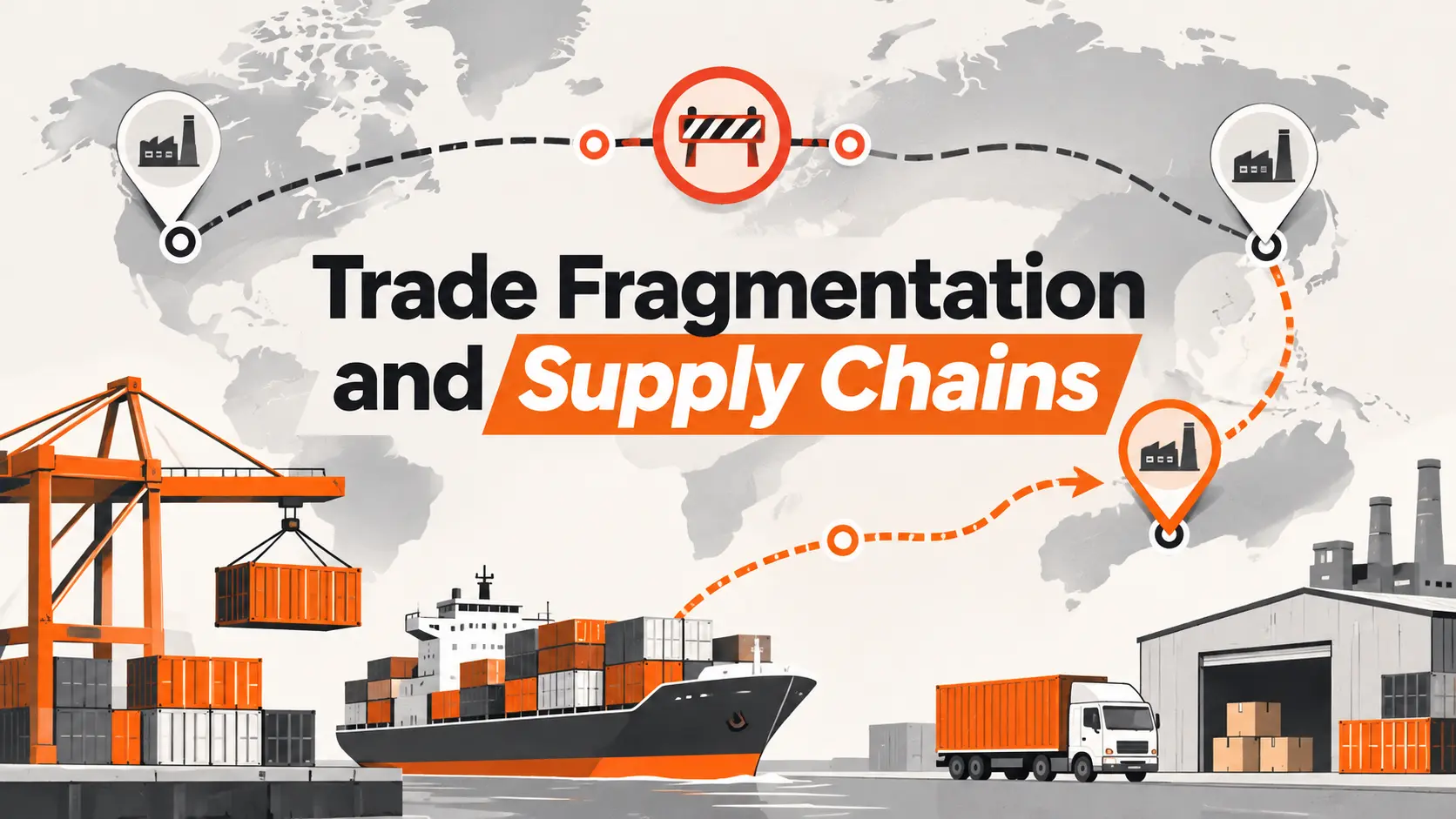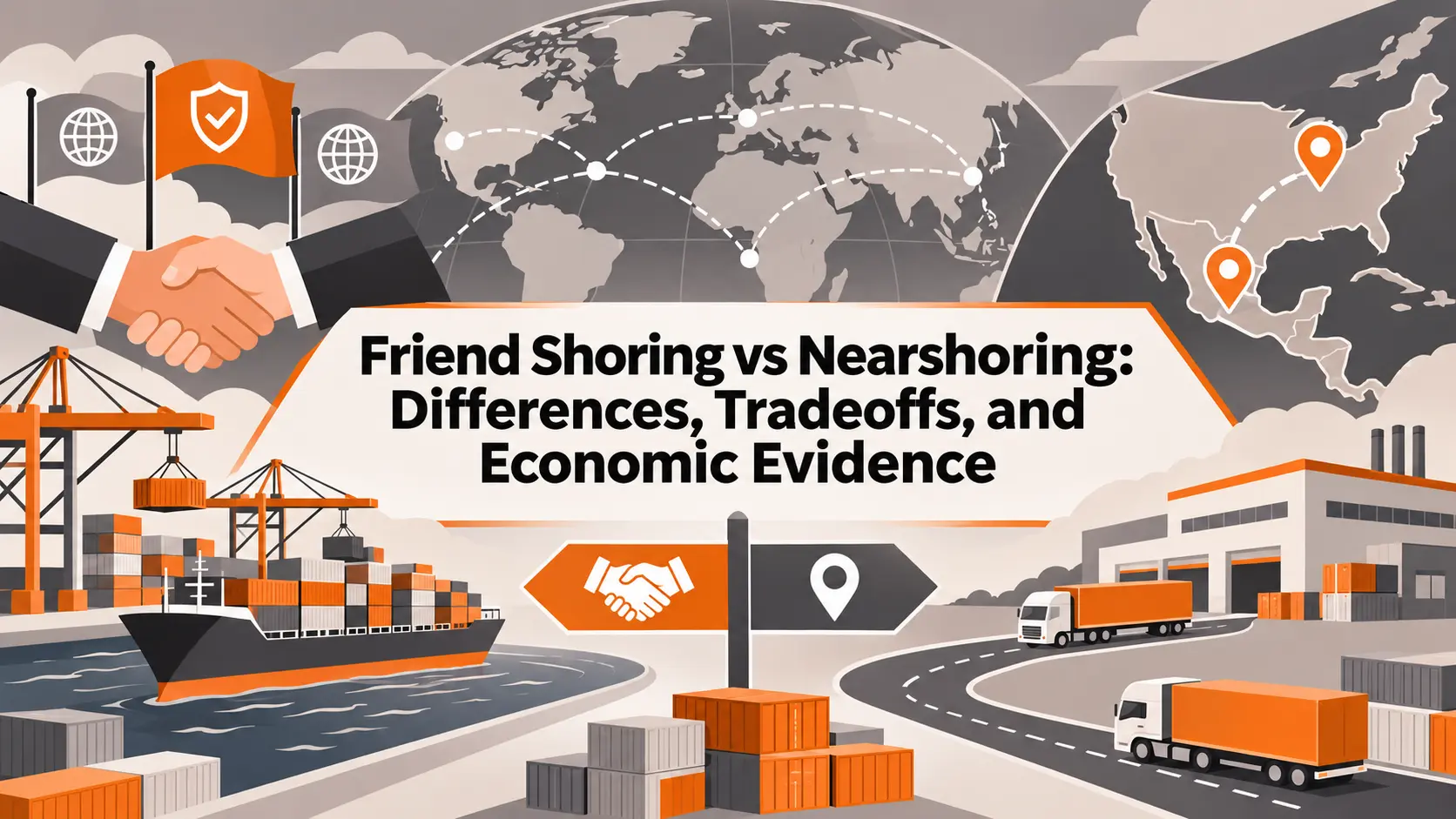
Friend shoring moves sourcing or investment toward countries regarded as politically reliable, while nearshoring moves activities closer to the market they serve. The first prioritizes geopolitical relationships; the second prioritizes physical distance and operating proximity. Neither strategy guarantees lower risk or lower cost, and a country can satisfy both criteria at the same time.
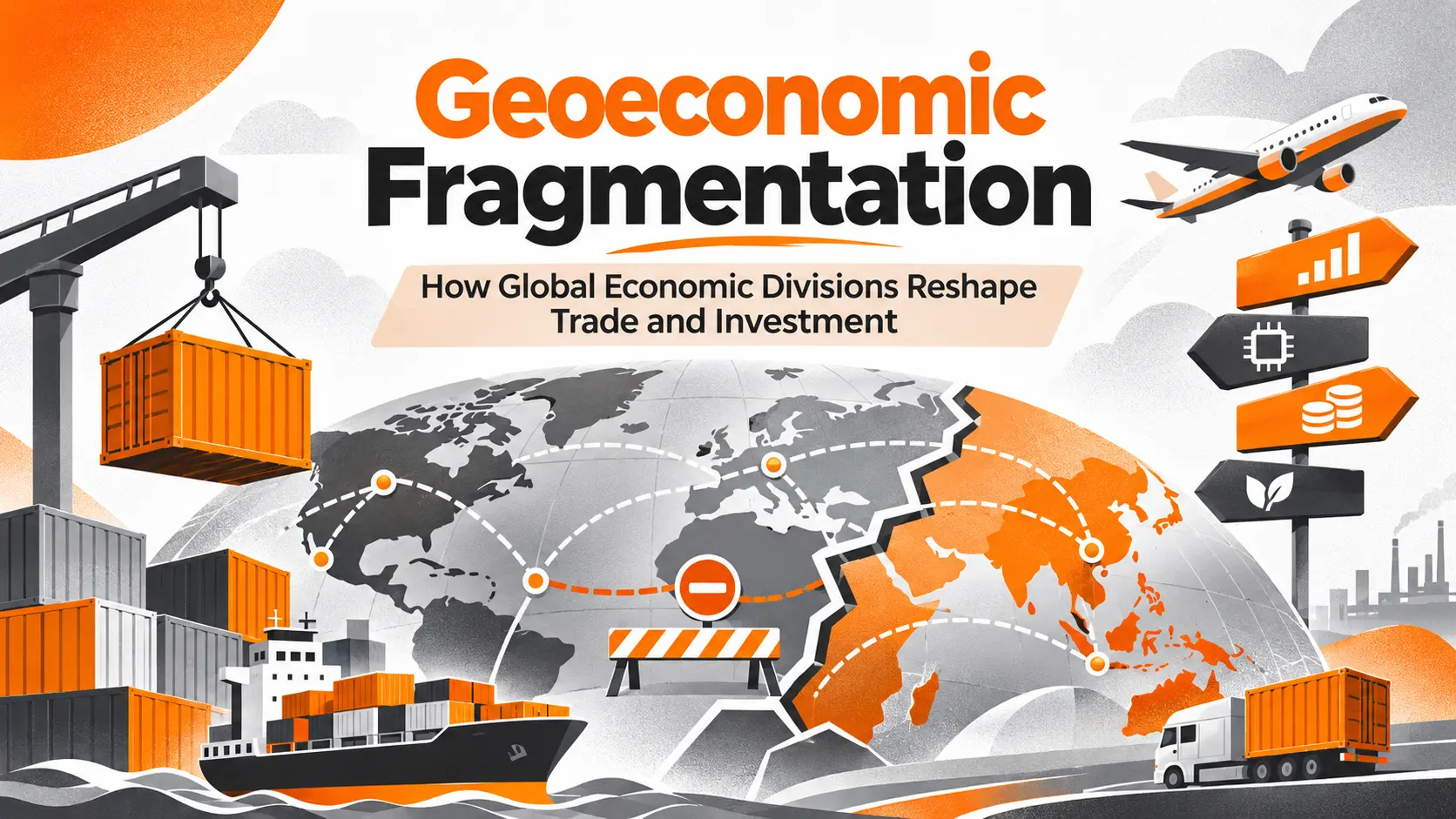
This comparison belongs within the broader discussion of Geoeconomic Fragmentation. Governments seek supply security for strategic inputs while businesses still need workable prices, capabilities, and delivery schedules. The resulting sourcing choices reflect the balance between distance, political exposure, and the risks created by concentrating production in a small group of locations.
The Difference Between Friend Shoring and Nearshoring
The two strategies are often grouped together because both can change where goods are made. Yet they solve different problems. A manufacturer choosing a supplier in a distant allied country is pursuing political alignment without necessarily shortening transit routes. A company moving assembly to a neighboring country may reduce transit times while remaining exposed to policy disagreements, border disruptions, or concentrated inputs from other regions.
Friend shoring is defined by the political relationship between trading partners rather than by a fixed map of friendly countries. That relationship can change as governments revise sanctions, export controls, security assessments, or investment rules. Nearshoring is defined by a relative reduction in distance, although geography alone does not establish the reliability of a production site.
Comparison of the Two Strategies
The following comparison isolates the primary economic mechanism behind each strategy. In practice, firms may combine them with supplier diversification and additional inventory rather than relocating every stage of production.
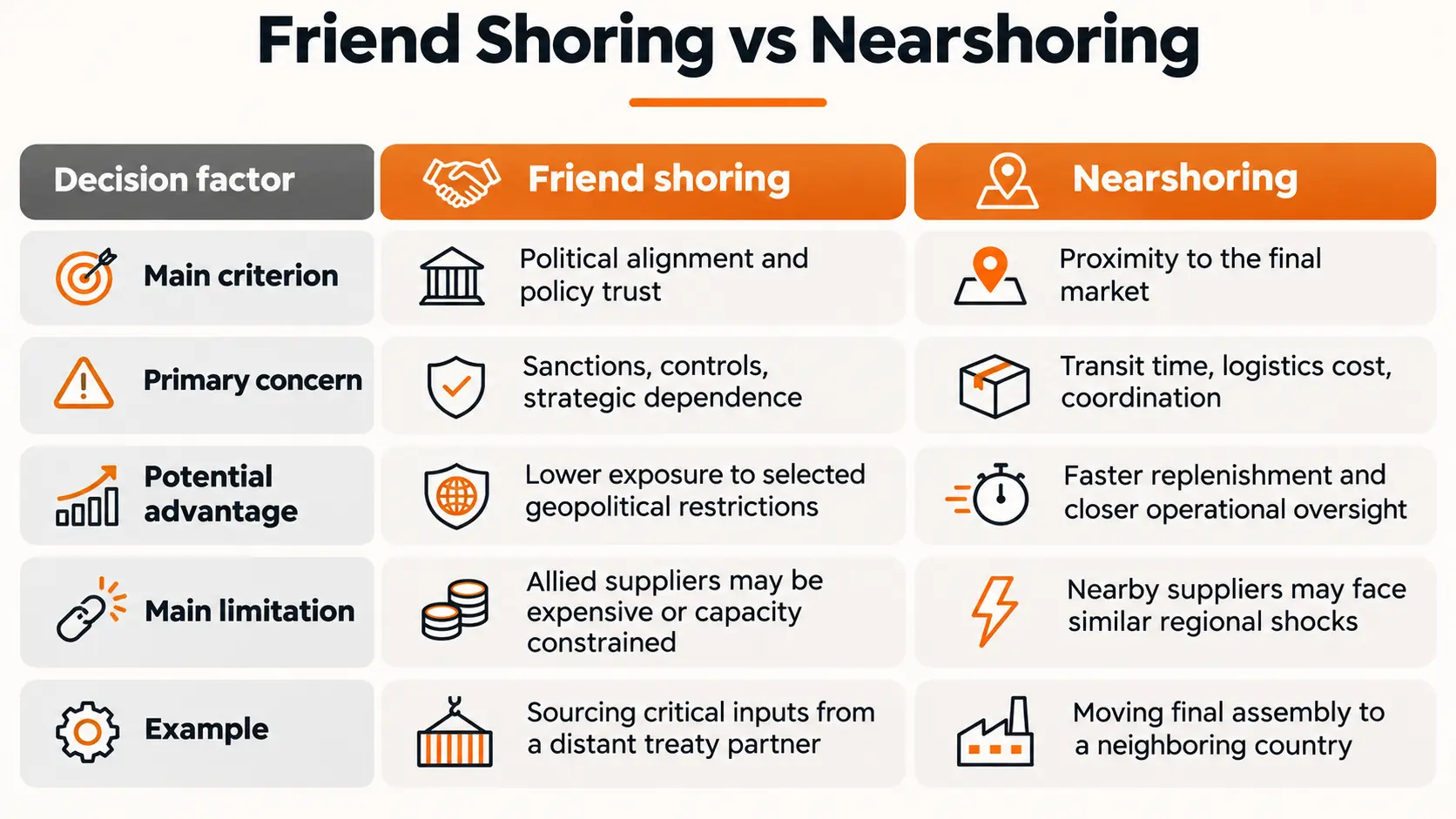
The distinctions matter most when management makes a sourcing decision under pressure. A closer supplier may shorten delivery times but leave the same geopolitical exposure in upstream components. Conversely, a trusted supplier may satisfy security requirements while increasing distance, transport expense, or exposure to maritime chokepoints.
Why Countries and Businesses Are Considering These Strategies
The shift toward alternative sourcing reflects several overlapping pressures. Governments worry about dependence on countries that could restrict exports during a conflict. Firms worry about tariff uncertainty, shipment disruption, access to essential components, and the reliability of long production networks. For strategic goods, the value of uninterrupted supply can outweigh the savings from the lowest quoted unit price.
There is also a difference between policy ambition and measured economic change. WTO research using goods trade data through February 2024 identified stronger sensitivity to geopolitical distance after the invasion of Ukraine but did not find a comparable rise in the regionalization of overall world trade. UN Trade and Development later reported that the friend shoring and nearshoring measures in its trade indicators eased during 2024. Neither finding supports the simple claim that all supply chains are rapidly moving closer to home.
Evidence can differ by what is being measured. A study of United States corporate greenfield investment announcements published in September 2026 found stronger indications of reshoring and nearshoring than of friend shoring in that investment measure. Announcements are not the same as completed production, and a result about one country or dataset cannot be automatically extended to every trade flow.
Where Each Strategy Creates Economic Value
Cost, Speed, and the Value of Flexibility
Nearshoring can shorten physical transit, reduce the working capital tied up in shipments, and allow teams to solve production problems in closer time zones. These benefits are especially relevant for goods with volatile demand, high inventory costs, or frequent design changes. However, labor productivity, infrastructure, customs procedures, and input availability can outweigh distance advantages. A plant that is closer but unreliable can make total delivery cost higher.
Friend shoring can reduce exposure to a particular set of sanctions, export restrictions, or politically motivated supply interruptions. It may also improve access to procurement programs and regulated markets. Yet political alignment does not eliminate shortages or provide an unlimited supply of specialized talent. Moving several critical suppliers into the same allied jurisdiction can replace one concentration risk with another.
Risks That Remain After Relocation
Physical relocation does not necessarily change the origin of intermediate components, intellectual property, specialized equipment, or financing. A finished product may be assembled in a neighboring country but still depend on inputs from the country the buyer intended to avoid. Economists therefore distinguish genuine diversification from trade rerouting, where the visible final trading partner changes while underlying dependencies persist.
A second issue is the ability of connector economies to absorb investment and trade without becoming overexposed. Some countries may gain export orders or new factories as production shifts. At the same time, infrastructure constraints, exchange rate pressures, changes in trade policy, and imported input dependence may complicate the gains. The outcome depends on domestic productive capacity, not simply on appearing on a new sourcing map.
How to Choose Between Friend Shoring and Nearshoring
A practical evaluation begins with the disruption that matters most. If a product depends on technology subject to export restrictions, the political acceptability of its supplier may dominate transport time. If a retailer repeatedly loses sales because replenishment takes months, nearby production may be valuable even when it offers no special political alignment. Both strategies should be evaluated against a diversified sourcing option that leaves some production in existing locations.
A Practical Decision Matrix
This matrix is a screening framework, not a numerical forecast. Teams should replace the qualitative descriptions with data on total landed cost, lead time variation, supplier capacity, contractual exposure, and the origin of critical inputs.
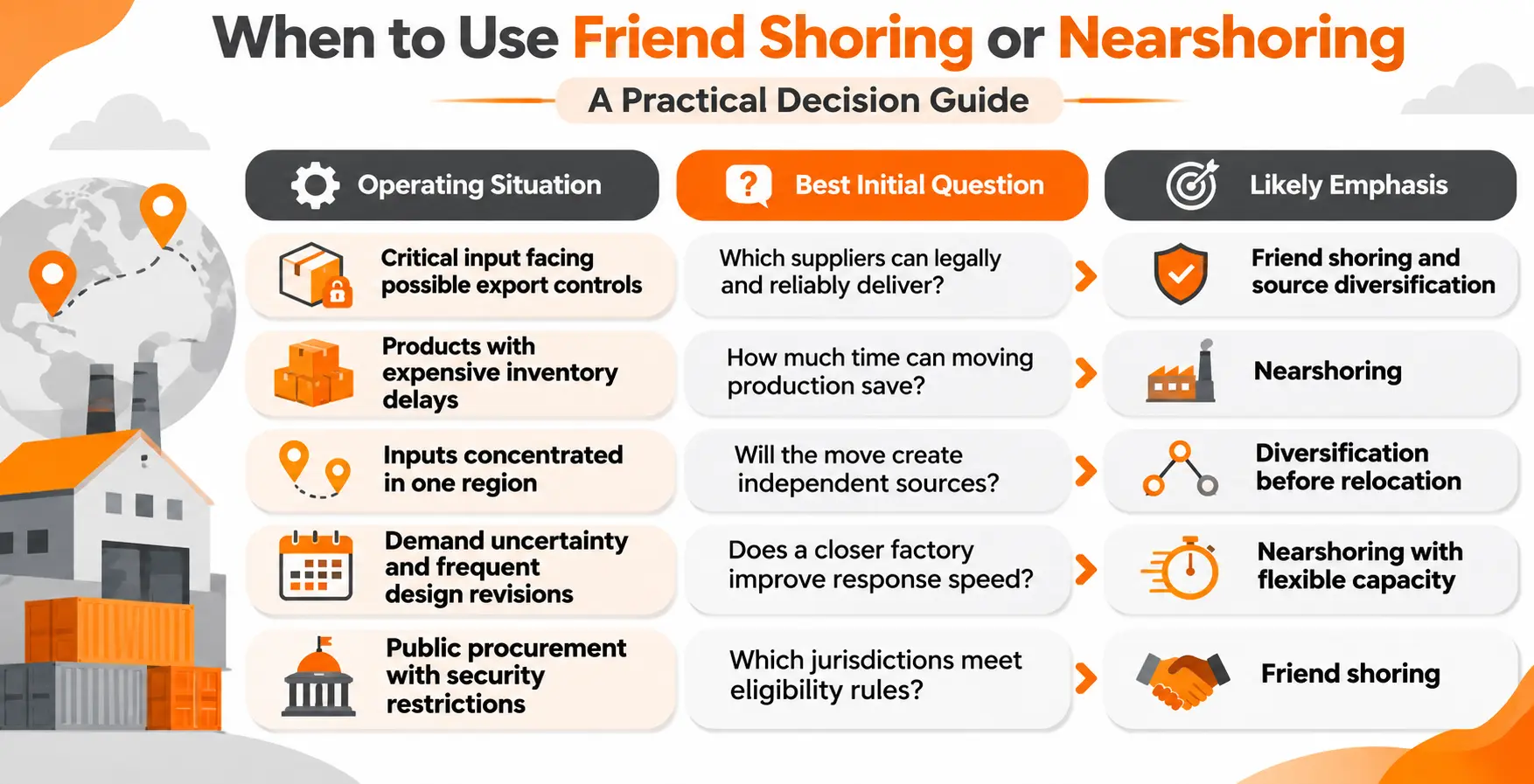
The strongest answer is sometimes neither strategy on its own. A firm may preserve low cost suppliers for normal operations, maintain an alternative source in a politically stable market, and use nearby production for urgent orders. This approach can diversify the causes of disruption rather than merely adding another supplier that shares the same vulnerabilities.
What the Economic Evidence Actually Shows
Research does not identify one globally superior strategy. A 2024 IMF model estimated that a large reversal of international integration could create lasting output losses, with simulated friend shoring losses lower than those from broad reshoring in the scenarios studied. These are model scenarios rather than observed forecasts for individual firms. Their relevance is that reducing exposure to one type of risk can impose efficiency costs elsewhere.
The WTO analysis of trade patterns and the 2026 research on investment announcements also illustrate why headlines should distinguish goods trade from new investment. Goods trade measures where products move today; investment announcements indicate plans that might alter production in future years. Data on foreign direct investment, actual factory capacity, input origin, and shipping performance are needed before concluding that a country has successfully reduced dependence.
A useful test is whether a relocation improves expected performance under more than one disruption scenario. If every alternative supplier is located in a single politically aligned region, the arrangement may still fail during an energy shock or port closure. If every nearshore factory relies on the same overseas component, delivery proximity has not removed the upstream risk.
Implications for Emerging Economies and Global Trade
Countries positioned between major economic blocs may attract business from firms seeking alternative production locations. They can also face pressure to comply with competing regulatory and trade requirements. A location may be attractive because it is close to a large customer market, because it maintains workable relations with several blocs, or because it has an established manufacturing base. These advantages need not coincide.
For policymakers, the challenge is to strengthen infrastructure, contract enforcement, skills, customs administration, and supply reliability rather than assume geopolitical shifts will create lasting demand. For companies, the challenge is to compare suppliers on measurable resilience while recognizing that government policy can alter the economics of a location faster than a factory can be built.
A Better Way to Read the Trend
The important question is not whether globalization is ending, but which economic relationships are becoming more conditional. When a firm values proximity, political alignment, and supply diversity differently for each product, its strategy becomes selective rather than universal. That is why sweeping claims about a worldwide nearshoring boom can be misleading, even when notable sectors or countries experience significant investment shifts.
For an economic analyst, the most informative indicators are changes in supplier concentration, actual import origin, foreign investment flows, delivery time variability, and policy restrictions. These measures reveal more than announcements of new factories or generic statements about resilience. Friend shoring and nearshoring are best understood as two possible responses to a changing risk environment, each with distinct tradeoffs.
FAQ
Is friend shoring the same as nearshoring?
No. Friend shoring emphasizes political alignment between trading partners. Nearshoring emphasizes geographic proximity to the end market. One production location may satisfy both goals.
Is friend shoring always safer?
No. It can reduce exposure to certain political restrictions while increasing exposure to other risks, such as high costs, limited capacity, or concentration among a small group of allies.
Does nearshoring always reduce costs?
No. Shorter transport routes can help, but wages, productivity, duties, energy prices, supplier quality, and infrastructure determine the total economic effect.
What is the difference between nearshoring and reshoring?
Nearshoring places activity in a geographically closer foreign location. Reshoring brings activity back to the home country. The two approaches can occur together across different stages of production.
Do the data show that world trade is moving closer to home?
Not uniformly. WTO research found clearer signs of trade realignment along geopolitical lines than of an overall rise in regional trade after major recent shocks. Trends differ by industry, country, and the data being measured.

Masoumeh Jahangard
Markets & Economy Writer at PinerookMasoumeh Jahangard covers markets, economic trends, and business conditions for Pinerook, focusing on how they affect startups and growing companies.
 Seen first.