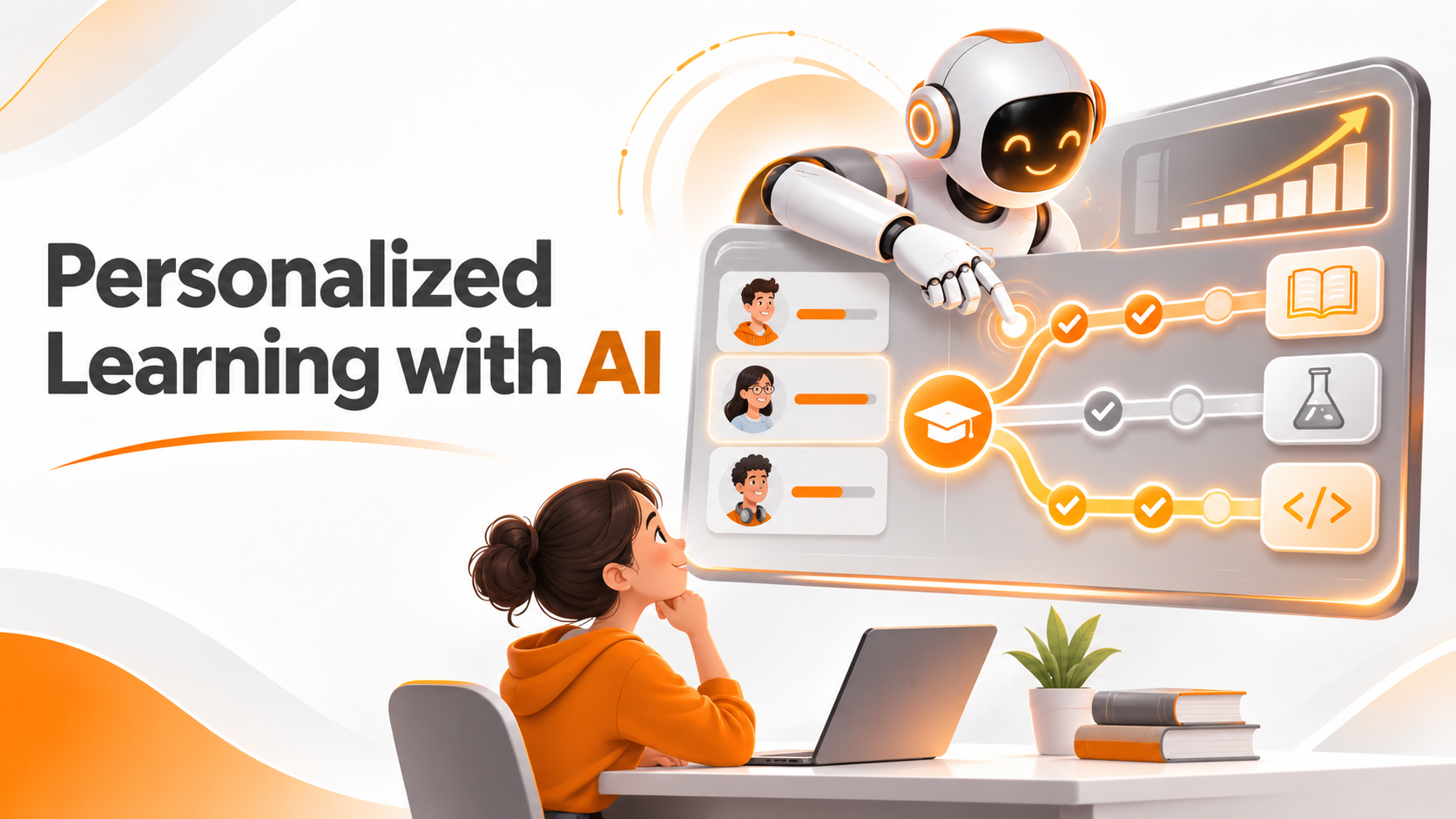
Two students can receive the same lesson, complete the same exercises, and leave the classroom with entirely different levels of understanding. Personalized learning with AI addresses this difference by adapting educational content, practice activities, feedback, and learning paths to individual student needs.
One of the most practical applications of AI in Education is identifying what a student needs to learn next. Rather than moving everyone through an identical sequence of lessons, AI helps educators respond to differences in knowledge, progress, and readiness while maintaining clear academic expectations.
How AI Personalizes Learning
Personalized learning begins with understanding the student's current knowledge, not simply generating different educational materials. The system needs evidence of what the learner understands, where difficulties exist, and which activity will support further progress.
Student Performance Analysis
AI learning systems analyze information collected through quizzes, assignments, practice exercises, and interactions with educational software.
Depending on the platform, this information includes answer accuracy, solution attempts, requests for hints, recurring mistakes, and progress across individual skills.
Consider a student struggling with algebra. A low score indicates a problem, but it does not explain its cause. An intelligent learning system can examine the student's responses to identify whether the difficulty involves negative numbers, arithmetic operations, or rearranging equations.
Each difficulty requires a different instructional response.
Personalized Learning Paths
Once the system estimates a student's current knowledge, it selects learning activities that address identified gaps or build on demonstrated skills.
A student who understands basic equations can progress to more complex problems. Another student who struggles with the same material receives additional instruction on prerequisite concepts.
Both students work toward the same academic objective through different learning paths.
The teacher retains responsibility for determining which objectives students must achieve and whether the recommended activities support those objectives.
Adaptive Content and Difficulty
AI powered personalized learning adjusts more than the order of lessons.
Educational systems can modify question difficulty, provide additional examples, introduce supporting explanations, or recommend further practice based on student performance.
The purpose is to maintain an appropriate level of challenge. Exercises that are too easy provide little opportunity for development, while tasks that exceed a student's current readiness can create unnecessary frustration.
Effective adaptation introduces difficulty gradually without removing the intellectual effort required to learn.
Personalized Feedback and Reassessment
Feedback becomes more valuable when it addresses the reasoning behind a student's mistake.
For example, a mathematics system can identify an incorrect calculation and provide guidance about the relevant operation rather than simply displaying the correct answer.
The student's next attempt provides additional evidence of understanding. This allows the system to update its estimate of the learner's knowledge and recommend further activities.
Personalization is therefore an ongoing process rather than a decision made at the beginning of a course.
Personalized Learning vs Adaptive Learning
Personalized learning and adaptive learning are closely connected, but they describe different aspects of education.
Adaptive learning focuses on adjusting instructional content, exercise difficulty, and learning sequences in response to student performance.
Personalized learning has a broader purpose. It considers individual learning goals, student interests, educational needs, available support, and participation in decisions about learning.
For example, an adaptive mathematics platform can select the next fraction exercise based on previous answers.
A personalized learning environment can also allow students to choose how they demonstrate their understanding of fractions, discuss their progress with a teacher, and connect the concept to meaningful applications.
Adaptive learning is one mechanism for delivering personalized education. It does not represent the entire instructional approach.
Real World Examples of Personalized Learning with AI
The value of AI personalized learning becomes clearer when examining educational systems that have moved beyond theoretical applications.
Mindspark: Addressing Learning Gaps in Mathematics and Language
Mindspark is an adaptive educational platform used in India.
The system identifies gaps in student knowledge and adjusts learning activities to address specific misconceptions. Students receive targeted exercises and feedback based on their demonstrated understanding.
A randomized study published in the American Economic Review in 2019 examined a technology supported educational program involving Mindspark.
After approximately four and a half months, students offered access to the program achieved test score gains of 0.37 standard deviations in mathematics and 0.23 standard deviations in Hindi compared with the control group.
These results reflect the effect of the educational program as a whole, rather than the isolated effect of its adaptive software.
The study demonstrates the potential value of instruction that responds to students' existing knowledge instead of relying exclusively on their assigned grade level.
MATHia: Individualized Mathematics Practice
Carnegie Learning's MATHia provides mathematics instruction through adaptive practice environments.
The platform evaluates students' work at the level of individual mathematical skills. In its mastery workspaces, the system considers correct steps, errors, and the way students use hints when estimating their understanding.
This matters because a student can complete a mathematics problem while still misunderstanding part of the procedure.
Evaluating intermediate steps provides a more detailed picture of learning than examining the final answer alone.
Adaptive Programming Education in Taipei
Research reported by Wharton in 2026 examined personalized AI tutoring during a five month Python programming course across ten high schools in Taipei.
Students had access to the same AI tutor and course materials. One group followed a fixed sequence of practice problems, while the other received exercises selected according to their performance and interactions with the tutor.
The personalized group achieved final examination results that were 0.15 standard deviations higher.
The important finding is that access to an AI tutor was not the distinguishing factor. The difference came from adapting the sequence of practice activities to individual progress.
This experiment provides direct evidence of the educational value of personalized learning paths within the studied setting.
Practical Applications of AI Personalized Learning
Different learning difficulties require different forms of personalization. Giving every struggling student easier exercises is not an effective instructional strategy.
The following examples illustrate how AI supported learning can respond to specific educational needs.
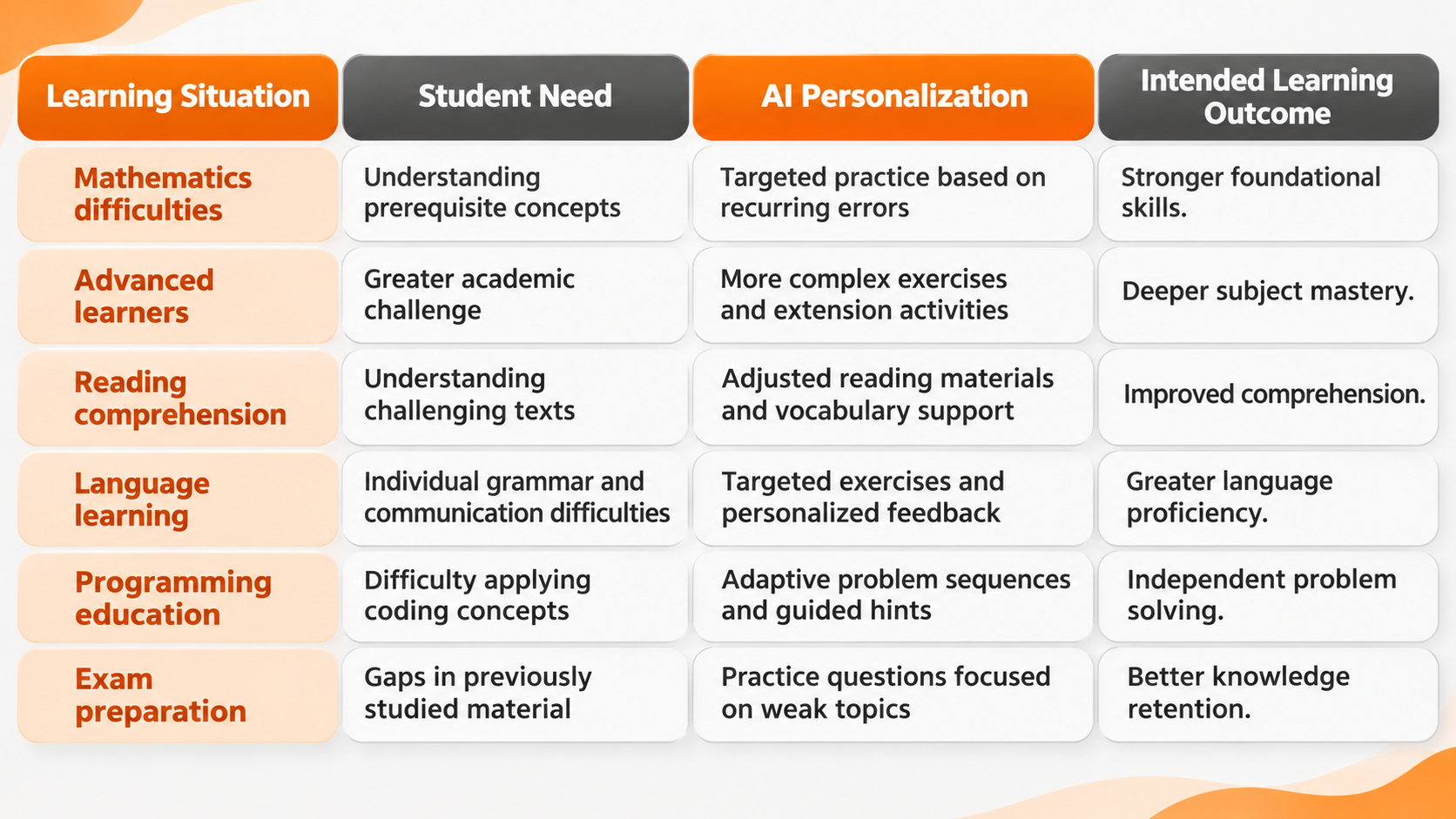
These examples show why personalization needs a specific educational purpose. Adjusting reading difficulty, increasing mathematical challenge, and recommending additional programming exercises address different barriers to learning.
The quality of the intervention depends on whether it resolves the identified difficulty without unnecessarily lowering academic expectations.
Benefits of AI Powered Personalized Learning
Earlier Identification of Learning Gaps
A final examination reveals difficulties after a substantial period of instruction has already passed.
AI learning analytics can provide earlier indications of recurring errors and incomplete understanding during everyday practice.
Teachers can use these signals to investigate learning difficulties before students move into more advanced material.
This is particularly valuable in subjects where new concepts depend on previously acquired knowledge.
Progress at an Appropriate Learning Pace
Classroom schedules require groups of students to progress through shared material within limited time.
Personalized learning provides opportunities for additional practice where needed and more advanced activities where students demonstrate readiness.
The benefit is not unrestricted learning at any speed. It is greater flexibility within a structured educational program.
More Relevant Academic Support
General revision materials cover an entire subject, including topics a student already understands.
Personalized instruction concentrates attention on specific areas that require improvement.
A student preparing for a chemistry examination, for example, can spend more time practicing chemical equations rather than repeatedly reviewing concepts that have already been mastered.
Better Instructional Decisions for Teachers
AI systems can organize information about student progress and highlight patterns that deserve attention.
Instead of reviewing every response to discover a shared misconception, a teacher can examine performance summaries and investigate the relevant student work.
This supports more focused classroom discussions, flexible learning groups, and targeted instructional interventions.
AI Personalized Learning Tools and Technologies
Several technologies contribute to the development of individualized learning environments.
Adaptive learning systems adjust activities and instructional sequences according to evidence of student understanding. Mindspark and MATHia are examples of this approach.
Intelligent tutoring systems provide contextual guidance during learning activities. Their purpose is to support reasoning and practice rather than deliver answers without student effort.
Learning analytics systems organize educational performance data and help teachers identify patterns that require instructional attention.
Generative AI tools produce explanations, practice activities, alternative examples, and learning materials based on specific educational requirements.
These technologies perform different functions. A chatbot that generates a personalized explanation does not automatically maintain an accurate learner profile or track mastery across an entire curriculum.
Schools should distinguish between tools that adapt a single learning interaction and systems that support continuous instructional personalization.
Implementing AI Personalized Learning in the Classroom
A manageable implementation starts with one subject, one learning objective, and a clearly defined educational difficulty.
Establish the Learning Objective
Identify the knowledge or skill students need to demonstrate.
For a mathematics lesson, the objective could be solving equations involving fractions. This provides a specific outcome against which student progress can be evaluated.
Assess Existing Knowledge
Use a short diagnostic activity to establish the students' current understanding.
The assessment should distinguish between different sources of difficulty. A student struggling with fractions requires different support from a student who misunderstands the structure of an equation.
Create Targeted Learning Activities
Use the assessment results to assign appropriate learning materials.
Students who lack prerequisite knowledge receive foundational practice. Those who demonstrate sufficient understanding move to applications or more demanding problems.
Students should also have opportunities to discuss their learning goals and request alternative explanations.
Review Recommendations and Adjust Instruction
Teachers need to inspect the activities recommended by the AI system and confirm their educational relevance.
A recommendation based on incomplete performance data is not a final instructional decision.
Classroom observation, discussion, and existing knowledge of the student provide additional context for determining the appropriate next step.
Verify Independent Understanding
Finish the learning activity with an exercise that students complete without AI assistance.
This provides evidence of whether the additional support has developed genuine understanding rather than simply improved performance while the tool was available.
Measuring Personalized Learning Outcomes
The number of exercises completed is not enough to establish whether personalized learning is effective.
A student can remain active on a platform for an extended period without developing transferable knowledge.
A stronger evaluation focuses on four indicators:
Skill mastery: The student demonstrates the intended knowledge or skill.
Error reduction: Previously identified misconceptions appear less frequently in subsequent work.
Knowledge retention: The student demonstrates understanding after a meaningful interval.
Learning transfer: The student applies the concept to unfamiliar problems without assistance.
These indicators distinguish educational progress from platform activity.
Schools implementing AI personalized learning should establish a baseline before introducing the technology and compare subsequent results using consistent assessment standards.
Where feasible, a comparison group provides stronger evidence of whether the new instructional approach contributed to improvement.
Challenges and Limitations of AI Personalized Learning
Dependence on AI Assistance
Personalized support loses its educational value when it removes the thinking that students need to perform.
A 2025 study published in the Proceedings of the National Academy of Sciences examined generative AI use in high school mathematics.
Access to an unrestricted AI assistant improved performance during practice but resulted in weaker examination performance when students no longer had access to the tool. A tutoring version designed to provide guided assistance largely reduced this negative effect.
The distinction is important: better assisted performance does not necessarily represent better learning.
Educational AI should preserve opportunities for independent reasoning and productive struggle.
Inaccurate Learning Profiles
AI systems estimate student understanding from available information. They do not directly observe knowledge, motivation, or the circumstances affecting performance.
A slow response can reflect careful reasoning, language difficulties, unfamiliar technology, or distraction.
Treating one behavioral signal as proof of limited ability creates an unreliable learner profile.
Teachers should interpret system recommendations alongside other evidence and ensure that students are not permanently restricted to less challenging material.
Student Data Privacy
Personalizing instruction requires information about learners.
Schools must establish which data the selected platform collects, how long it retains that information, who can access it, and whether it is used for purposes beyond educational support.
Identifiable student records should only be processed through approved services under the appropriate institutional policies.
Collecting more information is not automatically beneficial. The information collected should serve a defined instructional purpose.
Educational Equity
Students need reliable access to suitable devices, connectivity, and accessible educational materials.
Introducing AI personalized learning without addressing these requirements creates differences in who can benefit from the technology.
Schools should provide alternative learning arrangements where digital access is limited and monitor whether the system distributes appropriate educational opportunities across different student groups.
Final Thoughts
Personalized learning with AI creates a more responsive educational experience by connecting instruction to each student's knowledge, progress, and learning needs. Its value lies not in delivering more content, but in helping learners receive the right support at the right stage.
For educators, the priority is to use these capabilities without losing sight of independent thinking, meaningful assessment, and individual learning goals. AI can guide instructional decisions, but effective personalization still depends on sound teaching practices and reliable evidence of progress.
The ultimate measure of success is simple: students should become more capable of learning, applying knowledge, and solving problems independently.
FAQ
Can students personalize their learning with AI when studying at home?
Yes. Students can use educational AI tools to establish learning objectives, identify topics requiring further practice, and organize study activities around their available time. The selected materials should remain aligned with their course requirements and reliable academic resources.
Does a school need to train its own AI model to offer personalized learning?
No. Schools can use existing adaptive learning platforms or approved generative AI services. Personalization can be implemented through instructional settings, learner progress records, curriculum resources, and activity selection without training a proprietary AI model.
Does AI need to know a student's learning style to personalize lessons?
No. Effective personalization relies on evidence of knowledge, educational needs, accessibility requirements, and learning progress. There is insufficient scientific evidence to support assigning students to fixed visual, auditory, or kinesthetic categories and matching all instruction to those categories.
Can students keep their personalized learning history when changing schools?
This depends on the original platform's data export capabilities and the receiving school's systems. Any transfer of identifiable learning records must follow applicable privacy requirements and institutional authorization procedures.
Can AI personalize group projects as well as individual assignments?
Yes. AI can support the design of different project responsibilities, research activities, and instructional resources according to students' demonstrated skills. Teachers should ensure that every participant has meaningful learning opportunities and that group responsibilities do not reinforce fixed assumptions about individual abilities.

Fatemeh Jahangard
Technology & AI Writer at PinerookFatemeh Jahangard covers AI, emerging technologies, and digital innovation for Pinerook, focusing on how technology shapes startups and industries.
 Seen first.