
Many founders want network effects because they appear to offer a rare advantage: the product gets better as more people use it. But that promise is easy to confuse with ordinary growth. A marketplace may double its registered users and still struggle to deliver a single reliable match. A community may attract thousands of signups without creating conversations anyone wants to return to. The question is not how quickly the user count rises. It is whether each relevant new participant makes the experience more valuable for someone already in the network.
That distinction matters when thinking about Startup Moats. A network effect can become a durable competitive advantage, but only when participation improves the product in ways a rival would struggle to recreate. For an early stage founder, the real work is to identify the smallest useful network, bring the right participants together, and measure the value created between them. This guide explains how to do that without mistaking paid acquisition, referral programs, or scale for evidence of a network effect.
What Are Network Effects in Startups?
A network effect exists when the value of a product to a participant changes because other relevant participants use it. In a messaging service, another friend joining can create someone new to talk to. In a marketplace, adding an appropriate supplier can give buyers a better chance of completing a purchase. This is different from a company simply becoming better at running its operations as it grows. The effect comes from interactions or relationships inside the network.
The word relevant is important. A plumber in another country does little for a customer who needs help in their own neighborhood. Ten new listings that duplicate existing options may add almost no value. In a professional community, recruiting people who never contribute can make the member count look better while leaving the experience unchanged. Networks become stronger through useful participation and density, not volume alone.
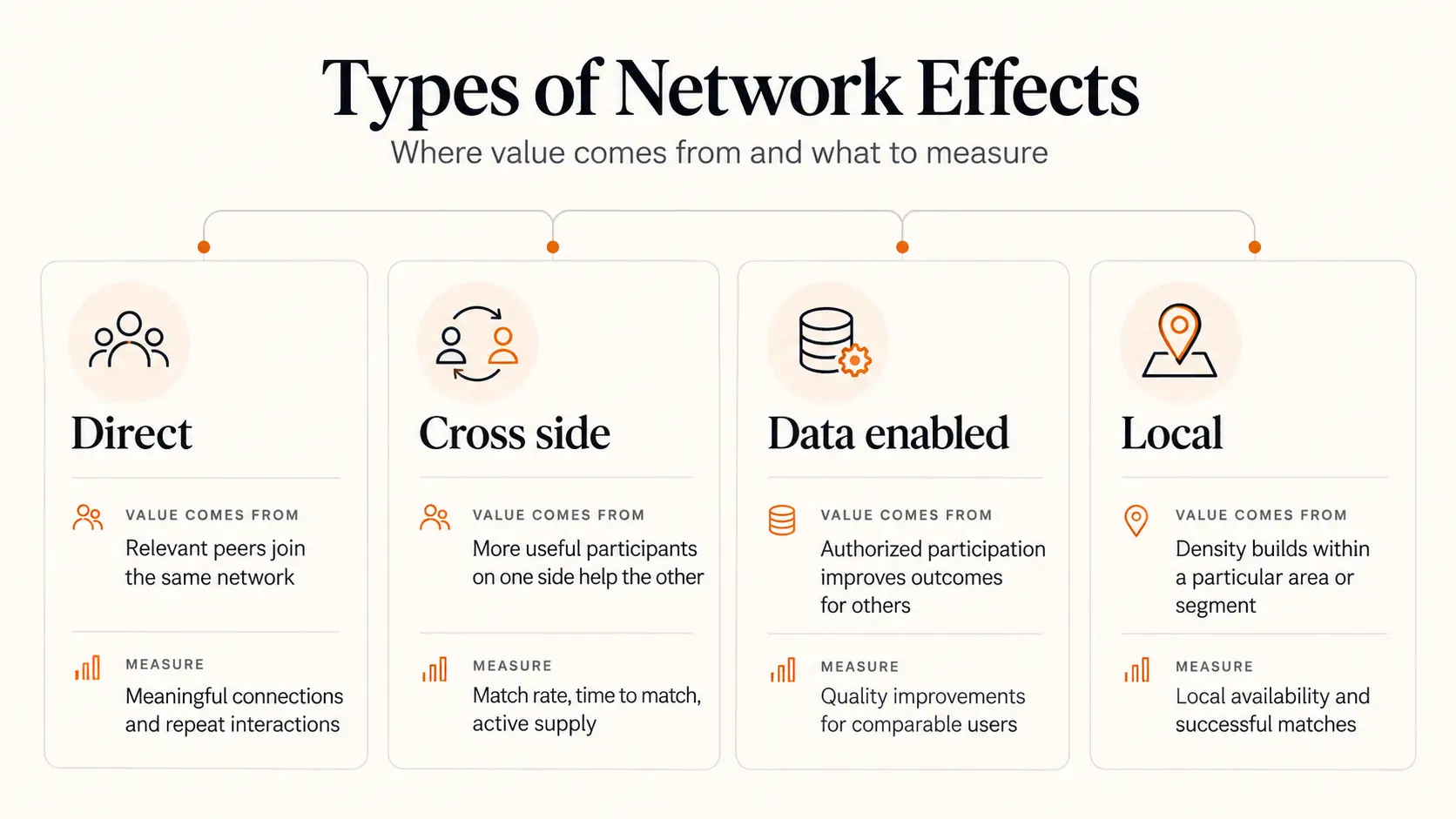
Types of Network Effects Founders Should Understand
There are several ways participants can create value for one another. Founders need to identify the mechanism behind their own product rather than assuming the same playbook works across messaging, marketplaces, developer platforms, and business software.
Direct network effects
Direct effects occur when participants on the same side make the product more useful to one another. A messaging application illustrates this clearly: a user gains more potential conversations when their actual contacts join. A business communication tool can show a similar pattern within a company when more colleagues participate in the same workflows. However, the effect may stop growing once the people a user needs are already present.
Indirect and cross side network effects
Indirect effects arise when growth among one group increases value for another group. A marketplace benefits buyers when relevant sellers join, while sellers benefit when enough real buyers arrive. A developer ecosystem can become more useful to customers as useful applications appear, which in turn makes the platform more attractive to developers. The two sides do not necessarily grow at equal rates, so founders must track each side separately.
Data enabled and local network effects
Some products become more useful when participation produces permissioned information that improves recommendations, search, fraud detection, or matching. This is a genuine network effect only if additional participation improves outcomes for other users; merely collecting more records is not enough. Other effects are local. A ride marketplace may have a strong network in one city and almost no useful network in another. Thinking locally prevents a startup from confusing national signup totals with the experience of a customer in a particular market.
Network Effects vs Viral Growth: Why the Difference Matters
Virality describes how users bring in more users. A network effect describes how additional users change the value of the product. They can reinforce one another, but they are not interchangeable. A referral campaign might generate a surge of registrations even when existing customers receive no added value. Conversely, a professional network may have strong interaction value but spread slowly because joining requires trust, screening, or approval.
An equally common confusion is economies of scale. A company may reduce average costs by spreading infrastructure or support expenses across more customers, even when those customers never interact or improve anyone else's experience. For founders, this matters because growth tactics, product priorities, and success metrics differ depending on the mechanism. A network business must make useful interactions happen; an efficient software business may simply need to serve customers more reliably at lower cost.
How to Build Network Effects from Zero
Early networks face a difficult contradiction. People are reluctant to join until useful participants are present, yet those participants may not join until the product already works. This is the cold start problem. Trying to launch everywhere often makes it worse by spreading limited activity across too many empty markets. The solution starts with a smaller unit of value.
Start with an atomic network
An atomic network is the smallest connected group that can reliably obtain value from the product. For a local services marketplace, it could be one city and one service category. For workplace collaboration, it might be one intact team instead of scattered employees across many companies. For a creator community, it could be a focused set of experts and followers who share a specific purpose. The exact boundary should follow how people interact, not how large the total addressable market looks in a pitch deck.
Recruit the hard side first
Find the participants whose presence creates disproportionate value and who are difficult to recruit. In a local marketplace, these may be reliable service professionals. In a software ecosystem, they might be skilled developers. In a community, they may be trusted contributors who give others a reason to return. Direct outreach, careful onboarding, and temporary incentives can help seed supply, provided the startup does not build a business that works only while incentives remain unusually high.
Deliver a useful first interaction before expanding
A founder should define a minimum successful experience and engineer the first network around it. In a job marketplace, that could be receiving a qualified applicant within a reasonable period. In a discussion product, it could be getting a substantive response from a relevant peer. If the startup cannot consistently provide this result in its strongest initial segment, opening five more segments is unlikely to fix the underlying problem. Once one network retains participants and generates repeat activity, the company can test an adjacent market using the same playbook.
How to Measure Whether Network Effects Are Real
Signups and gross transaction volume are useful business measures, but neither proves that a network is strengthening. A better evaluation begins by asking what improvement an existing participant should experience when the network becomes denser. Then the team measures that improvement for comparable users or markets over time.
Measure the outcome, not just the network size
For a marketplace, track successful match rate, time to match, relevant available supply, and the share of requests that receive no satisfactory response. For a communication product, measure meaningful connections, replies, and repeated interactions among active members. For a platform ecosystem, examine whether new third party contributions increase adoption or engagement for existing users. Organic acquisition and retention can provide supporting evidence, but they are influenced by marketing, seasonality, product changes, and customer mix.
Compare like with like
Imagine a hypothetical local tutoring marketplace. In its first month, 30 of 50 qualified requests find a suitable tutor within two days, a match rate of 60 percent. Three months later, 60 of 80 comparable requests are matched, a rate of 75 percent. That improvement is consistent with a healthier network, but it is not proof by itself. The team should check whether the request mix, marketing, service quality, and available locations changed. If matched customers also return more often and tutors receive useful demand without higher subsidies, the network effect claim becomes more credible.
A useful further test compares similar regions or cohorts with different network density. If customers in denser networks repeatedly receive faster, better matches under otherwise similar conditions, the startup has evidence that participation is creating value. This is much more informative than comparing total users this quarter with last quarter.
What Can Weaken or Reverse Network Effects?
Network effects are not automatically positive. Congestion can increase wait times, low quality contributions can bury useful content, and too many nearly identical listings can make discovery harder. A marketplace with many providers but few serious buyers may deliver disappointing earnings to suppliers. An open community may become less useful if activity grows faster than moderation and relevance. In each case, more participation can reduce value for some users.
Founders should also understand multihoming, when participants use several competing services. If suppliers can list everywhere at little cost and buyers can compare alternatives instantly, an early network lead may be less protective than it appears. Network strength can also reset across geographies or customer segments. The response is not to create artificial lock in, but to make the product genuinely easier to use, more trustworthy, and consistently better at producing the outcome users came for.
A Simple Decision Framework for Founders
Before calling network effects a competitive advantage, write down who creates value for whom. Define the smallest network where that value can appear. Identify the hard side, specify the first successful interaction, and choose two or three measurements that would improve if network participation were genuinely making the product better. Review those measures alongside incentives, retention, and service quality. If network density rises but outcomes do not improve, investigate the product rather than automatically spending more on growth.
The strategic goal is not to accumulate the largest possible audience. It is to build a network where each useful addition helps current participants succeed, so that joining and staying become increasingly rational choices. For a startup with limited capital, a small network that works reliably is often more valuable than an impressive national footprint that has yet to deliver consistent results.
FAQ
What is a simple example of a network effect?
A messaging app becomes more useful to someone when more of the people they actually want to contact join. The benefit comes from new potential conversations, not simply from the company having more customers.
Do all startups need network effects to succeed?
No. Many strong businesses compete through specialist expertise, distribution, reliable operations, brand trust, or deep integration into customer workflows. Network effects matter most where participation itself increases user value.
How do startups solve the cold start problem?
They focus on a narrowly defined group that can become useful with relatively few participants, recruit the side that creates the hardest to replace value, and make the first interaction reliable before expanding to another network.
Can network effects disappear?
Yes. User needs change, participants move to competitors, poor quality reduces trust, and congestion can offset the benefits of a larger network. Healthy network effects require sustained useful interactions rather than permanent growth in signup totals.

Mohsen Avid
Founder & Editor, PinerookMohsen Avid is the founder of Pinerook, covering entrepreneurship, startup strategy, digital business, and the decisions behind building new ventures.
 Seen first.