Choosing an LLM inference engine is not simply about finding the fastest way to generate tokens. vLLM is a strong starting point for production serving across different models and hardware platforms. SGLang deserves attention for structured generation and workloads with reusable prompts, while TensorRT LLM targets performance optimization on NVIDIA GPUs. For local inference, llama.cpp offers a different balance of hardware compatibility and resource requirements.
The right choice depends on the model you need to run, the hardware available, and the response times your application must deliver. I narrow those requirements before comparing benchmark results, because an impressive throughput figure means little if the engine cannot support the actual deployment.
Best LLM Inference Engines by Use Case
For a general production API serving multiple users, vLLM is my first candidate. It supports a broad range of model architectures, accelerator platforms, and serving features, making it a practical baseline for evaluating alternatives.
For applications built around repeated context, agent workflows, and constrained generation, I put SGLang on the shortlist. For deployments committed to NVIDIA hardware, TensorRT LLM deserves a separate performance evaluation, particularly when the team can tune the runtime for a specific model and GPU configuration.
I approach local inference differently. llama.cpp makes sense when models must run on personal computers, CPUs, Apple Silicon, or mixed hardware. LMDeploy is worth evaluating when its TurboMind or PyTorch backend supports the chosen model and deployment requirements.
These are starting recommendations, not universal performance rankings. The strongest engine for one model and workload is not automatically the strongest for another.
LLM Inference Engines and Their Role in Model Serving
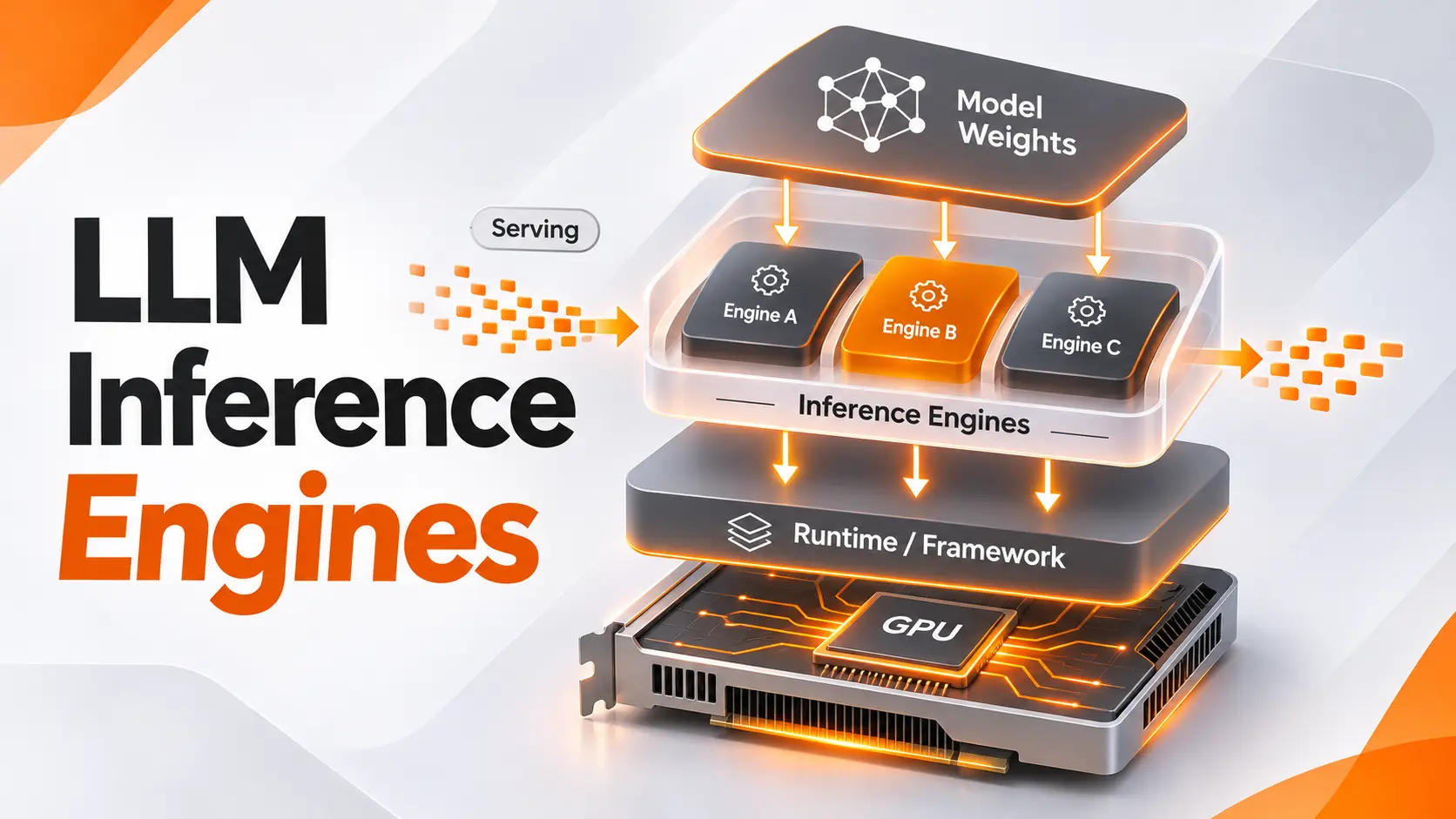
An LLM inference engine is the software responsible for executing a trained language model and managing the computational work required to generate responses. It determines how requests are scheduled, how model memory is allocated, and how efficiently available processing resources are used.
The engine operates between the model and the infrastructure delivering its responses. It is not the language model itself, and it is not necessarily the complete deployment platform.
The most important responsibilities are:
Model execution: Loading model weights and executing the operations required for inference.
Request scheduling: Managing incoming requests and batching compatible operations to use processing resources efficiently.
Memory management: Allocating and reusing memory for model weights, intermediate states, and the KV cache.
Generation control: Managing token decoding, sampling parameters, and supported output constraints.
Serving integration: Exposing inference functionality through APIs or integration interfaces.
These capabilities explain why two inference engines running the same model on the same GPU can deliver different latency, throughput, and memory utilization.
Leading LLM Inference Engines
vLLM: Broad Compatibility and Production Serving
vLLM is an open source inference framework built around efficient model execution and request processing. Its PagedAttention approach introduced a more efficient way to manage KV cache memory, reducing waste associated with memory allocation during generation.
The framework supports continuous batching, prefix caching, structured outputs, and distributed inference. It also provides an OpenAI compatible API server, which makes it useful when an application already communicates with models through standard chat completion interfaces.
What makes vLLM attractive to me is the breadth of its ecosystem. It supports major model families, including Llama, Qwen, Gemma, and DeepSeek, along with NVIDIA and AMD GPUs and additional hardware platforms.
That flexibility matters when a team expects to change models or infrastructure. Instead of selecting a runtime optimized exclusively for one configuration, vLLM provides a common foundation for testing multiple deployment options.
Its broad feature support still requires verification against the exact model, quantization format, and hardware combination. Compatibility at the framework level does not establish support for every individual configuration.
SGLang: Efficient Context Reuse and Structured Generation
SGLang is a serving framework designed for efficient language model execution, particularly in applications with complex request patterns.
One of its central capabilities is RadixAttention, which organizes reusable KV cache data so requests sharing a common prefix can avoid repeating the same prompt computations.
This becomes valuable when requests contain a substantial shared system prompt, a repeated document prefix, or conversation history that can be reused.
SGLang also supports constrained generation using JSON schemas, regular expressions, and grammar rules. These capabilities make it relevant to applications that depend on predictable output structures.
I would evaluate SGLang closely for an agent workflow that generates structured responses and repeatedly processes related context. However, structured output support is not exclusive to SGLang. vLLM and other engines also provide constrained generation, so the final decision must account for implementation compatibility and measured performance.
SGLang supports multiple accelerator platforms and advanced serving capabilities. The practical consideration is whether its configuration and feature requirements match the application's workload.
TensorRT LLM: NVIDIA GPU Performance
TensorRT LLM is NVIDIA's inference framework for accelerating large language models on NVIDIA GPUs.
It provides optimized execution paths, quantization support, batching, KV cache management, speculative decoding, and distributed inference capabilities.
The main reason I would consider TensorRT LLM is the opportunity to optimize a deployment around a specific NVIDIA GPU generation and model architecture.
This is a different selection problem from choosing a framework primarily for portability. If the infrastructure is already standardized on NVIDIA hardware, the runtime's integration with NVIDIA optimized kernels becomes directly relevant.
TensorRT LLM has also evolved beyond its earlier engine compilation workflows. Its current architecture includes a PyTorch based LLM API, so it should not be evaluated solely through assumptions about older deployment requirements.
The limitation is its NVIDIA hardware focus. Teams planning deployments across different accelerator vendors should account for that dependency before committing to the framework.
llama.cpp: Local and Resource Constrained Inference
llama.cpp is an inference implementation written in C and C++ that supports running language models across CPUs and several GPU backends.
It supports the GGUF model format, quantized model execution, and partial GPU acceleration when a model cannot fit entirely into available video memory.
These characteristics make llama.cpp relevant for personal computers, edge systems, and infrastructure where dedicated datacenter GPUs are unavailable.
Its hardware support includes Apple Silicon through Metal, NVIDIA GPUs through CUDA, and AMD hardware through HIP, alongside other supported backends.
I would prioritize llama.cpp when hardware flexibility and local execution are more important than building a large distributed serving environment.
It also includes an HTTP server with an OpenAI compatible interface, parallel request handling, and continuous batching. Therefore, it should not be dismissed as a tool that can serve only one user.
The real selection boundary is the required model format, performance target, available hardware, and scale of the intended service.
LMDeploy: TurboMind and PyTorch Inference
LMDeploy provides tools for model deployment, serving, and inference optimization. Its two principal execution backends are TurboMind and PyTorch.
TurboMind is implemented using C++ and CUDA, with an emphasis on efficient GPU execution. The PyTorch backend provides an alternative implementation with different model and hardware compatibility characteristics.
This separation is important because support for a model in LMDeploy does not guarantee identical capabilities across both backends.
LMDeploy supports language and vision language models, quantization options, and an OpenAI compatible serving interface.
I would include it in an evaluation when the model appears in its compatibility matrix and the hardware configuration matches a supported backend.
Its value is determined by that specific combination rather than a general claim that it is faster than competing inference engines.
LLM Inference Engines Comparison
The differences between these engines become clearer when hardware requirements, model compatibility, and operational constraints are considered together.
The following comparison focuses on where each engine fits and what I would verify before selecting it for production.
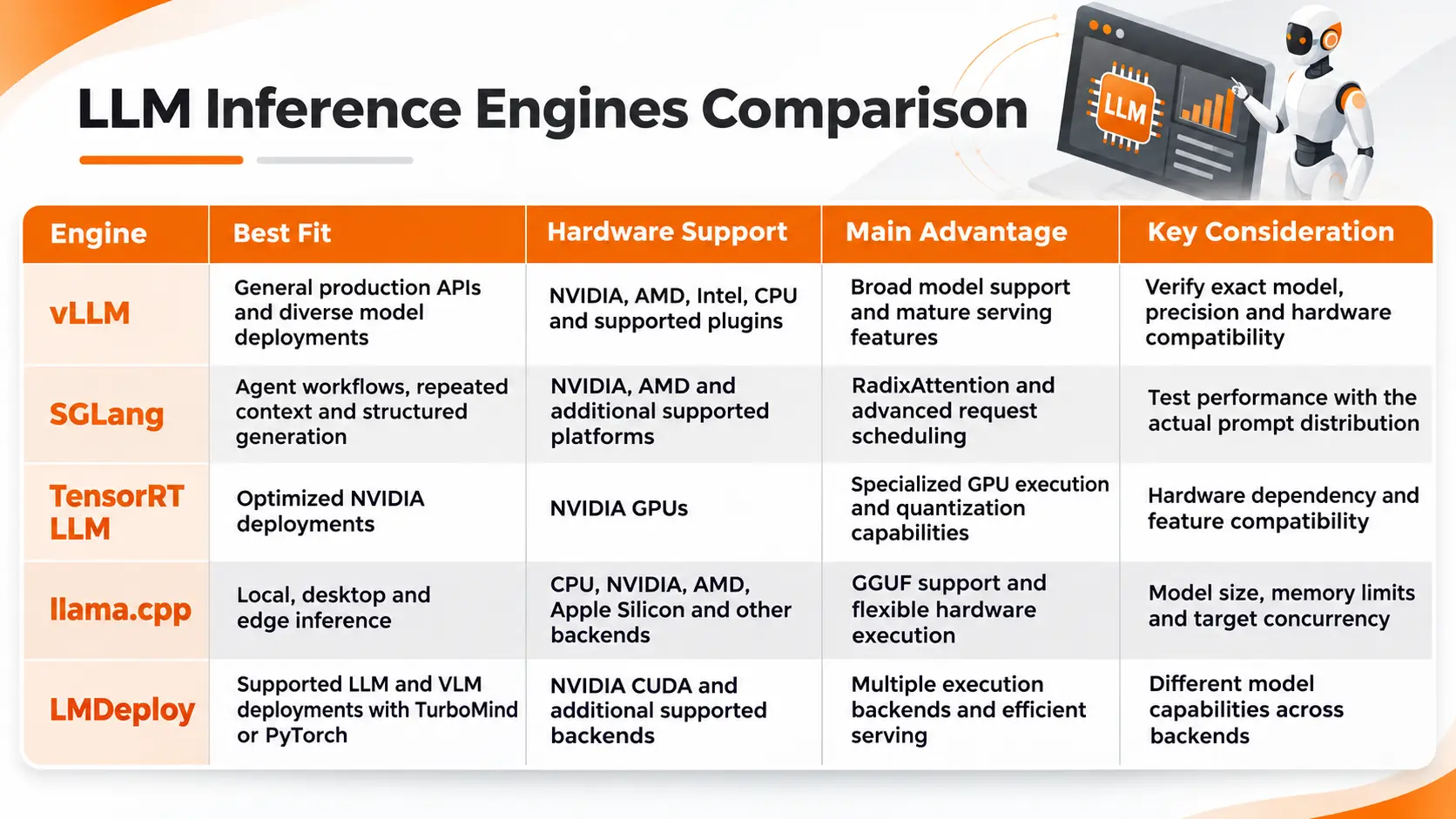
The table is a selection guide rather than a performance ranking. A deployment with a high request rate and long prompts places different demands on the inference engine than a local application processing one document at a time.
For that reason, I use the comparison to narrow the candidate list before testing performance.
Other LLM Serving Tools and Project Status
Not every tool discussed alongside LLM inference engines belongs to the same software category.
Ollama provides an accessible way to download, manage, and run models locally. It is a strong option for developers who want a straightforward local model experience, but its model management and application interface extend beyond the responsibilities of a bare inference runtime.
NVIDIA Triton Inference Server operates at a broader serving layer. It can deploy models using different backends, including vLLM and TensorRT LLM. Comparing Triton directly with vLLM without distinguishing their responsibilities creates a misleading comparison.
NVIDIA Dynamo addresses distributed inference coordination and works with engines including vLLM, SGLang, and TensorRT LLM. It is not a replacement for the underlying model execution engine.
Another important distinction concerns Hugging Face Text Generation Inference (TGI). TGI remains relevant to existing deployments, but Hugging Face has placed it in maintenance mode and recommends alternatives including vLLM and SGLang.
I would not choose TGI as the default foundation for a new deployment without a specific requirement that justifies maintaining it.
Choosing the Right LLM Inference Engine
Engine selection is a practical part of LLM Inference Optimization. The decision determines which model architectures, scheduling capabilities, memory strategies, and hardware optimizations are available to the application.
I assess four factors before deciding which engine deserves a production evaluation.
Model and Quantization Compatibility
The first requirement is support for the exact model checkpoint.
A framework can support the Llama family without supporting every architecture variation, attention implementation, or quantization format associated with it.
The same distinction applies to model files. A GGUF checkpoint designed for llama.cpp does not establish that every other inference engine can execute it without conversion or additional compatibility checks.
I check the model architecture, weight format, tokenizer, attention implementation, and supported numerical precision together.
This matters particularly for newly released models. General framework compatibility is insufficient evidence that every model feature will work correctly.
GPU Memory and Hardware Requirements
Available GPU memory determines which model sizes, precision formats, context lengths, and concurrent workloads a deployment can accommodate.
Model weights consume part of that memory. The KV cache, execution buffers, and runtime allocations require additional capacity.
A model fitting into GPU memory at startup does not prove that the deployment can process the intended number of simultaneous requests.
For a single GPU, I prioritize the memory requirements of the exact model and workload. For larger deployments, I also examine the supported parallel execution strategies and communication costs.
Hardware support must be evaluated at the feature level. An engine supporting AMD and NVIDIA GPUs does not mean that every kernel, quantization format, and optimization behaves identically across both platforms.
Latency, Throughput and Workload Behavior
I separate interactive responsiveness from aggregate processing capacity.
An interactive assistant needs fast initial responses and consistent token delivery. A batch processing service places greater emphasis on the number of requests or tokens completed over a defined period.
The critical measurements include time to first token, output token throughput, total response latency, and successful request completion under the expected traffic load.
Prefix caching deserves particular attention when applications reuse substantial portions of their prompts. However, the benefit depends on the amount of reusable context and the cache behavior of the selected engine.
I do not use published benchmark rankings as the final selection criterion. The model version, hardware, request lengths, concurrency, caching conditions, and serving configuration must match the intended deployment closely enough for a comparison to be meaningful.
Deployment and Operational Requirements
Performance is only valuable when the engine can operate reliably within the application.
I examine API compatibility, model loading behavior, monitoring support, configuration management, and the team's ability to maintain the serving environment.
An OpenAI compatible interface reduces integration work, but it does not guarantee identical support for every API parameter, response format, or tool calling feature.
Version stability is another consideration. An engine update can change supported model features, resource requirements, or runtime behavior. Production deployments need tested versions and a controlled upgrade process.
Security also belongs in this assessment. API authentication, network exposure, access controls, and request isolation must be addressed by the complete deployment rather than assumed to be provided by the engine alone.
Final Engine Selection for Production
My preferred selection process starts with compatibility, then moves to performance and operating cost.
I first eliminate engines that cannot support the required model, precision, hardware, or application features. From the remaining candidates, I select the most practical baseline and one alternative with a clear technical advantage for the workload.
For example, vLLM provides a reasonable baseline for a general model serving API. SGLang becomes a meaningful alternative when shared prefixes and structured generation are central to the application. TensorRT LLM belongs in the comparison when NVIDIA specific optimization is the objective.
The final decision should be based on the number of successful requests the deployment can serve within its latency targets, together with the cost and operational complexity required to sustain that performance.
The best LLM inference engine is the one that satisfies the application's compatibility, performance, and reliability requirements at an acceptable operating cost. Selecting it requires evidence from the intended workload, not a universal ranking of software frameworks.
FAQ
Can I switch inference engines without changing my OpenAI client?
Yes, provided the replacement engine exposes the API endpoints and request features used by the application. The client can be configured to communicate with the new server endpoint. However, API compatibility does not guarantee identical handling of tool calls, structured outputs, streaming responses, or error formats. These behaviors must be tested before migration.
Why do I get different answers from two engines running the same model?
Different inference engines can use different numerical kernels, precision settings, token sampling implementations, and execution orders. These differences can affect generated output even when the model weights are identical. Matching the tokenizer, generation parameters, precision, and model configuration reduces differences but does not guarantee identical responses across implementations.
Can I run an inference engine without an internet connection?
Yes. Local inference can operate without an internet connection when the model files, runtime dependencies, and required supporting resources are already available on the machine. The deployment must also be configured to avoid external services for authentication, model downloads, telemetry, or other runtime dependencies.
Do I need to retrain my model before moving to another inference engine?
No. Changing inference engines does not inherently require retraining the model. The existing weights can be reused when the destination engine supports the model architecture and checkpoint format. A conversion step may be necessary, and the resulting deployment should be validated for output quality and numerical compatibility.
Can I update my inference engine without taking the API offline?
Yes. A deployment can maintain availability by running the new engine version alongside the existing version and routing traffic between them. The replacement must pass compatibility, health, and performance checks before the previous deployment is removed. Existing requests and session state must be handled according to the application's serving architecture.

Fatemeh Jahangard
Technology & AI Writer at PinerookFatemeh Jahangard covers AI, emerging technologies, and digital innovation for Pinerook, focusing on how technology shapes startups and industries.
 Seen first.