
What Is a Go to Market Plan?
A go to market plan is the operational document that turns a market entry decision into coordinated work. It identifies the offer being launched, the specific customers to reach, the channels and assets required, the people responsible, the launch sequence, and the evidence that will determine what happens next. For an early stage startup, its value is not the number of pages. Its value is making the next few weeks of work observable and accountable.
A plan is narrower than a strategy. The broader Go to Market Strategy for Startups establishes the choices behind the market entry: whom to serve, why the offer matters, and the route to customers. This document translates those choices into tasks, dependencies, dates, spending limits, and review points. A team should be able to open it on Monday morning and know what is due, what is blocked, and which assumption it is trying to test.
The most useful plan is deliberately small enough to update. It may fit into two pages plus an activity tracker. A plan that assumes every channel will work, postpones measurement until launch day, or gives multiple people vague ownership is not ready to execute. The goal is a short feedback cycle rather than a perfect rollout.
Decide What This Launch Must Prove
Start with one launch outcome, not a collection of aspirational targets. A startup testing a new scheduling product might aim to secure five paid pilot organizations in a defined customer segment during a 12 week period. That objective is more useful than “increase brand awareness” because it specifies the customer, desired behavior, and deadline. The numbers must reflect the company’s capacity and sales cycle; they are illustrative, not universal benchmarks.
Separate the business result from the assumptions that produce it. The team may need to test whether buyers recognize the problem, respond to a message, agree to a demonstration, complete onboarding, and pay after a trial. Those are different points of possible failure. A useful plan makes each assumption measurable, identifies how evidence will be collected, and names the decision that follows an unfavorable result.
Build a One Page Go to Market Plan
Before creating a launch calendar, assemble the minimum set of decisions in one place. Each entry should describe an observable choice rather than a vague intention. For a first launch, one target segment and one primary acquisition route may produce clearer learning than a broad campaign across multiple audiences. More ambitious launches can retain the same structure while adding separate workstreams.
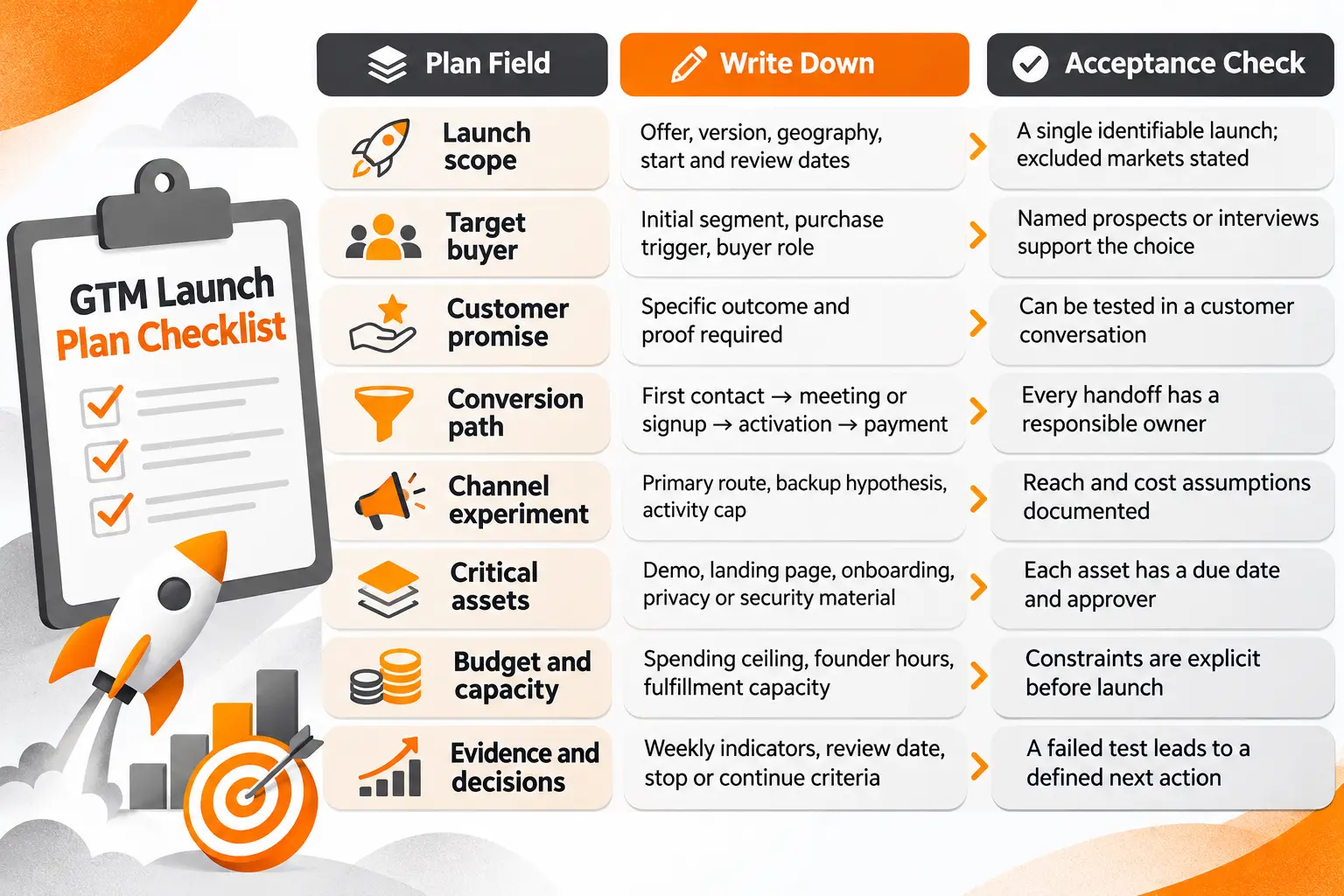
The canvas is a decision record, not a substitute for the work itself. Where an assumption remains uncertain, label it rather than presenting it as a fact. If the buyer is not yet confirmed, assign customer interviews before finalizing messages. If the product cannot support more than ten pilot accounts, the plan must not reward a campaign for attracting hundreds of unserviceable customers.
Assign One Owner to Each Dependency
A founder may own most early tasks, but ownership should still be explicit. For every deliverable, record a single directly responsible individual, a deadline, the evidence of completion, and the task it unlocks. A launch email cannot be approved until the promise has been checked against product capabilities. A paid campaign should not begin until the landing page and conversion tracking have been tested. These are dependencies, not administrative details.
Keep an issue log beside the plan. Mark an item blocked when the prerequisite is missing rather than quietly moving its date. When outside partners are involved, record who can approve copy, change pricing, sign contracts, and respond to a failed onboarding. Small teams often move quickly because informal coordination is easy; the risk is that nobody notices a missing handoff until the launch is public.
Set an Experiment Budget Before Spending
Budget for the full cost of a test, including people’s time, production work, software, outreach and customer support. A low advertising bill does not make a channel inexpensive if founders spend dozens of hours handling poorly qualified leads. Set a maximum commitment for each channel experiment and record what qualifies as useful evidence before beginning. This prevents a team from redefining success after results arrive.
For example, an outbound pilot could have a capped prospect list, a specified outreach sequence, a defined qualification standard and a deadline for evaluating response quality. A search experiment would require different assets and a longer learning horizon. Neither should receive more budget simply because its activity metrics look impressive. The allocation decision depends on credible progression to the next customer action and the economics of fulfilling demand.
Measure Movement Through the Customer Journey
Choose a small scorecard that follows the customer from contact to value. Depending on the buying motion, it might include targeted prospects reached, qualified replies, completed demos, activated accounts, paid pilots, and the time or effort required at each step. Report both counts and conversion rates, with clear definitions. If an apparent improvement comes from changing what “qualified” means, it is not a comparable result.
Early numbers will be noisy. With a handful of prospects, a change of one or two wins can dramatically alter a conversion rate. Use customer conversations and recordings alongside quantitative signals to interpret why people leave the process. Assign weekly reviews to operational blockers and a larger review at the end of the test to decide whether to expand, revise, or stop. Avoid treating 30 , 60 , or 90 day milestones as evidence of product market fit by themselves.
Work Through a Concrete Startup Example
Consider a fictional startup selling software that helps independent clinics coordinate staff availability. Its first plan targets clinics with between five and twenty employees that still use shared spreadsheets and frequently reschedule shifts. The offer is a short guided pilot, with the operations manager as the user and the clinic owner as a likely buyer. The founders choose direct outreach and referrals from industry advisers, not a broad social media campaign, because the initial buyers are identifiable.
During the first month, the founders speak with clinics and discover that fast scheduling matters less than avoiding last minute coverage gaps. They revise the demo to show how managers identify unfilled shifts. The next month they run a limited outreach test and track qualified conversations, completed pilots and actual use. They decide in advance that insufficient qualified interest means revisiting the segment or promise, while interested prospects who never activate indicate a product or onboarding problem. This is a useful plan because it maps observations to decisions rather than declaring success after a launch announcement.
Common Planning Failures and How to Avoid Them
One frequent failure is planning around the public announcement instead of the customer’s first successful experience. That creates launch day traffic without a working way to convert, onboard or support people. Another is assigning every task a date while ignoring dependencies. Both problems can be addressed by making readiness checks explicit: the product works for the intended use, someone owns inbound questions, and the next step is available when the customer is ready.
The more subtle mistake is treating the plan as a commitment to an unchanged hypothesis. A good plan protects a learning process. It limits simultaneous tests, documents why a decision was made, and separates useful customer signals from vanity measures. If evidence contradicts the original premise, revising the plan is a sign of discipline, provided the team records what changed and why.
When to Update, Pause or Replace the Plan
Update activity details weekly and revisit assumptions when new evidence appears. Pause acquisition when customers cannot activate, compliance requirements remain unresolved, or service delivery is failing. Replace the plan when the target buyer, core promise, or buying motion changes materially. A new market entry with a different procurement process may require a fresh plan even if the product itself remains unchanged.
At the close of the initial experiment, produce a short decision memo: what was attempted, what happened, the strongest and weakest evidence, the unresolved risks and the next funded action. This document lets future hires and partners understand the history of the launch without relying on founder memory. The best outcome is not always an immediate scale up; sometimes it is a cheap, early discovery that a market assumption needs to change.
FAQ
What should a startup go to market plan include?
It should identify the precise launch scope, customer segment, offer, conversion process, channels, deliverables, owners, budget, milestones, evidence and decision rules. The plan must be specific enough to run, not merely present.
How long should a go to market plan be?
For a small startup, a one or two page summary supported by a task tracker is often sufficient. Complexity should reflect the launch and its dependencies rather than a preferred page count.
How far ahead should a startup plan its launch?
Plan far enough to coordinate dependencies and gather meaningful evidence. Twelve weeks can be a practical illustration, but sales cycles, regulatory reviews and product readiness determine the real horizon.
What is the difference between a go to market plan and a marketing plan?
A go to market plan coordinates the entire path from a specific offer to customer adoption, including product, sales, onboarding and measurement. A marketing plan principally addresses audience communication and demand creation.
When should a startup change its GTM plan?
Change it when customer evidence invalidates a core assumption, a critical dependency fails, or the buyer and sales motion differ from what the team originally expected. Record the reason and revised test.
Who should own a startup GTM plan?
One person should maintain the live document and run reviews, even if several people own individual workstreams. In an early startup, that owner is often a founder.

Mohsen Avid
Founder & Editor, PinerookMohsen Avid is the founder of Pinerook, covering entrepreneurship, startup strategy, digital business, and the decisions behind building new ventures.
 Seen first.