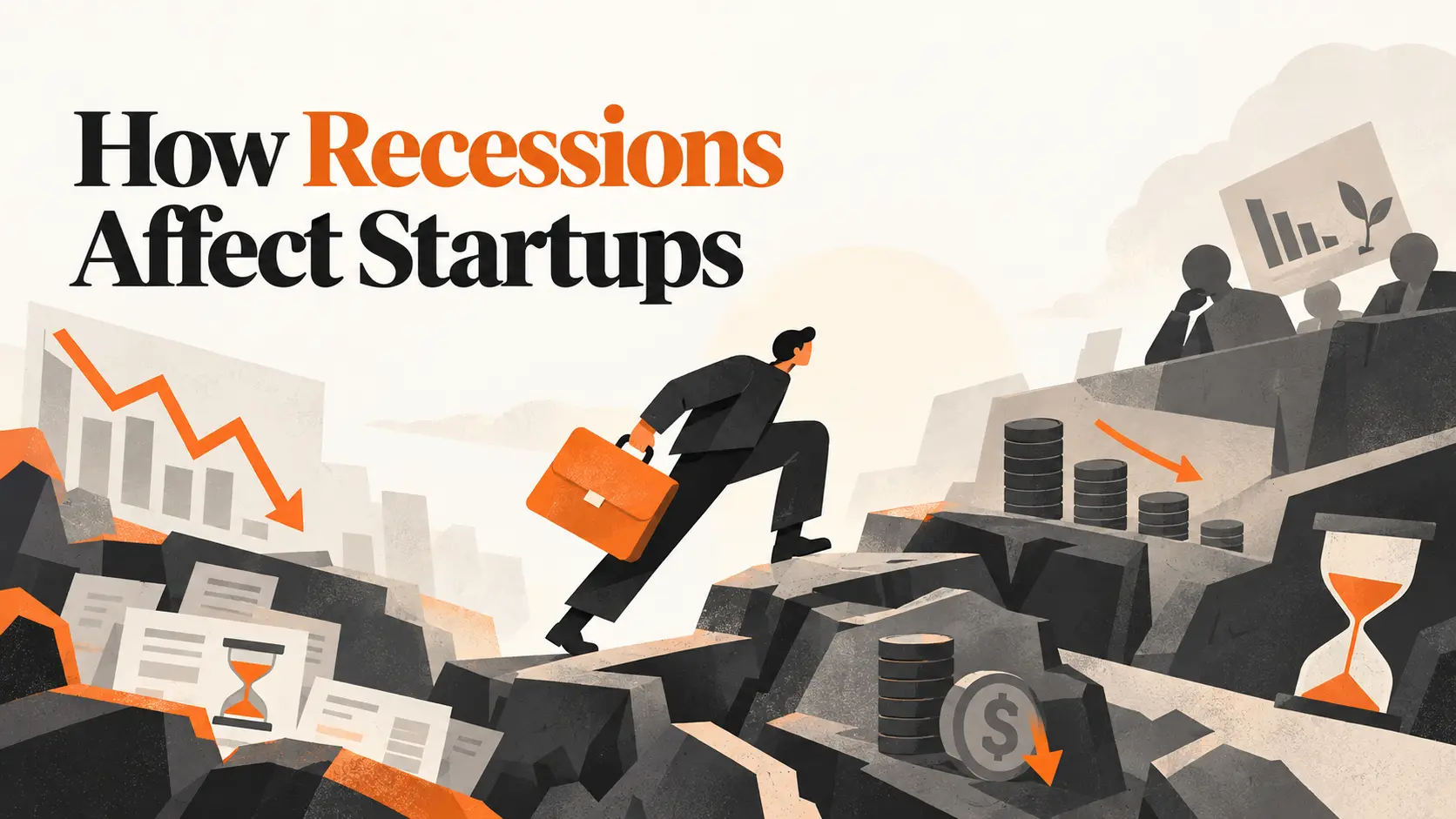
Recessions affect startups through several connected pressures. Customers delay purchases, invoices take longer to collect, investors become more selective and fixed costs become harder to carry. The result can be a shorter cash runway even when a company has not changed its spending.
Founders cannot control the economic cycle, but they can identify which assumptions are changing. Understanding macroeconomics for startups helps connect those external pressures to decisions about pricing, hiring, financing and growth. The objective is not to cut everything. It is to protect the business while preserving room to adapt.
What a Recession Actually Changes
A recession is a broad decline in economic activity. It is different from a slowdown in one industry or a difficult venture capital market, although these conditions can overlap. A startup may struggle to raise money while its customers continue buying. Another may have access to investors but lose revenue because buyers are reducing budgets. Those problems require different responses.
Four Ways Recessions Affect Startups
1. Customers become more selective
Consumer buyers may postpone purchases or choose cheaper alternatives. Business customers may add approval steps, negotiate smaller contracts or demand clearer proof of return on investment. Watch sales cycle length, conversion, average deal size and renewal discussions. A full pipeline is not reassuring if fewer deals are closing.
2. Cash arrives later
Revenue booked on paper does not pay salaries. Customers may request longer terms, miss payment dates or dispute invoices. For businesses with large contracts or concentrated customers, delayed collections can be more damaging than a modest decline in sales. Review overdue invoices and expected cash receipts every week.
3. Funding becomes less predictable
Investors may take longer to make decisions, ask for stronger retention evidence or offer less favorable terms. This does not mean every startup loses access to capital. It means a fundraising date should not be treated as guaranteed cash. A company should know which milestone it can reach with the money already available.
4. Fixed commitments create pressure
Payroll, vendor contracts, inventory orders and infrastructure costs often continue even as demand weakens. Hiring may become easier in some roles, but affordability still depends on revenue and cash. The same applies to suppliers and major customers whose own financial problems can interrupt operations.
Which Startup Models Face the Most Pressure?
Exposure depends on whether customers consider a purchase essential, how quickly they can cancel and how much cash the startup must commit before getting paid. The patterns below are illustrative, not rules for every company.
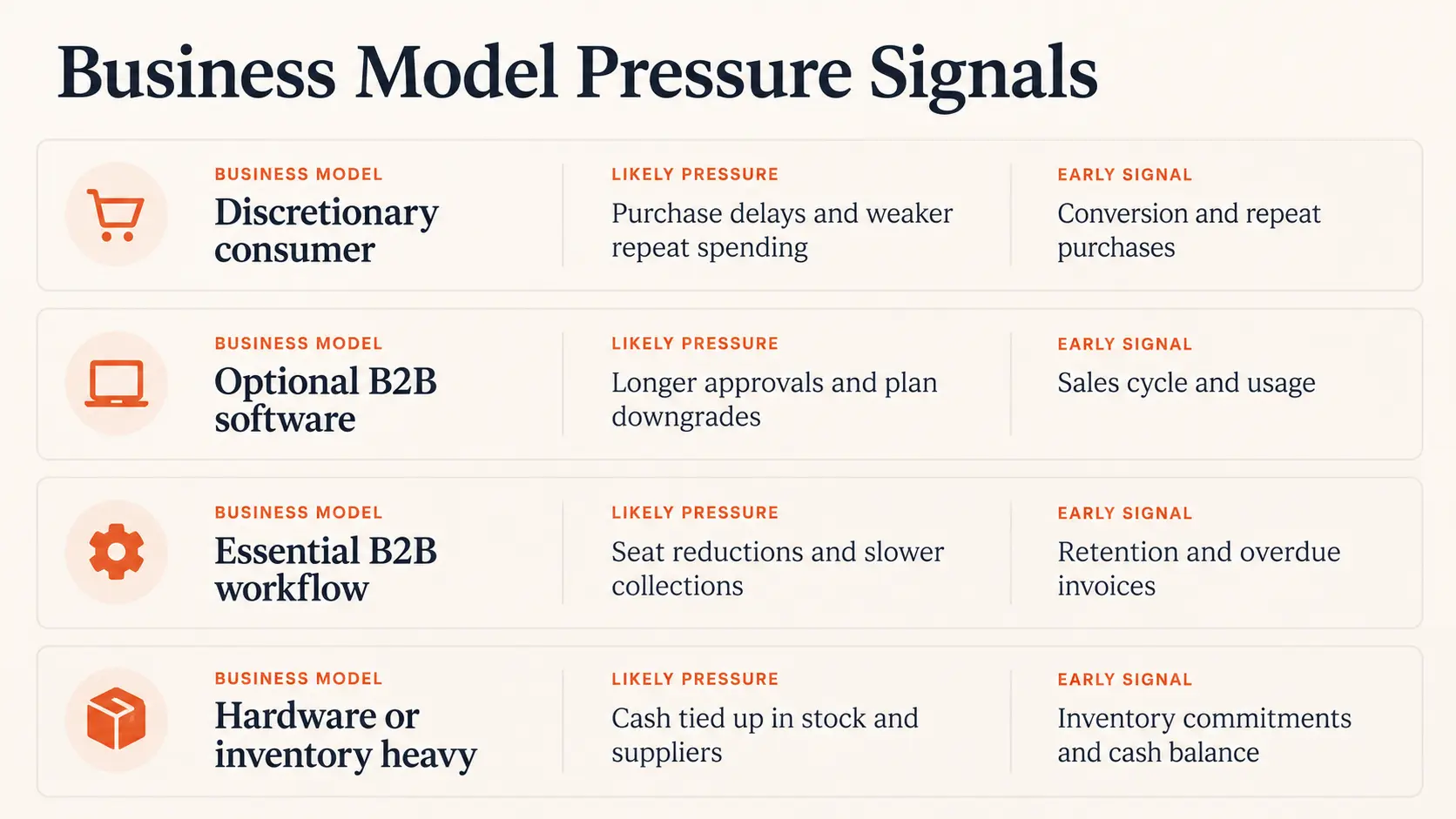
The best test is to ask customers which budget pays for the product, what would cause them to cut it and which outcome they would still pay to protect.
Why Runway Can Shrink Faster Than Revenue
Consider a hypothetical startup with $900,000 in cash, $160,000 in monthly payments and $100,000 in monthly cash receipts. Its net burn is $60,000 a month, giving it about 15 months of simple runway. If receipts fall to $80,000 while costs stay unchanged, burn rises to $80,000 and runway falls to about 11 months. A $20,000 monthly cash shortfall has removed nearly four months of decision time.
This is an illustration, not a full forecast. Actual cash balances depend on payment timing, taxes, debt and irregular expenses. A rolling 13 week cash forecast is more useful for near term decisions than one runway figure.
How Founders Should Respond
Build scenarios before making cuts
Model a base case, a pressure case with slower sales and collections, and a severe case in which a major customer or expected funding round disappears. Decide in advance which commitments would change under each scenario. Use clear triggers, such as a sustained decline in conversion or a projected cash balance below an agreed buffer.
Protect retention and collections
Speak to important customers before renewal dates. Help buyers explain the value they receive and resolve payment problems early. A smaller plan or phased rollout can sometimes preserve a relationship, but broad discounts may damage margins without solving the underlying problem.
Review spending by consequence
Pause duplicate tools, weak experiments and expansion plans that depend on optimistic forecasts. Be more cautious about cutting customer support, reliability or a proven acquisition channel. The right question is not which expense is easiest to remove, but what customer or cash consequence follows the decision.
Treat hiring and fundraising as choices
Prioritize roles that protect delivery or remove a demonstrated revenue bottleneck. Delay hires supported mainly by an aggressive growth plan. Approach investors with clear retention, margin and runway data, while keeping an operating plan that does not depend on a round closing at the expected time.
Signals Worth Watching Each Week
Focus on a small dashboard: qualified pipeline and conversion, renewals and downgrades, overdue invoices, cash receipts, net burn and the lowest projected cash balance. Compare several weeks rather than reacting to one lost deal. When customer demand, collections and cash all weaken together, founders have a stronger reason to act than when a single economic headline turns negative.
Can Recessions Create Opportunities?
They can. Customers may become more willing to try a product that demonstrably saves money or reduces risk. Strong candidates may become available, and competitors dependent on frequent fundraising may slow down. But opportunity is not automatic. Test demand with small commitments and protect the cash needed to serve existing customers.
The Bottom Line
The biggest recession risk is often not the headline decline in economic activity. It is the gap between how quickly cash conditions change and how slowly a startup adjusts its commitments. Founders who monitor customers, collections and runway can respond earlier, protect what works and retain the option to grow when conditions improve.
FAQ
Do recessions always reduce startup funding?
No. Financing can become slower or more selective, but access varies by sector, stage and company performance. A funding slowdown can also occur without a broad recession.
Are SaaS startups recession proof?
No. Recurring revenue can improve predictability, but customers can reduce seats, downgrade or cancel products they consider optional. Retention and customer value matter more than the billing model alone.
Should startups freeze hiring during a recession?
Not automatically. Review each role by its cost, urgency and expected effect on revenue or customer service. Delay speculative expansion before cutting essential capacity.
How much runway should a startup keep?
There is no universal target. The right buffer depends on burn, customer concentration, cash volatility and funding needs. Stress test several scenarios and update the cash forecast regularly.

Masoumeh Jahangard
Markets & Economy Writer at PinerookMasoumeh Jahangard covers markets, economic trends, and business conditions for Pinerook, focusing on how they affect startups and growing companies.
 Seen first.