
A startup can increase revenue, retain more customers and still receive a lower valuation than it might have earned a year earlier. That is not necessarily a contradiction. Investors price a company based on its future prospects, the risk of reaching them and the alternatives available for their capital. All three can change with the economy.
For founders, macroeconomics for startups is useful only when it clarifies a financing decision. A lower price for equity can reflect a change in the market rather than a deterioration in the product, but founders still need evidence that distinguishes the two.
Why the Same Startup Can Receive Different Valuations
Startup valuation is not a fixed A startup can increase revenue, retain more customers and still receive a lower valuation than it might have earned a year earlier. That is not necessarily a contradiction. Investors price a company based on its future prospects, the risk of reaching them and the alternatives available for their capital. All three can change with the economy.
For founders, macroeconomics for startups is useful only when it clarifies a financing decision. A lower price for equity can reflect a change in the market rather than a deterioration in the product, but founders still need evidence that distinguishes the two.
score for business quality. In a priced funding round, it is a negotiated estimate of what investors are willing to pay for ownership under specific conditions. Growth, retention, margins and market size remain central. So do the price and availability of capital at the moment a company raises money.
This creates two separate questions: Has the business become more or less valuable because its prospects changed? Or are investors paying a different price for similar prospects? A founder needs to separate operating performance from changes in market expectations before deciding how to respond.
Four Economic Forces That Change Investor Pricing
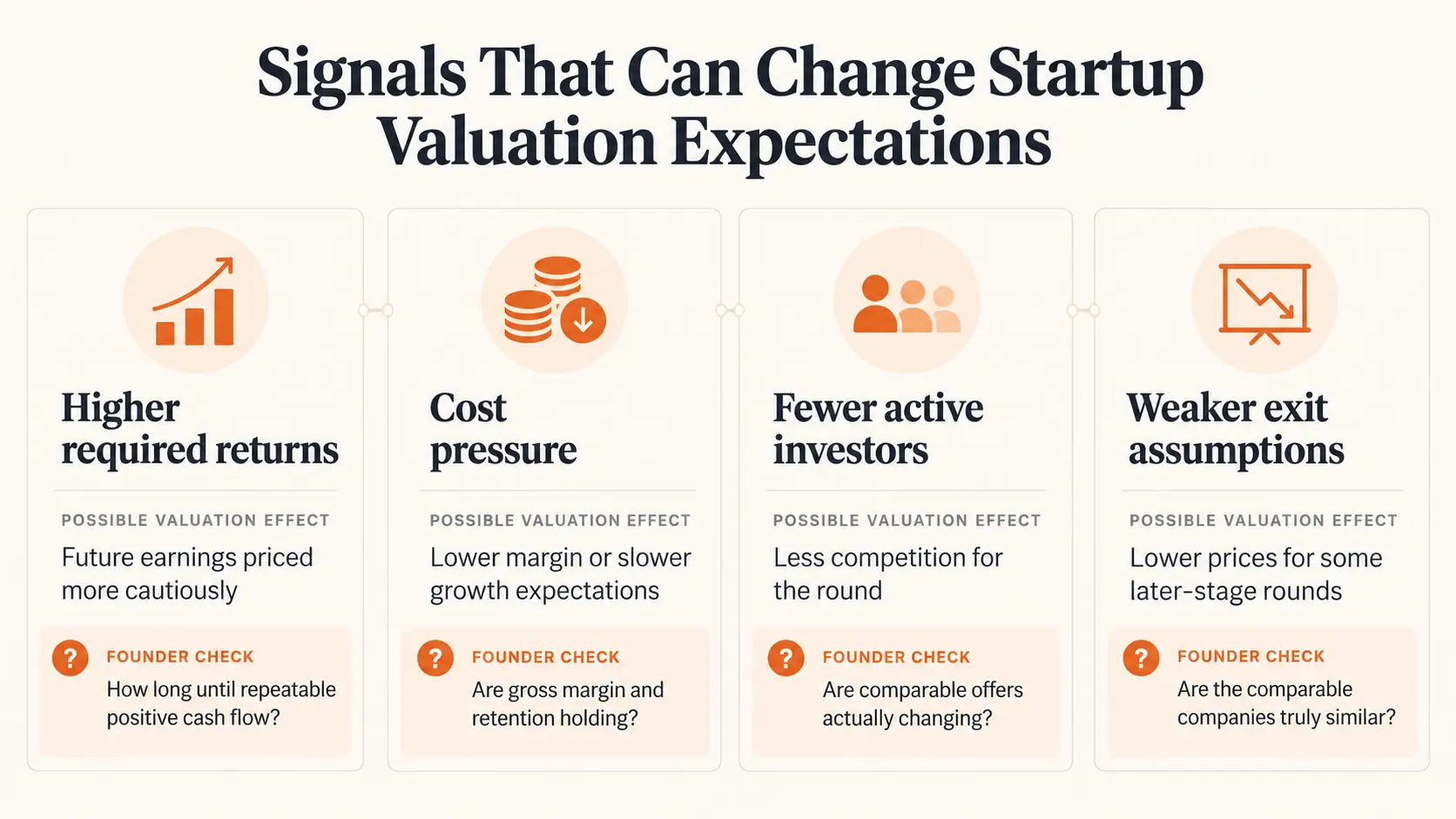
Interest rates change the value of future growth
Investors compare uncertain future returns with safer alternatives. When required returns rise, cash flows expected far into the future are worth less in present value terms, all else equal. Companies whose investment case depends heavily on profits many years away may be especially sensitive. This does not mean every interest rate increase automatically reduces every startup valuation.
Inflation changes margins and confidence in forecasts
Higher payroll, infrastructure and supplier costs can weaken projected margins. Inflation may also reduce customer purchasing power or make enterprise buyers more cautious. However, higher nominal revenue does not necessarily mean higher real value. Investors will ask whether the company can preserve unit economics and pass on cost increases without losing demand.
Venture capital availability changes bargaining power
When fewer investors compete for a round, founders may face more questions, longer processes or lower offers. Capital is not evenly distributed across stages and sectors. Carta reported that more than 60% of venture funding raised by companies on its platform in the first quarter of 2026 went to AI companies. A headline about abundant venture funding therefore does not guarantee strong pricing for an unrelated startup.
Comparable valuations and exit expectations provide context
Later stage investors pay attention to acquisition prospects and the prices attached to comparable businesses. If investors expect weaker exits, they may seek more ownership at entry. For a young company without meaningful revenue, direct public market comparisons are far less reliable. Stage, business model, growth quality and financing terms still matter.
How to Tell Market Pressure From Company Weakness
Before revising a fundraising target, examine external conditions alongside internal evidence. The point is not to forecast a valuation to the nearest dollar. It is to identify which assumption an investor is likely to challenge.
What a Lower Valuation Means for Founder Dilution
The financial consequence becomes concrete when a company sells equity. Imagine a startup raising $3 million in a priced round. At a $12 million pre-money valuation, the post-money valuation is $15 million, so the new investor buys 20% of the company. At an $8 million pre-money valuation, the same $3 million buys about 27.3%.
That is a difference of roughly 7.3 percentage points of ownership for the same cash raised. It does not prove either valuation is fair. The example assumes a simple equity financing without option pool changes, convertible securities, debt adjustments or other terms that can alter the cap table.
Valuation caps on SAFEs are not the same as pre-money valuations in priced equity rounds. Founders should also assess ownership outcomes after conversion rather than treating a cap as a guaranteed company valuation.
What Founders Can Do Before the Next Funding Round
Defend the business case with evidence
Show retention, repeat purchase behavior, gross margin trends and the payback period on acquiring customers. A clear view of which revenue is durable can do more for investor confidence than a presentation built around ambitious forecasts. If growth slowed because a customer segment pulled back, identify that exposure rather than blaming the entire economy.
Model at least two valuation outcomes
Prepare a funding plan that works at a preferred valuation and a more conservative one. For each, calculate cash raised, dilution, runway and the milestone that new capital should finance. This makes the trade between speed, ownership and the risk of running short of cash visible before negotiations begin.
Evaluate terms, not just the headline number
A higher valuation can come with terms that affect future ownership or exit proceeds. Review option pool changes, liquidation preferences, investor rights and the amount of capital actually available. Complex provisions deserve professional legal and financial review. A lower clean valuation can sometimes be preferable to a higher number with unfavorable economics.
Do Not Use the Economy to Explain Every Valuation Gap
A difficult market can change investor appetite, but a startup may also face a product problem, high churn, weak margins or a pricing model that no longer works. Likewise, a strong market can support valuations that are difficult to sustain. The founder’s task is to show which assumptions are under management control and which depend on external conditions.
The useful response is not to predict the next interest rate decision. It is to build a funding case that still makes sense if investor pricing becomes less generous. Strong fundamentals do not eliminate macroeconomic risk, but they give founders more options when market conditions change.
FAQ
Do higher interest rates always lower startup valuations?
No. Higher required returns can pressure valuations, especially for businesses reliant on distant profits, but company performance, sector demand and competition among investors can offset that pressure.
Can a startup grow and still raise at a lower valuation?
Yes. Revenue and customer metrics can improve while investors adjust the price they will pay because of weaker market conditions, changing comparables or lower risk appetite.
Which metrics best support a startup valuation in a weak market?
Evidence of durable demand matters: retention, gross margin, revenue quality, customer acquisition efficiency and credible runway. The most important measures depend on the business model and stage.
Is a SAFE valuation cap the same as a startup valuation?
No. A valuation cap is a conversion term, not a priced round valuation. The ownership outcome depends on the SAFE terms and the later financing structure.

Masoumeh Jahangard
Markets & Economy Writer at PinerookMasoumeh Jahangard covers markets, economic trends, and business conditions for Pinerook, focusing on how they affect startups and growing companies.
 Seen first.