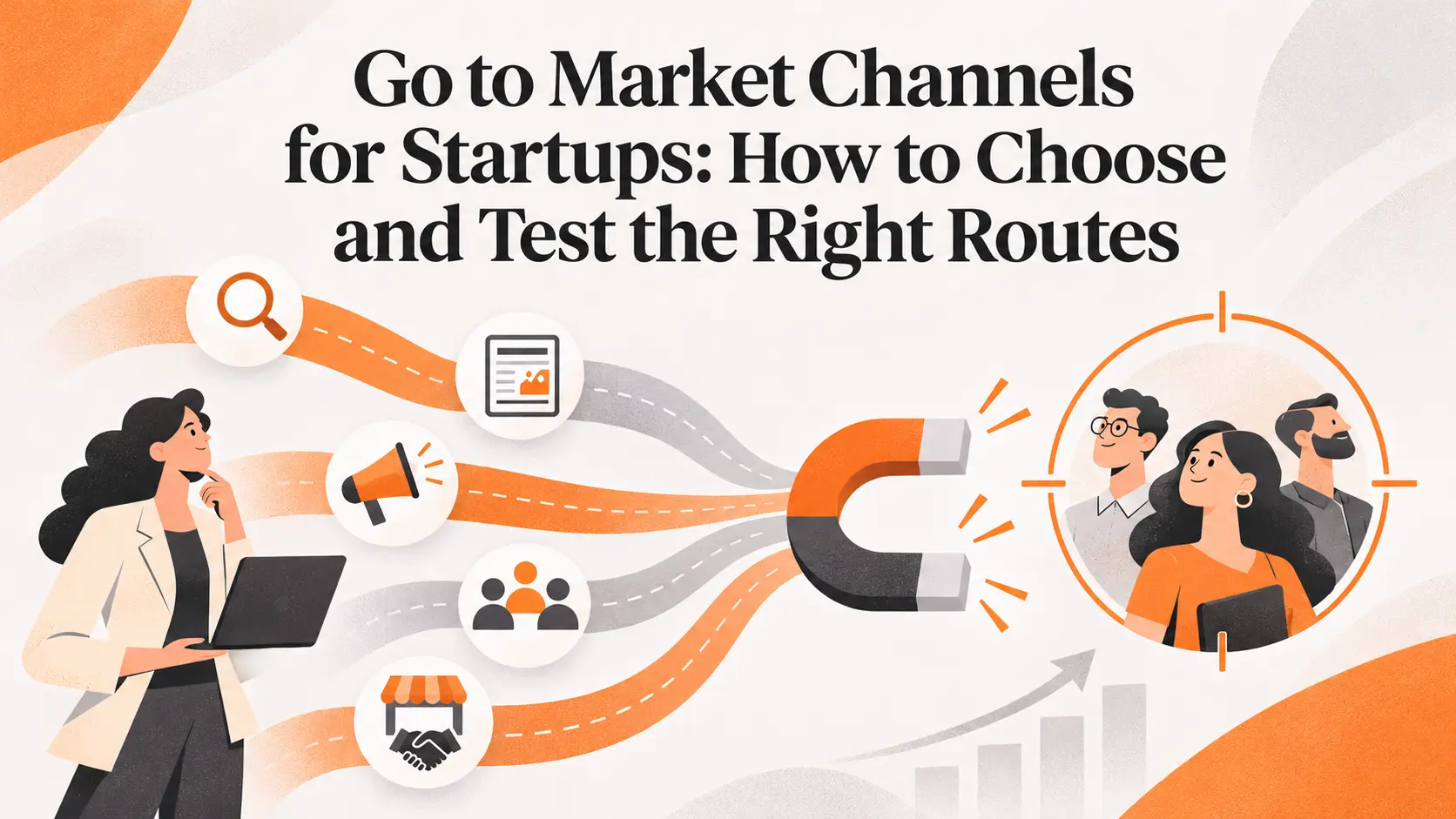
Go to market channels are the routes a startup uses to reach prospective customers and move them toward a meaningful buying or adoption decision. They can include direct outreach, search, professional communities, partners, marketplaces, paid advertising, and customer referrals. The difficult part is not finding a list of possibilities. It is choosing a route that fits how a specific customer discovers a problem, evaluates alternatives, and decides to act.
Channel selection sits inside a broader Go to Market Strategy for Startups because even an appealing offer can stall when its buyers cannot be reached at the right moment. A founder with limited money and time needs to know where suitable customers already pay attention, what kind of interaction would earn trust, and which early signals would justify investing further. The objective is not visibility everywhere. It is a believable path from first contact to customer value.
What Is a Go to Market Channel?
A channel is a repeatable way to make contact with a relevant buyer, not merely a platform account or a campaign format. Search can be a channel when buyers actively look for a solution. Industry partnerships can be a channel when trusted advisers introduce companies at the moment a problem becomes urgent. An event is only a channel candidate until it produces conversations with people who could realistically adopt the product.
The channel should also be distinguished from the commercial motion. A sales motion describes how a company qualifies, persuades, and converts buyers. A product led motion allows people to experience value before a purchasing conversation. Either motion may use search, referrals, communities, or direct contact. Channel choice answers where access comes from. The buying motion answers what must happen after contact.
Start With the Customer's Buying Moment
A founder should map the circumstances that cause buyers to seek help before choosing a channel. Who notices the problem first? What event makes it costly to ignore? Where do people ask for recommendations? Who influences the shortlist? A small business owner looking for payroll support near a filing deadline behaves differently from a developer who discovers a useful tool while reading technical documentation.
Recent customer conversations are more useful than assumptions about where an industry spends time online. Ask what the person did the last time the problem occurred. Did they search for a provider, ask a colleague, consult an adviser, attend an association meeting, or keep using a manual workaround? These answers reveal both a potential channel and the context in which an introduction would be credible.
Separate accessibility from intent. A founder may be able to reach thousands of professionals through social posts while only a small fraction currently face the relevant problem. In contrast, a modest number of introductions from a specialist adviser may reach buyers already evaluating a change. Neither route is automatically superior. The stronger route is the one that produces suitable conversations at a level of effort the startup can sustain.
The Main Customer Acquisition Routes
Founder outreach and direct sales
Personal introductions, targeted email, relevant professional networks, and carefully researched outreach can help a startup learn quickly. The founder can ask why the buyer accepted a conversation, hear objections directly, and discover who controls the decision. This route often fits narrow business audiences or products that require explanation. It becomes ineffective when the team substitutes mass messaging for relevance or counts replies from people who have no buying authority.
Search and problem focused content
Search works best when potential customers already describe the problem in words they use to look for help. Useful comparison pages, practical guides, and clear product explanations can capture that intent. However, content requires credibility, discoverability, and time. A new startup should not treat articles published this month as proof that organic demand will arrive next week. Early research can establish whether relevant queries exist, while customer conversations test whether the pages answer an important purchasing question.
Paid campaigns with clear intent
Paid search or targeted advertising can provide controlled exposure and allow a founder to compare messages with a defined audience. It is most useful when the target buyer and next action are clear enough to measure. Buying clicks before confirming the problem can conceal weak demand behind traffic. Campaign costs also require full interpretation: a cheap registration is not helpful if the user never activates or does not match the intended customer.
Specialist communities and industry events
Communities, professional groups, smaller conferences, and trade gatherings can give access to focused audiences where trust matters. They work when the startup can contribute expertise and understand the discussion, not simply distribute promotions. A founder selling a complex service may learn more from conversations at one specialist meeting than from broad online exposure. Community participation should respect the group's norms and avoid treating member attention as an entitlement.
Partners, advisers, and marketplaces
A complementary service provider, industry adviser, reseller, or marketplace may already be trusted at the point where a buyer needs help. Partnerships can shorten the path to a qualified introduction, but require aligned incentives and clarity about who owns the customer relationship. Marketplaces can place a product near active demand while also imposing competition, fees, and platform rules. A partnership is worth testing only when both sides can explain why an introduction benefits the customer.
Customer referrals and product sharing
Referrals can be useful when existing customers genuinely want colleagues to receive the same benefit. Products may also contain natural collaboration or sharing moments, such as inviting a teammate to review a report. These mechanisms cannot be assumed before customers consistently experience value. Incentives may increase invitations without increasing suitable adoption, so early tests should follow the quality and subsequent behavior of referred users.
How to Compare Channels Before Committing Budget
Start with a short list rather than ranking every marketing tactic in existence. Evaluate each route against the customer's discovery behavior, the ease of reaching qualified prospects, the time before a meaningful result can be observed, and the team's ability to execute credibly. A founder who has no industry relationships should not assume an established partner channel will appear instantly. A team with no advertising expertise should not assume more spending will solve weak targeting.
Early channel selection matrix
The table below illustrates how to form a testable hypothesis for different routes. It is a decision aid, not a universal ranking. The same channel can be attractive for one buying situation and unsuitable for another.
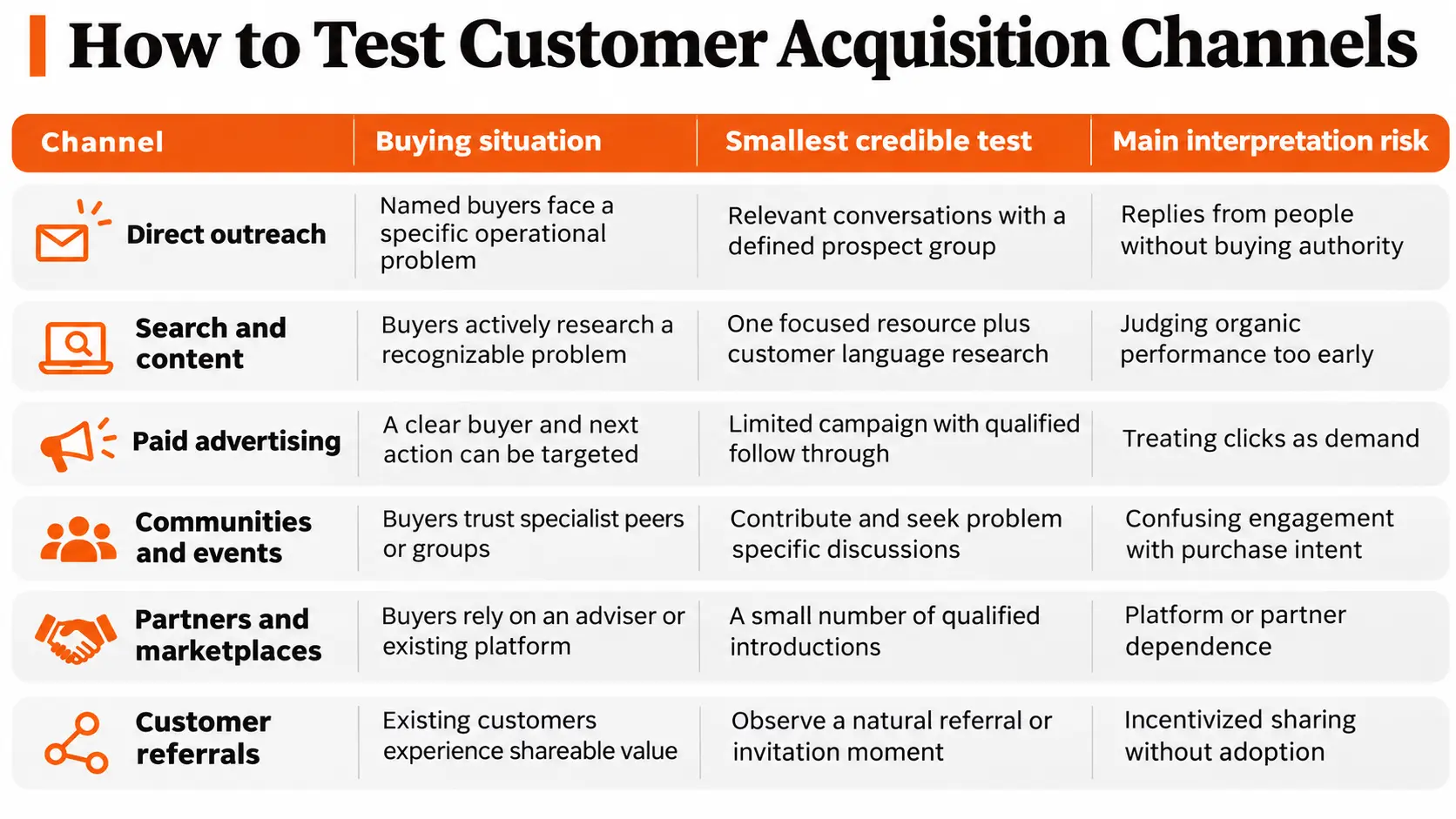
Notice that each route has a different observation window and a different failure mode. A founder cannot compare one week of search content with one week of direct outreach as if both should produce the same number of conversations. The first test for a channel should ask whether buyers can be reached and will take an appropriate next step. Only then does it make sense to examine whether that access can become economical at greater volume.
Design a Channel Test That Can Actually Teach You Something
A useful test begins with a falsifiable statement. For example: operations managers at regional wholesalers will accept a short review of their inventory discrepancy process when contacted with an explanation of a specific workflow problem. The statement names the audience, the offer, the route, and the behavior that would count as progress. A vague plan to raise awareness has no comparable decision rule.
Record the effort limit and observation window before testing. The constraint might be founder hours, an agreed advertising budget, a specific number of targeted contacts, or access to a small industry event. The window must fit the buying cycle. A self service tool may reveal relevant behavior within days, while a product that requires procurement review may need weeks or months to distinguish lack of demand from ordinary purchasing delay.
Keep the audience and core offer sufficiently stable to interpret what happened. If the team simultaneously changes the buyer segment, message, price, and channel, an improvement provides little evidence about which decision mattered. Record who responded, how closely they matched the intended buyer, what objections emerged, and whether the conversation advanced toward genuine product use or purchase.
A Practical Example: Choosing Between Outreach and a Specialist Newsletter
Consider a fictional software startup called StockSignal that helps regional wholesale operations teams investigate recurring inventory discrepancies. The founder has spoken to warehouse managers who describe the problem, but has not yet established how purchasing decisions begin. Two plausible channels are targeted outreach to operations leaders and a sponsorship in a specialist logistics newsletter. These are hypothetical test options rather than documented company results.
For outreach, the founder can contact a narrowly selected group of operations leaders with a relevant question and an invitation to review their existing process. The useful signals are whether the recipients recognize the problem, whether the right decision makers join the discussion, and whether anyone is willing to provide sample workflow information for a pilot. A meeting with an unrelated consultant may be pleasant but does not count as a qualified commercial opportunity.
For the newsletter, the startup could test a concise explanation of one operational problem with a direct invitation to the same kind of review. The founder should not judge the channel solely by opens or website visits. Qualified follow through matters more: the visitors' role, evidence of the problem, willingness to continue, and ability to adopt the product. If newsletter traffic is numerous but unsuitable, the problem may be audience mismatch rather than an unsuccessful message.
The point of the comparison is not to announce a winner after a handful of contacts. It is to learn which route connects the offer to customers who could plausibly buy, what the access requires, and whether that route can be repeated. Founder time spent preparing outreach and staff hours spent qualifying newsletter inquiries belong in the assessment even when there is little direct media spending.
Measure Qualified Progress, Not Just Activity
Channel dashboards often emphasize what is easiest to count: impressions, clicks, views, registrations, or contact volume. These numbers can help identify problems within a channel, but they should not be presented as commercial success on their own. An early startup should define what makes a contact qualified and trace a reasonable sequence from exposure to conversation, product use, and an actual commitment where applicable.
A sensible record contains the acquisition source, target customer match, initiating problem, next customer action, elapsed time, and meaningful objections. Compare results over comparable periods and buyer groups. Avoid assigning a purchase entirely to the last click when a referral, article, and sales conversation may all have influenced the decision. Small samples are better described with actual cases and uncertainties than with precise percentages that imply statistical confidence.
Cost matters, but this article is not a substitute for a financial analysis of customer acquisition cost or lifetime value. For channel selection, founders need to know whether the observed quality justifies another constrained test and whether the route consumes scarce staff capacity. A channel that produces customers through extensive personal customization may be suitable for learning without yet being suitable for expansion.
Know When to Keep Testing, Change the Route, or Stop
Different failure patterns require different responses. If the intended buyer never encounters the message, access may be the problem. If buyers respond but misunderstand the offer, communication may need revision. If qualified people request demonstrations but never adopt, the barrier may sit in the buying process or product experience. Switching channels cannot repair every weak conversion point.
Continue a channel when successive tests attract suitable buyers and reveal a plausible path toward repeated customer value. Change the experiment when the evidence points to a specific obstacle that can be addressed. Stop when the route persistently reaches the wrong audience, relies on unsustainable effort, or offers no meaningful progress despite an adequate test. A founder does not need proof of a permanent winner before making the next decision, but does need a clear explanation of what was learned.
A successful initial route should not automatically become a claim of competitive defensibility. The separate Distribution Moat topic concerns whether customer access grows harder for rivals to copy over time. This article addresses the earlier and narrower question: can the startup find a credible way to reach appropriate customers and observe genuine interest without wasting its limited resources?
The Founder's Channel Decision
The most useful channel is not necessarily the largest, cheapest, newest, or most fashionable. It is the route that matches a real buying situation, allows the team to reach suitable people, and produces evidence strong enough to guide the next commercial decision. Start with customer behavior, design one interpretable test, account for the full effort, and expand only when the results justify the commitment.
FAQ
What are go to market channels for startups?
They are the routes a startup uses to reach potential customers and initiate meaningful adoption or purchasing activity, including outreach, search, communities, partners, marketplaces, advertising, and referrals.
Which go to market channel is best for a new startup?
There is no universal best channel. The right first test depends on where suitable buyers look for solutions, the complexity of the purchase, the startup's existing credibility, and the resources available to run a fair experiment.
How many channels should an early startup test?
An early team often benefits from concentrating on one primary route and, if capacity permits, one limited comparison. The goal is enough evidence to make a decision, not an appearance of activity across many platforms.
Are paid ads better than organic channels?
Neither is inherently better. Paid advertising may generate faster exposure, while search and content can require longer to mature. The comparison should account for qualified customer behavior, total effort, purchase timing, and the startup's ability to sustain the channel.
How do you know whether a channel test succeeded?
Success means the route reached the intended customer and produced a preselected meaningful action, such as a qualified conversation, serious pilot request, or relevant product activation. The standard should reflect the buying process and be set before the test.
When should a startup add another acquisition channel?
Add a route when the first has produced repeatable evidence or when a clear access limitation justifies a separate experiment. Expanding too early can scatter attention and make it difficult to explain which activities are actually generating customers.

Mohsen Avid
Founder & Editor, PinerookMohsen Avid is the founder of Pinerook, covering entrepreneurship, startup strategy, digital business, and the decisions behind building new ventures.
 Seen first.