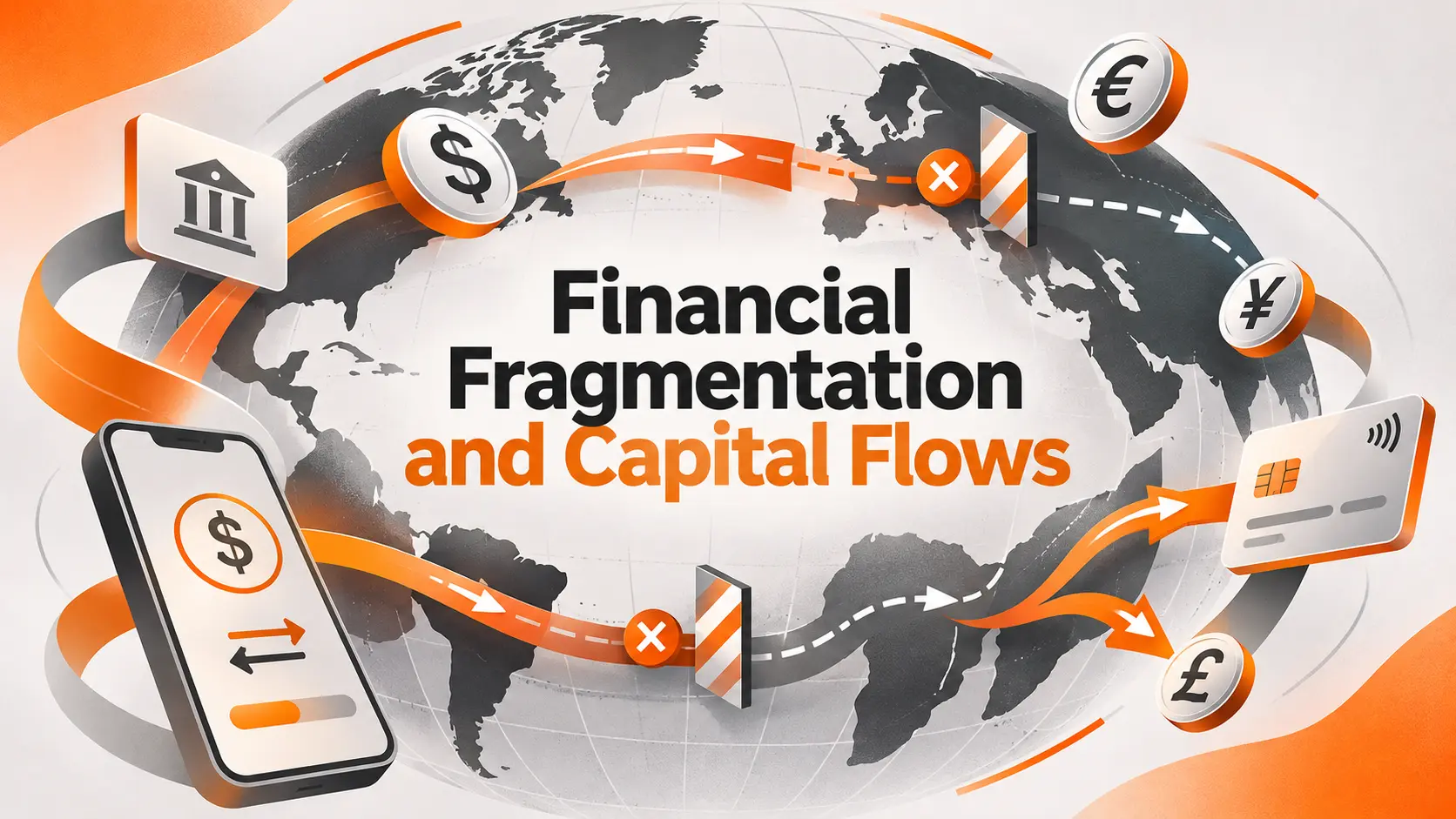
Financial fragmentation occurs when political tensions, financial restrictions, or shifts in perceived risk weaken the connections through which money moves across borders. Investors may redirect capital toward familiar jurisdictions, banks may reduce lending to foreign counterparties, and companies may face fewer choices when raising funds. These changes are not always visible in headline capital flow totals. An economy can attract substantial investment while its financial relationships become more concentrated and less resilient.
Understanding these changes is essential to the wider debate about Geoeconomic Fragmentation, because restrictions on trade and production can interact with equally important changes in the financing of businesses, governments, and investment projects. A country may still be able to sell goods abroad but find that lending, insurance, payments, or investment from particular partners has become more expensive or harder to obtain. The financial channel therefore deserves analysis on its own terms.
What financial fragmentation means in practice
Global financial integration allows savings in one economy to support investment in another. Companies obtain long term funding from foreign owners, governments borrow from international investors, and banks intermediate credit across currencies and borders. Financial fragmentation does not require these connections to disappear. It can begin when the relative importance of counterparties changes, when access becomes conditional on political alignment, or when the same transaction requires additional legal and operational safeguards.
The central distinction is between a broad decline in international finance and a politically patterned reallocation of finance. Higher interest rates can depress foreign investment across many markets without necessarily indicating fragmentation. By contrast, a sustained decline in investment between politically distant countries relative to otherwise comparable relationships may indicate that geopolitical divisions have begun to shape capital allocation. Researchers must control for differences in economic growth, expected returns, exchange rates, industry composition, and financial conditions before drawing that conclusion.
Why money moves differently when political risks rise
Capital responds to the possibility that an investment will become difficult to own, finance, sell, or repatriate. Sanctions, screening of foreign acquisitions, export controls, restrictions on technology transfers, payment disruptions, and the threat of asset freezes can alter expected returns. Even where a formal prohibition does not exist, asset managers and lenders may reduce exposure if they anticipate future restrictions or face higher compliance costs. The result is a shift in who finances whom, not simply a reduction in the amount of financing available worldwide.
Trust matters because international financial contracts often extend across years. A lender advances money today in expectation of future payments, while a foreign equity investor depends on enforceable ownership rights and the ability to exit later. Geopolitical uncertainty can weaken confidence in those future arrangements. A 2026 BIS working paper studying decades of international bank credit finds that adverse geopolitical events have been associated with a relatively larger decline in credit between geopolitical blocs than within them. Its historical evidence also suggests that banking relationships may be slower to recover than trade links.
Foreign direct investment and the geography of ownership
Foreign direct investment, or FDI, involves a lasting ownership interest or substantial influence over a foreign enterprise. New factories and acquisitions may be financed through FDI, but the recorded figures also include transactions routed through intermediate holding companies. This matters because a change in the immediate investor country is not necessarily a change in the ultimate owner. A company may invest through a third jurisdiction while the final source of capital remains unchanged.
The IMF reported in 2023 that strategic investment increasingly showed patterns related to geopolitical alignment. Yet a more focused IMF working paper published in 2024 found that broad FDI fragmentation was not widespread in the sample it examined. The strongest signs appeared in selected strategic industries and particular investment relationships. These findings should be read together rather than treated as contradictory: a meaningful shift in sensitive sectors does not establish that every category of international direct investment has broken into separate blocs.
For analysts, it is useful to separate announced projects, completed investment transactions, immediate source countries, and ultimate investor ownership. An announcement may never become a functioning project, while a recorded investment can reflect internal corporate restructuring rather than a new productive facility. Changes in investment patterns are more convincing when supported by both financial records and evidence of where productive capacity actually expands.
Portfolio capital can react faster than direct investment
Portfolio investment covers holdings such as foreign equities and debt securities where investors generally do not exercise the type of influence associated with direct investment. These positions can often be adjusted faster than long term operating investments. A major geopolitical shock may therefore produce a sudden repricing of sovereign bonds, a rotation in equity holdings, or withdrawals from funds before any multinational company changes its physical footprint.
Direction alone does not tell the whole story. Some investors may seek safety in large, liquid markets, while others may buy assets that appear cheap after a shock. Countries facing similar political developments may experience different capital responses depending on currency credibility, market liquidity, existing foreign ownership, and the perceived capacity of domestic institutions. Research published in 2026 on cross border portfolio allocation finds that investment funds tend to assign smaller portfolio shares to countries with greater geopolitical distance from their home countries. This is evidence of differentiated allocation, not proof that all global investors follow the same rule.
Cross border banking and the cost of financing
International banks are another important transmission channel. They support corporate borrowing, interbank funding, trade finance, and foreign currency liquidity. When lenders reduce exposure to particular markets, borrowers may need to rely on a smaller group of banks, accept shorter maturities, post additional collateral, or pay a higher spread. Domestic banks may not immediately replace all lost foreign credit, particularly when loans require specialist knowledge or access to a reserve currency.
A March 2025 BIS study examines the interaction of geopolitical tensions and monetary policy in international bank lending. More recent BIS work published in March 2026 highlights how geopolitical differences can affect credit relationships over long periods. These findings point to a crucial difference between liquidity and access. A market can appear liquid in aggregate while particular borrowers face a much narrower range of viable international counterparties.
Not every higher borrowing cost should be attributed to geopolitics. A shift in policy rates, credit quality, bank regulation, or currency hedging expenses can produce similar outcomes. Strong analysis asks whether the borrowing gap is larger for politically distant pairs than for comparable relationships, after accounting for these other drivers.
Four financial channels to examine together
The effects of fragmentation vary with the financial instrument and the institutions involved. The following table offers a compact way to connect each channel to observable evidence. It should be used as a diagnostic framework rather than a scoring system that automatically labels every capital movement as geopolitical.
Financial fragmentation channels and the evidence to examine
This comparison distinguishes different capital flows, typical responses to geopolitical pressure, and data that can help analysts test an interpretation.
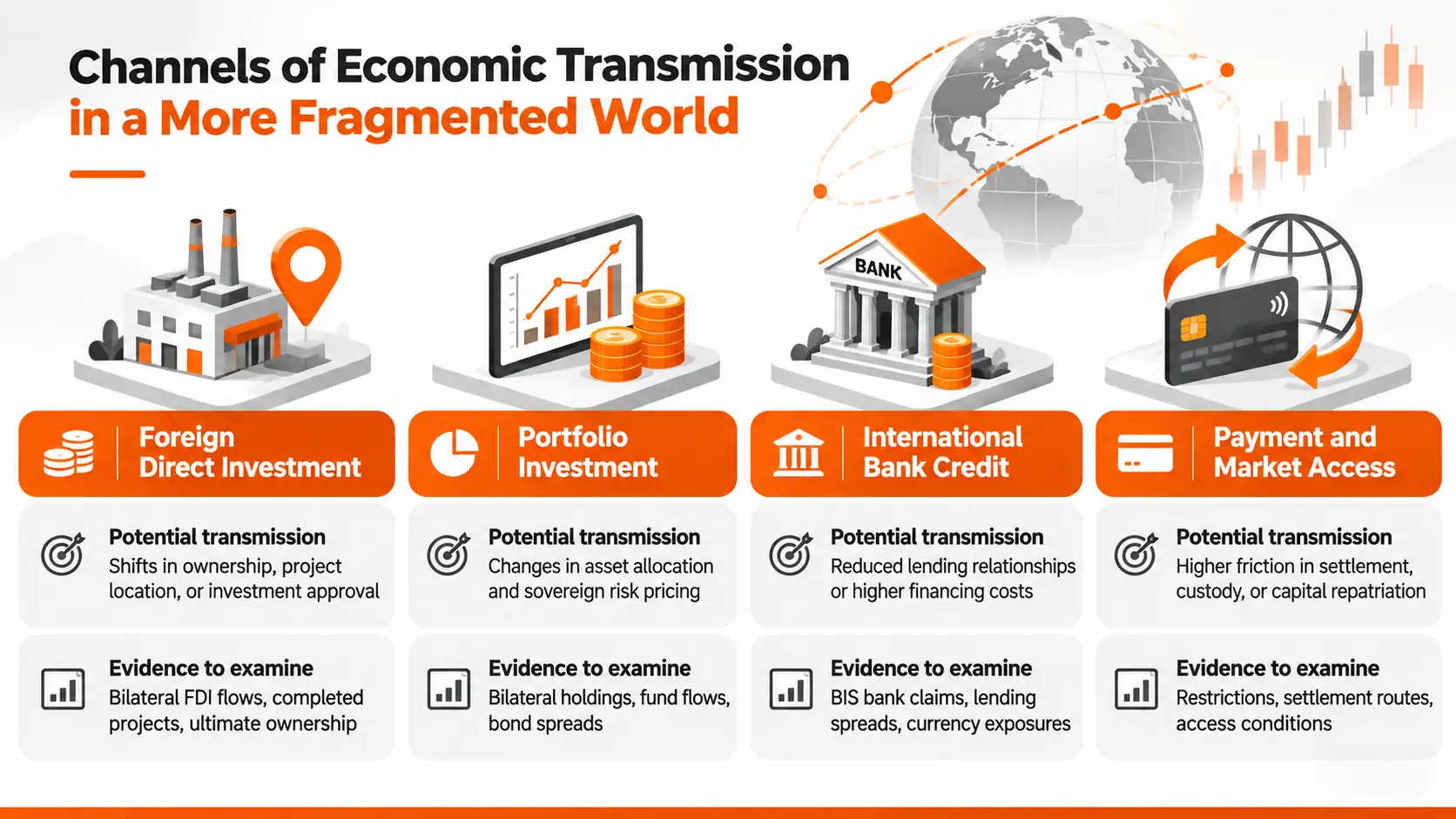
A useful interpretation compares the same relationships over time, checks whether gross flows and outstanding positions tell different stories, and establishes whether a change is specific to a geopolitical divide. The table also explains why a single aggregate measure can conceal a substantial reorganization of financial links.
How capital flow figures can mislead
Capital flow data are often cited as though a positive net inflow proves that finance remains open. Net inflows, however, are the difference between potentially large incoming and outgoing transactions. If both inflows and outflows shrink, a small net figure can conceal considerable withdrawal from international financial integration. Analysts should inspect gross flows, stocks of foreign assets and liabilities, and the distribution of counterparties whenever data permit.
An additional issue is the role of intermediary financial centers. Ownership structures, fund domiciles, and banking subsidiaries can make a transaction appear to originate from a country that is not the ultimate economic source of funds. Geopolitical fragmentation may encourage new intermediaries, but the presence of an intermediary does not necessarily mean that the original exposure has disappeared. The location of legal ownership, the identity of the ultimate investor, and the location of the underlying economic activity can all differ.
Currency valuation also matters. A decline in the dollar value of foreign securities may reflect weaker asset prices or exchange rate movements rather than net capital withdrawal. Changes in the composition of investment can similarly distort aggregate comparisons. A more reliable approach examines bilateral patterns alongside sector data and clearly identifies what the chosen measure includes.
An illustrative example of two investment destinations
Consider two fictional economies that both receive foreign financing for new manufacturing capacity. Economy A attracts a large headline amount through holding companies established in a regional financial center. Economy B receives a smaller amount, but investors fund completed facilities directly and maintain diversified banking lines with several countries. A simple ranking by total FDI inflows would favor Economy A. A resilience assessment may draw a different conclusion after identifying ultimate owners, project completion, investor concentration, and access to credit.
Now imagine a political dispute causes one banking group to stop renewing loans to borrowers in Economy A. The economy may continue to report robust investment inflows, yet affected companies face more expensive short term funding. Economy B could experience a milder adjustment if its financing relationships are diverse. This is a hypothetical illustration, not a forecast. Its purpose is to show why capital volume and financing resilience are different variables.
Consequences for governments, investors, and businesses
For governments, financial fragmentation may complicate debt management and investment policy. A narrower investor base can make financing more sensitive to the behavior of a few institutions, while heightened uncertainty can increase sovereign risk premiums. Authorities may seek a broader set of funding sources, but measures that reduce dependence on one bloc can also introduce new regulatory, currency, or governance risks. The effect depends on local financial depth and institutional credibility.
For asset managers, the challenge concerns diversification and liquidity. Securities from several countries do not necessarily provide independent exposures if those markets share the same political shock or depend on the same settlement channels. Investors should distinguish diversification across asset labels from diversification across risk drivers. The IMF has explored how restrictions on trading with geopolitically distant economies could weaken international diversification benefits under hypothetical scenarios.
For companies, the most immediate problem may be access to a dependable financing route. A project can remain commercially attractive while foreign lenders shorten maturities or demand additional guarantees. Corporate leaders should understand where their capital originates, which institutions are essential to refinancing, and what legal or currency constraints might delay settlement or repatriation. These are operational questions arising from the financial structure of a business, not merely from its geographic sales exposure.
What the evidence supports and what remains uncertain
Research does not support a simple claim that global finance has divided cleanly into two separate systems. The strongest evidence is more selective: geopolitical alignment influences certain investment relationships and banking exposures, while many cross border links remain intact. Outcomes differ by sector, financial instrument, country pair, and period. Furthermore, a decline in one bilateral link can coincide with growth through other markets, which makes aggregate global totals an incomplete guide.
The IMF study of changing global linkages released in 2024 found significant relative reductions in trade and FDI between geopolitically distant blocs following the invasion of Ukraine, while emphasizing that the overall extent of fragmentation remained limited. A separate IMF study of FDI breadth found that the phenomenon was concentrated rather than universal. The balanced conclusion is that geopolitical effects are measurable and potentially consequential, but their size and persistence must be assessed with care.
How to assess financial fragmentation responsibly
Begin with a precise question: which source countries, recipient countries, financial instruments, and time period are relevant? Next, compare gross flows and outstanding holdings, and distinguish immediate financial routes from ultimate ownership where possible. Identify alternative explanations including interest rates, growth prospects, exchange rate changes, valuations, and changes in the sector mix. Finally, look for evidence that a geopolitical event or policy shift produced a persistent divergence between comparable country pairs.
Useful starting points include IMF balance of payments and international investment position datasets, IMF research on FDI, and BIS international banking statistics. Securities holdings can be explored through relevant portfolio investment statistics, subject to coverage and methodology limits. No single measure will settle the issue. The strongest analysis combines complementary datasets and states what cannot be observed.
FAQ
What is financial fragmentation?
It is a weakening or reorganization of financial connections across countries, often reflected in changes to investment relationships, lending access, asset allocation, or settlement routes. Political alignment can become more influential even if overall global capital flows remain large.
How does financial fragmentation differ from trade fragmentation?
Trade fragmentation concerns the movement and sourcing of goods and services. Financial fragmentation concerns the ownership, lending, investment, and payment relationships that fund economic activity. The two can reinforce each other but need not move at the same pace.
Does geopolitical tension always reduce foreign direct investment?
No. It may redirect investment toward selected destinations or change the route through which ownership is recorded. The available research finds important changes in some relationships and industries rather than universal declines.
Why do banks matter in geoeconomic fragmentation?
Banks provide credit and international financial services that depend on long term confidence, regulatory permissions, and reliable counterparties. A loss of access to specific banks may raise borrowing costs even if other financing remains available.
Can rising capital inflows coexist with financial fragmentation?
Yes. A country can attract more capital overall while becoming increasingly dependent on a small set of politically aligned investors. Net inflows can also mask shrinking gross inflows and outflows.
What should analysts monitor first?
Bilateral foreign investment, the ultimate origin of capital, international bank exposures, portfolio holdings, financing spreads, and legal restrictions are useful complementary indicators. They should be interpreted alongside economic and valuation controls.

Masoumeh Jahangard
Markets & Economy Writer at PinerookMasoumeh Jahangard covers markets, economic trends, and business conditions for Pinerook, focusing on how they affect startups and growing companies.
 Seen first.