An exchange rate can change without a startup making a single new decision, yet the value of its sales, salaries and supplier invoices can move. A founder who earns euros and pays engineers in dollars may find that the same customer contract produces less cash than the forecast assumed.
Exchange rate risk for startups is therefore an operating issue, not a currency trading problem. Within the wider picture of macroeconomics for startups, currency movements matter when they change margins, runway or the economics of entering a market. The goal is not to predict the next move. It is to understand the exposure.
What Exchange Rate Risk Means for a Startup
Foreign exchange risk, or FX risk, is the possibility that currency movements change the value of revenue, costs, assets or payments when measured in the company’s reporting currency. It exists whenever money is earned, held or owed in a currency different from the one used to plan the business. A startup can have this risk simply by paying an overseas contractor, even if all its customers are domestic.
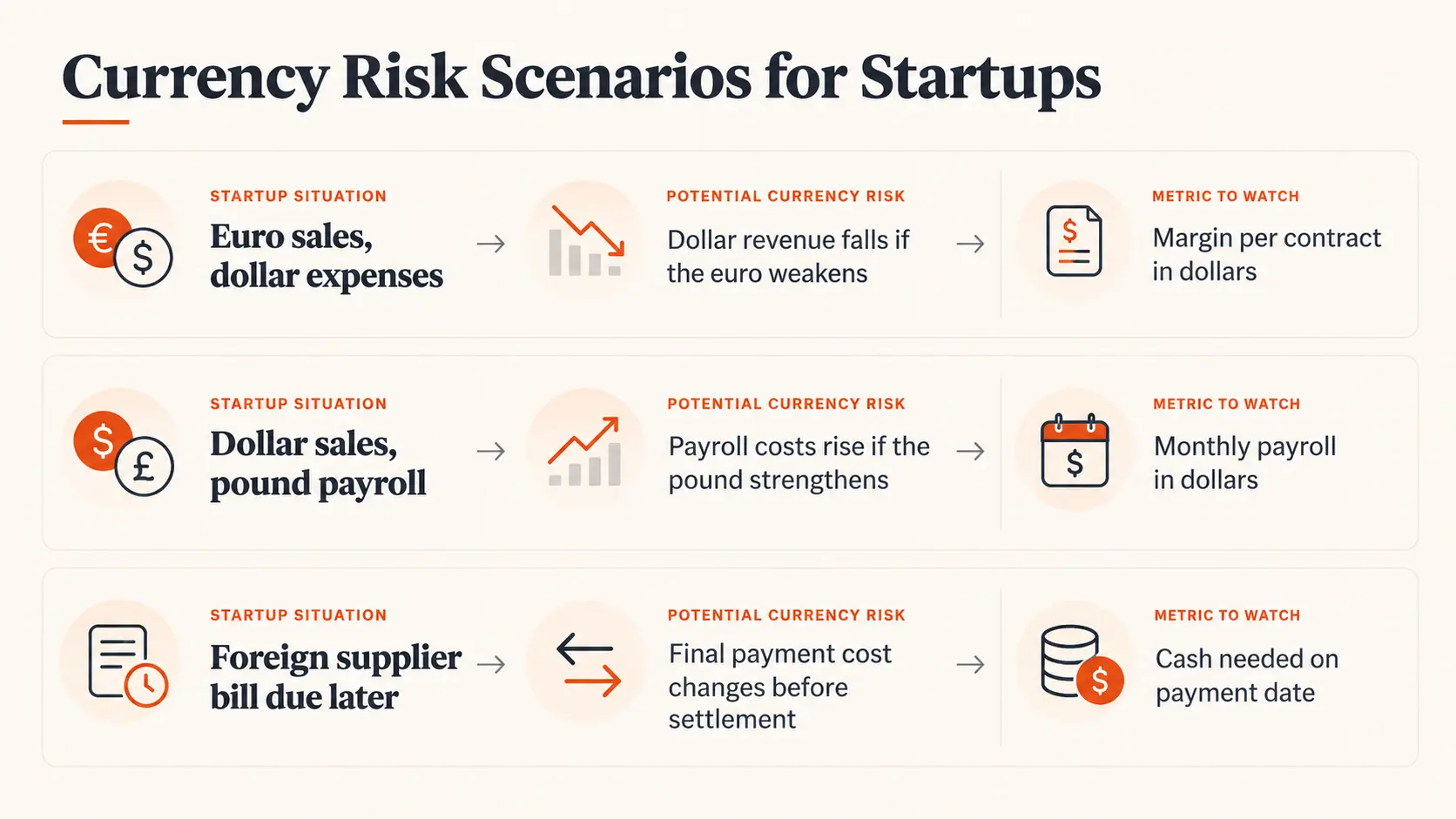
Not every exchange rate movement is harmful. A stronger foreign currency can increase the reported value of overseas sales while making foreign payroll more expensive. The important question is whether the company has a meaningful mismatch between the currencies it receives and the currencies it needs to spend.
Where Currency Fluctuations Hit Startup Economics
Customer Revenue and Pricing
A startup selling subscriptions in euros but reporting results in dollars may collect the same number of subscriptions and still record less dollar revenue when the euro weakens. Local currency pricing can help conversion in a new market, but it also means the founder must monitor margins after conversion. Changing prices too frequently may damage trust, so the business needs room for normal currency movement in its pricing assumptions.
Payroll, Suppliers and Infrastructure
International teams, manufacturing partners and software providers can create currency exposure on the cost side. A company earning mostly dollars while paying salaries in pounds will spend more dollars if the pound strengthens. Fixed contracts can therefore become variable costs in the company’s home currency, particularly when payment dates are weeks or months away.
Cash Flow, Funding and Runway
Currency movements also change how far cash reserves can stretch. A startup that raises dollars but spends most of its budget in another currency may discover that its local payroll covers fewer months than expected. This matters most when cash is tight or when a large international payment must be made before the next customer receipt arrives.
A Simple Example: The Same Sale, Less Cash
Consider a US startup with a €40,000 customer contract and $32,000 in direct costs payable in dollars. At an illustrative rate of $1.10 per euro, the contract is worth $44,000, leaving $12,000 after those costs. If the euro falls to $1.00 before payment, the same invoice is worth $40,000, leaving only $8,000.
The customer did not buy less and the team did not spend more, yet the contribution from that sale fell by one third. These rates are hypothetical and exclude conversion fees. The example shows why founders should test the value of contracts in the currency used to pay their bills, not only in the currency shown on the invoice.
Map Exposure Before Choosing a Solution
Start with a list of currencies attached to expected receipts, committed payments and cash balances. The relevant exposure is the amount and timing of the mismatch, not simply the number of countries in which the startup operates.
How Founders Can Reduce Exchange Rate Risk
Match Currency Inflows and Outflows
When practical, use money received in a currency to pay expenses in that same currency. This is often called a natural hedge. A startup earning euros and paying European contractors in euros may need fewer conversions and may reduce its net euro exposure. Accounts that hold several currencies can make this easier, but holding foreign currency does not eliminate its changing value against the reporting currency.
Set Pricing and Payment Terms Deliberately
Decide who carries the currency risk before signing a contract. Billing in dollars may protect a US startup’s expected receipts, but it can make the price less attractive or less predictable for overseas customers.
For larger deals, founders can consider shorter payment periods, deposits or clearly defined price review terms. The best arrangement balances commercial competitiveness with cash certainty.
Stress Test the Financial Plan
Instead of forecasting a single exchange rate, calculate what happens if the main currency pair moves by 5% or 10% in either direction. Check the effect on gross margin, planned hiring and runway. A scenario that changes none of those decisions may need only occasional monitoring. One that makes a key contract unprofitable deserves attention before the company commits more cash.
Use Financial Hedges Selectively
For a large and predictable future payment, a forward contract can set an exchange rate in advance and improve budget certainty. However, it can create an obligation even if the underlying customer payment is delayed, and terms, fees and eligibility vary. Small startups should not treat hedging as a way to profit from currency predictions. It is a tool to consider when a real exposure is material enough to justify the complexity.
When Should a Startup Take Action?
A founder does not need to follow every currency headline. Review the size of expected receipts and payments by currency, the dates when they settle, and the effect of an unfavorable move on cash. Set a practical trigger, such as a currency change that would erase a meaningful share of contract margin or reduce the runway needed for an upcoming milestone.
For a small software business with naturally matched income and expenses, a monthly or quarterly review may be enough. A hardware startup with a major foreign supplier invoice due next month may need to review exposure before signing the purchase order. The right frequency follows the financial commitment, not the news cycle.
Exchange rate risk becomes important when a currency move changes what a startup can afford to build, hire or deliver. Map the mismatch, test the effect on margins and cash, and choose simple controls before complex financial products. Founders do not need to forecast currencies. They need to make sure a viable business remains viable when exchange rates move.
FAQ
Can a startup face currency risk without international customers?
Yes. Paying overseas employees, contractors, software providers or suppliers can create currency exposure even when every customer pays in the startup’s home currency.
Does charging customers in US dollars eliminate FX risk?
Not necessarily. Costs or cash held in other currencies can still change in dollar terms. Dollar pricing can also make the product more expensive for international buyers when their local currency weakens.
Can an account that holds multiple currencies remove exchange rate risk?
No. It may reduce unnecessary conversions and help match receipts with payments, but the value of any foreign currency balance can still move relative to the company’s reporting currency.
When should a startup consider currency hedging?
When a future payment or receipt is large, reasonably predictable and capable of materially affecting cash flow or margins. Founders should understand the contractual obligations and costs before using a hedge.

Masoumeh Jahangard
Markets & Economy Writer at PinerookMasoumeh Jahangard covers markets, economic trends, and business conditions for Pinerook, focusing on how they affect startups and growing companies.
 Seen first.