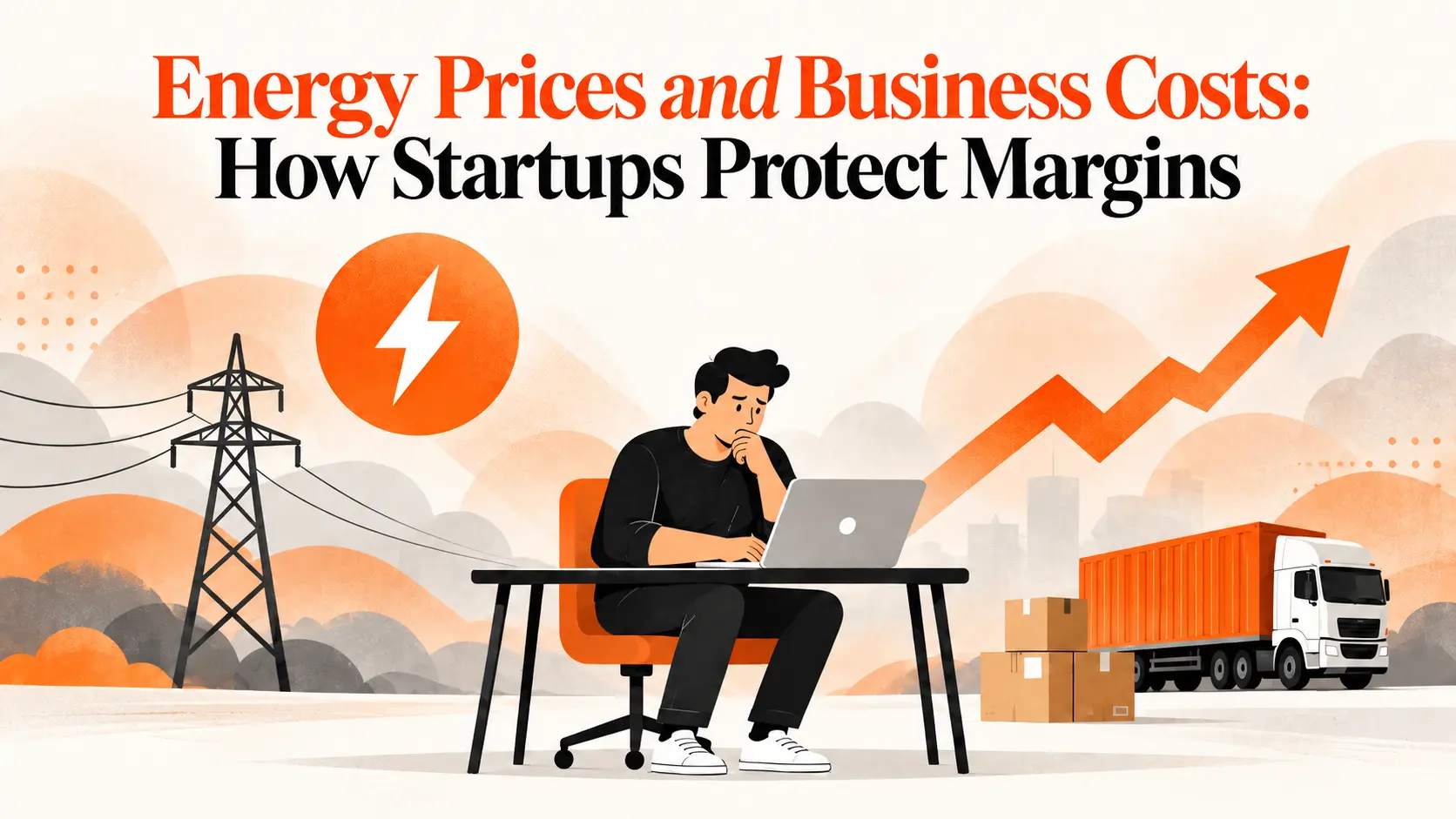
Energy prices can change a startup’s finances even when the company uses little electricity itself. A delivery partner raises its rates, a manufacturer revises a quote, or customers postpone purchases because household bills are climbing. The effect reaches the founder through higher costs, weaker demand or both.
Understanding macroeconomics for startups helps connect these signals to operating decisions. The useful question is not whether oil or electricity prices will rise next month. It is which costs, contracts and customer behaviors would change if they did.
How Energy Prices Reach a Startup’s Cost Base
The first channel is direct spending on electricity, gas or vehicle fuel. This matters immediately for businesses operating kitchens, workshops, refrigerated storage, fleets or energy intensive equipment. A small software company may have much lower direct exposure.
The second channel is indirect. Carriers may add fuel surcharges, suppliers may raise prices to cover production costs, and landlords may pass through some utility expenses. Cloud and hosting providers also consume energy, but a startup’s bill changes only when its usage, pricing agreement or provider charges change. Higher wholesale electricity prices do not automatically increase every cloud invoice.
There is also a demand effect. If customers face more expensive transport or household utilities, discretionary purchases can weaken. For a startup, the combination of higher input costs and slower sales is more dangerous than either pressure alone.
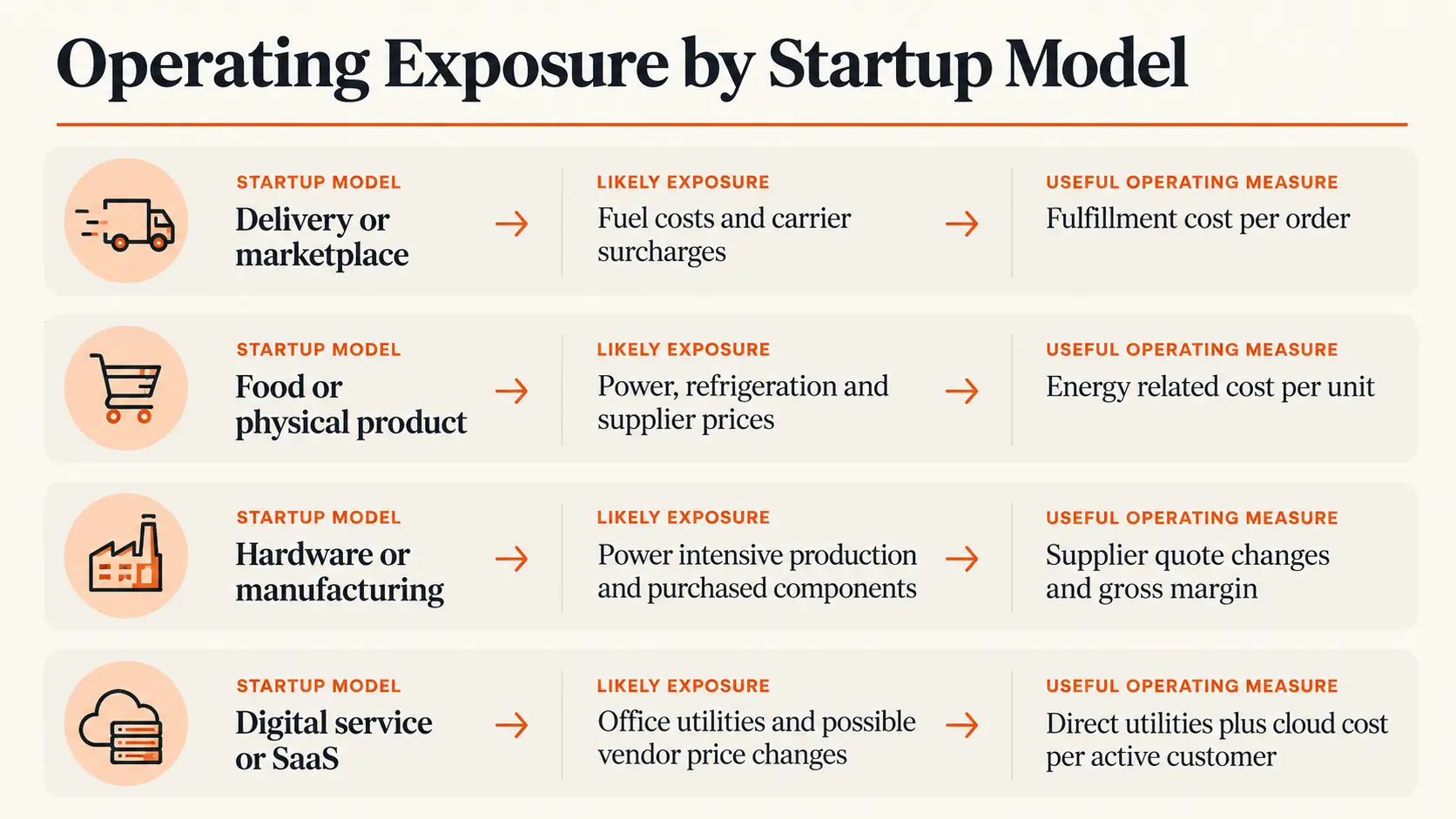
Which Startup Models Are Most Exposed?
Exposure depends less on the company’s age than on how it delivers value. The table identifies the cost driver a founder should monitor before making a broad budget cut.
What an Energy Price Shock Does to Runway
Consider an illustrative startup with $180,000 in cash and a monthly net burn of $15,000. Its runway is 12 months if revenue and other costs remain unchanged. It spends $6,000 a month on energy sensitive expenses included in that burn.
If those expenses rise by 30%, the additional monthly cost is $1,800. Net burn increases to $16,800, reducing estimated runway to about 10.7 months. A price shock in one cost category has removed roughly 1.3 months of planning time, without any change in headcount or sales.
The same logic applies to margins. If a company cannot pass higher input costs to buyers, profit per order falls. If it increases prices too aggressively, conversion or retention may fall instead. Founders need to test both sides of the equation rather than assume price increases solve the problem.
A Practical Response for Founders
Measure exposure in the units your business actually sells
Start with the past three months of invoices. Separate direct utilities and fuel from supplier charges, transport fees and fixed contracts. Then translate the most sensitive items into cost per order, cost per product or cost per customer. This reveals whether the problem scales with sales or sits inside fixed overhead.
Run scenarios instead of forecasting commodity prices
Model what happens if exposed costs rise by 10%, 20% or 30%. Recalculate contribution margin, monthly burn and runway for each case. Ask suppliers about renewal dates, notice periods and surcharges. A stress test is useful even when the founder has no reliable view on future energy markets.
Reduce waste before making expensive commitments
Schedule power intensive work more efficiently where tariffs make that worthwhile, maintain equipment and check for avoidable consumption. Compare the upfront cost of upgrades with realistic savings and the remaining life of the equipment. A large efficiency purchase that drains cash today is not automatically the right decision for a startup with a short runway.
Adjust pricing with evidence
For businesses with variable fulfillment costs, a minimum order size, delivery fee or carefully communicated price revision may preserve margins better than an across the board increase. Check existing customer contracts first. For essential products, customers may tolerate changes; for discretionary purchases, demand can be more sensitive. Test before rolling out permanent changes.
Watch the Secondary Effects, Not Just the Utility Bill
Energy price increases can arrive in stages. A logistics provider may change fuel charges this week, while a component supplier adjusts quotes at the next renewal. Customer demand may shift later. Review supplier notices, fulfillment cost per order, sales conversion and cash collections together. When only one metric moves, investigate the cause before attributing everything to energy.
Research from the International Energy Agency illustrates why smaller firms need this visibility: in 2025, small and medium enterprises in the European Union spent an estimated 4.4% of revenue on gas and electricity, versus 2.6% for large firms. Those figures describe businesses broadly, not startups specifically, but they underline the unequal capacity to absorb price shocks.
A 30 Day Action Plan
In the first week, identify every material energy sensitive expense and its contract terms. In the second, calculate exposure per sale and build three cost scenarios. In the third, speak with affected vendors and identify changes that can be made without significant capital spending. In the fourth, update pricing assumptions and the cash forecast, then assign one owner to review the indicators monthly.
FAQ
How do energy prices affect startups that operate entirely online?
Usually through indirect channels such as vendors, logistics, office costs and changes in customer spending. Hosting costs should be evaluated through actual usage and contract terms, not assumed to move in lockstep with electricity markets.
Should a startup raise prices whenever energy costs increase?
Not automatically. The decision depends on unit economics, customer sensitivity, competitors and contract terms. A targeted fee or operating improvement may protect margins with less demand risk.
How can founders estimate the impact on runway?
Add the expected monthly increase in energy related expenses to current net burn, then divide available cash by the revised burn. Update the calculation if revenue or other costs are also likely to change.
Are fixed energy contracts always safer for startups?
They can improve cost predictability but may include premiums, minimum commitments or exit restrictions. Compare the expected savings and flexibility against how quickly the business might change location, volume or operating model.

Masoumeh Jahangard
Markets & Economy Writer at PinerookMasoumeh Jahangard covers markets, economic trends, and business conditions for Pinerook, focusing on how they affect startups and growing companies.
 Seen first.