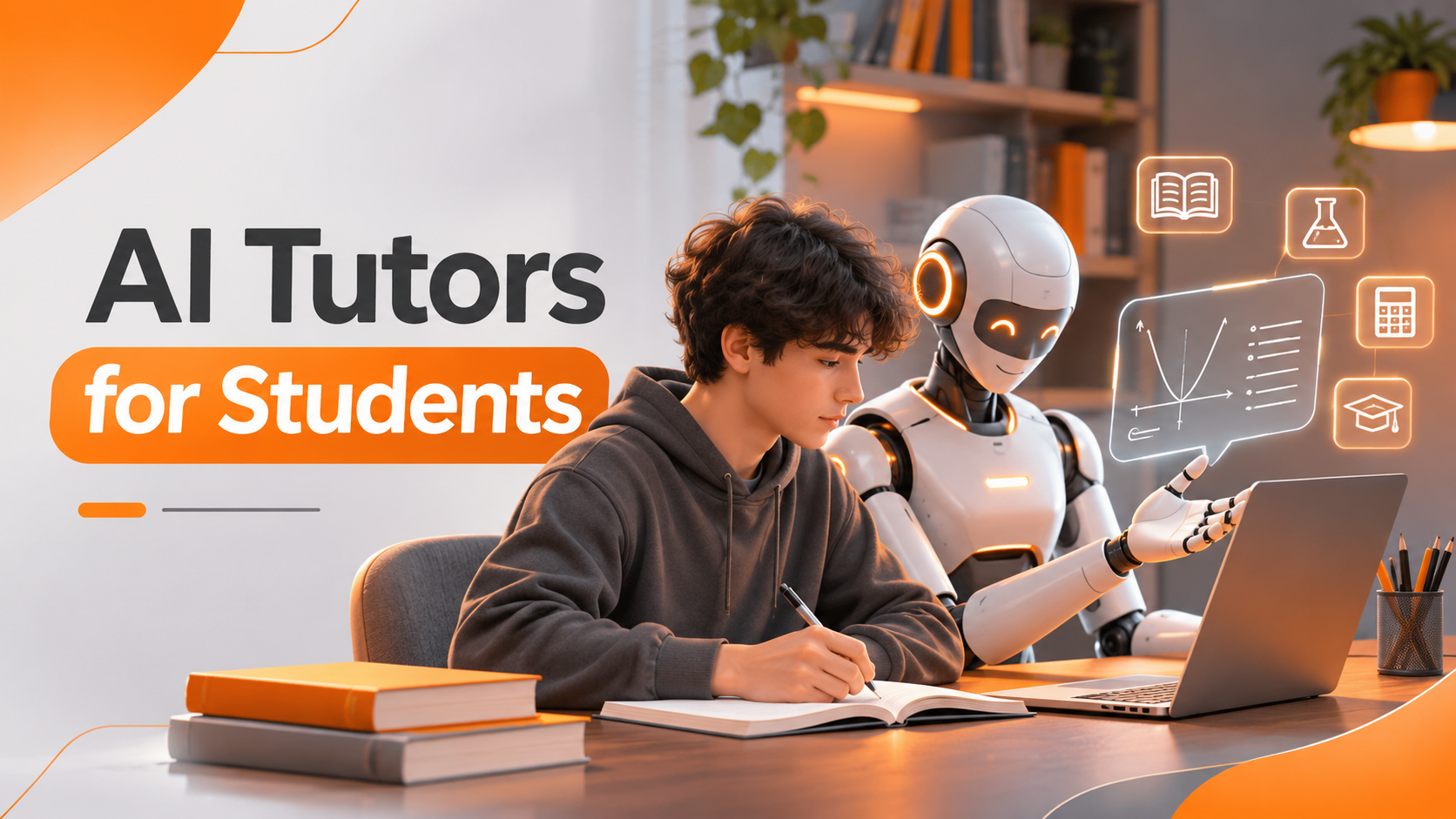
The best AI tutors for students do more than solve homework questions. They explain difficult concepts, guide students through problems, and provide practice that develops independent understanding. ChatGPT Study Mode, Gemini Guided Learning, Khanmigo, YouLearn, and other tutoring platforms approach these tasks differently, making the right choice dependent on the subject, study materials, learning style, and budget.
Within AI in Education, the distinction between tutoring and answer generation is particularly important. A tool that completes an assignment in seconds is not necessarily the one that helps a student understand it. Comparing how these platforms teach is more useful than counting their AI features.
Best AI Tutors for Students
A useful comparison begins with the learning task. Students who need explanations across several subjects have different requirements from those preparing for mathematics exams or studying from university lecture recordings.
The following seven tools cover these different needs.
ChatGPT Study Mode: Best for General Academic Support
Best for: Students who need guided explanations, homework support, and exam preparation across multiple subjects.
ChatGPT Study Mode turns a regular AI conversation into a more structured learning experience.
Instead of delivering a complete answer immediately, it can ask questions, explain difficult concepts in stages, and check whether a student understands the reasoning.
A student working through a physics problem, for example, can request help identifying the correct formula before attempting the calculation.
The same approach works for history, literature, mathematics, and other academic subjects.
Students can also use supported file and image uploads to discuss textbook pages, exercises, and lecture notes.
Main advantages: Broad subject coverage, flexible explanations, and access through ChatGPT's free plan.
Limitations: The tutoring experience depends on the selected study mode and the quality of the conversation. Responses still require verification, and free accounts have usage limits.
Pricing: Study Mode is available on free and paid ChatGPT plans, subject to the limits of each plan.
Verdict: A strong starting option for students who need a flexible AI tutor without committing to a paid educational platform.
Gemini Guided Learning: Best for Visual Explanations
Best for: Students who understand concepts more easily through diagrams, examples, videos, and interactive questions.
Google Gemini Guided Learning takes a structured approach to explaining academic subjects.
Rather than treating every student question as a request for an immediate answer, it uses guided explanations and questions to support understanding.
Visual learning is an important part of the experience.
A student studying human anatomy can receive explanations supported by diagrams and educational resources. A student exploring a physics concept can work through the reasoning with additional visual context.
Gemini also supports study materials, quizzes, and learning activities within Google's educational ecosystem.
Main advantages: Visual explanations, guided problem solving, broad subject coverage, and integration with Google's learning tools.
Limitations: Access to particular features depends on account eligibility, educational settings, and product availability. Students using school accounts are subject to institutional controls.
Pricing: Guided Learning is available through Gemini for eligible users, including access through the free experience. Paid plans provide additional capabilities and usage allowances.
Verdict: One of the most suitable choices for students who benefit from visual learning rather than text explanations alone.
Khanmigo: Best for Structured School Learning
Best for: School students who need guided practice within an established educational curriculum.
Khanmigo is Khan Academy's AI tutoring assistant.
Its main advantage is its connection to Khan Academy's educational content and structured learning activities.
Instead of simply solving a mathematics question, Khanmigo is designed to guide the student toward the next step.
This approach fits subjects that require progressive understanding, particularly mathematics, science, and foundational academic skills.
Khanmigo also offers parent and school arrangements that distinguish it from general purpose AI chatbots.
Main advantages: Curriculum connected tutoring, guided explanations, structured academic support, and parental supervision options.
Limitations: Individual subscriptions are restricted to eligible adults in the United States with a United States billing address. Students under 18 need access through a parent or participating school.
Pricing: The published individual subscription is $4 per month, with other subscription arrangements available.
Verdict: A strong choice for eligible families seeking an educational tutor connected to established school learning materials.
AI Tutor Features and Pricing Comparison
Choosing between these platforms becomes easier when their educational functions, intended users, and access conditions are compared directly.
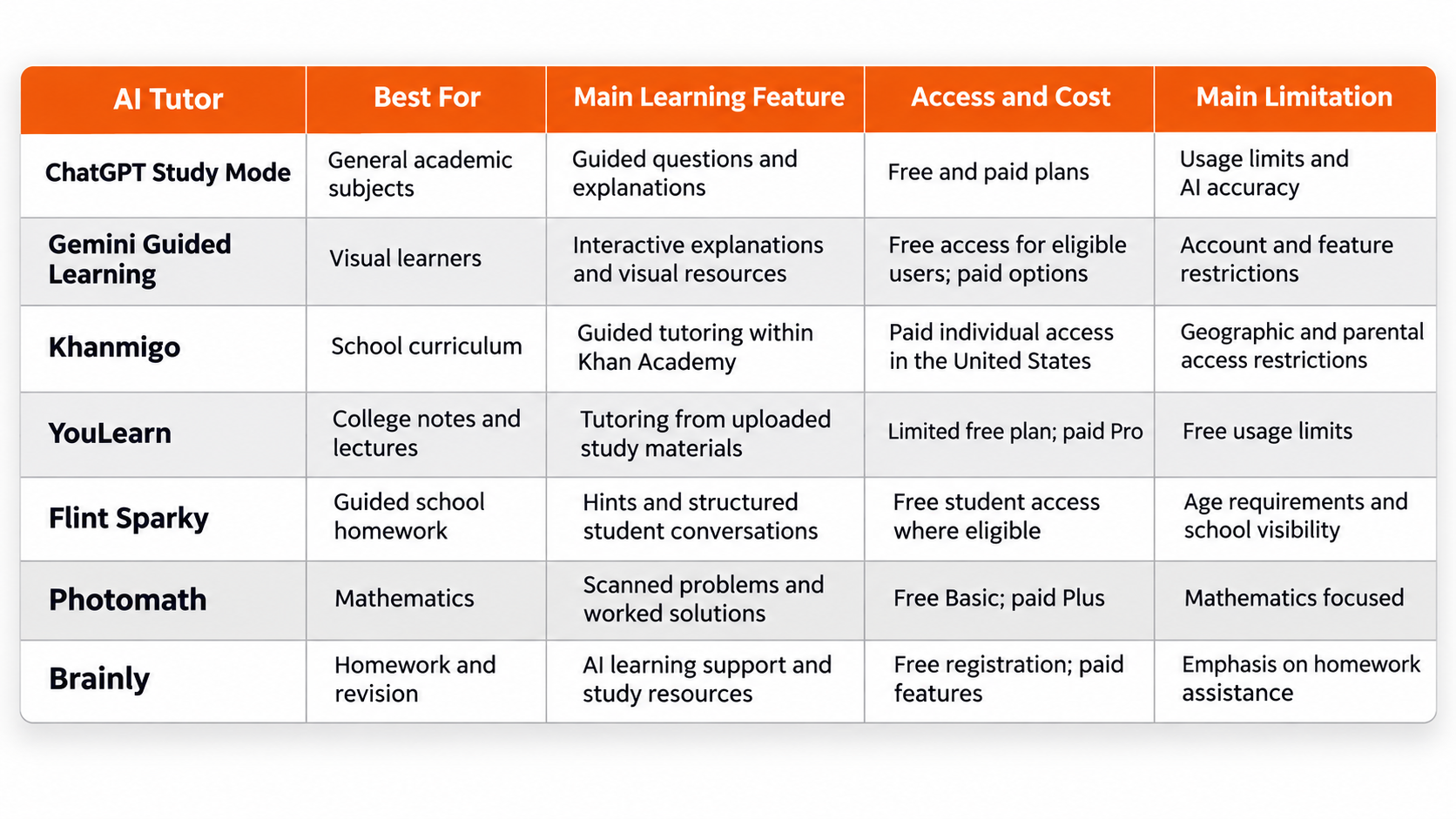
The comparison shows why there is no universal winner.
ChatGPT and Gemini provide flexible support across subjects. Khanmigo and Flint emphasize guided school learning. YouLearn is designed around personal study materials, while Photomath concentrates on mathematical problems.
These distinctions matter more than the number of features listed on a product page.
YouLearn: Best for College Students and Lecture Materials
Best for: University students studying from PDFs, recorded lectures, presentations, and videos.
YouLearn approaches AI tutoring through the materials students already use.
Students can upload course documents, lecture recordings, slides, or other supported resources and generate summaries, practice questions, flashcards, and interactive tutoring conversations.
Consider a university student preparing for a biology examination.
Instead of asking a general chatbot to explain the entire subject, the student can upload relevant lecture materials and ask questions about specific concepts.
This makes YouLearn particularly useful for revision organized around a course.
Main advantages: Support for personal learning materials, practice tests, quizzes, and interactive document based study.
Limitations: Uploaded material must still be accurate, and generated explanations should be checked against the original course content. Free accounts have limits on uploads and AI interactions.
Pricing: A free plan is available. The published Pro subscription costs $20 per month or $12 per month when billed annually.
Verdict: A practical option for college students whose study routine revolves around lecture notes and assigned reading.
Flint Sparky: Best for Guided Homework Practice
Best for: Middle school and high school students who need hints instead of completed assignments.
Flint provides an AI tutoring assistant called Sparky.
Its student experience focuses on helping learners work through their own reasoning.
A student who submits a mathematics problem can receive a hint, an explanation of a difficult step, or a similar example rather than having the entire assignment completed.
Flint also supports uploaded homework images and documents.
For school use, teachers can organize activities and review student interactions within the permissions provided by the platform.
Main advantages: Guided problem solving, student focused tutoring, document support, and classroom integration.
Limitations: Independent access is subject to age requirements. Conversations associated with school activities can be visible to authorized school staff.
Pricing: Flint advertises free access for eligible students, including personal student accounts.
Verdict: A suitable option for students who need structured assistance while remaining responsible for completing their own work.
Photomath: Best for Mathematics
Best for: Students who struggle with mathematical procedures and need to understand the steps behind a solution.
Photomath focuses on a narrower educational need than general AI tutors.
Students can scan a mathematical problem using a phone camera or enter it manually.
The application provides a worked solution with intermediate steps.
For example, a student solving a quadratic equation can compare the application’s procedure with their own calculations and identify where their reasoning diverged.
This makes Photomath useful for understanding mathematical techniques.
However, showing the steps of a solution is different from guiding a conversation through the student's misconceptions.
Main advantages: Camera based problem recognition, mathematical explanations, and a focused learning interface.
Limitations: Subject coverage is limited to mathematics, and the app can reveal the complete solution before a student attempts independent work.
Pricing: Basic explanations are free. Photomath Plus offers additional visual explanations and learning features, with a published monthly price of $9.99 in the United States.
Verdict: A practical mathematics support tool, especially when students need to inspect the procedure behind an answer.
Brainly: Best for Homework Questions and Revision
Best for: Students who need support with individual homework questions and additional revision materials.
Brainly combines homework assistance, educational resources, and AI based learning features.
Students can work with question explanations and use the platform's learning functions to review academic material.
Its primary strength is helping students address specific homework problems rather than organizing a complete course.
This makes Brainly useful when a student is stuck on a particular question and needs an explanation before continuing.
Main advantages: Homework support, broad subject coverage, and accessible study resources.
Limitations: The emphasis on finding answers requires students to distinguish between obtaining a solution and understanding the reasoning behind it.
Pricing: Free registration is available, with additional features offered through paid plans.
Verdict: Suitable for focused homework assistance, although students seeking a continuous tutoring dialogue should compare it with guided learning platforms.
Free vs Paid AI Tutors for Students
The price of an AI tutor matters, but the number of available conversations is not the only feature worth paying for.
A student preparing for a short examination may find a free tutoring plan sufficient. Another student regularly uploading lengthy lectures and textbooks needs greater document capacity and more study sessions.
The main difference between free and paid access lies in usage allowances, supported features, and specialized learning experiences.
Free AI Tutoring Options
ChatGPT Study Mode and Gemini Guided Learning provide broad educational assistance without requiring every user to purchase a subscription.
Flint also provides free student access under its eligibility conditions.
YouLearn offers a limited free plan, while Photomath provides basic mathematical explanations without a paid subscription.
For students exploring AI tutoring for the first time, these options allow an initial evaluation without an immediate financial commitment.
Paid AI Tutoring Features
Paid subscriptions become more relevant when students require extensive document processing, additional study sessions, specialized visual explanations, or a curriculum connected tutoring experience.
Khanmigo provides a dedicated educational environment through its paid individual subscription.
YouLearn Pro expands access to document based study functions, while Photomath Plus adds features for deeper mathematical explanations.
Before purchasing, students should confirm the total subscription cost, renewal terms, regional availability, and cancellation conditions.
The useful comparison is the amount of educational support received, not simply the number of AI messages included.
Choosing an AI Tutor by Subject and Learning Goal
The most effective selection process begins with identifying where a student needs help.
Mathematics and Science
For mathematics, Photomath provides focused support for understanding calculations and solution procedures.
ChatGPT Study Mode, Gemini Guided Learning, Khanmigo, and Flint offer broader conversational explanations that can help students reason through a problem.
A student who needs to identify a calculation error has a different need from one who cannot understand the underlying concept.
The first task requires clear worked steps. The second benefits from guided questions and conceptual explanations.
Writing and Humanities
Students studying history, literature, and essay writing benefit from tutors that ask them to defend interpretations, compare arguments, and examine evidence.
ChatGPT Study Mode and Gemini Guided Learning support these conversations across different subjects.
A useful AI tutor should help a student strengthen an argument rather than produce a complete essay for submission.
For humanities subjects, the ability to challenge reasoning matters more than generating polished text.
College and University Study
University students work with long readings, lecture slides, research notes, and specialized terminology.
YouLearn is designed for studying directly from these materials.
ChatGPT Study Mode and Gemini Guided Learning also support broader academic discussions and explanations.
The deciding factor is whether the student needs a tool organized around uploaded course resources or a flexible tutor for exploring concepts beyond those resources.
Exam Preparation
An effective AI tutor should test recall, identify gaps in understanding, and require students to answer questions without immediate assistance.
YouLearn provides quizzes and practice tests based on uploaded materials.
General tutoring tools can also generate questions and guide students through revision activities.
The final test of preparation remains independent performance. A student who succeeds only while receiving hints has not yet demonstrated the same level of mastery as one who can answer unaided.
Learning Quality and AI Tutor Reliability
A polished answer is not evidence of good tutoring.
A useful AI tutor needs to respond appropriately when a student makes a mistake, misunderstands an explanation, or repeatedly struggles with the same concept.
One effective way to evaluate a platform is to give it a familiar academic problem and deliberately submit an incorrect intermediate answer.
Observe whether the tutor identifies the reasoning error, explains the relevant concept, and allows the student to correct the work.
A strong learning interaction has three characteristics:
Guided reasoning: The student participates in solving the problem instead of receiving the final answer immediately.
Useful feedback: The explanation identifies the specific misunderstanding and supports correction.
Independent practice: The student can attempt a related problem without repeating the same guidance.
AI generated explanations also require accuracy checks.
For technical subjects, equations, factual claims, and references should be verified against reliable course materials.
An AI tutor is most valuable when it strengthens the student's ability to recognize and correct errors independently.
Student Privacy and Age Requirements
Educational AI platforms process information that can include assignment content, learning difficulties, conversation histories, and personal details.
Students and parents should examine how the service handles this information before using it for academic work.
The relevant questions concern account eligibility, storage of conversations, access by teachers or administrators, and the provider's data retention rules.
Khanmigo requires parental or institutional access arrangements for minors.
Flint's classroom experience includes oversight by authorized educational staff, while personal and school accounts have different access contexts.
For ChatGPT, Gemini, and other general purpose AI services, eligibility and available controls depend on the applicable account and product policies.
Students should avoid uploading confidential school records, private information about classmates, or restricted academic materials without authorization.
Privacy protection is part of selecting an educational tool, not a concern to investigate only after an account has been created.
Using an AI Tutor for Independent Learning
The way students interact with an AI tutor influences how useful the experience becomes.
Instead of requesting a finished solution, students should define the concept they want to understand and explain which part is difficult.
A practical study session follows this sequence:
Begin with a specific learning goal.
Attempt the problem before requesting assistance.
Ask the tutor to explain the next step rather than complete the task.
Correct the original attempt using the feedback.
Solve a similar problem independently.
For example, a student learning chemical equations can ask the tutor to review an attempted balancing procedure and identify the first incorrect step.
This preserves the student's role in the learning process.
Students can also ask the tutor to generate practice questions without displaying the answers until the exercise is finished.
The final measure of progress is whether the student can complete the task without the tutor.
Final Thoughts
The best AI tutors for students serve different educational needs.
ChatGPT Study Mode and Gemini Guided Learning provide flexible academic assistance. Khanmigo offers curriculum connected tutoring for eligible users. YouLearn focuses on personal course materials, Flint emphasizes guided homework, Photomath supports mathematics, and Brainly helps with individual study questions.
Choosing between them requires attention to subject coverage, instructional quality, pricing, eligibility, and privacy.
The best choice is the tool that helps a student understand more and depend less on assistance over time.
FAQ
Can an AI tutor remember what I struggled with last month?
Progress tracking depends on the platform's memory, conversation history, and learning analytics features. A saved conversation does not automatically mean the system maintains an accurate record of mastered concepts. Students should verify whether the service provides persistent learning progress before relying on it for long term tutoring.
Can I move my study history to another AI tutor?
Data transfer depends on whether the original platform supports exporting conversations, notes, or learning records and whether the receiving service accepts those formats. Students should check export and deletion options before transferring personal academic information.
What if my AI tutor disagrees with my teacher's answer?
The student should compare the AI explanation against the assigned course material and ask the teacher to clarify the disagreement. AI generated responses are not authoritative evidence, and even a convincing explanation can contain an error or use assumptions different from those required in the course.
Can my siblings and I share one AI tutoring subscription?
Account sharing depends on the provider's subscription terms. Khanmigo allows eligible parents to grant access to multiple linked child accounts under its family arrangement. Other services require separate accounts or specific family plans. Individual learning records should remain separate to avoid mixing student progress.
Can I use an AI tutor during a take home exam?
Permission depends on the examination instructions and the institution's academic integrity policy. An examination completed outside the classroom does not automatically permit AI assistance. Students must follow the stated rules and disclose AI use whenever the assessment policy requires it.

Fatemeh Jahangard
Technology & AI Writer at PinerookFatemeh Jahangard covers AI, emerging technologies, and digital innovation for Pinerook, focusing on how technology shapes startups and industries.
 Seen first.