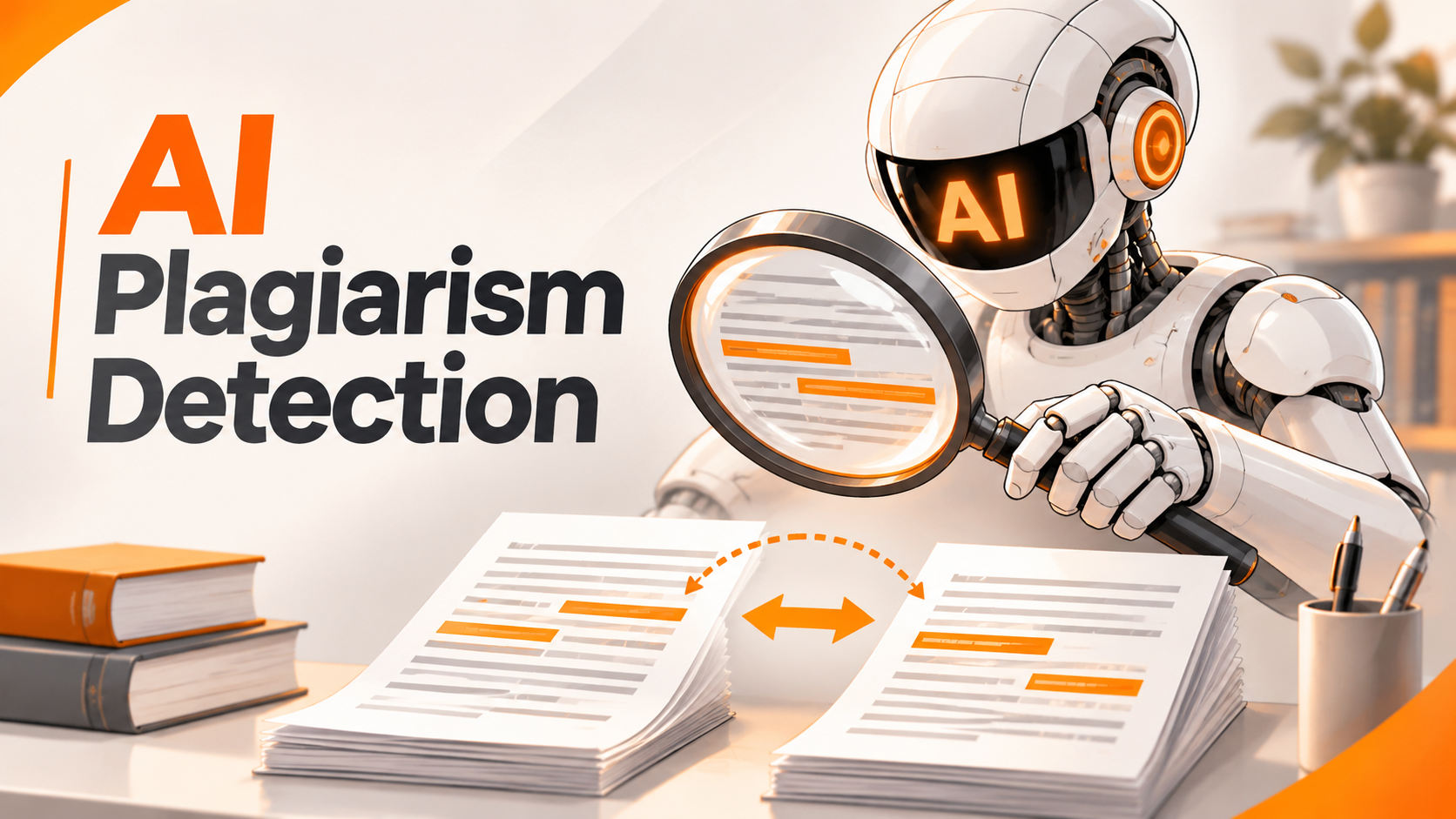
AI plagiarism detection helps identify copied material, suspicious similarities, and potential AI generated writing. But finding a matching passage is not the same as proving plagiarism, and an AI detection score cannot establish who wrote a document.
The most useful approach is to examine the evidence behind each result. A highlighted source, an unexplained similarity, and an AI writing flag tell us different things. Understanding those differences makes plagiarism checking more accurate, fair, and useful.
What AI Plagiarism Detection Can Identify
An AI plagiarism checker examines written content for signs of unoriginal work. Depending on the software, it searches for matching passages, identifies similarities in meaning, or evaluates writing patterns associated with artificial intelligence.
We find it useful to separate these capabilities because they answer different questions.
Copied text and source similarities
Plagiarism detection software compares a document against accessible websites, academic publications, and other indexed material. When it identifies matching passages, the report highlights the relevant text and identifies available sources.
A match provides something concrete to investigate. We can read the original publication, compare the passages, and check whether the writer provided appropriate attribution.
Paraphrased or rewritten material
AI powered plagiarism detection can extend beyond identical wording. Systems using semantic analysis examine relationships between passages, helping identify material that preserves another source's meaning despite changes in vocabulary or sentence structure.
This matters when a writer has substantially rewritten a source without acknowledging it. However, similar meanings alone do not establish copying. The relationship between the passages still needs examination.
Potential AI generated writing
AI content detection addresses a separate concern. Instead of searching for an original source, it examines linguistic patterns to estimate whether text resembles machine generated writing.
This distinction matters because a document can contain original AI generated text without matching existing publications. Conversely, a human author can copy an entire passage without producing a detectable AI writing signal.
How AI Powered Plagiarism Detection Works
AI based plagiarism detection combines document comparison with language analysis. The exact technology differs across platforms, but the underlying methods explain what a report can establish.
Text Matching and Source Comparison
The checking process begins by comparing submitted content with material available in the software's reference databases.
Traditional systems identify overlapping words, phrases, and longer passages. Their strength lies in making similarities traceable to specific documents.
We consider source coverage especially important. A checker cannot identify a matching passage in a document it cannot access. An unpublished manuscript or a publication outside its reference collection can remain undetected.
Semantic Similarity Analysis
Advanced systems use natural language processing to compare meaning rather than relying exclusively on shared wording.
Consider two passages describing the same research finding through different sentence structures. A semantic model can identify their conceptual similarity, even when an exact matching system finds limited overlap.
That result requires interpretation. Two writers can independently describe an established fact in similar terms. Semantic similarity becomes stronger evidence when it is supported by distinctive details, matching arguments, or a traceable source.
AI Writing Pattern Analysis
AI writing detectors use statistical and machine learning models trained to distinguish patterns in human and machine generated prose.
These models examine features such as word predictability, sentence structure, and linguistic consistency. Their output represents a classification of the submitted text, not a verified record of the writing process.
We therefore treat AI writing detection as an additional assessment rather than a replacement for source checking.
Understanding AI Plagiarism Detection Results
A detection report is only useful when its numbers are interpreted correctly. Similarity scores and AI writing percentages represent different measurements, even when the same platform displays both.
A similarity score describes how much submitted text matches material in the software's reference collection. It does not measure the percentage of plagiarism.
For example, a paper with a 30% similarity score is not automatically 30% plagiarized. Properly attributed quotations, reference entries, and standardized terminology contribute to text matches.
An AI writing score has a different meaning. It indicates how much qualifying text a particular model classifies as likely AI generated. It does not represent the probability that the writer committed academic misconduct.
Turnitin explicitly separates its AI writing percentage from its Similarity Report. Its AI writing system also suppresses numerical results between 1% and 19% because that range carries greater concerns about false positives.
Our approach is to examine the flagged passages before drawing conclusions from either measurement.
Interpreting an AI Plagiarism Detection Report
The clearest way to review a report is to connect each finding with the evidence needed to evaluate it.
The following table provides a practical reference for students, educators, and editors reviewing written work.
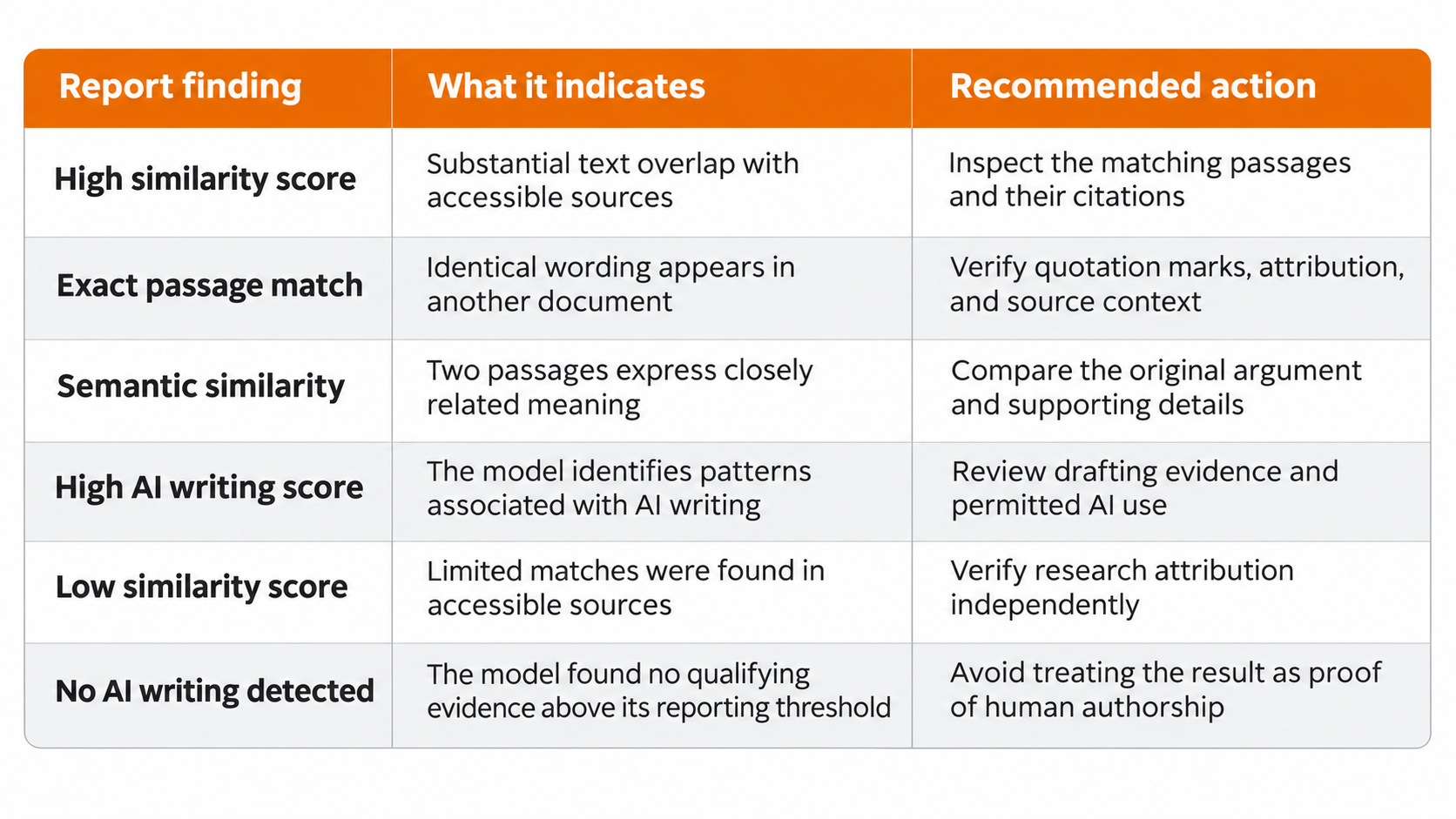
These findings should guide the review rather than determine its outcome. A properly cited passage can produce a strong match without constituting plagiarism, while unattributed ideas can remain problematic even when the similarity score is low.
The important question is whether the report provides evidence that supports a specific concern.
A Practical Method for Checking Written Content
When reviewing an academic paper or professional manuscript, we begin with the similarity report. It provides identifiable passages and source material that can be compared directly.
The first review focuses on substantial matches within the main argument, analysis, and supporting evidence. A matched quotation with correct attribution requires different treatment from a copied explanation presented as original writing.
Next, we examine paraphrased passages. Changing sentence structures does not remove the obligation to acknowledge another author's ideas. When a finding appears suspicious, we compare the source and submitted text in context rather than evaluating an isolated sentence.
If the platform includes AI writing detection, we review that result separately. The purpose is to identify concerns that require further evidence, not to translate a score into an accusation.
For academic submissions, draft history, research notes, earlier revisions, and the author's explanation provide valuable context. These records help establish how a document developed and whether the writing process complies with institutional requirements.
Finally, we verify citations against the original publications. A reference that appears credible in a bibliography is not evidence that the publication exists or supports the claim attributed to it.
This process requires more attention than accepting a single percentage. It also produces a more defensible assessment.
Accuracy and Limitations of AI Plagiarism Detection
AI plagiarism detection accuracy depends on the task being measured. Finding copied passages, recognizing rewritten source material, and estimating AI authorship are different technical problems.
Text matching provides verifiable evidence when a relevant source is available. Its limitations become apparent when the source lies outside the database or substantial rewriting removes recognizable wording.
AI generated content detection faces a different limitation. Its conclusions depend on statistical patterns rather than direct knowledge of who composed a passage.
False positives occur when human writing is classified as AI generated. False negatives occur when machine generated writing is classified as human.
Research published in 2026 on AI detection in higher education found substantial differences in performance across tools and writing categories. Results for documents combining human and AI writing were particularly dependent on the detector being evaluated.
We would not apply a universal accuracy percentage to all AI plagiarism detection tools. The evidence supports evaluating each system against the particular type of content it is designed to examine.
Another important distinction concerns the strength of a result. A high AI score is not evidence equivalent to a passage matched against a verifiable original source.
Choosing an AI Plagiarism Checker
The right software depends on whether the main concern is copied material, unattributed paraphrasing, or AI generated content.
For academic manuscripts, we prioritize access to relevant scholarly databases and reports that identify matching publications. A detector that provides a percentage without showing the underlying sources offers limited value for investigating plagiarism.
Semantic comparison becomes valuable when the review involves rewritten arguments or substantial paraphrasing. Its findings still need support from identifiable source material.
For institutions evaluating AI writing, the important criteria include documented testing, supported languages, minimum text requirements, and transparent explanations of false positives.
We also examine how a platform handles uploaded documents. Research papers, unpublished manuscripts, and student assignments contain material that should not be submitted to an external service without checking its data handling terms.
A useful AI plagiarism detection tool should make evidence easier to inspect. An attractive numerical score is not a substitute for an explainable report.
AI Plagiarism Detection in Academic Integrity
The growing role of AI in Education has made writing authenticity more complex than identifying copied sentences.
A student can use an AI assistant for permitted language corrections while retaining responsibility for the research and argument. Another student can submit entirely human written material that improperly reproduces someone else's work.
Neither situation can be judged fairly through AI detection alone.
Academic integrity depends on accurate attribution, transparent authorship, and compliance with the rules governing an assignment.
For educators, this means treating automated findings as evidence to investigate. For students, it means understanding that an acceptable similarity report does not replace proper research practices.
The goal is not to produce a perfect detection score. It is to establish whether the submitted work represents an honest and appropriately attributed contribution.
Final Assessment
AI plagiarism detection is most valuable when it helps identify specific source similarities and supports a careful review of written work. Its usefulness declines when statistical estimates are treated as definitive judgments.
We recommend starting with traceable evidence, examining the writing context, and using AI detection results only for the questions they are designed to address.
FAQ
Will a plagiarism checker keep a copy of my essay?
That depends on the service's storage and submission policies. Some platforms retain documents or add submissions to a comparison repository, while others provide options that restrict retention. Review these settings before uploading unpublished work, particularly when the document contains confidential research.
Does translating someone else's article into English count as plagiarism?
Translating another author's work without appropriate attribution can constitute plagiarism. Changing the language does not transfer ownership of the original ideas or expression. Proper attribution remains necessary, and reproducing protected material can raise separate copyright considerations.
Can I upload screenshots instead of the original document?
A screenshot must be converted into readable text before a text analysis system can process its contents. Some services support optical character recognition, while others require selectable text or supported document formats. For reliable source comparison, use a format that preserves the complete written content.
Will my teacher see the plagiarism check I ran on another website?
Using a separate checking service does not automatically send its report to your teacher. However, the provider's retention, sharing, and repository policies determine what happens to uploaded material. Check those conditions before assuming a private scan cannot affect a later submission.
Does using Grammarly or another grammar tool make my work AI written?
Grammar assistance does not automatically mean a document was generated by AI. However, the academic acceptability of a particular feature depends on the assignment's rules. Basic spelling corrections and substantial AI rewriting are different forms of assistance, and institutional policies can distinguish between them.

Fatemeh Jahangard
Technology & AI Writer at PinerookFatemeh Jahangard covers AI, emerging technologies, and digital innovation for Pinerook, focusing on how technology shapes startups and industries.
 Seen first.