A startup should consider pivoting when repeated evidence challenges a central assumption about its customers, problem, product or economics, and reasonable attempts to improve execution have not changed the result. A disappointing launch is not enough. The stronger signal is a pattern: buyers understand the offer but will not commit, returning customers do not receive enough value, or a different opportunity attracts more convincing demand.
Knowing when to change direction is one part of a broader Startup Pivot Strategy. The immediate task is more specific. Founders need to determine whether the original idea has received a fair test, identify which assumption is failing, and decide whether there is still enough time and money to test a credible alternative. That assessment should happen before the company announces a new product or abandons its existing customers.
The Difference Between a Bad Week and a Broken Assumption
Startups operate with incomplete evidence, so weak results are normal early on. A low conversion rate may reflect an unclear message, an unsuitable acquisition channel or an unreliable product. Those are execution problems. A strategic problem is more fundamental: even when the right customers understand and experience the product, the promised outcome is not valuable enough to support repeat usage or payment.
This distinction matters because a pivot changes what the business believes it must deliver, to whom, or under what commercial conditions. Improving onboarding while the target customer and core offer remain the same is typically iteration. Moving from a dashboard that customers ignore to a service that resolves the operational problems behind that dashboard could constitute a pivot. The key test is whether the company must replace an important assumption, rather than simply carry out an existing plan better.
The Signals That Make a Pivot Worth Considering
The most useful warning signs come from customer behavior and business economics rather than founder anxiety. No single indicator is decisive. A founder should look for several pieces of evidence that point to the same underlying problem and remain weak after a relevant attempt to fix it.
Buyers Understand the Offer but Do Not Commit
A lack of interest does not always mean that the problem is unimportant. The company may be presenting its offer to the wrong buyers. But when qualified prospects repeatedly recognize the proposed benefit, understand the price and still decline a trial with meaningful effort or a paid commitment, demand deserves scrutiny. Record their actual objections rather than categorizing every refusal as a sales problem. If the problem is consistently described as inconvenient but not urgent, the proposed market may not support the business the founder imagined.
The evidence becomes stronger when the team has compared several relevant customer segments, tested a clear offer and addressed obvious objections. Polite praise in interviews is weaker evidence than a customer making time for implementation, sharing operational data or paying. Founders should not treat a full calendar of discovery calls as proof that demand exists.
Users Find Value Somewhere Other Than the Core Product
Sometimes the most valuable part of a product is not the part the startup planned to sell. A team may launch a broad analytics platform and discover that customers primarily return for automated exception alerts. This behavior matters more than enthusiastic reactions to the product demonstration. It suggests that the company may have defined the product around the wrong job.
Before pivoting, examine whether the usage pattern persists across accounts, whether those customers have a common urgent problem, and whether they will pay for the narrower outcome. A handful of enthusiastic users can reveal a direction worth testing, but they do not establish a repeatable market. The next step is to isolate the alternative offer, not rebuild the whole company on one anecdote.
Retention and Unit Economics Stay Weak After Focused Improvements
Initial acquisition may be promising while the business underneath remains fragile. Customers sign up but stop using the product after their first task. Service costs rise with each new account. Even at a price customers accept, fulfillment leaves too little contribution to cover the costs of acquiring and supporting the customer. These are different problems, but they share one diagnostic question: is the weakness fixable within the present model?
For retention, separate customers who never activated from those who reached the promised outcome and still left. The first group may indicate onboarding friction; the second is stronger evidence of limited ongoing value. For economics, compare realistic revenue with the full cost of delivering that value. A bad early margin may improve with scale, but founders need evidence for that improvement, not a forecast that assumes it will happen automatically.
Success Depends on a Change the Team Cannot Control
A venture may depend on a regulation being approved, a dominant platform granting access or a technology becoming inexpensive enough for ordinary customers. Waiting can be defensible when there is an independent business and a credible timeline. It is much riskier when the entire thesis works only if an outside event occurs. Founders should distinguish a plausible market catalyst from a substitute for current demand.
An external change can also undermine an existing model. If a distributor removes access or a new constraint makes delivery uneconomic, revisiting the strategy may be necessary even when customers still like the product. The decision should reflect the actual effect on the business rather than a reaction to headlines alone.
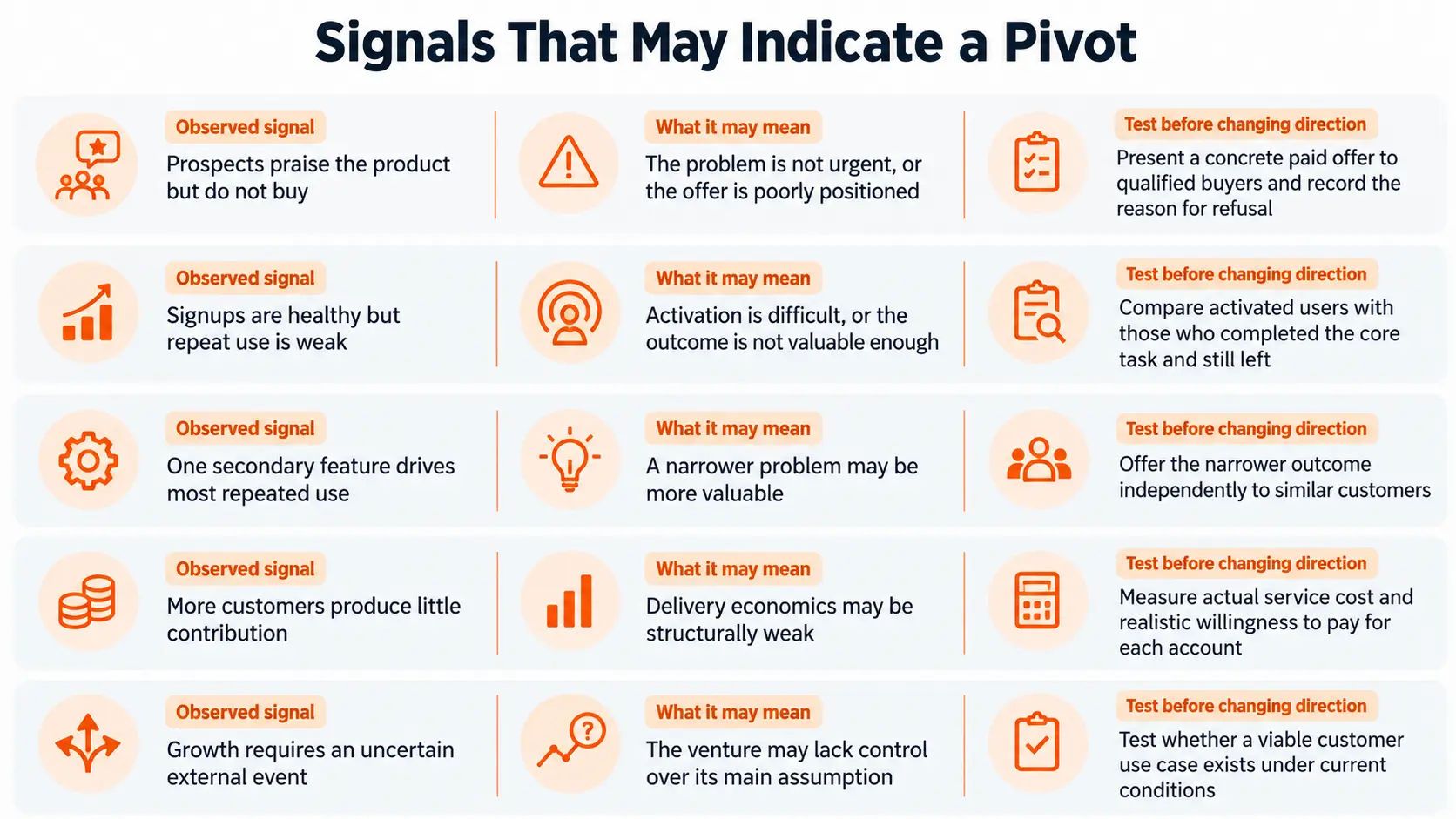
A Diagnostic Table for Founders
The table is a starting point for investigation, not an automatic scorecard. The same indicator can mean different things in an enterprise product with a long sales cycle and a consumer tool that can be tried in minutes.
Build an Evidence Standard Before Calling the Pivot
Founders often ask how many weeks or failed sales calls justify a pivot. There is no universal number. The relevant period depends on how customers buy, the time required to observe value and the amount of runway left. A cybersecurity tool sold to banks cannot use the same trial window as a self service scheduling application. A sample of ten carefully selected buyers may reveal a clear, consistent objection, but it is not enough to estimate market wide conversion with confidence.
Set an evidence standard tied to the riskiest belief. If the assumption is that a particular buyer has an urgent problem, test a specific offer with people who actually control the budget. If the assumption is that the product delivers recurring value, look beyond registrations to completed tasks and repeat behavior. If the assumption is that the business can earn a margin, include support, integration and servicing costs in the calculation. Each test should be capable of disproving the belief, not merely producing another interesting metric.
Write down the starting hypothesis, what was tried, which customers were included and what result would change the decision. This also reduces the influence of sunk costs. Founders are naturally reluctant to abandon a product after spending months building it. The decision is about the likely value of the next month, not the amount already spent.
Match the Decision to Runway and Sales Cycle
A company with ample cash can run more experiments, but money alone does not justify indefinite persistence. A company with little runway may feel pressure to pivot immediately, yet a new direction often requires a new selling cycle, additional implementation work and temporary support for current customers. A pivot can consume the remaining cash faster than the existing business.
Estimate runway after committed expenses, not just the balance in the bank. Then calculate what evidence can realistically be observed before the next funding or operating decision. If the new opportunity requires six months to prove and the company can fund only two, presenting it as an imminent rescue is misleading. The realistic choices may include narrowing the business, securing enough resources for a bounded test, finding a partner or stopping responsibly.
For a company selling to larger organizations, the first weeks may establish budget ownership and willingness to run a pilot, while renewal and long term economics remain unobservable. That is acceptable if the decision is limited to funding the next test. Avoid asking an early experiment to prove what only a full customer cycle could show.
Recognize a Better Opportunity Without Chasing Every Trend
Evidence for an alternative should be more substantial than a founder's excitement about a fashionable sector. Look for a specific customer group that independently describes the same costly problem, takes steps to solve it and shows willingness to commit resources. Ideally, the new direction reuses something the team has already earned: trusted relationships, domain knowledge, technology or access to a difficult workflow.
A nearby opportunity can still be the wrong one. A large prospective customer may offer significant revenue but demand so much custom engineering that the result is a consulting engagement rather than a repeatable startup. Before moving, ask whether other buyers have the same problem and whether the offer can be delivered without reinventing it for every account. The strongest signal is not that the alternative appears larger on a slide; it is that customers behave differently when presented with it.
A Practical Example of the Decision
Consider a fictional startup that sells a planning dashboard to independent retailers. Over a defined sales period, the founders make a clear paid offer to 35 qualified owners and close two small pilots. Most prospects understand the software but say they already have reports and cannot justify adding another dashboard. The team simplifies onboarding and adjusts the presentation, yet the central objection persists.
During those pilots, customers repeatedly ask the founders to identify inventory exceptions and recommend actions before stockouts occur. The team offers a limited alert service to 12 comparable retailers. Four agree to pay for a short trial, but the service is currently labor intensive. Those results suggest a more urgent job than the original dashboard, not yet a confirmed business model. The two groups were reached through different channels and represent small samples, so the conversion figures should not be treated as a reliable forecast.
The founders have enough evidence to investigate a narrower offer. Their next decision should depend on whether the alert service delivers measurable reductions in missed orders, whether customers keep paying after the initial trial and whether the cost of delivering it can fall to a sustainable level. If those tests fail, the company has learned something useful without committing a full rebuild prematurely.
Situations Where Persevering Is More Rational
Not every period of weak growth calls for a new strategy. Keep the current direction under review when customers clearly value the outcome, retention is improving among activated users and the main barrier is identifiable. An unreliable integration, a confusing first experience or a poorly matched sales channel may justify another focused iteration. Changing the customer and product together would make it harder to understand whether the original opportunity was actually weak.
A pivot is also premature if the founder has avoided the most uncomfortable work. Shipping repeatedly without making a direct offer, refusing to talk with budget holders or abandoning an idea after a handful of cold emails leaves too much unknown. Conversely, a few paying customers should not prevent scrutiny if serving them is unsustainable. Perseverance is warranted by learning and improving economics, not by the simple existence of activity.
Turn Uncertainty Into a Specific Decision
Before a decision meeting, put the evidence into one page. State the customer and problem originally targeted, the assumption that is now in doubt, the strongest evidence against it and the execution improvements already attempted. Name the alternative, explain why it may be better, and estimate the cost of one meaningful test. If the team cannot articulate these points, it is probably not ready to declare a pivot.
The meeting should end with one of three conclusions. Continue the original strategy with a focused test and a review date. Investigate a clearly defined alternative with a fixed budget and an agreed threshold. Or stop a venture that no longer has a credible path within its resources and obligations. Each conclusion needs an owner and a condition that would cause it to be reconsidered. Avoid changing course quietly through a series of unrelated feature requests.
The best time to pivot a startup is not a particular month after launch or the moment the founders become frustrated. It is when the available evidence has seriously weakened a core assumption, reasonable fixes have been tested and a better direction can still be investigated responsibly. The goal is not to celebrate a dramatic change. It is to make the next decision with less guesswork than the last one.
FAQ
How do I know if my startup needs a pivot or better marketing?
Test whether qualified buyers understand the offer and whether users who experience the core benefit want to return or pay. If the problem is real and customer value is strong but the company struggles to reach buyers, improve positioning or distribution before replacing the business model.
Is low revenue enough reason to pivot a startup?
No. Revenue may be low because the company is early, sales cycles are long or the offer has not reached the right decision makers. A pivot becomes more credible when repeated tests show weak willingness to pay or unsustainable delivery economics despite targeted improvements.
How long should founders wait before deciding to pivot?
There is no standard period. The test must run long enough to observe relevant customer behavior but fit the company's actual runway. Define the learning goal, required evidence and review date before starting rather than choosing an arbitrary number of weeks.
Can a startup pivot while it still has paying customers?
Yes. Existing revenue does not guarantee the model can support sustainable growth. The founder must nevertheless honor customer obligations, preserve critical services and evaluate whether the alternative improves the economics rather than simply changing the story.
What is the strongest sign that a pivot could work?
A credible alternative attracts behavior that the original offer could not, such as qualified buyers committing budget or users repeatedly completing a valuable task. The signal becomes stronger when it appears across comparable customers and the company can deliver the outcome at a sustainable cost.

Mohsen Avid
Founder & Editor, PinerookMohsen Avid is the founder of Pinerook, covering entrepreneurship, startup strategy, digital business, and the decisions behind building new ventures.
 Seen first.