The most instructive startup pivot examples are not simply stories about well known companies changing direction. They show a specific business assumption breaking down, a useful capability surviving, and a new proposition that still had to win customers. Instagram, Slack, Shopify, Segment and Groupon each changed something fundamental, but they did not all make the same kind of change. Fab offers a necessary counterpoint: a pivot can generate attention without producing a durable business.
A broader Startup Pivot Strategy begins by identifying the assumption that no longer fits the evidence. This article takes the next step by examining what actually happened in six ventures, what can reasonably be inferred from their histories, and which small experiments might help a founder facing a similar decision. The point is to learn how to think, not to copy a famous company's outcome.
Six Startup Pivot Examples at a Glance
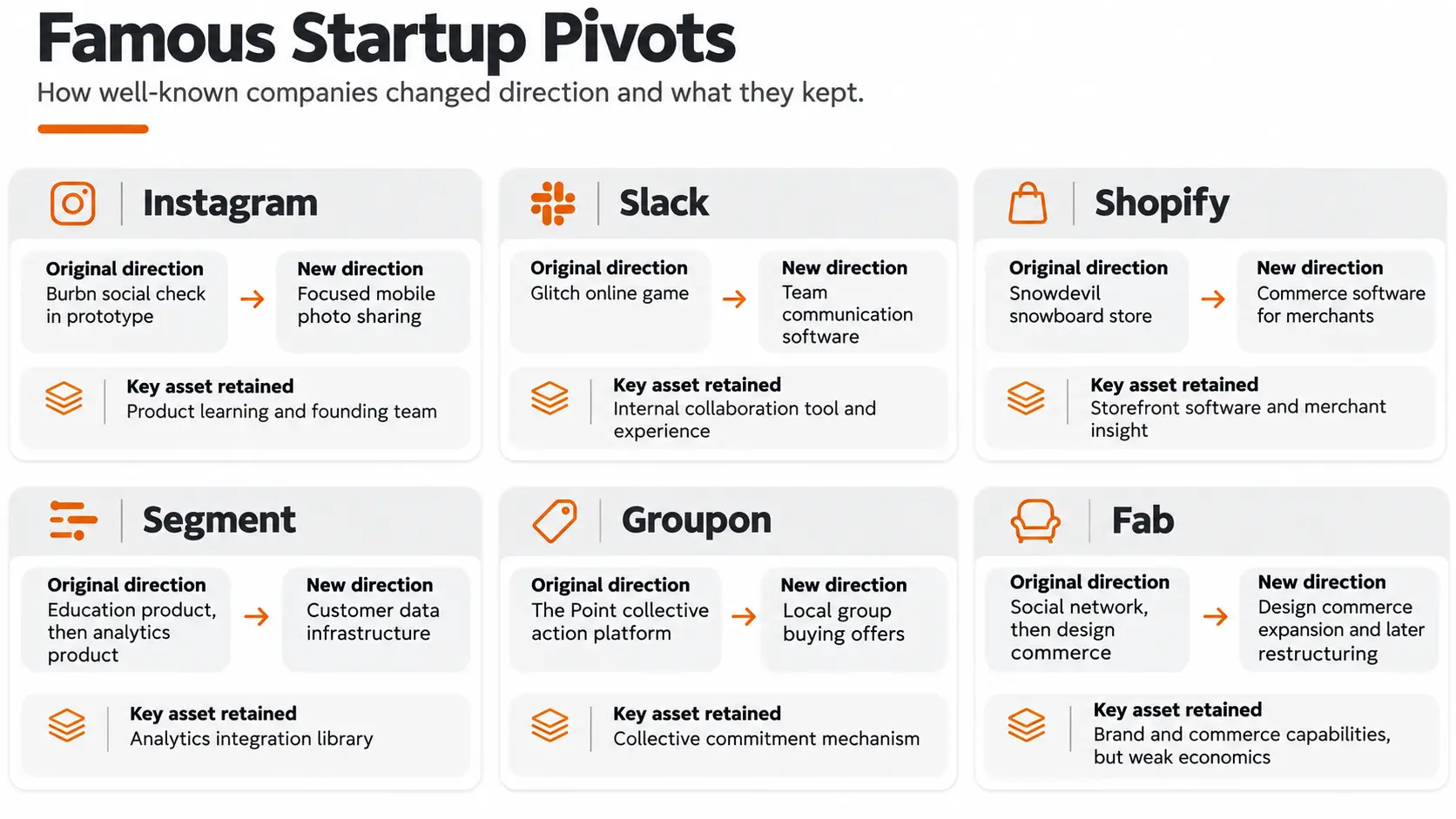
The table identifies the change, not proof that a particular action caused success. A good comparison asks how demand was discovered, whether an existing asset reduced the cost of trying the new idea, and whether the team subsequently validated adoption and sustainable economics.
What Makes a Startup Pivot Example Worth Studying?
A useful case needs four elements: the original customer or product hypothesis, a credible signal that challenged it, the asset carried into the new direction, and an observable test of the replacement idea. If one element is missing, the story can become a retrospective myth. Successful companies are especially prone to this treatment because the final result makes every earlier decision look inevitable.
Some of these changes were product focus decisions, while others replaced an entire market or commercial proposition. A narrow feature becoming the main product is not the same as turning an internal tool into a new company. Nor is growing a business through a gradual service expansion necessarily a single dramatic pivot. The distinctions below describe the central change without pretending each history fits neatly into one label.
Instagram: Cut the Product Back to Its Clearest Use
Kevin Systrom's early product Burbn combined social and location oriented ideas with photo sharing. The team eventually focused on the photo experience that became Instagram. Founder interviews describe the process as an evolution through experimentation rather than a perfectly planned transformation. Systrom has even challenged the tidy way the shift is often described as a pivot, which matters when reconstructing decisions many years after the fact.
The central strategic change was product scope. Instead of expecting users to understand a crowded combination of functions, the team concentrated on an action people could recognize and share. The retained assets were the product development work, knowledge from early users, and the founding team's capacity to iterate. The new proposition still needed a compelling experience, including simple creation and sharing, to earn adoption.
For a founder facing similar evidence, the relevant test is not to remove features indiscriminately. Identify the task that brings a defined cohort back, make it accessible as a focused experience, and compare repeat use and invitations with the broader product. A spike in clicks on one button is weaker evidence than customers repeatedly completing the underlying job.
Slack: Turn an Internal Necessity Into a Product
Tiny Speck built the online game Glitch while coordinating people working across different locations. The game did not become a viable business, but the team's internal communication system solved a problem they knew intimately. After winding down the game, Stewart Butterfield and colleagues developed that collaboration tool into Slack. Slack's own history and Butterfield's interviews confirm the connection, while also showing that the internal tool had not originally been designed as a public product.
The original market hypothesis changed completely: from entertainment for players to workplace communication for teams. What survived was an extensively used internal system and years of operational learning. That gave the founders unusually deep exposure to the problem, but it did not prove that unrelated organizations would adopt the software. First Round Review describes how the team invited outside companies of different sizes to test Slack and discovered requirements they could not see from their own team.
The portable lesson is to distinguish a useful internal workaround from an external market. If a tool saves your team time, ask whether similar organizations share the pain, who controls the purchase, and whether the product works outside your own processes. Recruitment of a handful of independent teams, followed by observed repeat usage, is stronger evidence than enthusiasm inside the founding company.
Shopify: Sell the Infrastructure, Not the Original Store
Shopify's founders initially built Snowdevil, an online shop for snowboarding equipment. Existing commerce software did not meet their needs, so they developed their own storefront technology. The software built to support one retailer eventually became the product offered to other merchants. Shopify describes Snowdevil as its first store and explicitly links the experience to the platform's origin.
This was a change in buyer and value proposition. The initial aim was selling physical merchandise to shoppers; the later business sold commerce capabilities to merchants. The team retained functioning technology and a firsthand understanding of merchant frustrations. Importantly, the story does not show that every bespoke internal system deserves a separate startup. The market must contain enough buyers who face the same recurring pain and prefer the proposed tool to available alternatives.
A founder encountering a similar opportunity could offer the internal system to three outside businesses with different workflows before rebuilding it into a platform. Watch the integration effort, support burden, willingness to pay and frequency of use. A workaround that is valuable only because its creators maintain it manually may not yet be a scalable product.
Segment: Find Demand in the Tool Built During Failed Experiments
Segment's founding team entered Y Combinator with an education idea and later attempted an analytics product. According to its own retrospective, both directions struggled to reach product market fit. The team then released an open source library designed to send analytics data to multiple tools through one interface. That component attracted a different kind of interest and pointed toward what became Segment's customer data infrastructure business.
This case differs from Slack in one essential respect. Rather than immediately treating the internal utility as a polished application, the team exposed a technical component to developers and observed a market response. The preserved asset was integration code created during earlier attempts, along with insight into a recurring implementation problem. An open source release can generate interest without revenue, however, so adoption alone is not evidence that the company has solved pricing, support or commercial distribution.
The comparable experiment for another technical startup is to make one narrow component available to a clearly defined audience. Measure activation, repeat integration, concrete requests from potential paying teams and the cost of supporting them. Decide in advance what behavior would justify turning that component into the main business rather than mistaking developer attention for a complete commercial model.
Groupon: Apply an Existing Mechanism to a Clearer Use Case
The Point was a platform for organizing collective action once enough participants committed. Groupon developed from it as a project using a similar group commitment mechanism to offer local discounts. Groupon's own company history and its founder's public filing explain the relationship between the two ventures. The key distinction was not a new fundamental technology but a more concrete reason for people to participate.
The shift replaced a broad, flexible social action proposition with a familiar consumer payoff. The team carried forward a way to coordinate group participation, then applied it to deals that merchants and customers could readily understand. Yet a successful offer does not establish a durable marketplace. Merchant economics, repeat buying, customer acquisition costs and operational quality still determine whether growth can be sustained.
For a startup with a flexible platform and weak adoption, test one sharply defined use case before expanding features. Recruit the parties who must both benefit, measure completion of the promised transaction, and learn whether they return after the novelty fades. Groupon's history suggests that reducing ambiguity in the buyer's outcome may sometimes matter more than expanding what a platform can theoretically do.
Fab: A Pivot Can Work Initially and Still Fail Economically
Fab began with a social community concept and shifted into a design oriented ecommerce business. That new direction produced rapid attention and investment, but the company later experienced substantial operating pressure, layoffs and strategic changes. Reporting from the period described heavy spending, expansion and a sale of the Fab business in 2015. The case complicates the assumption that visible growth after a pivot proves the new model is defensible.
The important missing piece in a celebratory pivot story is unit level sustainability. Demand can be real while customer acquisition, inventory, fulfillment or expansion consumes more resources than the business can recover. Fab's experience does not prove that its initial decision to change direction was wrong. It shows that validating a new product or audience is only one part of building a company that can survive its own growth.
A founder should therefore track contribution margin, repeat purchase behavior, cash conversion and service or fulfillment costs alongside adoption. If the new proposition requires steadily increasing spending to preserve demand, the pivot may need further refinement even when top line metrics look impressive. This is why a genuine counterexample is as important as a familiar success story.
What These Pivots Have in Common
Five of the companies found some value already present in the original venture: a feature, an internal tool, a technical library, a commerce system or a participation mechanism. None had to throw away everything it had learned. But the underlying source of value changed. In some cases the end customer changed; in others the central job, product packaging or buyer incentive changed.
The pattern is more useful than a claim that pivoting usually produces success. These are selected stories that reached public attention. Most experiments do not produce household names, and public accounts rarely include all the rejected alternatives or internal data. A founder can extract hypotheses from these histories, but should avoid using them as evidence that their own proposed change will work.
How to Apply the Lessons Without Copying the Stories
Start by naming the asset that could survive a change: a trusted customer relationship, recurring user behavior, a specialized workflow, reusable technology or a proven distribution channel. Then state the hypothesis that would be different. For example, a scheduling startup might discover that its reminders are valuable, but only to operations teams responsible for reducing missed appointments, not to individual professionals. That is a specific buyer and outcome hypothesis, not a vague intention to become an AI platform.
Choose a test small enough to distinguish real interest from polite approval. For the new customer segment, that may mean a paid pilot with clear acceptance criteria. For an internal tool, it may mean independent users completing a core task without the developer standing beside them. For an emerging marketplace, it may mean repeat transactions on both sides after promotional incentives end. Record the baseline from the current model so a new headline metric does not hide a worse business underneath.
A practical evaluation can cover four questions. Did the new offer create value that users independently sought? Did any customer make a meaningful commitment? Can the team deliver the outcome reliably at a cost the model supports? Is there sufficient runway to learn more while honoring existing obligations? These are not universal thresholds. The right evidence depends on the sales cycle, industry and risks, but the decision rules should be specified before results arrive.
A Founder Checklist for Reading Any Pivot Story
Before adopting a lesson from a celebrated example, ask which details come from founders or original documents and which are later commentary. Separate observable events from plausible motives. Identify the original offer, the alternative, the asset retained, the first external sign of demand and the economics that had to work afterward. Most importantly, note what the story does not reveal. If a source has no conversion, retention or margin data, do not invent those figures to make the lesson sound decisive.
A pivot can be a disciplined response to learning, but it can also be a costly distraction. The cases above support careful reuse of assets and specific customer tests, not a general instruction to abandon an underperforming company. Founders should leave every case study with a more testable question about their own venture rather than a more dramatic origin story to tell investors.
FAQ
What are some well documented startup pivot examples?
Instagram's shift from Burbn to photo sharing, Slack's move from the Glitch game to workplace software, and Shopify's evolution from Snowdevil to commerce infrastructure are widely documented. Segment and Groupon also provide useful cases because public accounts show how an existing technical or organizational mechanism was redirected toward another market.
What is the most common lesson from successful startup pivots?
The useful lesson is to preserve what has genuine value while changing the hypothesis that customers or economics have contradicted. That may mean retaining technology, customer knowledge or a proven behavior. It does not mean that every startup should switch direction when growth slows.
Are all famous startup pivots planned in advance?
No. Founder interviews show that some shifts developed through iterations and exploration rather than through one formal decision. Instagram's founders, for example, have described a less tidy process than later summaries imply. The founder's task is still to make the next hypothesis explicit and testable.
How can founders tell whether a pivot has worked?
Look for repeatable customer value, credible willingness to pay or other meaningful commitment, and viable delivery economics. Early signups, press coverage and venture funding can be positive signals without establishing long term sustainability. Judge results against the experiment's original decision criteria.
Can a startup pivot successfully and still fail later?
Yes. Fab illustrates how a new concept can attract considerable attention while later running into operational and financial strain. The first validation question is whether customers value the new offer. The second is whether the business can serve them sustainably at the required scale.

Mohsen Avid
Founder & Editor, PinerookMohsen Avid is the founder of Pinerook, covering entrepreneurship, startup strategy, digital business, and the decisions behind building new ventures.
 Seen first.