Product Qualified Leads, commonly called PQLs, are users or accounts whose experience inside a product provides credible evidence that a purchase, paid upgrade, or useful sales conversation may be appropriate. The label should reflect more than curiosity or an active trial. A useful PQL has reached meaningful product value and shows a reason to consider a commercial commitment. For an early software startup, identifying those users can improve the timing and relevance of sales assistance without making every free user a sales target.
Within a broader Product Led Growth for Startups strategy, qualification connects what customers actually accomplish with what the business should do next. A founder may see ten people opening the product every day, but only two may have completed the workflow that solves their problem and invited colleagues who would benefit from a paid plan. The second group deserves closer attention, although the correct response might be an in product offer rather than a sales call.
What Is a Product Qualified Lead?
A PQL is a potential buyer qualified primarily through observed product experience rather than marketing engagement alone. The exact definition varies by product. For a reporting platform, a meaningful signal could be connecting accurate data, saving a working report, and using it again during a real review. For a collaboration tool, it might be repeated shared work by several active members of a team. Neither example should be copied into a different product without examining what makes that product valuable.
Qualification needs three kinds of evidence. First, the customer has achieved something useful. Second, the user or account resembles a customer the startup can serve successfully. Third, there is a plausible commercial reason for an upgrade or conversation. These conditions do not always arrive together. Someone may be highly engaged but never need a paid feature. Another account may match the target customer profile but have not yet discovered enough value to justify a conversation.
The point of a PQL program is not to congratulate the product team for generating more qualified labels. It is to make a better decision about when to help a customer buy, expand, or receive support. A qualification rule that never changes what the company does is only an additional report.
How PQLs Differ From MQLs and SQLs
A Marketing Qualified Lead, or MQL, typically reflects evidence that a potential buyer may be interested in a category or solution. This might include a meaningful content interaction, attendance at a relevant event, or a request for educational material combined with suitable customer characteristics. Such activity can identify interest but does not prove the person has experienced the product.
A Sales Qualified Lead, or SQL, has usually been assessed through a sales process and judged suitable for a commercial opportunity. A sales representative may confirm the business problem, decision process, timing, and purchasing conditions. A PQL follows a different route: meaningful product use can reveal readiness before a formal sales conversation takes place. These stages can coexist. A company may consider an account product qualified and later sales qualified after confirming procurement needs.
A PQL is not automatically better than an MQL or SQL. Some enterprise buyers need legal and security discussions before they can try a product. Others purchase independently without any need for sales intervention. Qualification should respect the actual buying journey rather than force every prospect through the same sequence.
Begin With Product Value, Not Activity Volume
The earliest error in PQL design is confusing use with value. Logins, screen views, session duration, and feature clicks are easy to collect, but they can represent confusion, troubleshooting, or repeated failed attempts. A person who spends an hour trying to repair an integration has not necessarily become a stronger buyer than someone who completes an important task in ten minutes.
Instead, begin with the customer outcome that makes the software worth keeping. A scheduling tool may help a business reduce missed appointments. An analytics tool may help a team make a decision using reliable data. A documentation product may help multiple colleagues complete a shared review. Once that outcome is clear, examine which events provide credible evidence that it occurred. Repeated value often carries more meaning than a single guided demonstration.
This is where qualification differs from activation measurement. Activation asks whether a user experienced a meaningful early result. PQL qualification asks whether that experience, combined with fit and buying context, supports a commercial next step. An activated user may be satisfied indefinitely with a free plan. A company that needs permissions for several departments may have a different reason to purchase even if its earliest users performed the same activation event.
Decide Whether You Are Qualifying a User or an Account
Many startup products record events at the individual user level while purchases occur at the organization level. One person might discover an application, several colleagues might use it, and an executive who rarely logs in might control the budget. If five people from the same organization meet a user based threshold, counting five separate sales opportunities exaggerates demand and can create repeated outreach to the same buyer.
Define the unit of qualification before setting a threshold. For an individual subscription, the user may be the correct unit. For business software with shared workspaces, the account or workspace may be more useful. A Product Qualified Account, often called a PQA, combines activity from relevant people within one buying entity. The account definition should explain how workspaces, domains, trials, and existing customers relate to one another.
This distinction also affects ownership. An existing customer approaching an expansion decision should usually follow a different process from a new prospect considering its first subscription. The company may need separate qualification rules for new purchase, team expansion, and enterprise consolidation rather than one score for every commercial objective.
Which Product Signals Suggest Commercial Readiness?
Useful signals often fall into three categories: evidence of customer value, evidence of customer fit, and evidence that a commercial change would remove a genuine limitation. Strong qualification brings these categories together instead of assigning the same importance to every event. A large number of clicks should not outweigh the absence of a real outcome.
Signals of value include completed core workflows, accurate outputs actually used for a decision, successful collaboration, and repeated work on separate days. Signals of fit include a supported use case, suitable organization characteristics, and an environment the startup can reliably serve. Commercial context may appear when users add stakeholders, require administrative controls, approach an appropriate capacity limit, or expressly ask about purchasing terms.
No universal signal guarantees a sale. An invite can mean successful team adoption, but it can also be part of a training exercise. Reaching a usage limit may signal growing demand or frustration with an overly restrictive trial. A pricing page visit can indicate purchase interest or simple curiosity. The strongest rules combine events, context, and evidence from actual customer conversations.
A Practical Framework for Identifying PQLs
The following table shows how a small SaaS team can turn observable actions into qualification decisions. It is an illustrative framework, not a set of industry benchmarks. Founders should replace each example with evidence that matches their own product and customer journey.
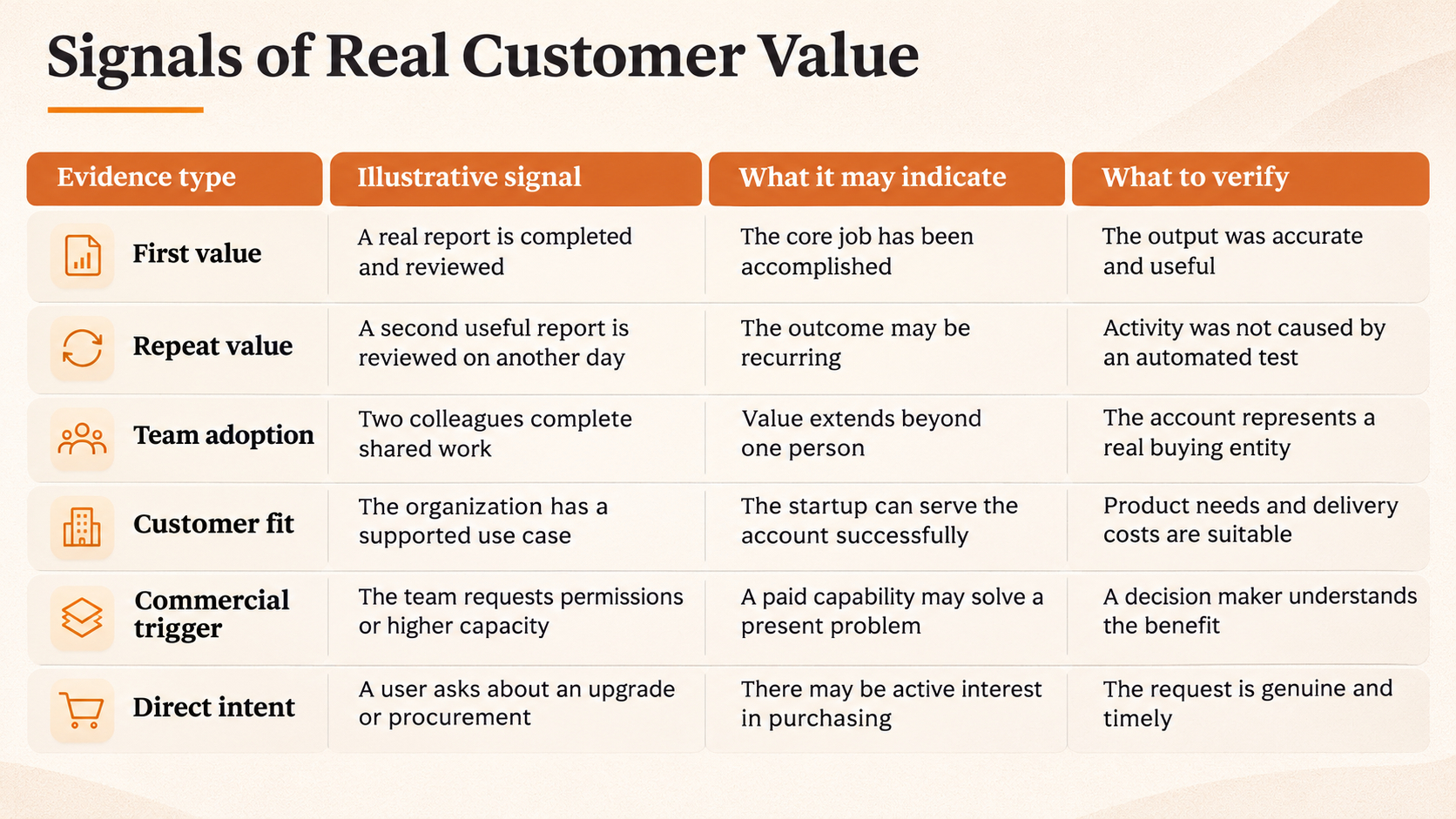
The table works only when the signals influence a decision. A founder might use successful repeat work and customer fit as the minimum requirements, then use an expansion request to determine whether to offer a consultation. An account with genuine value but no commercial trigger may deserve a useful in product explanation rather than a personal sales message. A qualified account that explicitly requests procurement assistance may need a prompt response even if its activity volume is modest.
Build a Simple Qualification Rule Before a Complex Score
A startup does not need a sophisticated predictive model to begin. A transparent rule is easier to explain and more practical to test when data is limited. Start with one commercial objective, such as converting suitable trial accounts to paid plans. Then state the evidence needed for that decision. For example, an account becomes a PQL after completing its core reporting workflow, returning to review another report, matching the supported customer profile, and requesting an advanced team capability.
The definition should also specify when the rule applies. A qualifying event may need to occur within the first thirty days after an eligible account begins a trial. A team might require the most recent meaningful use to have occurred in the past week. The exact windows should reflect the product cycle, not an arbitrary industry standard. A product used during monthly planning may require a much longer observation period than a communication tool used daily.
Record negative conditions as carefully as positive ones. Exclude internal test accounts, known spam, duplicate workspaces, organizations already purchasing the relevant plan, and accounts that requested no contact. Where sufficient data exists, compare a simple binary rule with a scoring system that combines several signals. A higher score is useful only if it improves decisions without concealing why an account was selected.
Example: Qualifying Accounts in a Reporting Startup
Consider an illustrative startup that offers reporting software to small operations teams. During a completed observation period, it identifies 200 eligible trial accounts. Its initial PQL rule requires a successful report, meaningful use on another day, supported customer fit, and a relevant need for a paid team feature. Twenty one accounts satisfy the rule. Of these, eight purchase within a defined forty five day follow up window. Among the other 179 accounts, nine purchase in the same window.
The observed paid conversion is about 38 percent for qualified accounts, compared with about 5 percent for the remaining eligible accounts. This hypothetical difference suggests that the rule may concentrate commercial readiness, but it does not prove that the qualification rule caused purchases. The selected accounts may already have had stronger demand. Small samples can also change sharply when only a few customers behave differently.
The founder should inspect the accounts the rule misses, including paying customers who never became PQLs. An enterprise buyer might need administrative controls before it can complete the typical workflow. Some smaller teams may buy without inviting colleagues. Reviewing both false positives and missed buyers makes the definition more useful than celebrating the conversion rate of a narrow selected group.
Turn Qualification Into the Right Customer Action
Once an account qualifies, a team needs to decide what happens next. Not every PQL requires a salesperson. A user who has experienced value and reached a clear plan limit may benefit most from a contextual upgrade option. A growing team that needs secure access controls may benefit from a short conversation with someone who understands deployment and procurement. An account that is blocked by an integration problem may need customer support before any commercial message.
When a person does reach out, the conversation should begin with the customer goal rather than a generic sales pitch. It is more relevant to offer help extending a workflow the team already uses than to announce that an algorithm has classified the account as a strong buyer. Internal routing can include the evidence behind qualification, the feature or task involved, and the support question the company expects to answer.
Set clear ownership, response expectations, and safeguards against repeated contact. Product, marketing, customer success, and sales teams should share the same definition and understand how a lead changes status. Avoid collecting information unrelated to the service or using sensitive behavioral detail to surprise customers. Where personal data is involved, apply the relevant consent, privacy, and communications requirements.
Measure Whether PQLs Improve Commercial Outcomes
A PQL count is not a measure of business success by itself. Start with a clearly defined eligible cohort and the proportion reaching qualification within a consistent period. Then examine which qualified accounts receive appropriate assistance, how many progress to an accepted opportunity, how many purchase, and whether those customers remain satisfied over time. Make comparisons using the same unit of analysis. If the sales process targets organizations, evaluate conversion by organization rather than by individual users.
Useful quality measures include paid conversion among PQL accounts, paid conversion among eligible accounts that were not qualified, time from qualification to a relevant response, and the share of qualified accounts whose needs a commercial team could actually meet. Retained revenue and customer satisfaction help test whether the program attracts suitable customers rather than simply closing easy trials. Complaints, opt outs, and unwanted outreach are important safeguards.
A stronger experiment separates the value of identifying a qualified account from the value of contacting it. Where ethical and operationally appropriate, compare similar eligible accounts receiving different types of assistance, rather than assuming every purchase after a sales call was caused by that call. Track outcomes across a mature buying window and avoid counting accounts still too early in their journey as failures.
Common Mistakes That Make PQL Programs Unreliable
One mistake is copying another company’s activation threshold as a purchase signal. Customer jobs, collaboration patterns, usage frequency, and purchasing authority differ across products. Another is treating all engaged users as equal. A student researching a free tool may generate more events than a procurement manager evaluating it for an organization, yet have no reason to purchase.
A third mistake is mixing individuals and organizations in the same denominator. It can make an apparent increase in qualified leads reflect nothing more than larger teams using the product. Other errors include changing thresholds every week, using a purchase event as an input into a score meant to predict purchase, and ignoring the users who qualify but never become customers.
Finally, a sales team can damage a useful product experience by contacting customers too early or too often. An account should not be treated as a commercial opportunity merely because its activity appears in a dashboard. Qualification is most valuable when it leads to assistance that matches the customer’s next genuine need.
How an Early Startup Can Start Without Large Data Sets
Founders can begin with a small, explainable process. Interview a few new paying customers to understand what happened before purchase. Compare their product journeys with those of similar trial users who did not buy. Look for a narrow behavior that indicates real value, confirm that the account is a suitable fit, and identify one reason that extra help or a paid plan might now matter.
Use that insight to propose a provisional rule and review its outcomes manually. Sales and support conversations can reveal why an account was misclassified, while product events show whether the intended workflow occurred. When the evidence is too thin to calculate reliable conversion differences, keep the rule provisional and collect observations rather than manufacture precise scores. Revisit the rule after the product, target segment, or purchasing process changes.
The objective is a consistent system that helps customers make progress and helps the startup notice when commercial assistance is genuinely useful. A small startup with clear judgment and accurate events can achieve more than a company with complex scoring software and no shared understanding of customer value.
FAQ
What is a Product Qualified Lead in SaaS?
A PQL is a user or account with meaningful product experience, suitable customer fit, and a reason to consider an upgrade or sales help. Signup alone is not enough.
What is the difference between a PQL and an MQL?
An MQL reflects marketing interest, while a PQL reflects meaningful product behavior. Neither alone guarantees a purchase.
Is a PQL the same as a Sales Qualified Lead?
No. A PQL is identified through product evidence, while an SQL is assessed through a sales process. An account can meet both definitions.
Which events are best for identifying PQLs?
Look for useful completed work, repeat use, team adoption, and genuine paid needs. Test each signal against real customer outcomes.
Can a free user become a PQL without contacting sales?
Yes. A free user can qualify and upgrade independently. A sales conversation is only one possible response to purchase readiness.
How often should a startup change its PQL definition?
Review it when sufficient customer outcomes accumulate or the product or buying journey changes. Avoid frequent changes based on small samples.

Mohsen Avid
Founder & Editor, PinerookMohsen Avid is the founder of Pinerook, covering entrepreneurship, startup strategy, digital business, and the decisions behind building new ventures.
 Seen first.