Product led onboarding is the process of helping a new user complete a meaningful task inside a product with as little unnecessary guidance as possible. The goal is not to show every feature or finish a welcome checklist. It is to help someone experience a result that makes the product worth using again. For an early startup, that first useful outcome often matters more than the visual polish of the introduction.
Within a broader Product Led Growth for Startups strategy, onboarding is the bridge between the promise made before signup and the evidence delivered after it. If that bridge is weak, the product may attract attention without demonstrating value. A founder should therefore design the first session around the customer's job, remove obstacles that do not protect the user, and observe where real work stops.
What Product Led Onboarding Actually Means
Traditional introductions often explain a product from the company's perspective: navigation, settings, features, and everything the user might eventually do. Product led onboarding starts from the user's perspective instead. It asks which task brought this person here, what they need to see to trust the product, and what minimum sequence of actions can deliver a credible first result.
This distinction applies to consumer applications and business software, although the path is rarely identical. A writing tool can offer an editable first draft within minutes. A reporting platform may require a verified data connection before its output becomes reliable. In both cases, the product should make the next useful action clear, explain why any necessary setup exists, and avoid treating completed forms as proof of success.
Begin With the First Useful Outcome, Not the Welcome Screen
The first design decision is to define one narrow task a new user can accomplish. It should reflect the product's core promise and be understandable to someone unfamiliar with its interface. For an appointment platform, the task might be creating a bookable time slot. For a collaborative workspace, it could be sharing a draft that another person can review. The outcome should be genuine, not a decorative demonstration that leaves the user unable to repeat the action independently.
Founders can discover this outcome by observing successful new customers rather than asking the team which features are important. Watch people complete an actual job, ask which step gave them confidence, and identify everything they did before that moment. Then work backward. If an action does not help deliver the first result, establish trust, or meet a real legal or security need, it is a candidate for removal or postponement.
Map the Shortest Honest Path Through the Product
A useful onboarding map follows the user from the entry point to the first meaningful result. Include the steps that are required, the decisions the user must make, the information the product needs, and the obstacles that can block progress. Distinguish friction that serves a purpose from friction that exists because the original interface was designed around internal teams. Verification and consent may be essential. Asking for a company size, preferred color, and billing details before any value appears may not be.
This map should also identify who the user is when the session begins. Someone arriving from an invitation already has context and may need to review shared work. A person who signs up after researching a feature may want a quick demonstration using their own content. Giving both users the same tour can hide the path each one actually needs. Start with a small number of meaningful routes rather than building an elaborate decision tree on day one.
Choose Onboarding Guidance That Helps Work Happen
No single interface component makes onboarding effective. Checklists are useful when there are several short tasks that belong together. Templates work when the user understands the destination but lacks an example. Sample data can reveal the product's capabilities before a user is willing to connect sensitive information. Contextual prompts help when someone reaches an unfamiliar control or repeatedly attempts an action without success. Each tool is worthwhile only if it changes what the user can accomplish.
Avoid covering the screen with messages before the person has tried anything. A short instruction attached to the exact moment of need usually creates less interruption than an extended product tour. Make optional guidance dismissible, provide a reliable way back to help, and let experienced users proceed without proving that they have read a series of tips. A good onboarding system respects attention and does not confuse obedience with understanding.
A Practical Friction Map for Startup Onboarding
The following decision map shows how a small product team can connect a visible obstacle with an appropriate design response. It is a working diagnosis tool rather than a universal checklist. Each change should be tested with the users experiencing the problem.
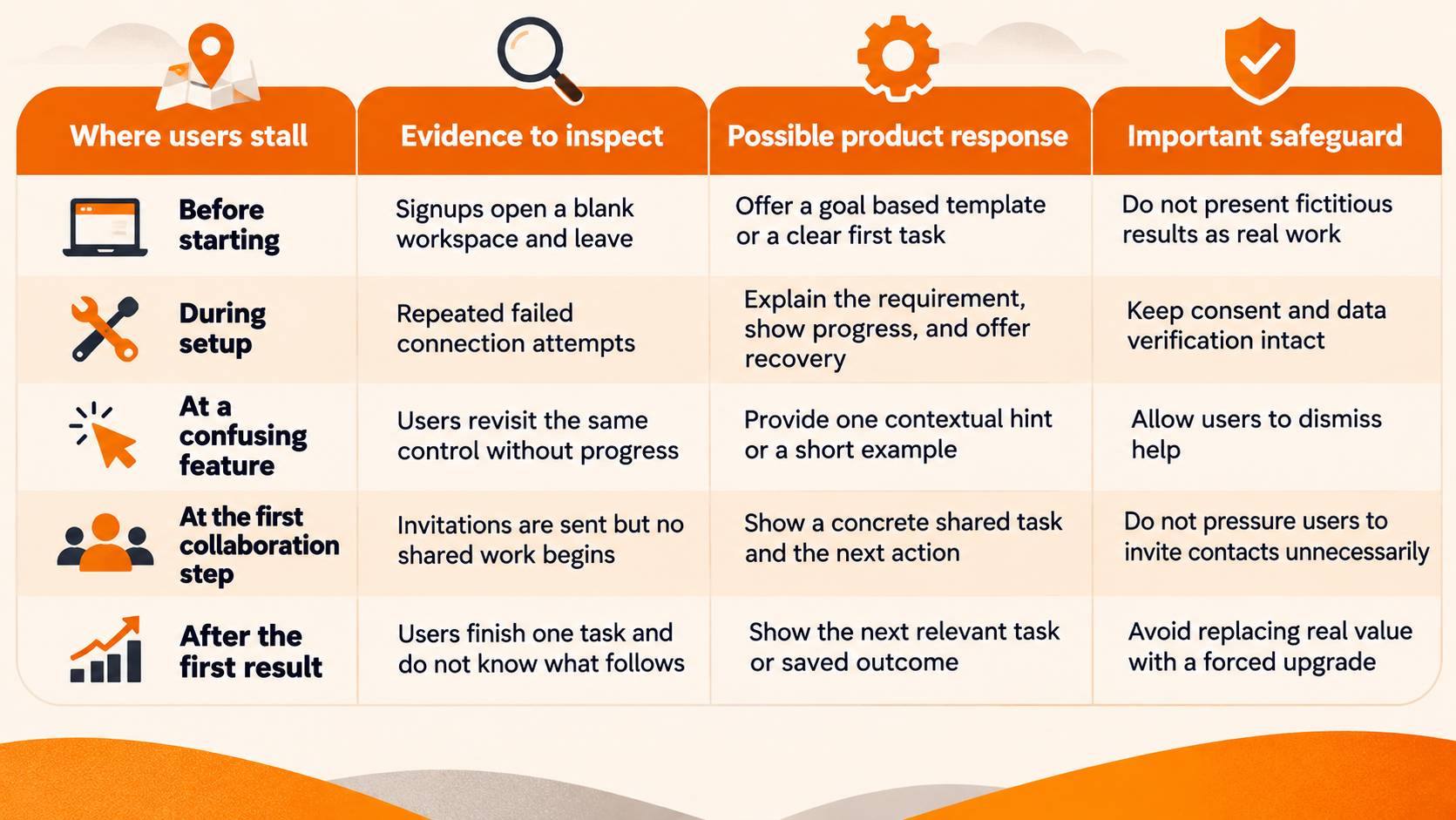
The map reveals a useful rule: the right intervention depends on the cause of the delay. If users do not understand where to begin, a template may help. If their data connection fails, a friendly animation will not fix the problem. If they finish a task but cannot see its outcome, the team must improve feedback rather than add another step. Choose the smallest change that addresses the observed cause.
Make the First Session Relevant Without Collecting Too Much Information
An effective first session can adapt to the user's immediate goal without demanding a detailed personal profile. A single question about the job to be done may be enough to present a relevant template or starting task. Asking for a role can help when an administrator and an individual contributor genuinely need different experiences. Information that does not change the first experience should usually wait until it becomes necessary.
Personalization also creates maintenance costs. Every additional route needs content, testing, analytics, and support. A startup should start with its two most common use cases and observe whether people take different paths toward value. If the paths are essentially the same, a shared flow with contextual help may be easier to maintain than separate introductions. This is particularly important for teams with limited engineering and design capacity.
Treat Required Setup as a Trust Decision
Some products cannot deliver credible value without real information, permissions, or organizational approval. Financial tools may require secure connections. Healthcare software may need access controls. Business systems may depend on administrator consent. The right response is not to remove safeguards in pursuit of a faster demonstration. It is to explain what access is needed, why it is necessary, what will happen next, and what limited preview is possible before consent.
A trustworthy onboarding experience offers recovery when a required step fails. Explain errors in plain language, preserve work that has already been completed, and give users a path to human support for blockers that the product cannot resolve. When sensitive information is involved, avoid using realistic looking sample data that could be mistaken for the user's own records. Transparency is part of the first value experience because it shapes whether users believe the result they see.
Use Behavioural Evidence to Improve the Flow
Founders should watch whether new users reach the intended outcome, where the journey breaks, and what questions people ask before leaving. A simple sequence of product events may include the first opening, meaningful setup, the primary task, and the visible result. Review it alongside short interviews or session observations. A funnel can show where progress stops; it cannot reliably explain whether users were confused, interrupted, cautious, or simply exploring.
Keep measurements narrow enough to support design choices. The proportion of new users who reach the first useful outcome tells the team whether the journey is working at a basic level. Completion by intended use case can reveal a mismatch between the promised experience and the path provided. Support requests can identify hidden dependence on manual guidance. Detailed definitions of activation and its longer term relationship with retention deserve separate analysis; onboarding teams first need evidence about the obstacles they can actually change.
A Fictional Example: A Reporting Product With an Empty Dashboard
Imagine a small startup selling reporting software to service businesses. New customers sign up after seeing a promise to create clearer weekly performance summaries. The first version of onboarding asks them to create a company profile, choose a theme, invite coworkers, configure a schedule, and connect a data source before a report appears. Many users leave after the second step. The team initially interprets this as a lack of demand, even though customers express strong interest in the final report.
The founders observe five sessions and discover that the blank dashboard creates uncertainty. They redesign the first experience around a single goal: preview the shape of a weekly report, then produce one verified report from the user's data. The preview is clearly labeled as sample information. Theme selection and invitations move later. The connection screen explains what data is requested, and connection failures lead to specific recovery instructions. After a valid report is generated, the user can save it or share it with a teammate.
This is a hypothetical design example, not a claim about measured results. The meaningful test is whether more users complete and understand the first report, not whether more people click through the introduction. If the revised flow improves setup completion but users still do not trust the resulting numbers, the company has learned that report accuracy or explanation is the next problem to solve.
Build a Small Onboarding Improvement Cycle
A startup does not need an expensive automation platform to begin. First, choose one new user segment and observe several complete attempts to reach the core outcome. Second, write down the most common point of confusion and the evidence that supports it. Third, make one focused change, such as showing a relevant template, simplifying the first task, or adding a specific recovery message. Fourth, compare new user behavior after the change and check whether the improvement created new problems elsewhere.
Keep acquisition source and user intent in view when comparing results. A visitor seeking a quick preview may behave differently from a teammate joining an established workspace. Product changes, traffic shifts, and seasonal demand can all affect the funnel, so avoid claiming causation from a simple before and after chart. Where volume allows, a controlled test is stronger evidence. With small samples, observation and transparent uncertainty are often more useful than a confident percentage.
Common Mistakes That Turn Onboarding Into Busywork
A long checklist can create the appearance of progress without helping users finish anything meaningful. Feature tours can draw attention away from the task the user came to perform. Heavy personalization can add questions before value appears. Premature upgrade prompts can interrupt discovery. And artificial urgency may push people into actions they do not understand or want.
The opposite mistake is assuming that every user wants to figure everything out alone. Some products involve organizational approval, sensitive data, or unfamiliar concepts. In those situations a clear explanation or timely human assistance is part of good onboarding. The real standard is not the absence of help. It is whether assistance arrives when it reduces a genuine barrier to the customer's outcome.
Product led onboarding works when the product proves its usefulness through a small, trustworthy result and makes the next step understandable. For startup founders, the best starting point is not a collection of interface patterns. It is observing the work new customers are trying to complete, identifying the obstacle that matters most, and building the shortest honest path around it. Better first experiences emerge from evidence about customers, not from forcing people through more screens.
FAQ
What is product led onboarding?
It is a product experience designed to help new users accomplish a meaningful task with relevant guidance inside the product, rather than relying on a mandatory presentation or sales call.
Is product led onboarding the same as a product tour?
No. A product tour is one possible guidance element. Onboarding includes the entire first path to value, including setup, essential permissions, completing work, and understanding the outcome.
Should a startup remove all onboarding questions?
No. Ask only for information that changes the next useful step, supports accuracy, or meets a real security or legal requirement. Defer unrelated profile questions.
Are sample projects useful for onboarding?
Yes, if they help users understand what the product can do and are clearly identified as examples. They should not be presented as verified customer results.
How can founders find where new users get stuck?
Combine a small funnel of relevant product events with direct observations, support conversations, and clear feedback from people attempting the first core task.
Does product led onboarding eliminate human support?
No. Timely human help can improve the experience when users face genuine setup problems, complex buying conditions, or sensitive permissions that software alone cannot resolve.

Mohsen Avid
Founder & Editor, PinerookMohsen Avid is the founder of Pinerook, covering entrepreneurship, startup strategy, digital business, and the decisions behind building new ventures.
 Seen first.