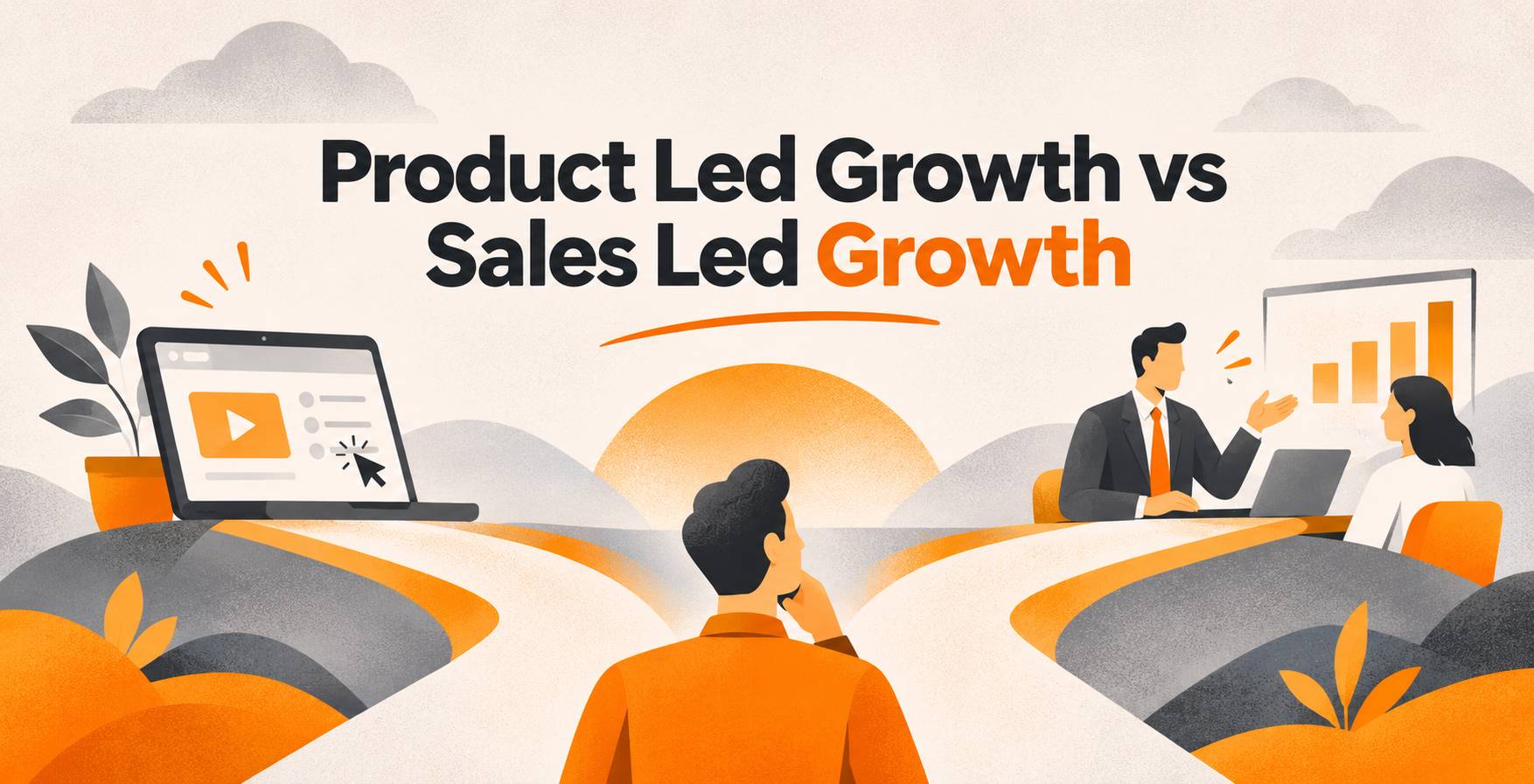
Product led growth and sales led growth solve the same commercial problem in different ways. In a product led model, people discover value mainly by using the product. In a sales led model, a person guides the buyer through discovery, evaluation, purchasing, and often deployment. Neither model automatically produces cheaper acquisition or faster growth. The better choice depends on how customers recognize value, how complicated the purchase is, and what the startup can afford to deliver.
For founders developing a broader Product Led Growth for Startups approach, the immediate question is not whether salespeople should disappear. It is where the customer needs proof, what kind of assistance makes that proof credible, and who should own each step from first interest to paid adoption. A startup may choose one primary model today and add elements of the other as it learns.
The Essential Difference Between Product Led and Sales Led Growth
Product led growth, often shortened to PLG, makes an accessible product experience a central part of acquiring and converting customers. Users may explore a free workspace, complete a real task, and develop confidence through their own results before committing financially. Marketing creates awareness, while onboarding and useful features carry much of the burden of persuasion. Sales can still help larger or more complex accounts.
Sales led growth, or SLG, places a guided commercial process at the center of the journey. A founder or representative identifies the buyer, diagnoses the problem, explains an appropriate solution, coordinates stakeholders, and helps the organization make a purchasing decision. The product still has to work, but the buyer may need financial justification, compliance assurances, or a custom rollout plan before they can use it meaningfully.
The dividing line is therefore not whether a company offers a demo or employs a sales team. It is how much evidence of value the prospect can obtain independently and how much guidance is necessary before adoption becomes possible.
How the Customer Journey Changes
In a product led journey, discovery may lead directly to an account, a guided first task, and a useful outcome. A customer might create a project, generate a report, share it with a colleague, and then choose a paid plan when the need expands. The company learns from observable product behavior, although interviews remain necessary to understand motivation and satisfaction.
In a sales led journey, the first meaningful step may be a conversation rather than a signup. The representative clarifies the problem, uncovers budget and authority, and may arrange a tailored demonstration or pilot. The buyer can still test the product, but evaluation is organized around stakeholders and purchase requirements. Progress is demonstrated through agreed milestones, not only account activity.
Both paths can fail when an early signal is mistaken for a commercial result. A signup does not prove activation, and a completed sales demonstration does not prove willingness to buy. Startups should decide what evidence will make the next step reasonable before spending heavily on either motion.
Comparison of Product Led and Sales Led Growth
The table compares how each model tends to operate. These are decision patterns, not guaranteed outcomes or universal industry benchmarks.
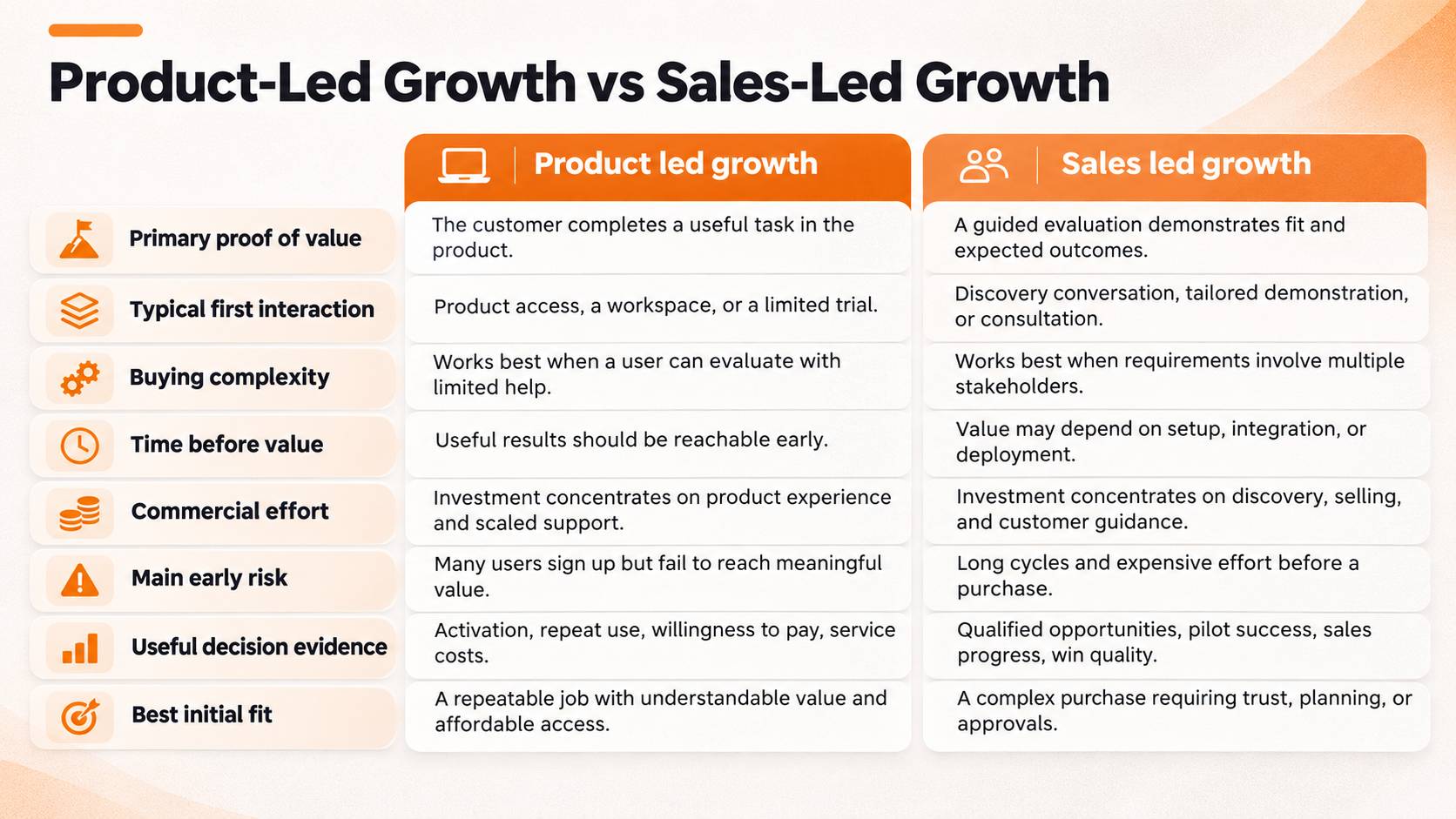
A company can combine the two columns. A user may experience value independently while an operations leader requires a security review and a sales conversation. The correct design follows the customer journey rather than forcing every account through the same process.
When Product Led Growth Is the Stronger Choice
PLG is most promising when the problem is recognizable, the product solves a useful piece of it quickly, and the buyer can begin with limited permissions or assistance. A design review tool that lets a professional upload a file and receive meaningful feedback is easier to evaluate independently than an enterprise system requiring a full data migration before the first result appears.
The initial experience must prove an authentic outcome. A dashboard filled with sample data may demonstrate navigation, but it does not establish that the tool works with a real customer workflow. Founders should test whether suitable users can reach first value, return when the problem recurs, and understand what a paid plan adds.
PLG also requires commercial discipline. Free access consumes infrastructure, support, and sometimes substantial computing resources. A large signup total can become an expense rather than an advantage if most accounts never realize value or have no realistic route to payment. A simple product experience is not automatically an inexpensive product to operate.
When a Sales Led Approach Creates More Value
Sales led growth may be more suitable when the economic buyer is different from the person using the product, or when purchasing involves legal, security, integration, and organizational change. A hospital network considering specialized infrastructure software may need assurance about data handling, procurement requirements, deployment responsibility, and training before it can authorize a meaningful pilot.
This model can also be valuable when the problem itself requires diagnosis. Early conversations may reveal what customers actually mean by a requirement, which features matter to their organization, and what alternatives are already being considered. For a young startup, those conversations provide learning that would be lost if the founder tried to automate every interaction too early.
The cost is that human assistance does not scale without limits. Long evaluation cycles can absorb founder time, and a pipeline filled with interested but unqualified prospects can mislead the team. A disciplined process defines buying authority, a credible problem, the next commitment, and the evidence required to move forward. More meetings are not necessarily more demand.
Compare Economics Without Assuming One Model Always Costs Less
Product led growth is often associated with lower selling effort for small purchases, but that does not guarantee lower total acquisition cost. Product engineering, experimentation, support, infrastructure, and unsuccessful free accounts all consume resources. Sales led companies invest in people and longer evaluations, but a sufficiently valuable contract may support that expense. The relevant comparison is the cost of winning and serving a valuable customer, not the number of people on the sales team.
Founders should compare matched customer segments and similar observation periods. In the product led route, look at the share of suitable signups that reach meaningful value, return, and become paying customers. In the sales led route, examine qualified opportunities, the work required to complete evaluations, purchase conversion, and implementation success. Compare the cost of those processes alongside retention and eventual account value.
A widely discussed McKinsey analysis of publicly listed software companies cautioned against assuming that product led firms routinely outperform traditional sellers. A small set of strong performers accounted for much of the apparent advantage. That finding is informative but not a universal prediction for early startups, whose product maturity and customer mix can differ substantially from public companies.
For additional context on that research and the emergence of combined models, see McKinsey's analysis of product led sales. The useful lesson is to test fit rather than adopt a label as a promise of superior performance.
The Hybrid Model and the Point Where Sales Should Enter
Many businesses benefit from allowing users to begin independently while retaining help for accounts with complicated buying requirements. In this combined approach, the product proves the immediate usefulness of a solution, and sales assists with organizational approval, implementation planning, or expansion. A hybrid model should have intentional handoffs, not a collection of disconnected forms and outreach messages.
The best trigger for assistance is not simply a large number of clicks. A team may have invited colleagues, completed an important workflow several times, and requested controls required for a wider deployment. Those signals, together with stated needs and company fit, can justify a conversation. By contrast, a user repeatedly visiting a help page may need support rather than a sales pitch.
Ownership should be explicit. Product teams improve the path to first value; sales handles the decisions that require negotiation or coordination; customer success verifies that promised outcomes survive deployment. The buyer should not have to repeat the same information at every handoff. A sales intervention adds value when it reduces uncertainty for the customer rather than merely slowing down a purchase.
A Founder Decision Framework for Choosing the First Motion
Begin with the customer rather than the growth label. Interview prospective users and buyers separately when they are not the same person. Ask what they must see before trusting the solution, who can approve a purchase, what data or integrations are required, and whether a small useful result is possible without organizational deployment.
Next, build the smallest credible evaluation path for each plausible motion. A product led test may let suitable users complete a real task without a meeting. A sales led test may involve a structured problem conversation, a focused demonstration, and an agreed pilot with a documented next step. Each path should serve a comparable customer need even if the interactions differ.
Finally, define the evidence that would change your decision. For independent usage, observe first value, meaningful return, the support burden, and willingness to pay. For guided selling, observe the proportion of qualified conversations that reach a real evaluation, the effort required, and whether buyers complete commitments. If both produce genuine demand, preserve both while deciding which segments each route should serve. Do not treat a few early interactions as statistically decisive.
A Fictional Example of Two Buying Paths
Consider an illustrative startup called AuditLane, which helps organizations prepare internal compliance evidence. A small consulting practice can upload a limited set of documents, organize the findings, and produce a useful review without assistance. This use case suggests a product led entry path, provided the trial protects sensitive information and the company can afford the cost of serving trial accounts.
A large regulated organization wants to connect internal repositories, enforce permissions, and coordinate approval among security, legal, and procurement teams. The same software may help these users, but a representative needs to establish requirements, clarify deployment boundaries, and structure the evaluation. That is a sales led buying path even if employees experience the product during a pilot.
The startup does not have to choose a single experience for every account. It can offer an independent initial workflow for smaller customers and an assisted route for complex organizations. The practical test is whether each group reaches credible value, completes a purchase it understands, and continues using the service. These are hypothetical scenarios, not reported results or industry benchmarks.
Mistakes That Distort the Choice
One mistake is equating a free trial with product led growth. If every user needs a meeting to perform the core task, the free trial is simply a preliminary stage in a guided process. Another is treating sales led growth as inherently outdated. Buyers managing material risk may reasonably prefer human expertise before they commit.
A third mistake is comparing signup volume with sales pipeline revenue as though they were the same metric. Different paths create different signals. Founders need to compare the quality of customer outcomes, total effort, commercial value, and repeat usage rather than selecting whichever dashboard looks more impressive.
Teams can also move toward hybrid growth without deciding who owns the customer experience. Unsolicited sales outreach can interrupt independent users, while a hands off approach can leave complex buyers without answers. A clear escalation rule, informed consent, and shared customer context prevent those failures.
Frequently Asked Questions
What is the main difference between product led and sales led growth?
Product led growth uses independent product experience to demonstrate value and support adoption. Sales led growth relies more on guided conversations, evaluations, and purchase coordination. Both can include product trials and sales assistance.
Is product led growth always cheaper than sales led growth?
No. Product led businesses still pay for development, onboarding, support, infrastructure, and free usage. Sales led businesses pay more directly for human selling, which may be justified by a complex purchase or larger customer value.
Does sales led growth work for an early startup without a sales team?
Yes. A founder can conduct discovery, run demonstrations, and guide pilots personally. The important question is whether direct conversations help customers make the decision and produce useful evidence for the startup.
Can a startup combine both growth models?
Yes. A product can allow independent first use while sales assists with enterprise requirements, team expansion, or negotiated purchases. The handoff should follow clear customer needs and product signals.
What should founders measure when comparing the two models?
Compare evidence of customer value, buying progress, cost to win and serve customers, and continued usage. Product activation and qualified sales opportunities measure different stages, so they should not be treated as interchangeable.
When should a startup switch its growth model?
Reconsider the primary model when buyers repeatedly get stuck at the same stage, sales effort is economically unsustainable, or independent users cannot reach value without guidance. Test changes within a defined customer segment before reorganizing the entire business.

Mohsen Avid
Founder & Editor, PinerookMohsen Avid is the founder of Pinerook, covering entrepreneurship, startup strategy, digital business, and the decisions behind building new ventures.
 Seen first.