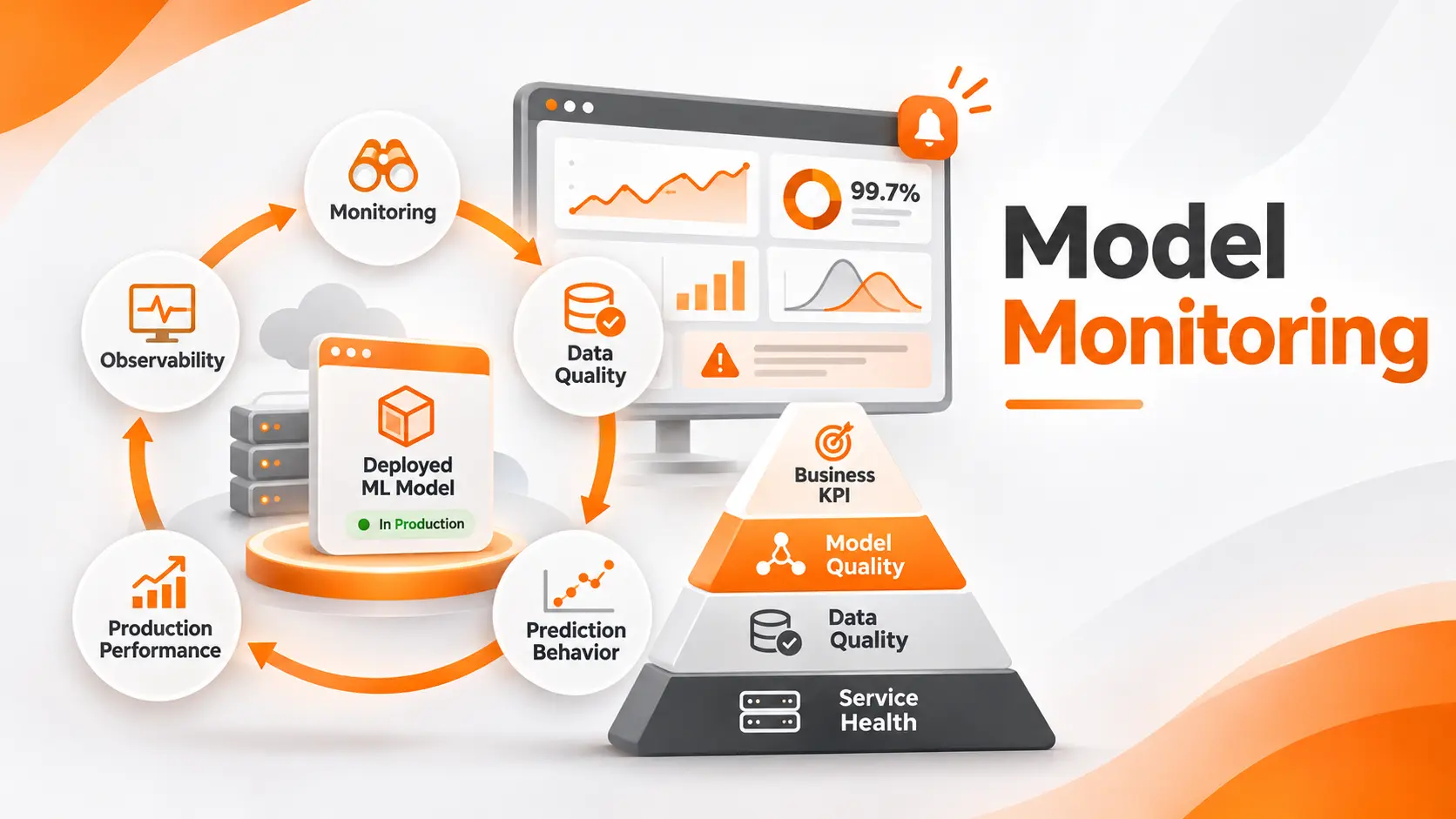
A machine learning model can perform accurately during testing and still produce unreliable predictions after deployment. Changes in customer behavior, incoming data, and application conditions can affect its results without causing a visible system failure.
Model Monitoring is the process of tracking a deployed machine learning model to verify that its predictions, input data, and operational performance continue to meet defined requirements. It helps teams detect problems, investigate their causes, and decide when corrective action is necessary.
When I assess a production ML system, I focus on what happens after its first successful prediction. A working endpoint proves that the model is accessible, but it does not prove that its predictions remain useful. Effective monitoring needs to measure both.
Model Monitoring Process
Monitoring a machine learning model begins with collecting evidence of its behavior in production. The process connects recorded predictions, incoming data, performance measurements, and defined acceptance criteria.
Within MLOps, monitoring provides the information needed to evaluate deployed models and make informed operational decisions. Without this feedback, teams cannot reliably distinguish a healthy model from one that continues running while delivering poor results.
I structure the monitoring process around four connected activities.
Production Data Collection
The first step is recording the information needed to evaluate each prediction. This includes input characteristics, model outputs, execution timestamps, model versions, and relevant operational measurements.
For a fraud detection model, the system can record the transaction characteristics used for inference, the predicted fraud score, and the identifier of the model that generated it. Once the transaction outcome becomes available, that result can be connected to the earlier prediction.
The collected information must be sufficient for evaluation while following the organization's data security and privacy requirements.
Performance Evaluation
The next step is calculating metrics that reflect the model's actual purpose. A classification model needs different evaluation criteria from a forecasting model, and the selected metrics must match the business decisions supported by its predictions.
Evaluation should compare production results with predefined requirements and an appropriate reference period. This allows engineers to identify whether a change represents an operational problem or remains within acceptable performance limits.
Anomaly Detection and Alerts
Monitoring systems compare recorded measurements with established baselines and alert thresholds. An alert identifies a condition that requires investigation, such as an increase in prediction errors, invalid inputs, or inference latency.
Not every detected change requires immediate intervention. I separate warning conditions from critical failures so the team can respond according to the impact on the application.
Investigation and Corrective Action
An alert starts an investigation rather than automatically triggering model retraining. The team must determine whether the problem originates from incoming data, infrastructure, feature processing, or the model's learned behavior.
The appropriate action depends on that finding. A broken input pipeline requires a data correction, while evidence of declining predictive quality can justify evaluating a new model version.
Key Model Monitoring Metrics
Choosing the right metrics is the most important part of a monitoring strategy. A dashboard containing dozens of measurements provides little value if none of them explains whether the model is meeting its intended requirements.
I separate monitoring into model quality, data integrity, prediction behavior, service reliability, and business performance. Each category reveals a different aspect of the production system.
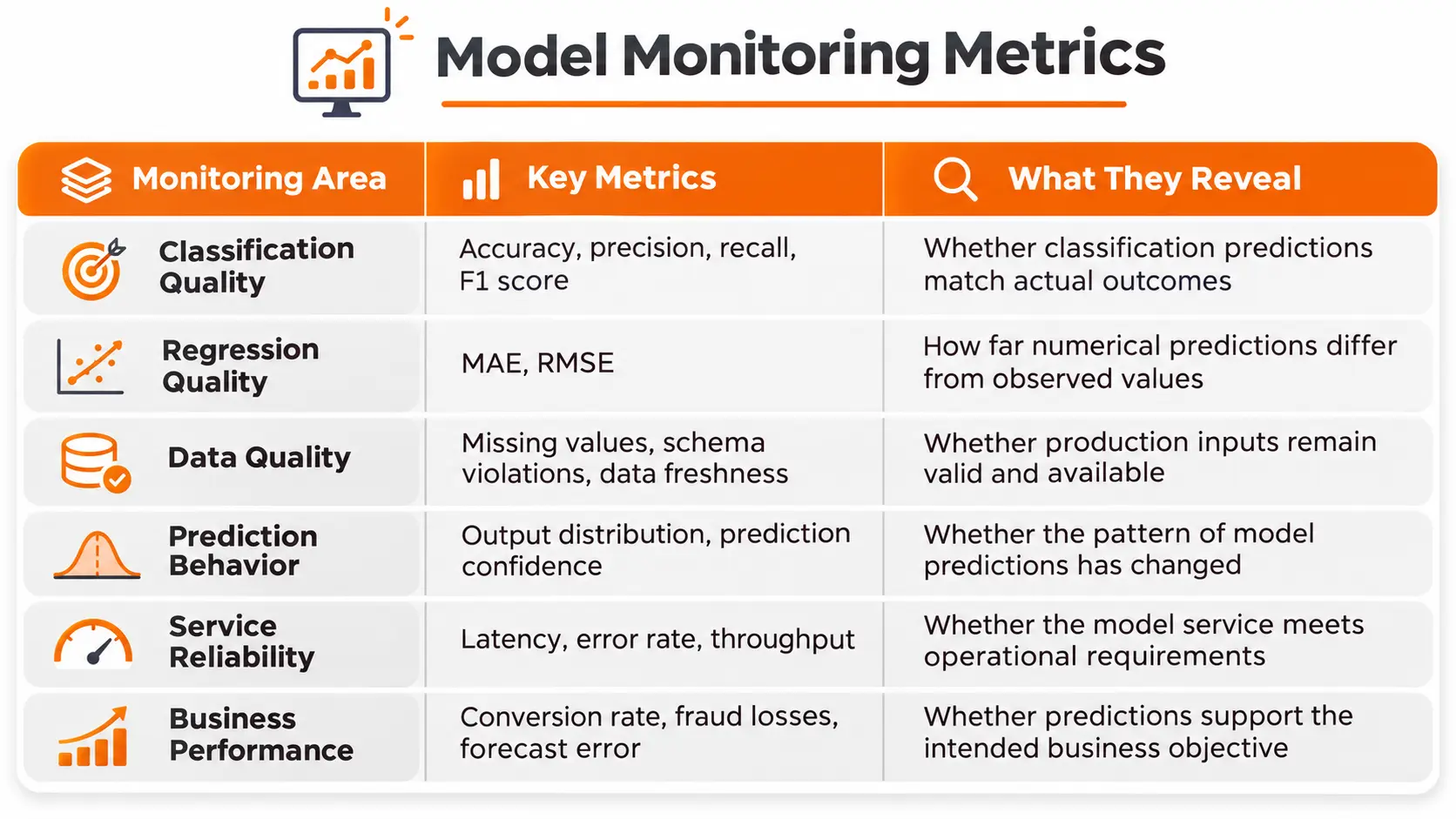
These metrics should not be treated as interchangeable. A model can maintain stable prediction distributions while its accuracy declines, and a service can respond quickly while generating incorrect predictions.
The most useful monitoring setup connects technical measurements with the decisions made using the model's output.
Monitoring Models Without Ground Truth
One of the biggest practical limitations in model monitoring is that actual outcomes are not always available when predictions are generated.
Consider a customer churn model that predicts whether a subscriber will cancel within the next 30 days. The system generates a prediction today, but the result cannot be evaluated against the customer's actual behavior until the observation period has passed.
During that interval, I would monitor input validity, prediction distributions, feature availability, and service performance. These measurements provide evidence about changing production conditions, but they cannot establish the model's actual accuracy.
Once the outcomes become available, the system must match them with the original predictions using appropriate identifiers and timestamps. The team can then calculate performance metrics for the corresponding prediction period.
This distinction matters because a change in prediction behavior is not proof of declining accuracy. Direct performance evaluation requires reliable outcome data.
Model Monitoring Architecture
A production monitoring architecture connects the prediction service with data collection, metric computation, storage, visualization, and alerting systems.
The inference service generates predictions while recording the information required for evaluation. A separate monitoring process analyzes those records and compares the results with reference data or accepted operating ranges.
Separating prediction execution from analytical monitoring also protects the application's response time. Expensive statistical calculations can run through scheduled processing jobs without delaying customer requests.
Monitoring Frequency
The monitoring schedule should reflect how quickly a problem can affect the application and how much information is available for evaluation.
A payment fraud model requires rapid visibility into service failures and invalid transaction inputs. A daily demand forecasting model can be evaluated after each scheduled prediction cycle.
Different metrics can use different schedules within the same system. Infrastructure failures require immediate attention, while predictive accuracy must be evaluated when sufficient verified outcomes have been collected.
Setting Baselines and Alert Thresholds
Monitoring metrics become useful when the team establishes what acceptable performance looks like.
A baseline provides a reference for comparison. It can come from validated model results, historical production measurements, or a defined period of reliable operation.
For example, assume a prediction service has an established input validation process and the acceptable missing value rate for a required feature is below 1%. If that rate reaches 4%, the monitoring system has evidence of a data quality violation that requires investigation.
The threshold must come from the application's requirements and the effect of invalid inputs, not from a universal value applied to every model.
I also examine the measurement window. A short window can reveal sudden operational changes, while a larger window provides more observations for evaluating trends. The chosen window must contain enough data to support a meaningful comparison.
Seasonal patterns and changes in request volume also affect interpretation. Comparing a weekend's customer activity with an unrelated weekday baseline can generate misleading alerts even when the model is operating as expected.
Alert Priority and Response
A warning should identify a measurable deviation that needs review. A critical alert should indicate a condition that threatens an established production requirement.
Each alert needs a defined owner, an investigation procedure, and a clear escalation path. Without those elements, monitoring produces notifications rather than operational decisions.
Model Monitoring in Practice
Consider an online retailer using a machine learning model to predict which customers are likely to complete a purchase.
The model receives customer activity data and produces a probability score that the application uses to personalize recommendations. Its performance has been validated before deployment, but the team must now determine whether the results remain reliable as customer behavior changes.
I would begin by monitoring the quality of incoming customer activity records. Missing product information, invalid event timestamps, and delayed data delivery can affect the predictions before any change in the model itself.
Next, I would examine prediction distributions and service performance. An unexpected increase in low purchase probabilities deserves investigation, particularly if it appears alongside changes in input quality or customer traffic.
Once completed purchase outcomes become available, the predictions can be matched with actual results. The team can then calculate predictive performance and examine whether the model's probability estimates correspond to observed purchasing behavior.
If conversion declines while predictive quality remains stable, I would investigate the shopping experience and other business conditions before blaming the model. A falling business metric does not establish that the machine learning system is responsible.
This approach separates measurement from assumption and keeps corrective decisions tied to evidence.
Investigating Model Monitoring Alerts
A monitoring alert identifies a deviation, but the investigation must establish what caused it.
My first step is to identify which measurement changed and when the change began. I then compare that period with deployment records, data pipeline activity, and relevant application events.
If prediction latency increases while model outputs remain stable, the investigation should focus on serving infrastructure, resource usage, and request processing. If incoming features contain invalid values, the data pipeline and preprocessing logic require attention.
A change in input distributions requires a different investigation. Model Drift describes changes in data distributions or relationships affecting model behavior, but detecting a shift does not establish that predictive performance has declined. The team must examine the affected features and available outcome measurements.
The final decision should follow the identified cause. Repairing a data pipeline, adjusting serving capacity, restoring an approved model version, and retraining a model solve different problems.
Treating every alert as a retraining trigger introduces unnecessary changes and can leave the original failure unresolved.
Model Monitoring Tools
The choice of monitoring technology depends on where the model runs, which measurements the team needs, and how the results must integrate with existing infrastructure.
Evidently AI provides tools for evaluating data quality, prediction behavior, and machine learning performance. Its reporting capabilities support comparisons between production data and reference datasets.
Arize AI and Fiddler AI provide platforms for monitoring and investigating model behavior. Their capabilities include model evaluation, operational visibility, and analysis of production predictions.
Azure Machine Learning provides monitoring features for deployed models, including data quality measurements, changes in input and prediction distributions, and configurable monitoring jobs.
I would evaluate these technologies based on data integration, supported metrics, alerting requirements, and the effort required to maintain the monitoring process. The tool must fit the operational environment rather than determine how the entire system is designed.
Model Monitoring vs. Model Observability
Model monitoring and model observability support related but different operational goals.
Model Monitoring tracks defined measurements and identifies when model behavior or operational performance moves outside accepted conditions. It answers whether the system is meeting its requirements.
Model Observability provides broader information for understanding the internal behavior and interactions of the system. It supports deeper investigations into how predictions, dependencies, data transformations, and infrastructure contribute to an observed issue.
A monitoring dashboard can identify that inference latency has increased. Detailed traces and operational records help determine whether the delay comes from preprocessing, model execution, or another service.
Both capabilities support production reliability, but monitoring defines what needs attention, while observability provides additional evidence for understanding the cause.
Reliable Model Monitoring in Production
A successful monitoring process does more than display model metrics. It connects measurable production behavior with the decisions required to maintain a dependable machine learning application.
I consider monitoring effective when the team can identify a meaningful problem, verify its impact, investigate its cause, and select an appropriate response without relying on assumptions.
The strongest approach starts with a small set of relevant measurements, reliable reference data, and clear operational responsibilities. Additional monitoring capabilities should support those requirements rather than add complexity without improving decisions.
FAQ
Can I monitor a model that barely gets any traffic?
Yes. Models with low prediction volumes can still be monitored for data validity, execution failures, and operational availability. Statistical comparisons require sufficient observations, so evaluation windows should be defined according to sample size and the reliability of the resulting measurements rather than a fixed daily schedule.
Is it safe to save every prediction my model makes?
Not without appropriate data controls. Prediction records can contain personal, financial, or commercially sensitive information. Organizations should apply data minimization, access restrictions, retention policies, and applicable privacy requirements. Aggregated measurements and carefully designed identifiers can reduce the need to retain sensitive raw inputs.
Can I monitor a model that runs through someone else's API?
Yes. An organization can monitor the inputs it sends, the outputs it receives, response latency, error rates, and application outcomes. Access to internal model parameters or training data is not required for these measurements. Visibility into the provider's internal infrastructure depends on the information the provider makes available.
Do I need separate monitoring for every version of my model?
Each deployed version should be identifiable in monitoring records. A shared monitoring system can evaluate multiple versions, but performance measurements must preserve version information so the results can be compared accurately. Combining predictions from different versions without distinguishing them can conceal differences in their behavior.
My model doesn't return confidence scores. Can I still monitor it properly?
Yes. Confidence scores are not required for monitoring input validity, prediction distributions, service health, or performance against verified outcomes. The available measurements depend on the model's output format and task. If confidence information is required for a specific operational decision, the model interface and evaluation approach must be designed to provide a suitable measure.

Fatemeh Jahangard
Technology & AI Writer at PinerookFatemeh Jahangard covers AI, emerging technologies, and digital innovation for Pinerook, focusing on how technology shapes startups and industries.
 Seen first.


