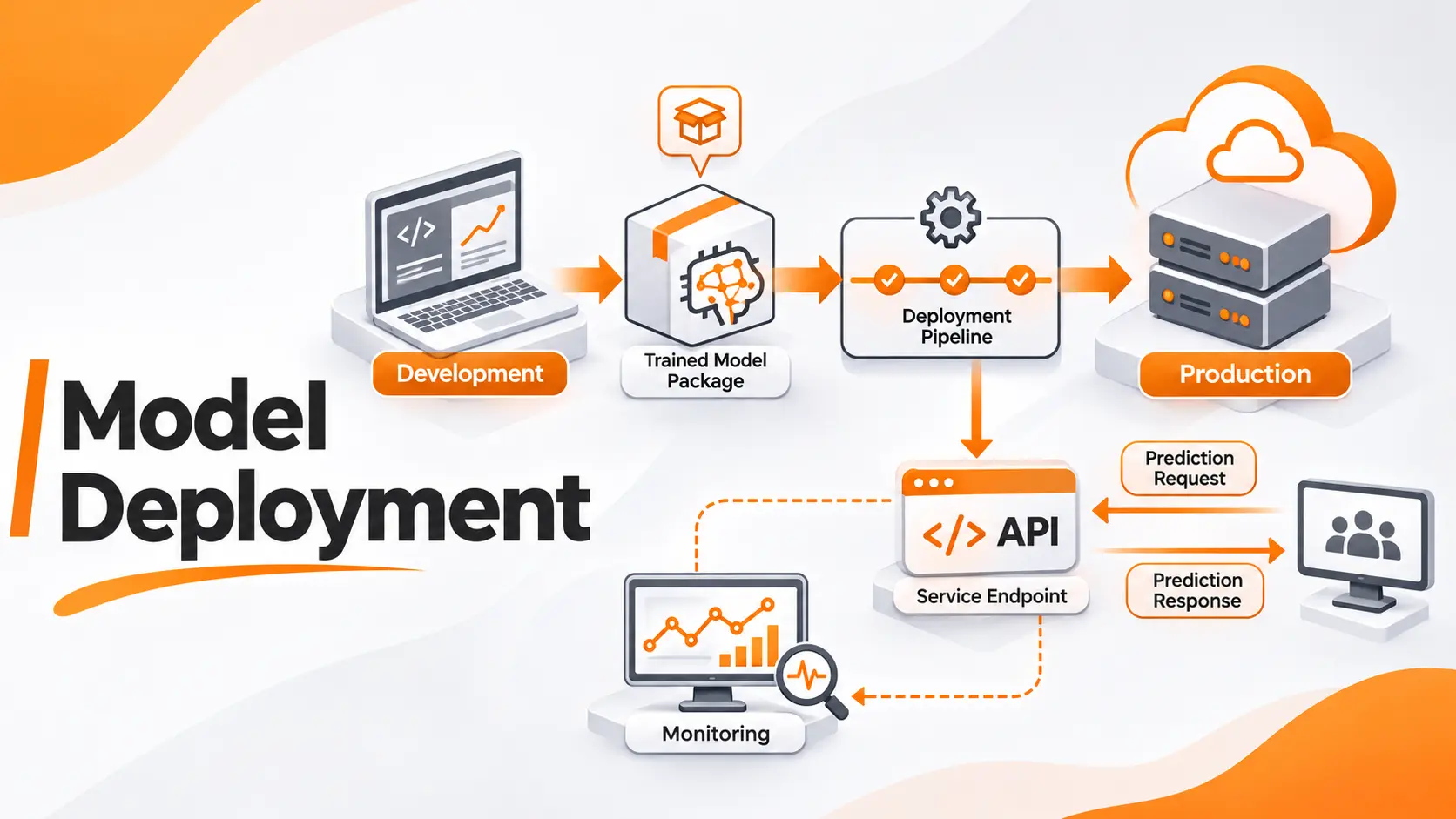
A machine learning model can deliver excellent predictions during testing and still be useless to customers if it never reaches a working application. Model is the process of taking a trained and validated machine learning model into a production environment, where it can process real data and generate predictions for users or business systems.
The process involves more than uploading a model file to a server. The model needs the right execution environment, a reliable connection to incoming data, and a release process that protects the application when a new version goes live.
When I assess a deployment plan, I focus on three things: whether the model can handle production inputs, whether the infrastructure meets the application's performance requirements, and whether the team can safely replace a failing version. These decisions determine whether a promising model becomes a dependable product.
Model Deployment Process
Deploying a machine learning model requires a controlled transition from development to production. The objective is to preserve the behavior established during validation while making the model accessible to the application that needs its predictions.
I prefer to treat deployment as a series of verifiable steps rather than a single release action. Each step should have a clear result before the next begins.
Model Validation and Release Approval
Before deployment, the model must satisfy its defined quality requirements using evaluation data that was not used to fit the model. For a fraud detection system, that means checking detection performance and false positive rates against the requirements of the payment workflow.
The evaluation should also cover relevant data segments and operating conditions. A model with strong overall accuracy is not ready for production if it fails an important business constraint. Once validation is complete, the approved model version and its evaluation results should be recorded.
Model Packaging and Environment Setup
The next step is preparing everything required to execute predictions. This includes the trained model artifact, inference code, preprocessing logic, software dependencies, and runtime configuration.
I pay particular attention to preprocessing consistency. If the training pipeline uses one method to transform customer data and the production application uses another, the model receives inputs that differ from those it learned to interpret.
The packaged model must also be compatible with the selected infrastructure, including its processor architecture, available memory, and required software libraries.
Staging and Integration Testing
A staging environment allows the team to test the deployment before exposing it to production traffic. The application sends representative requests through the complete prediction workflow, including input validation, preprocessing, inference, and response formatting.
Testing should cover invalid inputs, missing fields, concurrent requests, and infrastructure failures. This reveals integration problems that model accuracy tests cannot detect.
The important result is evidence that the application and model work together, not just confirmation that the model can generate a prediction.
Production Release and Verification
After the staging tests pass, the approved model is released using the selected deployment strategy. The application begins directing prediction requests to the new version according to the rollout plan.
Verification continues during the release. Engineers check request success, response times, resource consumption, and the behavior of the application receiving the predictions.
The deployment is accepted only after it meets the predefined release criteria. If those criteria fail, traffic should return to the approved version or another defined fallback.
Types of Model Deployment
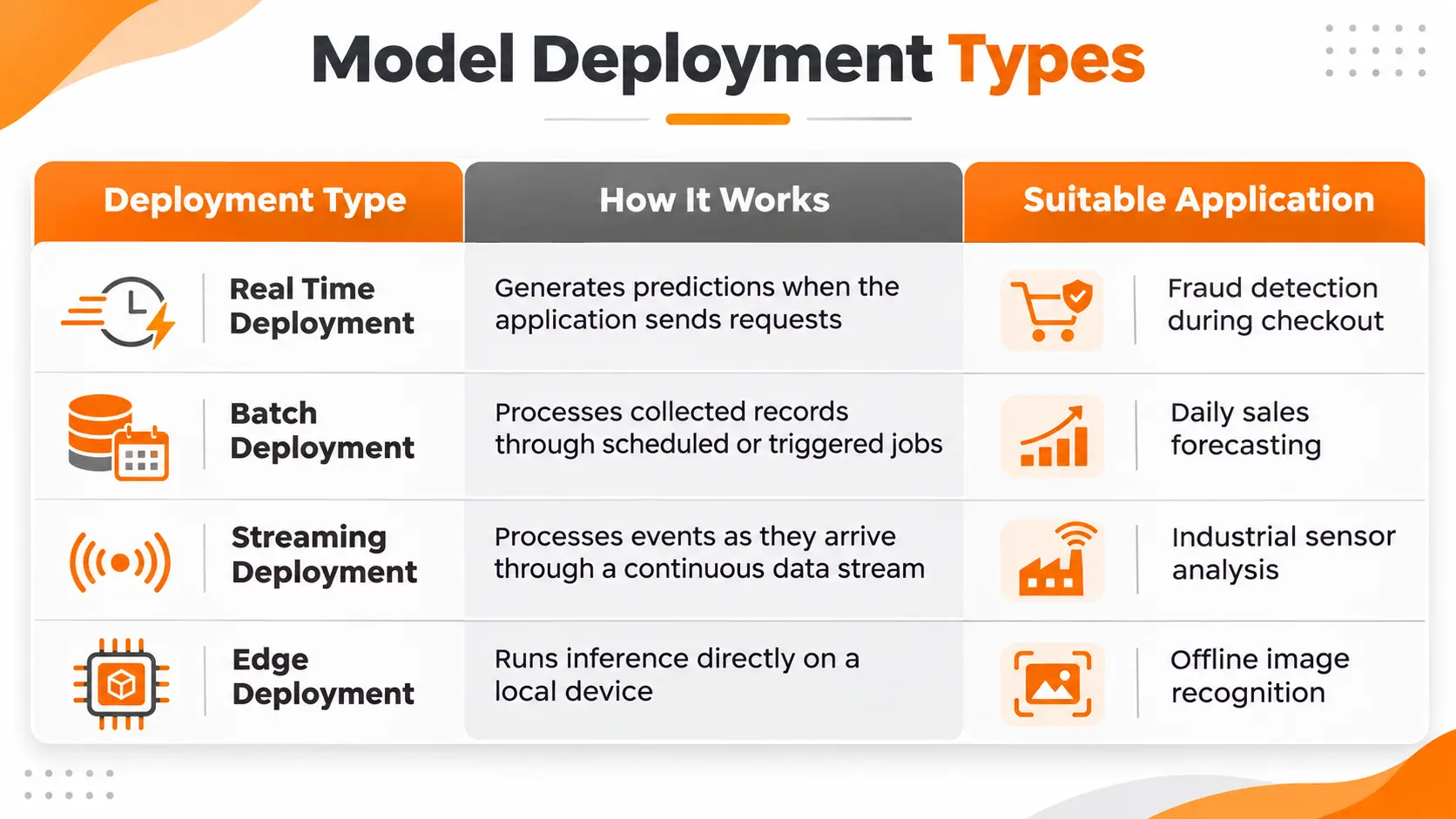
The deployment method depends on when predictions are needed, how data arrives, and where the model must execute.
The clearest way to choose a method is to begin with the application's requirements rather than the available infrastructure.
Real Time Deployment
Real time deployment makes a model available to applications that require immediate predictions. A payment system, for example, can submit transaction details to a prediction service and use the response before approving a transaction.
Response time is critical because inference becomes part of the application's user experience. The infrastructure must support the required request volume while maintaining acceptable latency.
Batch Deployment
Batch deployment processes data in groups rather than responding to individual requests immediately. A retailer can collect transaction records throughout the day and run a demand forecasting model overnight.
This approach suits workloads where results are needed at scheduled intervals. It also allows computing resources to be allocated around processing jobs instead of maintaining a continuously active prediction service.
Streaming Deployment
Streaming deployment connects a model to a continuous flow of incoming events. An industrial monitoring system can process sensor readings as they arrive and produce predictions for equipment conditions.
Streaming describes how data is processed, rather than requiring a completely separate model hosting technology. The model can execute inside a stream processing system or through a prediction service connected to that system.
Edge Deployment
Edge deployment places the model on a device close to where data is generated. Smartphones, industrial controllers, and embedded systems can perform predictions without sending every input to a remote server.
The model must fit the device's memory, processing, storage, and power constraints. Local inference can also support applications that must operate without a network connection.
Model Deployment Architecture
A production deployment connects the application, inference runtime, model artifact, and supporting infrastructure.
For an online prediction service, the request enters through an authenticated endpoint. The service validates the input, applies the required transformations, executes the model, and returns a response in the format expected by the application.
The model itself is only one part of that workflow. A complete architecture also needs appropriate compute resources, dependency management, logging, access controls, and a method for selecting the active model version.
The underlying machine learning operations process, known as MLOps, connects deployment with model development and ongoing operational management. The deployment architecture is responsible for making the approved model available, while the wider process maintains control over its lifecycle.
Model Deployment vs. Model Serving and Inference
These three concepts describe different responsibilities.
Model Deployment is the process of releasing an approved model into an operational environment.
Model Serving is the infrastructure that makes the deployed model available to applications, whether through an endpoint, a batch job, or another execution interface.
Model Inference is the actual computation that produces a prediction from new input data.
For example, publishing a fraud detection model to an online endpoint is deployment. Keeping that endpoint available is serving. Calculating a fraud score for a transaction is inference.
Understanding this distinction helps teams separate release failures from runtime problems and prediction quality issues.
Model Deployment Strategies
A deployment method determines how predictions are delivered. A deployment strategy determines how a new model version replaces or operates alongside an existing version.
The choice matters because a model that passes offline evaluation can still cause problems when exposed to production traffic.
Canary Deployment
Canary deployment routes a limited portion of eligible production traffic to a new model version. The existing version continues serving the remaining traffic while engineers evaluate the candidate.
For a payment application, the team can initially expose a small share of requests to the new model and compare the results against established release thresholds.
If the candidate passes validation, traffic can be increased until the release is complete. If it fails, the team stops the rollout and restores traffic to the existing version.
Blue Green Deployment
Blue green deployment maintains two separate production environments. The current model runs in one environment while the new version is prepared and validated in the other.
Traffic is then switched to the new environment according to the release plan. Keeping the previous environment available provides a direct recovery path if the new deployment causes problems.
This strategy requires enough infrastructure capacity to support both environments during the transition.
Shadow Deployment
Shadow deployment sends a copy of production requests to a candidate model without allowing its predictions to control the live application's decisions.
I consider this valuable when a team needs evidence about runtime behavior before giving a new model responsibility for real outcomes. The candidate can be evaluated using production inputs while the existing model remains responsible for user facing predictions.
The shadow environment still consumes computing resources and must follow the same security and data handling requirements as the production system.
Model Deployment Tools and Infrastructure
The right deployment technology depends on the model framework, hosting environment, traffic requirements, and the operational capabilities of the team.
For a model built with Python, a lightweight prediction API can be developed using FastAPI. Docker can package the application and its dependencies into a container, while an appropriate hosting environment provides the computing resources.
BentoML offers model serving and deployment capabilities designed for machine learning applications. KServe supports model serving on Kubernetes environments.
Managed services such as Amazon SageMaker AI, Azure Machine Learning, and Google Cloud Vertex AI provide infrastructure for deploying and operating models without requiring teams to build every hosting component themselves.
I would select a managed service when reducing infrastructure maintenance is a priority. A custom deployment environment becomes relevant when the organization needs direct control over runtime configuration, integration, or infrastructure.
The selection should account for operational cost, response time, scaling requirements, and the engineering effort needed to maintain the system.
Model Deployment in Practice: Fraud Detection
Consider an online payment platform that uses a machine learning model to identify suspicious transactions.
The model has completed training and validation. Its deployment requirements specify that the application must receive a fraud score before deciding how to process a payment.
The engineering team packages the model with its preprocessing logic and prepares an online prediction endpoint. The payment application sends transaction attributes, and the service returns a score that the application's decision rules can interpret.
Before the service is released, the team tests request compatibility, processing time, missing input values, and behavior under concurrent traffic.
A new model version is then introduced through a controlled rollout. Engineers verify that the updated service satisfies technical requirements while the business evaluates its detection performance using available transaction outcomes.
One detail deserves attention: a successful prediction request does not establish that a payment decision is correct. The application must distinguish technical availability from predictive quality, and the release process must account for both.
This example also illustrates why deployment needs business context. The purpose is not simply to make an API available; it is to deliver predictions within the operational constraints of the payment system.
Production Readiness and Rollback
Before approving a production release, I want evidence that the complete prediction workflow meets its operational requirements.
The main readiness checks include model quality, input compatibility, request latency, throughput, resource limits, authentication, and the ability to recover from a failed release.
Latency should be evaluated under representative traffic rather than a single test request. Response time at the 95th or 99th percentile helps reveal delays experienced by a portion of users even when average performance appears acceptable.
Memory consumption and model startup time also matter. A deployment can pass a functional test and still fail under concurrent requests because the serving environment lacks sufficient resources.
Rollback planning is equally important. Restoring a previous model artifact is not enough if the application has already changed its input format or preprocessing requirements.
A dependable rollback procedure restores a compatible combination of model, inference code, dependencies, and configuration. The team must also determine how predictions already produced by the failed release affect downstream systems.
For applications where predictions trigger financial or operational actions, returning to a previous model does not automatically reverse those actions. Recovery procedures must address the consequences separately.
Model Deployment and Production Reliability
A successful deployment makes a validated model available to the application that needs it. A reliable deployment also ensures that the model can meet operational requirements, be updated safely, and be restored when a release fails.
My priority is to keep the process measurable and manageable. A simple deployment with reproducible artifacts, meaningful tests, and a verified recovery procedure is more valuable than a complex platform whose behavior the team cannot explain.
The model provides the predictions. The deployment process makes those predictions available under controlled production conditions.
FAQ
Can I deploy a model straight from a Jupyter notebook?
Yes, but the notebook itself should not be treated as the production runtime. The trained model must be exported or registered, and its inference logic and dependencies must be prepared for the target environment. The application should execute predictions through a reproducible service or processing job rather than relying on an interactive notebook session.
Do I need a GPU to deploy my model?
No. GPU requirements depend on the model architecture, inference workload, and performance targets. Many traditional machine learning models run effectively on CPUs. GPU acceleration becomes relevant when the model's computational requirements or throughput targets justify it.
How do I update a model without breaking apps that use it?
Maintain a stable prediction interface and validate compatibility before release. If the input or output structure must change, introduce an appropriate API version and coordinate the migration with consuming applications. Contract tests help identify breaking changes before they reach production.
Where should I keep API keys and other secrets when deploying a model?
Secrets should be stored in an approved secrets management service or secure platform mechanism, not embedded in source code, model artifacts, or container images. Access should follow the principle of least privilege, and credentials should be rotated according to the organization's security policies.
How can I estimate the monthly cost of running a deployed model?
Start with the expected request volume, average processing time, memory requirements, and compute resources needed to meet the latency target. Add storage, network transfer, logging, and any managed service charges. For continuously running services, include idle capacity; for scheduled workloads, calculate the compute time required for each processing job.

Fatemeh Jahangard
Technology & AI Writer at PinerookFatemeh Jahangard covers AI, emerging technologies, and digital innovation for Pinerook, focusing on how technology shapes startups and industries.
 Seen first.


