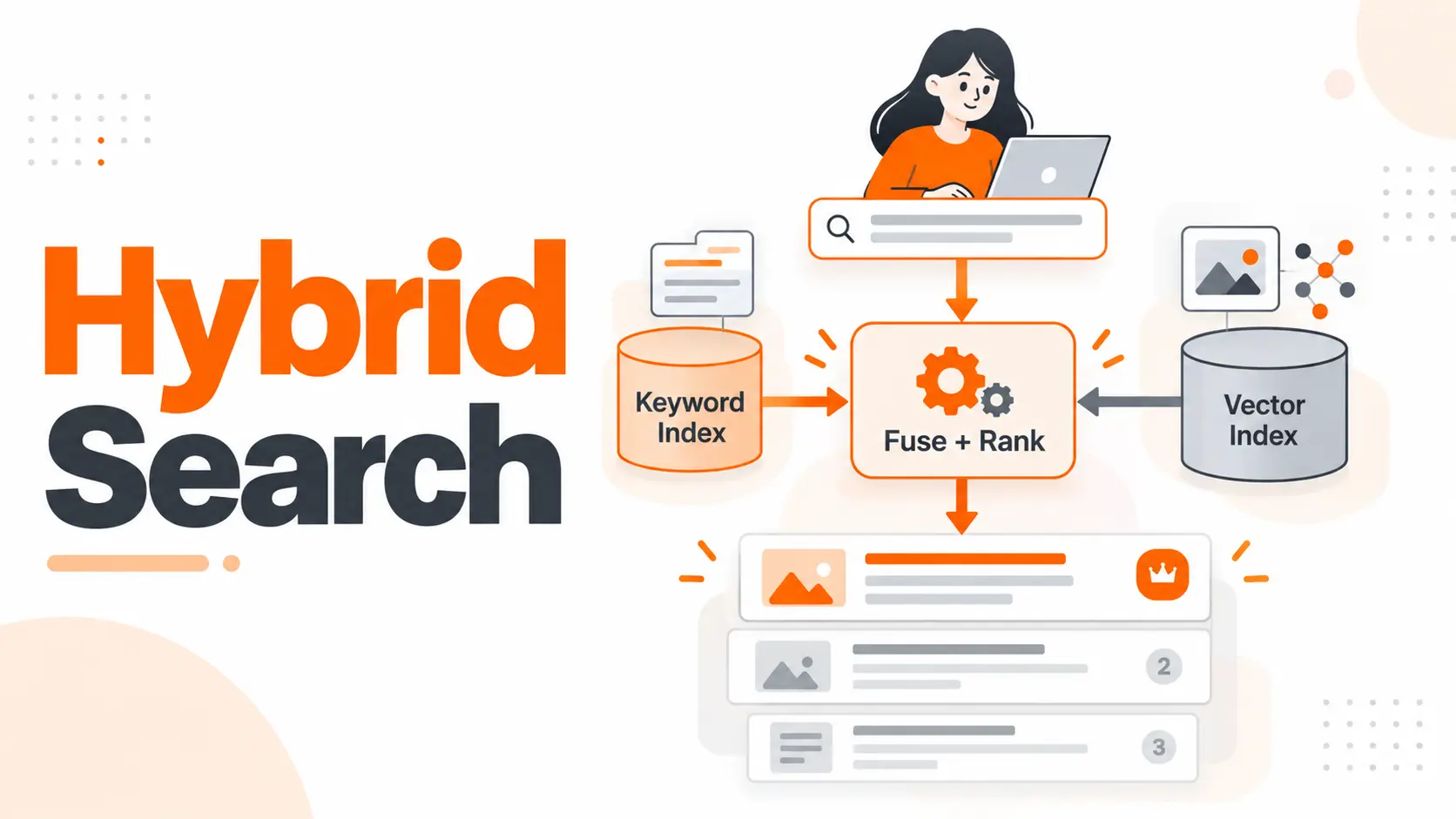
Hybrid search combines keyword-based retrieval with semantic vector search to find documents that match both the exact terms and the meaning of a user's query. It brings the results together into a single ranked list, making it useful for AI assistants, product search, and technical documentation.
Consider someone searching for an error code alongside a description of what went wrong. Keyword search identifies the exact error code, while vector search finds documentation describing the underlying problem. Hybrid search brings both sets of evidence into one result list.
For a startup building AI-powered search, the important decision isn't simply whether to use hybrid search. It's understanding when combining retrieval methods improves relevance enough to justify the additional complexity.
How Hybrid Search Works
A hybrid search pipeline runs two retrieval methods against the same information and combines their ranked results.
The process has three main stages: lexical retrieval, semantic retrieval, and result fusion.
Keyword Search with BM25
Keyword search retrieves documents based on the terms contained in a query.
BM25 is a widely used ranking algorithm that considers factors such as term frequency, document length, and how common a term is across the indexed collection.
A rare technical identifier appearing in a document can be more informative than a common word appearing in hundreds of documents.
Suppose a developer searches for:
ERR_AUTH_403
A lexical search index can identify documentation containing that identifier.
This is especially valuable for product names, API parameters, error codes, model numbers, and technical terminology.
There is an important distinction between keyword relevance and strict equality. BM25 ranks term matches, but it does not guarantee an exact character-for-character identifier match. For critical identifiers, I would preserve a dedicated exact-match field or configure the text analyzer to retain the required token.
That prevents meaningful characters from being lost during indexing.
Semantic Search with Vector Embeddings
Semantic search retrieves documents according to similarity in meaning.
An embedding model converts searchable content into numerical vectors. The same model, or a compatible query encoder, represents the user's search query.
The system then retrieves documents whose vectors are closest to the query representation.
Imagine a customer searching:
"Why can't invited contractors open our project boards?"
The relevant documentation might be titled:
"External Collaborator Permissions"
A semantic search system can identify the relationship between these phrases without requiring the wording to match exactly.
That makes semantic retrieval valuable when people describe problems in natural language rather than using official product terminology.
However, vector similarity does not guarantee precise identification of a particular error code, version number, or product identifier.
This is where the two methods complement each other.
Combining Search Results
Once both retrieval methods return their candidates, the system needs to produce a single ranked list.
This stage is called result fusion.
The lexical search might rank a troubleshooting article first because it contains the exact error code. The vector search might rank a permissions guide first because its content closely matches the user's description.
A fusion algorithm combines these rankings to determine which documents deserve the highest positions in the final results.
The database or search engine then returns the merged candidates to the application.
Hybrid search is therefore more than running two unrelated searches. Its usefulness depends on how the results are combined and ranked.
Hybrid Search vs Keyword Search and Vector Search
The difference between these methods becomes clearer when we look at what the user is trying to find.
Keyword search prioritizes lexical matches. It works well for identifiable terms, exact product references, and documents that use the same terminology as the query.
Vector search prioritizes semantic similarity. It supports natural-language questions, alternative wording, and conceptually related documents.
Hybrid search combines their results. It is particularly useful when the query contains both a specific identifier and a description of the user's intent.
For example, a search for "OAuth callback mismatch error 400" contains technical terms that benefit from lexical matching, while the wider problem can also be described in documentation without using that exact phrase.
Using both retrieval methods expands the candidate set beyond what either method finds independently.
That does not mean hybrid search will outperform every single-method search.
For a query containing only an exact invoice ID, a structured lookup is more appropriate. For an exploratory question over a small collection of descriptive documents, semantic search alone might already meet the product's relevance requirements.
I would choose based on the actual query patterns rather than assuming that adding another retrieval method always improves the results.
Hybrid Search Ranking with Reciprocal Rank Fusion
The biggest technical challenge in hybrid search is combining results produced by different scoring systems.
BM25 scores and vector similarity scores operate on different scales.
Adding those raw values directly is not a reliable way to compare relevance. A larger BM25 score does not automatically mean stronger relevance than a smaller vector similarity score.
Two fusion approaches are particularly useful to understand.
Reciprocal Rank Fusion
Reciprocal Rank Fusion, or RRF, combines documents based on their positions in separate result lists rather than their original scores.
A document that ranks highly in both keyword and semantic search receives contributions from both rankings.
Consider an illustrative result:
A permissions guide ranks second in keyword search.
The same guide ranks third in vector search.
A separate document appears only in the keyword results.
RRF gives the permissions guide credit for appearing in both lists. Its final position depends on the ranks of all candidate documents and the configured fusion parameters.
This avoids directly comparing incompatible score scales.
I would start with RRF when evaluating hybrid search because it provides a straightforward ranking method without requiring detailed calibration of the original scores.
The exact rank constant, weighting options, and implementation differ across search engines.
Weighted Score Fusion
Weighted fusion combines the influence of keyword and semantic search using configurable weights.
Before combining raw scores, the system needs a suitable normalization strategy so that differences in scoring scales do not distort the ranking.
For a documentation search system where exact technical identifiers matter, I would test a configuration that gives lexical relevance greater influence.
For a knowledge-search application dominated by descriptive questions, I would test a higher semantic contribution.
The weights should be chosen using a representative evaluation dataset, not personal preference.
The key distinction is that RRF focuses on ranking positions, while normalized score fusion can preserve information about the relative strength of individual matches.
Hybrid Search Example in a SaaS Application
Consider a fictional project management startup called DeskFlow.
Its help center contains articles about account permissions, billing, external collaborators, API errors, and workspace administration.
The company wants customers to find the correct documentation without contacting support.
A customer submits this search:
"External contractors can't open shared projects after an invitation. ERR_AUTH_403"
The query contains two distinct signals: a description of the access problem and an exact technical identifier.
Results from Keyword Search
The lexical search identifies documents containing ERR_AUTH_403.
One result is an error reference page explaining that the code indicates an authorization failure.
Another is a troubleshooting article documenting circumstances in which the error appears.
Both are relevant, but the error reference alone may not explain how to resolve the customer's specific access problem.
Results from Semantic Search
The vector search identifies documentation discussing external collaborator permissions.
A guide titled "Managing Guest Access to Shared Projects" becomes a candidate because its content is semantically related to the question.
That guide might explain how workspace administrators assign guest access.
However, it may not mention ERR_AUTH_403 or distinguish this authorization failure from other access problems.
Results from Hybrid Search
Hybrid search combines the lexical and semantic candidates.
The merged list can include the exact error reference alongside the broader troubleshooting and permissions documentation.
If one article contains both the error identifier and the relevant permission instructions, it has an opportunity to rank strongly in both retrieval methods.
The final ranking still depends on the actual documents, search configuration, and fusion method.
I would inspect the returned passages to verify that the customer receives the information needed to resolve the issue, rather than assuming that combining two search methods guarantees the correct result.
For DeskFlow, success means retrieving the applicable troubleshooting instructions, not merely returning more documents.
Hybrid Search in RAG Applications
Hybrid search becomes especially useful when an AI assistant needs to retrieve evidence before generating an answer.
In Retrieval Augmented Generation, the retrieval layer determines which documents or passages are supplied to the language model.
If that layer misses a critical instruction or exact technical condition, the model cannot reliably recover the missing evidence from the retrieved context.
A hybrid retrieval pipeline can bring together exact matches and semantically related passages before the application sends selected evidence to the model.
For example, DeskFlow's AI support assistant might need both the official description of ERR_AUTH_403 and the documentation explaining guest access settings.
Hybrid search helps assemble that candidate evidence.
The application can then select the strongest passages and pass them to the language model.
The language model remains responsible for generating the response. Hybrid search does not verify that the model's final explanation is correct.
This separation matters because retrieval quality and answer quality need to be evaluated independently.
Hybrid Retrieval and Reranking
Hybrid search and reranking are related, but they perform different jobs.
Hybrid retrieval combines candidates from multiple search methods.
A reranker evaluates the retrieved candidates again, using a separate ranking model or scoring process, to determine which passages are most relevant to the query.
For DeskFlow, a reranker could compare the combined troubleshooting documents against the full customer question and promote the passage that best addresses the access problem.
I would add reranking after establishing a reliable retrieval baseline.
A reranker can reorder the candidates it receives, but it cannot recover a relevant document that never entered the candidate set.
That makes the quality and size of the initial retrieval pool important.
Configuring Hybrid Search for Better Relevance
A working hybrid search pipeline is the starting point. Its configuration determines how effectively it handles real queries.
I would focus on four areas before expanding the architecture.
Document Preparation and Indexing
The lexical and vector retrieval methods need to reference the correct underlying documents.
For product documentation, I would preserve titles, section headings, source identifiers, technical terms, and document versions.
Keyword fields must remain searchable, while text intended for semantic retrieval needs an appropriate embedding representation.
The system should also maintain consistent document identifiers across retrieval methods so duplicate candidates can be recognized during fusion.
Poorly structured documents reduce the quality of both retrieval approaches.
For instance, splitting an error code from its corresponding troubleshooting instructions can make it harder to retrieve the full explanation.
Candidate Pool Size
Each retrieval method returns a limited number of candidates.
If a relevant document falls outside that initial result window, the fusion stage cannot promote it.
This creates an important trade-off between candidate coverage and processing cost.
I would test several candidate pool sizes using the same evaluation questions and compare the results.
A larger candidate pool can make more documents available for fusion and reranking, but it also increases processing requirements.
The right setting is the smallest configuration that meets the application's measured relevance targets.
Keyword and Semantic Weighting
Some search engines expose controls for balancing keyword and vector contributions.
For example, Weaviate supports an alpha parameter that influences the weight of each retrieval method.
Other systems use configurable RRF weighting or normalized scoring approaches.
I would test these controls against distinct query categories rather than relying on one setting for every situation.
Queries containing technical identifiers deserve separate examination from natural-language questions.
If the search engine supports query-specific configurations, different retrieval strategies can be applied to different query types.
The complexity of that design should be justified by measurable improvements.
Metadata Filtering and Permissions
A SaaS knowledge base contains more than searchable text.
Documents can belong to particular workspaces, subscription plans, customers, or product versions.
Hybrid search must respect these conditions.
For example, a customer on an older product version should not receive instructions for an unavailable feature simply because the newer article has stronger semantic similarity.
Similarly, private documents must not become accessible through the search process.
I would apply verified authorization and document filters consistently across the retrieval workflow.
The timing of filtering also affects search quality. Applying highly restrictive filters only after retrieving a small unfiltered candidate set can exclude eligible documents that should have appeared in the results.
Search configuration must therefore account for both permission enforcement and retrieval completeness.
Measuring Hybrid Search Performance
Adding hybrid search only makes sense if it improves the results that matter to users.
For a new implementation, I would compare three configurations against the same test dataset:
Keyword search alone
Vector search alone
Hybrid search using the selected fusion method
The evaluation dataset should contain queries with verified relevant documents.
For DeskFlow, I would include exact error codes, natural-language support questions, product terminology, and queries containing both technical identifiers and descriptive language.
Retrieval Relevance
The first measurement is whether the system retrieves the correct evidence.
Recall@k measures how many known relevant documents appear within the first k retrieved results.
MRR, or Mean Reciprocal Rank, measures how highly the first relevant result appears across test queries.
NDCG@k evaluates ranking quality when documents have graded relevance labels, rewarding stronger matches placed nearer the top.
These metrics reveal different aspects of retrieval performance.
For a technical support product, I would also check whether critical policy conditions, identifiers, and troubleshooting instructions appear in the returned passages.
Response Quality
If hybrid search powers an AI assistant, retrieval improvements should also be tested against generated answers.
Better retrieval scores do not guarantee better responses.
The model might ignore a relevant passage or misinterpret an important restriction.
I would compare answer correctness, faithfulness to retrieved evidence, and completeness before and after changing the retrieval method.
This establishes whether improvements in search relevance lead to a better user-facing result.
Latency and Cost
Hybrid search requires additional indexing and retrieval work compared with a single-method implementation.
That affects resource usage, search latency, and operational cost.
I would measure the entire retrieval process under realistic query volume, including embedding generation when performed at query time, both retrieval branches, fusion, and optional reranking.
The goal is not to maximize retrieval complexity.
It is to find the configuration that meets the product's relevance and performance requirements at an acceptable cost.
Choosing Between Keyword, Vector, and Hybrid Search
Before introducing hybrid search into a product, I would classify the queries users actually submit.
This provides a clearer starting point than selecting a search architecture based on a technology trend.
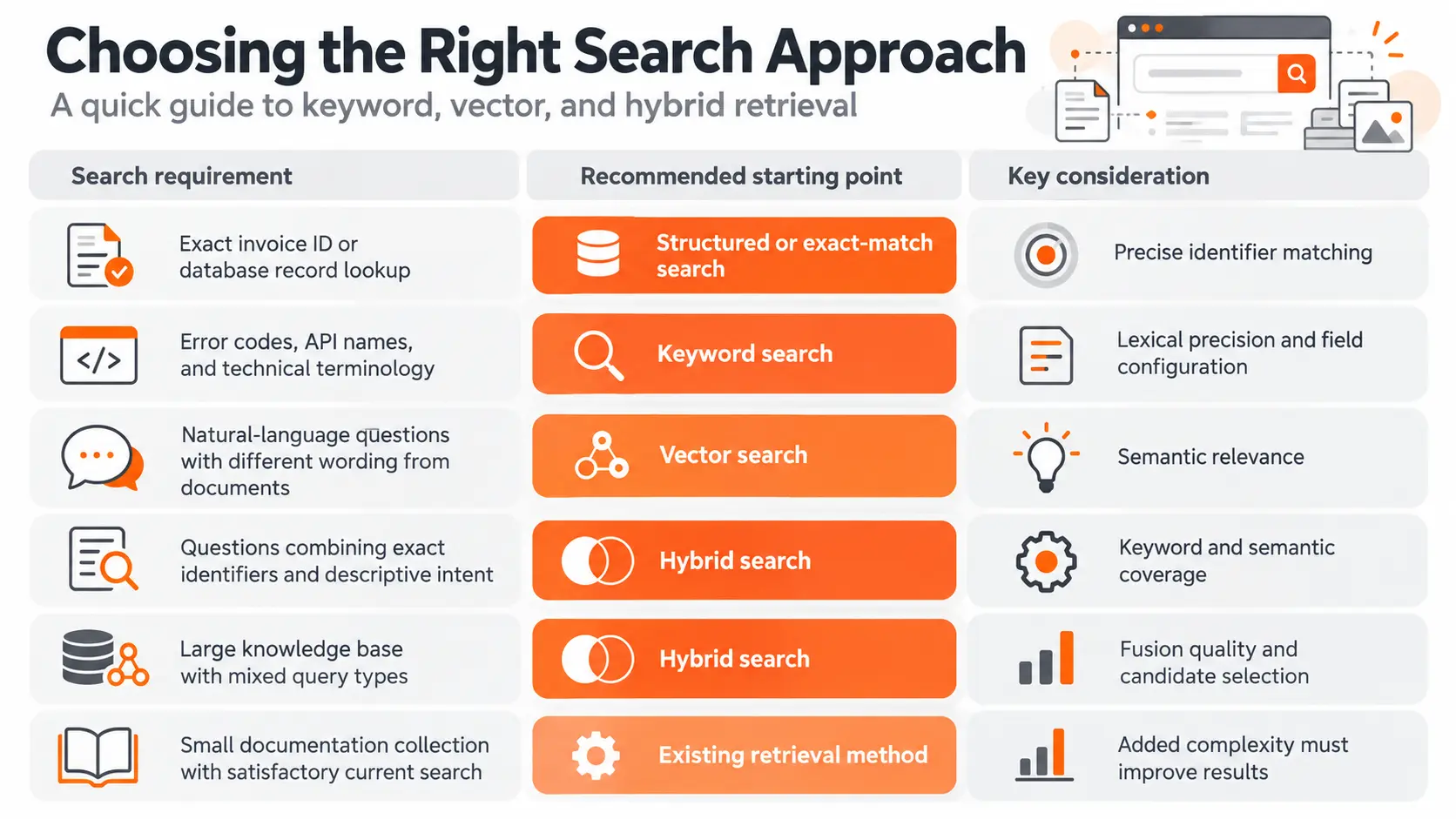
The table describes starting points, not guaranteed winners.
A search system needs to be evaluated against its actual documents and queries.
For a startup already using vector search, I would first identify the questions it fails to answer. If those failures involve exact technical terms, product identifiers, or rare terminology, adding lexical retrieval has a clear purpose.
If the existing system already retrieves the right documents at the required speed, introducing another retrieval method adds infrastructure work without an established benefit.
Hybrid Search Tools and Implementation Options
Hybrid search does not require a universal database architecture.
Several established search platforms support combining lexical and semantic retrieval, but they differ in indexing, fusion, filtering, and operational design.
Elasticsearch
Elasticsearch supports lexical retrieval and vector search within its search infrastructure.
It provides RRF-based retrieval as well as approaches for combining scores.
I would evaluate it when a startup already uses Elasticsearch for application search, logs, or indexed documents.
Its existing search infrastructure can provide a foundation for adding vector-based retrieval.
Azure AI Search
Azure AI Search supports hybrid queries combining full-text and vector retrieval.
It merges results using Reciprocal Rank Fusion and supports additional ranking and filtering capabilities.
For teams already operating in Microsoft Azure, I would assess how its managed indexing and retrieval features fit their existing application architecture.
Weaviate
Weaviate combines BM25-based keyword retrieval with vector search and provides configurable fusion methods.
Its relative score fusion approach uses normalized retrieval scores rather than relying only on ranking positions.
I would evaluate it when the team wants direct control over the balance between lexical and semantic retrieval.
Qdrant
Qdrant supports hybrid retrieval through dense and sparse vector representations.
Its query capabilities include Reciprocal Rank Fusion and Distribution-Based Score Fusion.
For a team working with dense semantic embeddings and sparse retrieval representations, Qdrant provides a way to combine those candidate lists.
The operational decision should include deployment requirements, filtering behavior, and evaluation results rather than the fusion algorithm alone.
Selecting the Infrastructure
I would begin by reviewing the search capabilities already available in the application.
If the current platform supports both lexical and vector indexes, introducing a separate search engine may be unnecessary.
If the existing infrastructure cannot meet the application's retrieval requirements, a dedicated search platform becomes worth evaluating.
The decision should account for indexing updates, query latency, filtering requirements, ongoing maintenance, and total operating cost.
Final Thoughts
Hybrid search combines the strengths of keyword retrieval and semantic similarity, giving applications access to both exact-term matches and conceptually related documents.
Its value becomes clear when users mix technical identifiers with natural-language descriptions, especially in AI support assistants and large documentation systems.
I would begin with the queries the existing search system fails to handle, establish a retrieval baseline, and test whether adding another search method improves the results.
The strongest hybrid search implementation is not the one with the most retrieval stages. It is the one that consistently returns the evidence users need, respects document access rules, and meets the application's performance requirements.
FAQ
Will hybrid search still work if someone misspells a product name?
Hybrid search does not automatically guarantee typo correction. The lexical search engine needs suitable text analysis, fuzzy matching, or spelling-handling capabilities. Vector retrieval can identify related content despite differences in wording, but it should not be relied on to resolve precise product identifiers. Search behavior must be tested using representative misspellings.
Can I use hybrid search when my documents are in different languages?
Yes. Multilingual hybrid search requires appropriate language processing for lexical retrieval and an embedding model that supports the required languages. Tokenization, stemming, and cross-language semantic matching must be evaluated separately. A system that performs well in English does not automatically provide equivalent retrieval quality in every other language.
Do I have to retrain my embedding model whenever I add new documents?
No. Adding documents to a standard embedding-based search system requires generating embeddings for the new content and updating the relevant indexes. Retraining the embedding model is a separate process and is not required for routine document additions. The new vectors must remain compatible with the existing vector index.
Can hybrid search read PDFs and scanned documents?
Yes, after their content has been extracted and prepared for indexing. Text-based PDFs can be processed through document extraction tools. Scanned files require OCR or another suitable document-understanding process. Tables, headings, and document structure should be preserved where they affect the meaning of the retrieved information.
Can I use customer clicks to improve hybrid search rankings?
Yes. Search interactions such as clicks, successful support resolutions, and explicit relevance feedback can inform ranking improvements. These signals require careful interpretation because clicks are influenced by result position and interface design. A reliable approach combines behavioral data with relevance judgments and controlled evaluation before changing ranking rules.

Fatemeh Jahangard
Technology & AI Writer at PinerookFatemeh Jahangard covers AI, emerging technologies, and digital innovation for Pinerook, focusing on how technology shapes startups and industries.
 Seen first.


