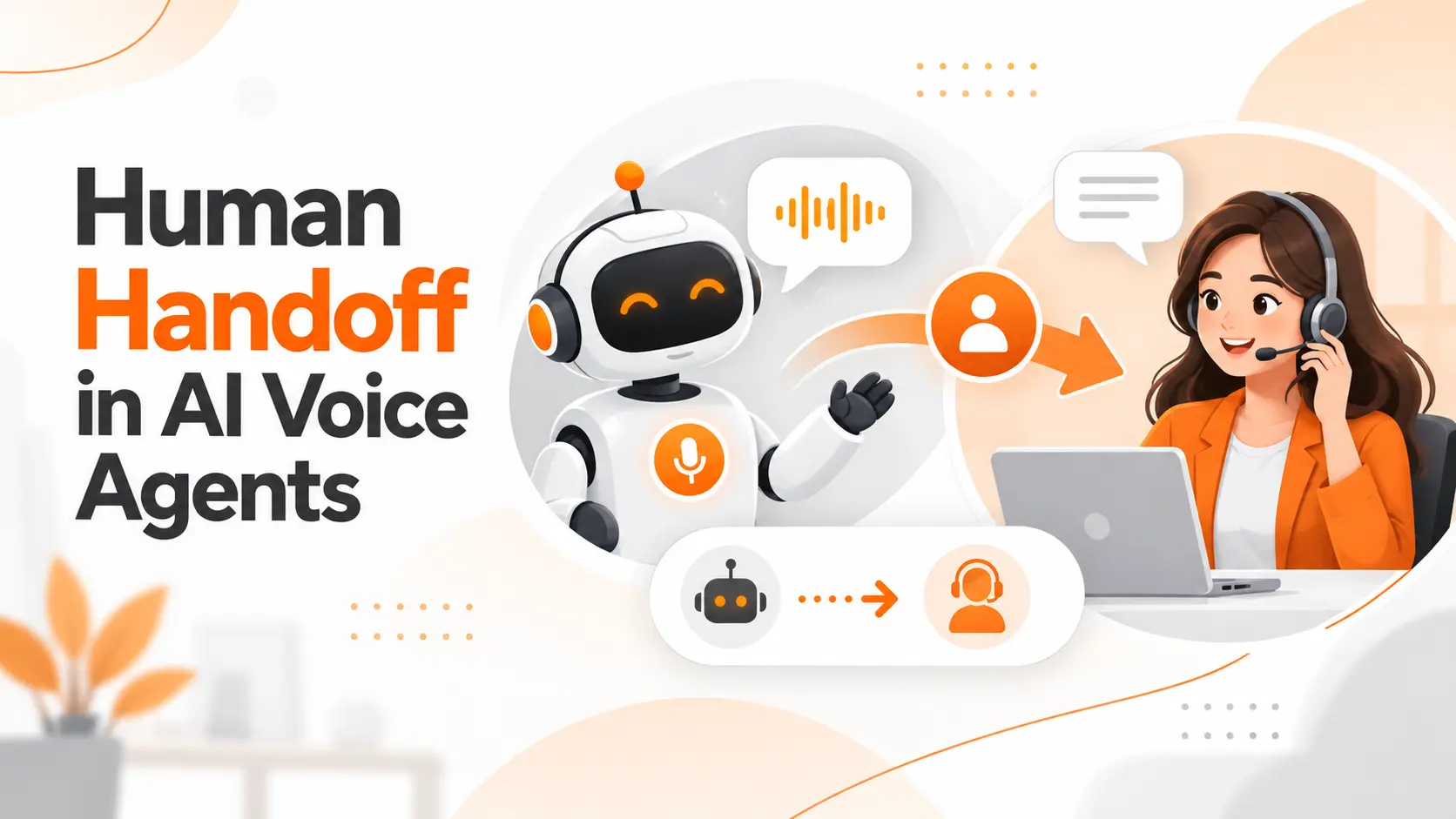
A voice agent shouldn't announce a successful transfer just because it dialed another number. The handoff is complete when the right human receives the call, has the information needed to continue, and can take responsibility for the customer's request.
For customer-facing AI Voice Agents, I would design that process before deployment. The essential steps are straightforward: define when human assistance is required, route the call to the right person, preserve conversation context, and establish what happens if the transfer fails. The difficult part isn't asking the AI to transfer a call. It's making sure the customer actually reaches someone who can help.
Human Handoff Workflow
A reliable human handoff needs a defined sequence rather than a general instruction telling the agent to transfer difficult conversations.
I would build the workflow around six steps:
Detect the escalation trigger. Identify a direct request for human support, an action outside the agent's authority, or a condition requiring specialist intervention.
Select the destination. Determine which team can handle the request and check the available routing options.
Prepare the context. Collect the relevant customer details, verification status, conversation summary, and actions already completed.
Initiate the transfer. Use the configured telephone or SIP transfer mechanism and tell the caller what is happening.
Confirm the handoff. Check the available call events and, for a controlled warm transfer, confirm that the receiving person is ready before connecting the caller.
Record the outcome. Mark the handoff as completed only when supported evidence confirms it. Otherwise, activate the defined recovery process.
I treat transfer initiation, human acceptance, and issue resolution as separate events.
A telephone system accepting a transfer request doesn't establish that a person answered. Likewise, reaching a human doesn't prove the customer's issue has been resolved.
Keeping these states separate gives developers clearer logs and prevents support teams from reporting successful handoffs that never reached an operator.
Human Handoff Triggers
The agent needs explicit conditions for escalating conversations. I wouldn't leave every decision to a language model's interpretation of whether a request seems difficult.
Business rules should determine which actions require human authorization. The model can identify caller intent, but the application must enforce the limits of what the agent is allowed to do.
The following decision matrix covers the main situations a customer support voice agent needs to handle.
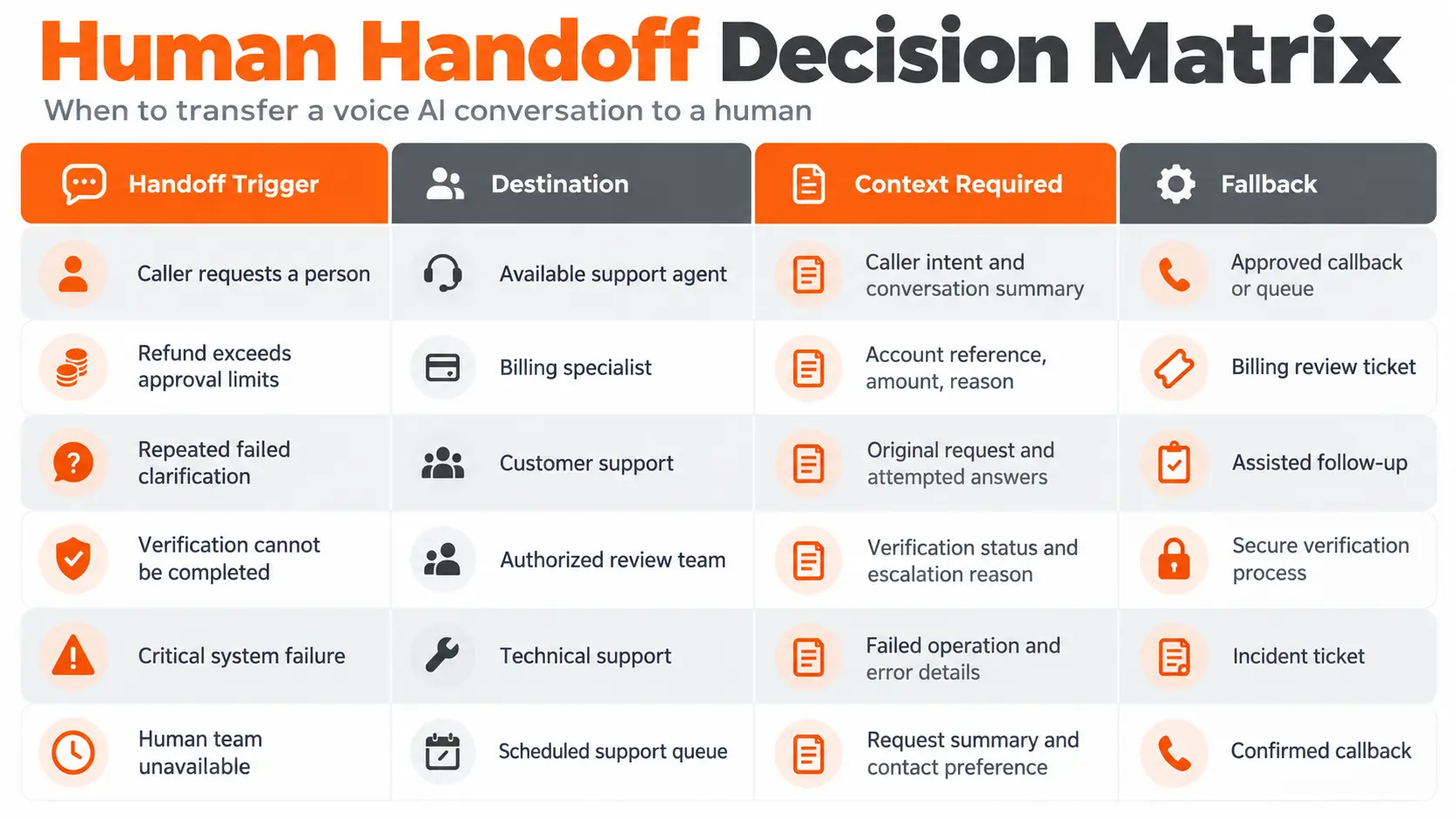
These triggers should lead to different destinations because not every human agent has the authority or knowledge to handle every request.
I would also keep a direct request for a human separate from the agent's confidence score. A caller shouldn't have to repeat that request until the AI considers escalation necessary.
For sensitive operations, the application should enforce an authorization boundary regardless of the model's confidence.
Warm Transfer vs Cold Transfer
The transfer method determines what happens between dialing the destination and connecting the caller.
Cold Transfer
A cold transfer sends the active call to another number, department, or telephone system without first briefing a receiving person.
The AI ends its involvement according to the platform's transfer behavior, leaving the destination to handle the incoming call.
I would use a cold transfer for simple routing tasks where the receiving team already has access to the necessary information or the customer is entering a standard queue.
A cold transfer does not guarantee that a human has answered. If the destination leads to voicemail or an unanswered queue, the application must not record human acceptance without supporting evidence.
Warm Transfer
A warm transfer introduces an additional step before the caller joins the receiving party.
The system contacts the destination, provides a private message or conversation summary, and connects the caller according to the configured transfer process.
A controlled warm transfer can confirm that a human operator is available before completing the connection.
I would use this method when the customer has already explained a complicated issue, the request involves a sensitive decision, or the receiving team needs background information.
Some systems also support an agentic warm transfer. A separate AI component speaks with the receiving person, confirms their availability, and decides whether to connect or cancel the transfer.
The important distinction isn't the label used by the provider. It's whether the system can brief the recipient, verify readiness, and retain control when the destination cannot accept the call.
Passing Conversation Context
A human agent needs enough information to continue the conversation without asking the customer to start again.
Sending a complete transcript is not the same as delivering useful context. A long conversation can contain corrections, irrelevant details, and information the receiving person doesn't need.
I would prepare a concise handoff record containing the following information.
Customer and verification status: A reference to the customer record and the outcome of any completed verification. A verification status must come from the authorized system, not the model's interpretation.
Reason for escalation: The customer's current request and the specific reason the AI cannot complete it.
Actions already taken: Completed tool calls, confirmed changes, unsuccessful operations, and relevant results.
Outstanding action: The decision or operation the human agent needs to perform.
For example, a billing specialist receiving a refund request should see the disputed invoice reference, refund amount, relevant verification status, and reason human approval is required.
They shouldn't need to listen to the entire AI conversation to identify those details.
Context Delivery and Access Control
The handoff record should be stored or delivered through a system the receiving team can access, such as the CRM or contact center platform.
A generated summary is not proof of delivery.
I would verify that the receiving interface contains the correct information and that the recipient has permission to view it.
Sensitive data should remain behind appropriate access controls rather than being placed indiscriminately in transfer messages or telephone signaling metadata.
The receiving team needs a verified account reference and authorized access to the record, not an unrestricted copy of the customer's private information.
Call Routing and Transfer Execution
Once the escalation decision and context are ready, the application must connect the existing call to the correct destination.
The voice agent makes or signals the decision. The telephony layer executes the transfer.
Depending on the platform, the destination can be a telephone number, a SIP URI, a contact center queue, or another supported routing endpoint.
For example, an agent handling subscription questions can direct billing disputes to a billing queue and technical incidents to a separate support destination.
I would make the routing rules explicit rather than allowing the model to construct arbitrary telephone destinations.
Call State Verification
A useful call log distinguishes the following states:
Transfer Requested: The agent or application submitted the handoff operation.
Destination Contacted: The telephone system initiated or established a connection with the destination.
Human Accepted: The receiving person was identified and confirmed as ready, where the transfer architecture supports that verification.
Caller Connected: The caller's audio path was connected to the receiving destination.
Handoff Completed: The application has the evidence required by its handoff acceptance rules.
An answered telephone leg does not, by itself, establish human acceptance. Automated attendants, voicemail, and contact center queues can also answer calls.
For warm transfers, the system can use operator screening or an explicit acceptance step before bridging the caller.
Blind transfers provide less control over what happens after the call leaves the original system. Their reported outcome should reflect that limitation.
A successful transfer event is not a substitute for confirmed delivery to a human.
Failed Transfers and Unavailable Agents
The recovery path needs to be defined before a call reaches an unavailable destination.
If a specialist does not answer, I would first determine whether the transfer infrastructure still controls the caller's connection.
A managed warm-transfer flow can cancel the attempted connection and return the caller to the original assistant when the platform supports that behavior.
A blind transfer can relinquish control of the call. In that case, recovery depends on the receiving telephone system rather than the original AI agent.
That distinction matters when selecting the transfer method.
Callback and Follow-Up Handling
When a live connection is unavailable, the agent can offer an approved alternative, such as a callback or support ticket.
However, the system should not promise a callback until the request has been successfully recorded.
I would require a confirmed record containing the request details, appropriate contact information, assigned team, and follow-up status.
If the ticketing system fails, the caller must receive an accurate explanation. The AI must not invent a ticket number or claim that the request has been assigned.
For urgent matters, the escalation policy should specify an appropriate alternative instead of placing the request in a routine follow-up queue.
The objective is to preserve responsibility for the customer's unresolved issue, even when the live transfer cannot be completed.
Human Handoff Example: DeskFlow SaaS
Consider DeskFlow, a fictional subscription management platform using a voice agent for customer support.
A customer calls about a refund for an annual subscription. The AI retrieves the relevant invoice but discovers that the requested refund exceeds its approval limit.
The customer says:
"I want someone to review this charge and authorize the refund."
The agent has enough information to identify the request, but it does not have authority to approve the refund.
Preparing the Transfer
I would route this conversation to the billing team.
Before initiating the transfer, the system prepares a short record:
Customer: Verified account reference
Request: Review and approve an annual subscription refund
Relevant details: Invoice reference and disputed amount
Completed actions: Invoice retrieved; no refund issued
Escalation reason: Refund requires human approval
The agent then informs the customer that it is connecting them to a billing specialist.
Completing the Handoff
In a controlled warm-transfer configuration, the billing specialist receives the summary and confirms readiness.
Only then does the system connect the caller.
The human specialist can begin with the disputed invoice instead of asking the customer to explain the entire situation again.
At that point, the handoff is complete. The refund itself remains unresolved until the specialist makes a decision.
Handling an Unanswered Transfer
Now consider the same request when no billing specialist is available.
If the transfer architecture retains control, the system cancels the attempt and offers the customer an approved follow-up route.
The application creates a billing review ticket and receives confirmation that the record was saved.
The customer is told that the request has been recorded for follow-up, not that a specialist has accepted the live call.
I would report this as a failed live handoff with a successful follow-up arrangement.
Those outcomes need separate records because they represent different customer experiences.
Testing the Handoff Workflow
A working transfer in a demonstration is not sufficient evidence that the handoff process is ready for production.
I would test the full telephone path, including the receiving system, rather than relying entirely on a simulated conversation.
The essential scenarios include a direct request for a human, a policy-triggered escalation, a busy destination, an unanswered call, an automated answering system, and a failed context delivery.
Each scenario needs a clear expected result.
For example, when the receiving number reaches voicemail, a warm-transfer test should not pass simply because the telephone system reports an answered call.
When the destination accepts the call but the CRM summary is missing, the connection has succeeded but the context requirement has failed.
I would also verify that a canceled transfer doesn't create duplicate follow-up records and that the agent doesn't falsely confirm completion.
Production Test Conditions
Transfers should be tested using the actual telephone integration and representative receiving endpoints.
SIP routing, carrier behavior, queue handling, and the way a platform reports call events can affect the final outcome.
For a deployment with several support departments, I would verify each route independently.
The test evidence should include the transfer event, destination response, context delivery record, and final disposition.
This makes a failed handoff traceable to the part of the system that needs correction.
Human Handoff Performance Metrics
The most useful handoff metrics describe whether customers successfully reached an appropriate person with the necessary information.
I would monitor four measurements.
Human Acceptance Rate: The percentage of eligible transfer attempts where a human agent actually accepted the call, measured only when the system can verify acceptance.
Context Delivery Rate: The percentage of completed handoffs where the required information was confirmed available to the receiving agent.
Transfer Completion Time: The interval between the escalation decision and the caller being connected to the destination.
Repeat-Explanation Rate: The percentage of transferred conversations where the customer had to restate information the AI had already collected.
These measurements reveal different problems.
A high connection rate with a low context delivery rate indicates that routing is working but information isn't reaching the receiving team.
A high repeat-explanation rate can indicate that the summary is incomplete, inaccessible, or not being used.
I would track final customer resolution separately. The handoff process is responsible for transferring control correctly; the receiving team remains responsible for completing the underlying request.
Final Thoughts
Human handoff works when the AI knows when to stop, the receiving person has the information needed to continue, and the system can establish what actually happened to the call.
I would design the process around explicit escalation rules, appropriate routing, concise context delivery, and a recovery path that does not depend on an unconfirmed transfer.
The clearest measure of success isn't whether the AI called a transfer tool. It's whether the customer reached the right person without losing progress, and whether unresolved requests remained accounted for when a live connection failed.
FAQ
Can I send an AI call to a human agent in another country?
Yes, if the voice platform and telephony provider support the destination and applicable international routing requirements. The deployment must account for international calling charges, destination restrictions, and the rules governing cross-border transfer of customer information.
Can I keep recording the call after a human takes over?
Call recording can continue when the receiving telephone system supports it and the recording configuration covers the transferred call leg. Recording consent, notification, and retention requirements must be satisfied under the applicable laws and organizational policies. A recording started during the AI conversation does not automatically continue after a transfer.
Can the human agent send the caller back to AI?
Yes, through a contact center workflow that supports transferring the active call back to an AI endpoint. The application must restore the necessary conversation context and prevent repeated routing between human and AI agents. A transfer that permanently releases the original AI connection requires a new supported call path to reintroduce AI.
Does human handoff work with outbound AI sales calls?
Yes. A platform can transfer an outbound conversation to a salesperson when it supports outbound call transfers. The workflow must comply with applicable calling and consent requirements, and the receiving salesperson should be available before the system promises a live connection.
Can customers choose a specific employee instead of a department?
Yes, when the routing system supports validated employee destinations and the selected person is eligible to receive the call. The application should resolve the employee through an approved directory rather than allow unrestricted phone numbers generated from the conversation. If that employee is unavailable, the business's configured alternative determines the next step.

Fatemeh Jahangard
Technology & AI Writer at PinerookFatemeh Jahangard covers AI, emerging technologies, and digital innovation for Pinerook, focusing on how technology shapes startups and industries.
 Seen first.