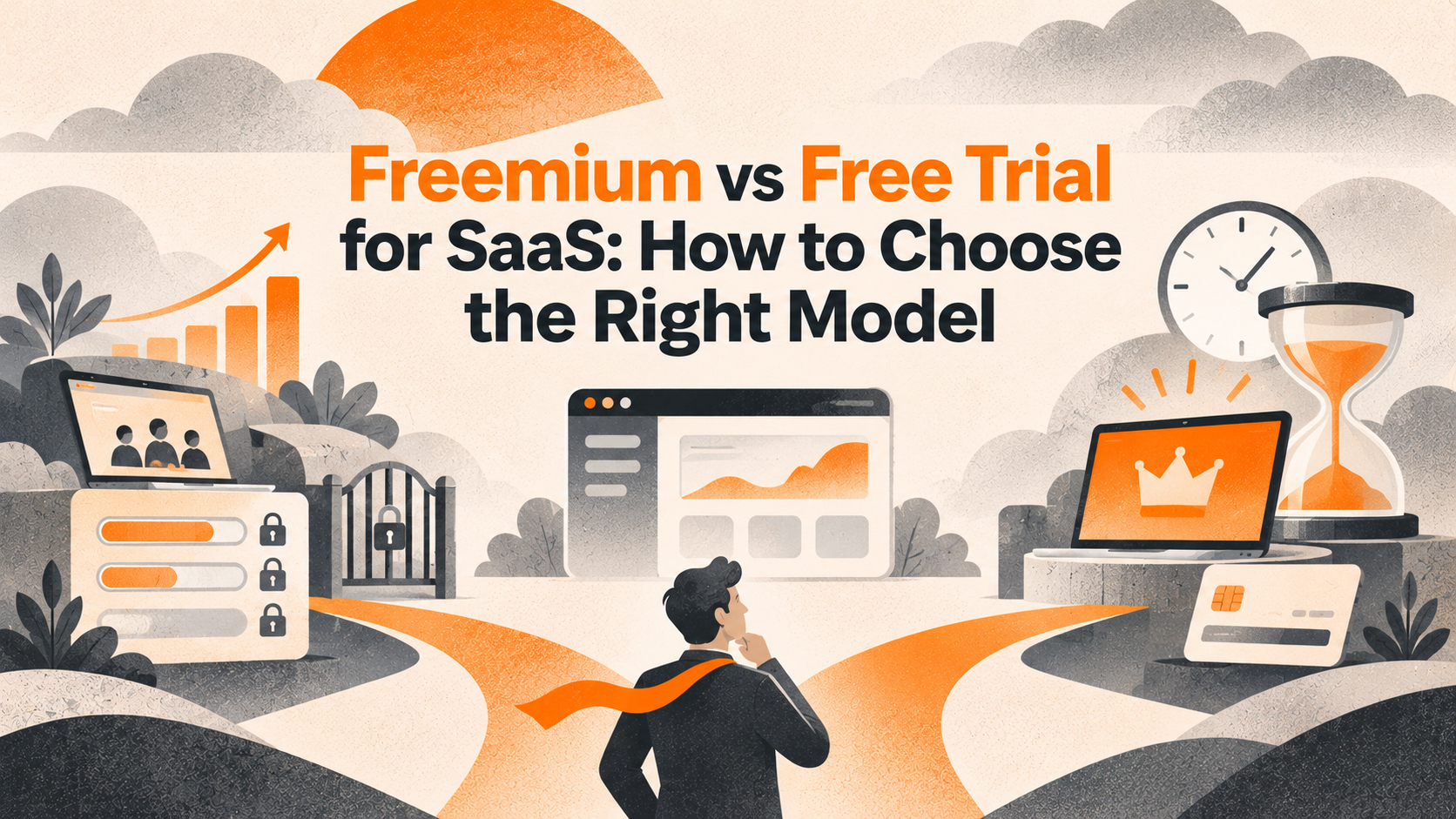
Freemium gives customers ongoing access to a limited but useful version of a product, while a free trial provides temporary access to a product or paid plan before asking the customer to subscribe. The first model usually places the payment decision at a usage or feature boundary. The second places it near the end of an evaluation window. For a SaaS founder, the better choice is not the one that attracts the most free accounts. It is the one that helps suitable customers experience real value and produces sustainable paid relationships at a manageable cost.
Within a broader Product Led Growth for Startups strategy, a free offer should be designed around the customer journey rather than treated as a permanent marketing giveaway. Before selecting either model, founders should understand how often users need the product, how quickly a meaningful result becomes visible, who approves payment, and what it costs to support continued use.
Freemium vs Free Trial: The Difference That Matters
In a freemium model, the customer can continue using the basic product without a deadline. The business earns revenue when an individual or team needs something beyond the free allowance, such as greater capacity, additional collaborators, advanced permissions, or a specialized workflow. This requires the free experience to accomplish a real job. If it only displays locked features, users have little reason to develop a habit or recommend the product.
A free trial offers temporary access to the product, often including features normally reserved for paying customers. The customer has a defined period to decide whether the value justifies a subscription. Some companies require payment details before the trial starts, while others allow an evaluation without a card. The key constraint is time, but the customer still needs sufficient opportunity to complete the work that demonstrates value.
The important distinction is therefore where the commercial boundary sits. Freemium asks whether the customer has reached the limits of a useful free experience. A trial asks whether the customer has seen enough benefit before access changes. Both can fail if the initial experience is confusing, the paid offer is not clearly more valuable, or the people using the product cannot authorize a purchase.
Which Model Fits the Way Customers Use Your Product?
Products with recurring individual use, inexpensive delivery, and natural collaboration may benefit from freemium. A user might build several reports for free, then upgrade when a team needs shared controls and additional capacity. Free access can support continued learning and referrals, but those benefits are only worthwhile if the resulting usage costs remain controlled.
A trial may be more appropriate when a complete paid workflow can demonstrate its value in a predictable evaluation period. A planning platform that supports a monthly review, for example, needs a trial long enough for the relevant meeting and a realistic setup. A seven day trial that ends before the customer can perform the job will not accurately test demand.
Complex enterprise software creates another constraint. A user may be able to evaluate a product independently but need procurement, security, or budget approval to purchase it. In those cases, a free trial can include human assistance without making the entire growth model sales driven. The founder should distinguish access to the product from permission to buy it.
Freemium vs Free Trial Decision Framework
The comparison below is a decision aid rather than a universal ranking. A model that looks attractive in one row can still fail because of a serious weakness elsewhere, especially delivery cost or a mismatch between the evaluation period and the buying process.
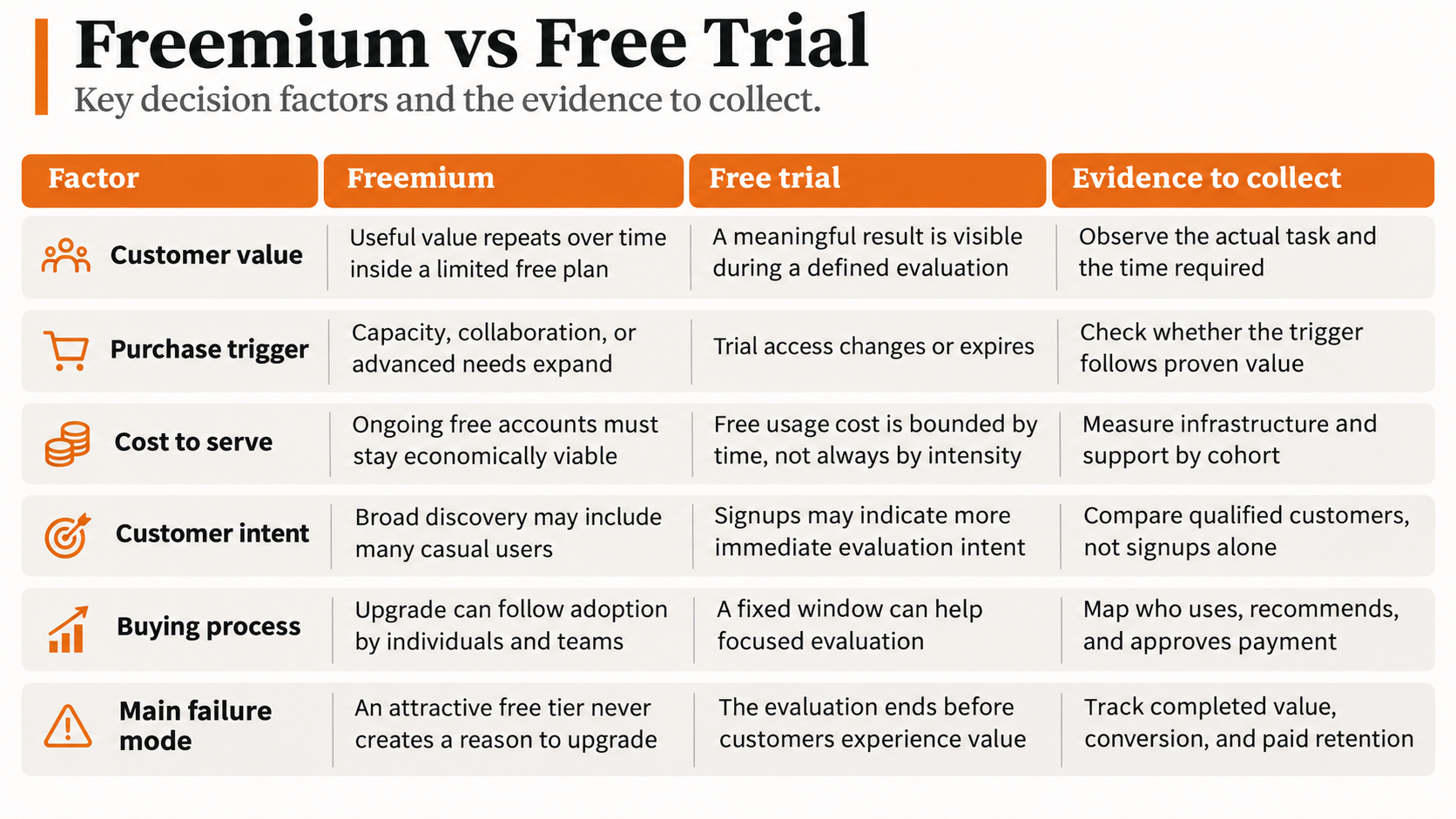
The table makes a deeper point: the best model is determined by the product and purchasing process, not by the label on a pricing page. When delivery is expensive or customer value requires lengthy setup, founders may need narrower free access, assisted evaluation, or a paid proof of concept instead of either standard option.
What the 2026 Conversion Research Actually Shows
A January 2026 study by ChartMogul, Growth Unhinged, and ProductLed surveyed 200 software products. In that sample, 57 percent used a free trial as the main entry experience and 26 percent used freemium. The most common trial duration was 14 days. These are observations about a particular set of products, not a recommendation that every SaaS company should copy their packaging.
The same study reported an overall median conversion rate of 8 percent from free signup or lead to paying customer within six months. Results varied considerably across businesses. Trials tended to show somewhat higher conversion among people who entered the product, but that difference diminished when the analysis accounted for how many website visitors signed up in the first place.
Credit card requirements are a useful example. Requiring a card can raise the percentage of trial users who become paying customers because fewer casual visitors begin the trial. But that higher percentage may coexist with fewer trial signups and can reduce customer trust if the terms of renewal are not clear. Founders should measure paying customers per qualified visitor, acquisition cost, retained revenue, and user complaints alongside signup conversion.
This research offers context, not a benchmark to paste into a forecast. A developer tool used daily, a specialist product with a lengthy procurement cycle, and an AI service with substantial computing costs may behave very differently. A useful internal comparison holds the audience, observation period, and customer definition as consistent as possible.
Designing a Free Tier That Encourages Healthy Upgrades
A freemium product should let an appropriate customer complete a meaningful job without paying. The boundary should become relevant as the value received expands. For a collaboration product, additional users or workspace controls can be a natural upgrade point. For an analytics service, a larger data allowance or advanced exports may represent genuine additional value. Hiding the core outcome behind the paywall prevents prospects from establishing why the product matters.
The free plan also needs a clear economic ceiling. Cloud storage, customer support, data processing, and third party services cost money even when the user pays nothing. This is especially important for products that generate expensive AI outputs. A few intensive users may consume more capacity than dozens of casual users. Rate limits, reasonable usage allowances, and honest explanations of the paid tier can protect the business without making the free experience unusable.
Teams should observe what happens when users reach a genuine limit. If hardly anyone approaches it, the free allowance may be too generous for the intended path to revenue, or the product may not have enough repeated value. If many users reach the limit but few upgrade, the paid capability may be poorly matched to their needs. The answer is not automatically to tighten every restriction. First investigate what those users were trying to accomplish and why the purchase did not feel justified.
Designing a Trial That Customers Can Evaluate Fairly
A free trial should last long enough for a representative customer to complete a real workflow. A trial for an everyday task may require less time than one for periodic financial reporting or team coordination. The commonly used duration of 14 days is a market observation, not a law of product design. Founders should select the window by observing when customers can reach the necessary outcome, including setup, collaboration, and internal review.
The trial experience should make the commercial transition predictable. Explain which features remain available after expiration, whether entered data will be preserved, what happens to collaborators, and exactly when any payment begins. If a card is collected, communicate the charging and cancellation terms before activation. A surprising renewal charge can create short term receipts while damaging retention and trust.
For high intent accounts, assistance can be appropriate. An implementation specialist who helps connect a data source or prepare a realistic trial workflow may increase the quality of evaluation. That is different from using a sales pitch to mask a product that does not work. The trial should still produce evidence the customer can evaluate independently.
When a Reverse Trial or a Hybrid Model Makes Sense
A reverse trial begins with temporary premium access and then leaves the user on an ongoing limited free plan unless they pay. This can let customers experience advanced capabilities without losing all access when the evaluation period ends. It can also create confusion if the downgrade removes the work they have just learned to depend on. The downgrade state must be explained in advance and should preserve trust.
Another option is a limited free plan that allows a short trial of an advanced capability at the moment a customer expresses relevant intent. A small team might use a basic reporting workflow for months, then test administrative permissions when more colleagues join. This separates product discovery from the timing of a higher value purchase. The drawback is operational complexity: entitlement rules, billing messages, analytics, and customer support all become harder to manage.
Founders should resist adding a hybrid model merely because it sounds flexible. Start with the simplest offer capable of revealing demand. Expand only when real user behavior shows why a second route to payment would reduce friction or better match different customer groups.
A Hypothetical Example: Why Conversion Percentages Mislead
Consider a fictional SaaS startup that helps independent consultants create client reporting dashboards. In two comparable experiments, each entry model receives 2,000 relevant website visits. The freemium version produces 160 free accounts, and eight become paying accounts within a defined 90 day observation window. The trial version produces 90 accounts, and nine become paying accounts over the same window. These figures are invented to demonstrate the method and are not market benchmarks.
Among people who signed up, freemium converts 5 percent to paid and the trial converts 10 percent. Looking only at that metric makes the trial appear twice as effective. Yet the visitor to payer results are much closer: 0.4 percent for freemium and 0.45 percent for the trial. Whether the trial is truly better depends on what those accounts pay, how long they remain customers, whether they complete meaningful work, and the cost of serving users who never upgrade.
If the freemium users invite colleagues and continue using the product before upgrading, they may create additional value. If the trial attracts a smaller number of higher quality organizations, it may support better revenue without carrying an indefinite free population. A useful decision compares customer quality and contribution over a mature observation period rather than declaring a winner from one convenient percentage.
How to Test the Model Before Committing to It
Begin by documenting the current customer journey. Identify the task customers want completed, when a genuine result becomes available, and what behavior indicates that customers would pay for continued or expanded value. Ask users why they would prefer an ongoing limited plan or a temporary complete experience. Their answers are hypotheses to test, not proof of future purchases.
Next, select a bounded experiment. Use comparable traffic where possible and record the source of each cohort. Measure qualified visitor to signup rate, the share reaching meaningful value, the share becoming paying customers within the same observation window, paid customer retention, revenue contribution, and the cost of serving the entire free population. Keep individuals separate from accounts if purchases occur at the organization level.
Use qualitative evidence to interpret the numbers. Talk to people who abandoned a trial, used a free plan heavily without upgrading, and paid after a particular usage boundary. Some may have no immediate buying need. Others may be blocked by procurement or a confusing change in access. The response to each problem is different. A pricing experiment becomes useful when it changes a specific business decision.
Finally, document a decision rule before reviewing results. For example, the team might prioritize the offer that creates more retained paying accounts per qualified visitor while remaining within a defined free service cost budget. Small cohorts, seasonal demand, and long purchasing cycles can make early results unreliable. Where the evidence is thin, extend observation rather than treating random variation as a strategic breakthrough.
Common Mistakes Founders Should Avoid
The first mistake is treating freemium as free marketing. Free accounts generate expenses and can attract users who were never likely to purchase. The second is choosing a short trial because it seems to create urgency, even though customers cannot experience a meaningful outcome before it expires. The third is comparing trial conversion against freemium conversion without including the signup step and a consistent measurement window.
Another mistake is setting an upgrade boundary that punishes success. Restricting essential functionality before the product proves useful can damage trust, while offering unlimited premium consumption can make the business uneconomic. Founders should also avoid changing packaging every week. Frequent changes make customer expectations unstable and prevent cohorts from accumulating enough evidence for fair comparison.
The underlying principle is straightforward: free access is not the product strategy itself. It is one way of allowing prospective customers to discover value and decide whether that value warrants an ongoing commercial relationship. A sustainable model aligns what the customer receives, what triggers payment, and what the business can afford to deliver.
FAQ
Is freemium the same as a free trial?
No. Freemium offers continuing access to a limited version of the product. A free trial offers access for a specified evaluation period and then requires a payment decision or changes the available features.
Does a free trial always convert better than freemium?
No. A trial may convert a larger proportion of signups, while freemium may attract more signups in the first place. Compare paying customers per qualified visitor and the quality of retained revenue.
How long should a SaaS free trial last?
Long enough for a representative user to experience the core outcome and evaluate a purchase. A common market duration is not a substitute for evidence about the actual customer workflow.
Should a free trial require a credit card?
It depends on intent, trust, and the purchasing journey. Card collection can filter casual signups but may reduce trial starts. If a card is required, state billing, renewal, and cancellation terms clearly.
Can a startup offer freemium and a free trial together?
Yes. A startup may offer an ongoing basic plan plus temporary access to premium capabilities. This is more complex to operate, so founders should validate demand and make downgrade behavior understandable before expanding the offer.
What metrics should founders use to compare the two models?
Use consistent cohorts to compare qualified visitor to paying customer conversion, meaningful product use, retained paid revenue, time to purchase, and the cost of serving all free users.

Mohsen Avid
Founder & Editor, PinerookMohsen Avid is the founder of Pinerook, covering entrepreneurship, startup strategy, digital business, and the decisions behind building new ventures.
 Seen first.