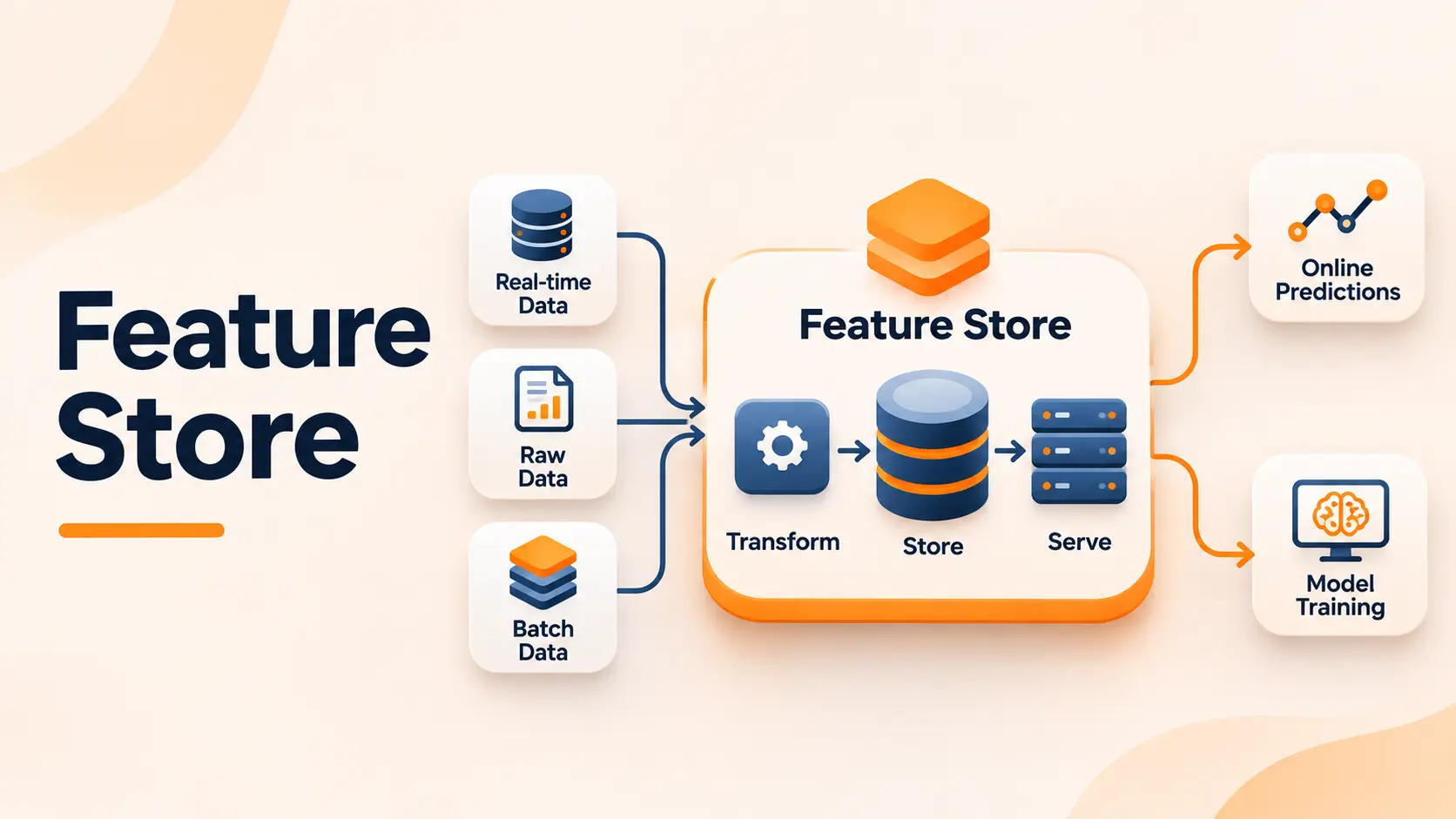
Machine learning models need reliable features to make accurate predictions, but managing those features across training and production creates a challenge. A Feature Store is a centralized system for managing, storing, and serving machine learning features. It allows teams to reuse feature definitions, access historical data for training, and retrieve current feature values for predictions.
The value becomes clear when multiple models depend on the same customer or transaction information. Within MLOps, a Feature Store connects feature engineering with production inference, reducing duplicated calculations and helping teams maintain consistent inputs throughout the machine learning lifecycle.
When I evaluate a Feature Store, I focus on three capabilities: retrieving the correct historical features, delivering current values when predictions need them, and keeping feature definitions consistent across both environments.
How a Feature Store Works
A Feature Store connects raw data sources with the features used by machine learning models. Instead of allowing every development team to calculate and manage features independently, it provides a shared system for defining, organizing, and retrieving them.
Consider a fraud detection model that needs to know how many transactions a customer completed during the previous 24 hours. This number is a feature derived from transaction records.
During training, the model needs the transaction count that was available at the time of each historical transaction. During production, it needs the current count before evaluating a new payment.
A Feature Store supports both requirements through a coordinated workflow.
Data Ingestion and Feature Transformation
The process begins with data collected from databases, transaction systems, event streams, or other approved sources.
Feature engineering transforms this raw information into values that machine learning models can use. For example, individual purchase records can become a customer's average transaction amount, purchase frequency, or number of recent failed payments.
These transformations can run through scheduled processing jobs, streaming pipelines, or calculations performed when predictions are requested.
The important requirement is that every feature has a documented definition and that its calculation produces values compatible with the model's expectations.
Feature Storage and Retrieval
After computation, feature values are made available through storage systems selected for their intended workloads.
Historical feature values support training and evaluation. Current feature values support operational predictions that require rapid retrieval.
Each record must also be associated with the correct entity, such as a customer ID, product ID, or transaction identifier. Time information becomes essential when feature values change during the observation period.
Feature Serving
Feature serving delivers the required values to a machine learning application.
For example, when a customer initiates a payment, the application retrieves the customer's recent transaction features and combines them with information from the current payment.
The model then uses those values to calculate a fraud score.
This approach allows the prediction service to access prepared features without recalculating every historical measurement during the request.
Feature Store Architecture
A Feature Store architecture coordinates feature computation, storage, metadata, and retrieval. Its components work together to support reliable feature access throughout the machine learning lifecycle.
The architecture consists of several functional layers.
Feature Pipelines
Feature pipelines collect and transform source data into reusable features.
A batch pipeline can calculate daily customer spending totals, while a streaming pipeline updates transaction counts as new events arrive.
The choice depends on how frequently the underlying information changes and how quickly the prediction system requires the updated values.
I would establish these requirements before selecting a processing framework. A feature that changes once a day does not need the same infrastructure as a fraud signal updated after every transaction.
Feature Registry
A Feature Registry maintains information about available features, including their names, definitions, data types, ownership, and associated transformations.
It helps engineers discover existing features instead of recreating the same calculation for every model.
For example, if several recommendation models need a customer's purchase frequency, a shared feature definition provides a consistent reference for that measurement.
The registry manages feature information, while the storage layer maintains the actual feature values.
Feature Serving Layer
The serving layer provides access to feature values through supported APIs, SDKs, or query interfaces.
It connects feature consumers with the appropriate storage system and applies the retrieval logic required by the application.
For production systems, I pay particular attention to retrieval latency, feature availability, and consistency between the values returned and the definitions used during training.
Online vs. Offline Feature Store
One of the most important distinctions in Feature Store architecture is the separation between online and offline storage.
These components support different workloads. An offline store provides historical feature information for training and analytical processing, while an online store supports rapid retrieval of current feature values for operational predictions.
The following comparison shows the practical differences.
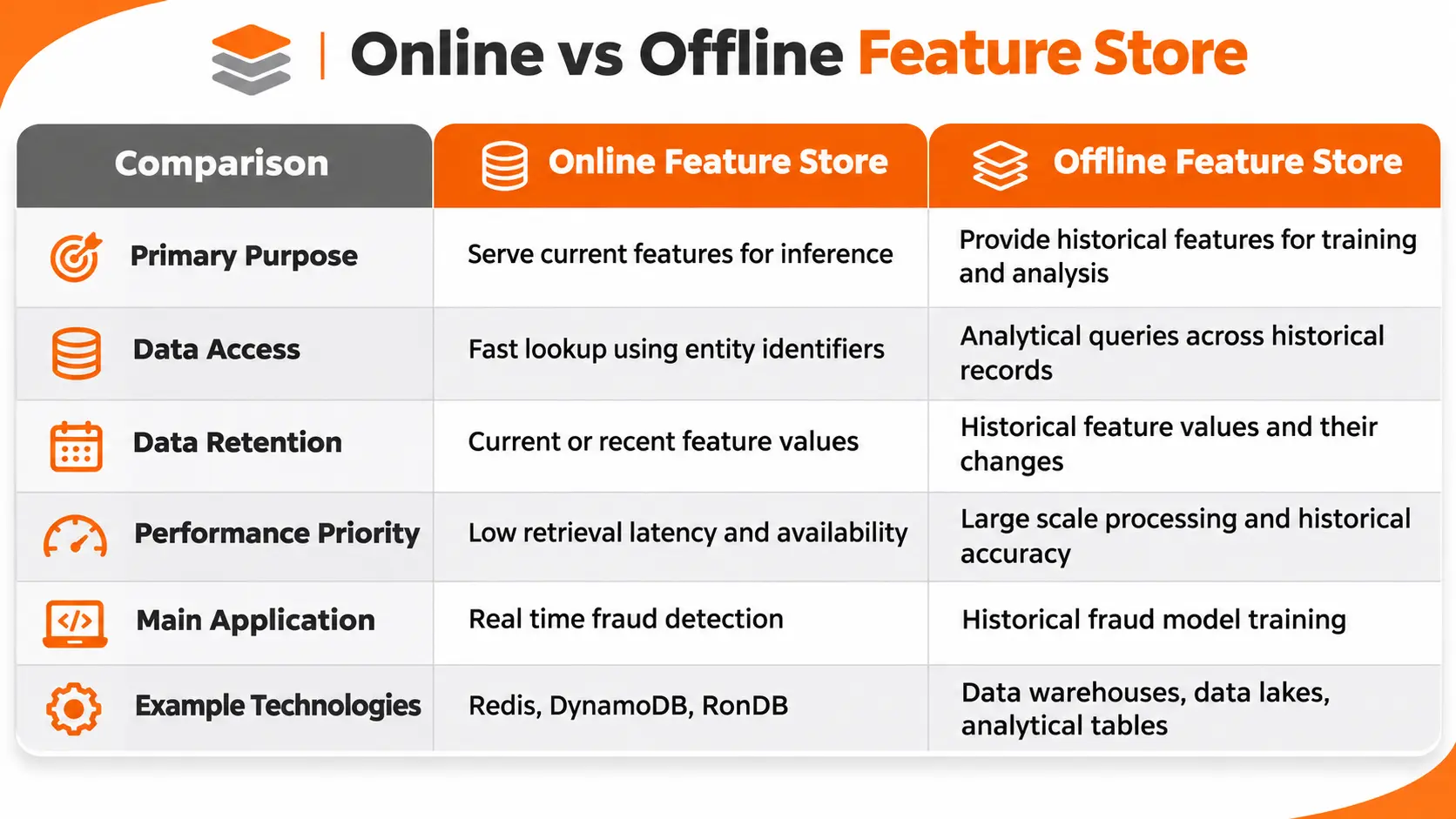
The key difference is not simply storage speed. It is the type of information each workload requires.
A model processing a payment needs the latest valid customer features available at that moment. Training the same model requires historical values that accurately represent what was known when each previous payment occurred.
A Feature Store does not need both storage layers for every application. Systems built exclusively for scheduled batch predictions can operate without a separate online store. However, applications requiring rapid access to current features need a serving architecture capable of meeting their latency requirements.
Feature Engineering and Feature Reuse
Feature Engineering transforms raw information into variables that help a machine learning model recognize useful patterns.
A Feature Store does not replace that process. It makes the resulting features easier to manage and reuse.
Consider two models developed by different teams. One predicts customer churn, while the other recommends products.
Both need information about recent purchasing activity.
Without shared feature management, the teams can independently calculate purchase frequency using different time windows, filtering rules, or definitions of a completed purchase.
The results might have similar names but represent different measurements.
A Feature Store allows the teams to use an established definition when their requirements match. Each model can retrieve the feature without rebuilding its calculation and storage process.
I would prioritize reuse for features with clear ownership, stable definitions, and established quality requirements. Features developed for a specific model should remain separate when their meaning or calculation differs.
Feature Definitions and Lineage
A feature definition should identify its source, transformation logic, data type, entity key, and time requirements.
Feature lineage connects that definition to the source data and processing steps used to produce its values.
This information matters when a feature changes.
If an engineer modifies the calculation of customer spending, the team needs to identify which models use that feature and whether the change affects their expected inputs.
A well managed Feature Store preserves those relationships so modifications can be reviewed before affecting dependent systems.
Training and Inference Consistency
A machine learning model learns relationships from the features supplied during training. If the production application calculates those features differently, the model receives inputs that no longer match its development conditions.
This problem is known as Training Serving Skew.
For example, imagine a fraud model trained using the number of completed transactions during the previous 24 hours.
If the production system counts both completed and declined transactions, the feature has a different meaning during inference.
The model might continue producing predictions, but those predictions are based on values calculated differently from its training inputs.
A Feature Store helps reduce this risk by maintaining shared feature definitions and coordinating the transformations used by training and production systems.
However, using a Feature Store does not automatically eliminate skew. Data freshness, processing consistency, and the correct application of feature definitions still need to be verified.
Point in Time Correctness
Historical training data must represent the information available when each prediction would have been made.
This principle is known as Point in Time Correctness.
Suppose a customer completes a transaction on March 10. The training dataset must use feature values available at that transaction's decision time.
If the dataset includes information recorded on March 15, the model receives knowledge that was unavailable when the original prediction would have occurred.
This creates data leakage and can make evaluation results appear stronger than the model's actual production performance.
Feature Stores with historical retrieval capabilities support temporal joins that select the appropriate feature values for each observation.
I would also account for when information became available to the system, not only when the underlying event occurred. A transaction recorded late must not be treated as information the model could already access.
That distinction is essential for producing trustworthy historical datasets.
Feature Store in Practice: Fraud Detection
Consider a payment platform that uses machine learning to identify suspicious transactions.
The model relies on several features, including the number of transactions completed during the previous hour, the average transaction amount over the previous seven days, and the customer's recent payment failure count.
These features are calculated from transaction records and stored under the appropriate customer identifiers.
Preparing Historical Training Features
The training process begins with historical transactions and their verified fraud outcomes.
For each transaction, the system retrieves feature values corresponding to the information available at that point in time.
The resulting dataset allows the model to learn patterns without accessing future transaction activity.
Historical accuracy is important because a fraud model trained with information from after a payment decision cannot be evaluated fairly against the conditions it will encounter in production.
Serving Features During a Payment
When a new payment request arrives, the application retrieves the customer's current feature values from the online serving layer.
The model combines those features with information supplied by the payment request and calculates a fraud probability.
The application's decision system then uses that prediction according to its established business rules.
Feature freshness matters here. If the customer has completed several transactions in the last few minutes, the model needs feature values that reflect the activity required by its design.
Maintaining Feature Consistency
The same feature definitions must govern the historical training process and production inference.
If the definition of recent transaction frequency changes, the team needs to assess its effect on the training dataset and deployed model.
The Feature Store makes this relationship manageable by maintaining shared definitions and identifying the systems that depend on them.
The practical benefit is not simply faster data access. It is having a consistent, traceable source of features across development and production.
Feature Store vs. Data Warehouse
A Data Warehouse stores structured information for reporting, analytics, and other data processing requirements.
A Feature Store focuses on organizing and delivering features for machine learning workloads.
The two technologies can work together.
A warehouse can hold transaction records and historical customer information. Feature pipelines transform that information into model features, while the Feature Store manages their definitions, historical retrieval, and access for inference.
Some Feature Store implementations use an existing warehouse as their offline storage layer.
I would not introduce a separate Feature Store simply to duplicate data that is already available in a warehouse.
The additional value must come from requirements such as reusable feature definitions, historical feature retrieval, consistent transformations, or rapid access for prediction services.
If an existing warehouse and well managed pipelines already satisfy those requirements, a separate platform adds limited value.
Benefits and Limitations of Feature Stores
The strongest benefit of a Feature Store is consistency across machine learning workflows.
Shared feature definitions reduce duplicated engineering effort. Historical retrieval supports reliable training datasets, while online serving provides prepared values for applications that require fast predictions.
Centralized ownership also improves traceability. Teams can identify where a feature comes from, how it is calculated, and which models depend on it.
These capabilities become particularly valuable when several models share data sources or when features change frequently.
However, adopting a Feature Store introduces additional operational responsibilities.
Feature pipelines must remain reliable, storage systems need appropriate capacity, and permissions must protect sensitive information.
Maintaining both online and offline storage can also increase infrastructure costs and operational complexity.
A Feature Store is not a substitute for data quality controls. Invalid source information, incorrect feature calculations, and delayed ingestion can still affect the values delivered to models.
The benefits depend on how well the system integrates with existing data workflows.
Feature Store Tools and Platforms
Several platforms provide capabilities for managing and serving machine learning features.
Feast is an open source Feature Store that supports feature definitions, historical retrieval, and online feature serving. It integrates with existing data infrastructure and allows teams to manage features without requiring a single proprietary storage platform.
Amazon SageMaker Feature Store provides managed feature groups and configurable online and offline storage. It supports historical feature data and low latency retrieval for inference workloads.
Databricks Feature Engineering provides feature management through Unity Catalog, supporting reusable feature definitions, lineage, and integration with machine learning workflows.
Hopsworks combines feature management with historical retrieval and online serving capabilities, supporting both batch and streaming feature pipelines.
Snowflake Feature Store allows teams to create and manage features within the Snowflake environment, making it relevant for organizations already using Snowflake for their data infrastructure.
I would compare these platforms based on existing data integrations, historical query requirements, online retrieval latency, operational cost, and the team's ability to maintain the system.
The most suitable platform is the one that meets the application's feature requirements without introducing unnecessary infrastructure.
Choosing a Feature Store for an ML Project
Before introducing a Feature Store, I would evaluate the actual requirements of the models and data pipelines.
The first consideration is feature reuse. If several models require the same derived information, centralized definitions can reduce duplication and improve consistency.
The second is historical accuracy. Projects involving changing customer, transaction, or event data need a reliable way to reconstruct features from the relevant historical period.
The third is production latency. Applications requiring immediate predictions need access to current feature values without introducing unacceptable delays.
Finally, the organization must consider operational ownership. A Feature Store requires maintained feature pipelines, clear definitions, appropriate access controls, and reliable data delivery.
For a single batch model with limited features and a stable data pipeline, existing analytical infrastructure can provide everything required.
For an organization operating multiple models with shared features, frequent updates, and demanding inference requirements, a dedicated Feature Store provides a more structured foundation.
The decision should follow the complexity of the data and prediction workflows, not the number of technologies available.
Feature Store and Reliable Machine Learning Systems
A Feature Store gives machine learning teams a structured way to manage the data their models depend on.
Its value comes from making feature definitions reusable, preserving accurate historical information, and delivering the right values when predictions are needed.
The distinction I consider most important is between storing features and managing them correctly. Fast access alone does not guarantee reliable predictions. Historical accuracy, consistent transformations, and clear feature ownership are equally important.
When those requirements are satisfied, a Feature Store becomes a practical part of the infrastructure supporting dependable machine learning applications.
FAQ
Can I build my own Feature Store with SQL and a database?
Yes. An organization can build feature management capabilities using SQL, existing databases, and processing pipelines. The implementation must address feature definitions, historical retrieval, version control, access permissions, and serving requirements. A custom solution also makes the organization responsible for maintaining these capabilities.
What happens if new data arrives late in my Feature Store?
Late arriving data must be processed according to its event time and the system's availability rules. Historical records can be corrected or updated while preserving the information needed to reproduce previous training datasets. The serving layer must also prevent older events from incorrectly replacing newer feature values.
Can a Feature Store manage embeddings for AI applications?
Yes, when the selected platform supports the required feature types or integrates with vector storage. Embeddings can be managed as machine learning features, but efficient similarity search requires appropriate indexing and retrieval capabilities. A traditional Feature Store does not automatically provide every function of a dedicated vector database.
What if two models need different versions of the same feature?
The feature definitions should be versioned or maintained separately so each model retrieves values calculated according to its expected specification. The training configuration and production application must reference compatible feature versions. Changes to a shared feature should be validated against dependent models before adoption.
What happens if the online Feature Store goes down?
Predictions that depend on unavailable features can fail or require a defined fallback. Depending on the application's requirements, the system can use permitted cached values, an approved alternative model, or a controlled service response. Recovery procedures should define acceptable feature age and prevent invalid fallback data from producing unsafe decisions.

Fatemeh Jahangard
Technology & AI Writer at PinerookFatemeh Jahangard covers AI, emerging technologies, and digital innovation for Pinerook, focusing on how technology shapes startups and industries.
 Seen first.


