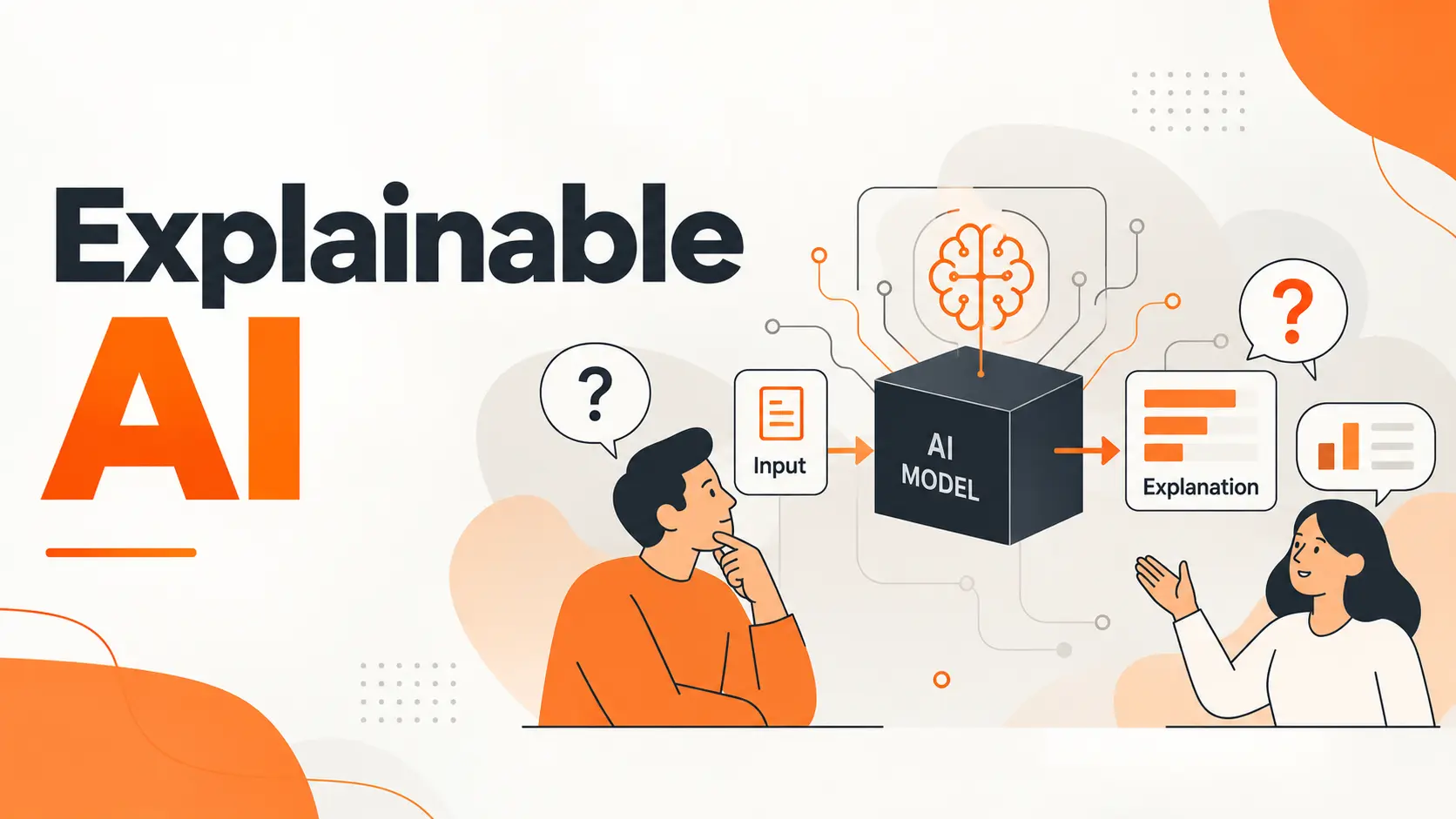
An AI model rejects a loan application in seconds. The applicant receives a decision, but the model's score says nothing about which factors influenced it. This is where Explainable AI (XAI) becomes important.
Explainable AI uses techniques that help people understand how artificial intelligence models produce predictions and decisions. It can reveal influential inputs, examine model behavior, and make complex results easier to investigate. For businesses building AI products, the real value is knowing what the model is doing, rather than accepting its output without examination.
How Explainable AI Works
Explainable AI examines the relationship between a model's inputs and its outputs. Depending on the technique, it can inspect the model's structure, measure the influence of input features, or test how predictions change under different conditions.
Consider a financial technology company using a machine learning model to evaluate loan applications.
The model considers payment history, existing debt, income stability, and employment information. It assigns an applicant a score of 0.42, while the company's approval threshold is 0.60. The application is rejected.
The score establishes the model's decision, but not the reasoning a person needs to understand it.
An explanation method can analyze how the applicant's characteristics contributed to that score. It might show that a high debt burden reduced the prediction, while consistent payment history increased it.
The company can then examine whether the explanation accurately represents the model's behavior.
I find it useful to separate this process into four parts:
Model prediction: The AI system produces an output from the supplied information.
Explanation method: A selected technique examines the prediction or the model's behavior.
Explanation output: The technique produces feature contributions, visualizations, or alternative input scenarios.
Validation: The explanation is tested to determine whether it accurately reflects the model and is understandable to its intended audience.
An important distinction runs through this process. Explaining which features influence a model's output is not the same as proving what causes an event in the real world.
For example, a model can associate existing debt with loan repayment risk. That association does not establish that changing a person's debt alone will cause a particular real world outcome.
Black Box AI and Model Interpretability
Some machine learning models contain complex interactions that are difficult to understand by inspecting their internal structure.
Deep neural networks illustrate this challenge. Their predictions result from many layers of mathematical operations, making it difficult to express the complete decision process in straightforward human terms.
These systems are described as black box models when their internal reasoning is difficult to interpret.
Not every AI model presents the same problem. A small decision tree, for example, can display the conditions leading to a prediction directly.
This distinction introduces two closely related concepts:
Model interpretability concerns how readily people can understand a model's structure, relationships, and behavior.
AI explainability concerns how a system's outputs or operations can be explained to people using suitable evidence and methods.
The terms overlap, and their precise definitions differ across research frameworks. For product development, the practical distinction is between understanding a model directly and using additional methods to explain its behavior.
I would not choose a complex model solely because it achieves a slightly better benchmark score. The decision must also consider whether the team can inspect its behavior and meet the explanation requirements of the product.
Types of Explainable AI
Explainable machine learning methods can be classified according to the scope of their explanations and the way those explanations are produced.
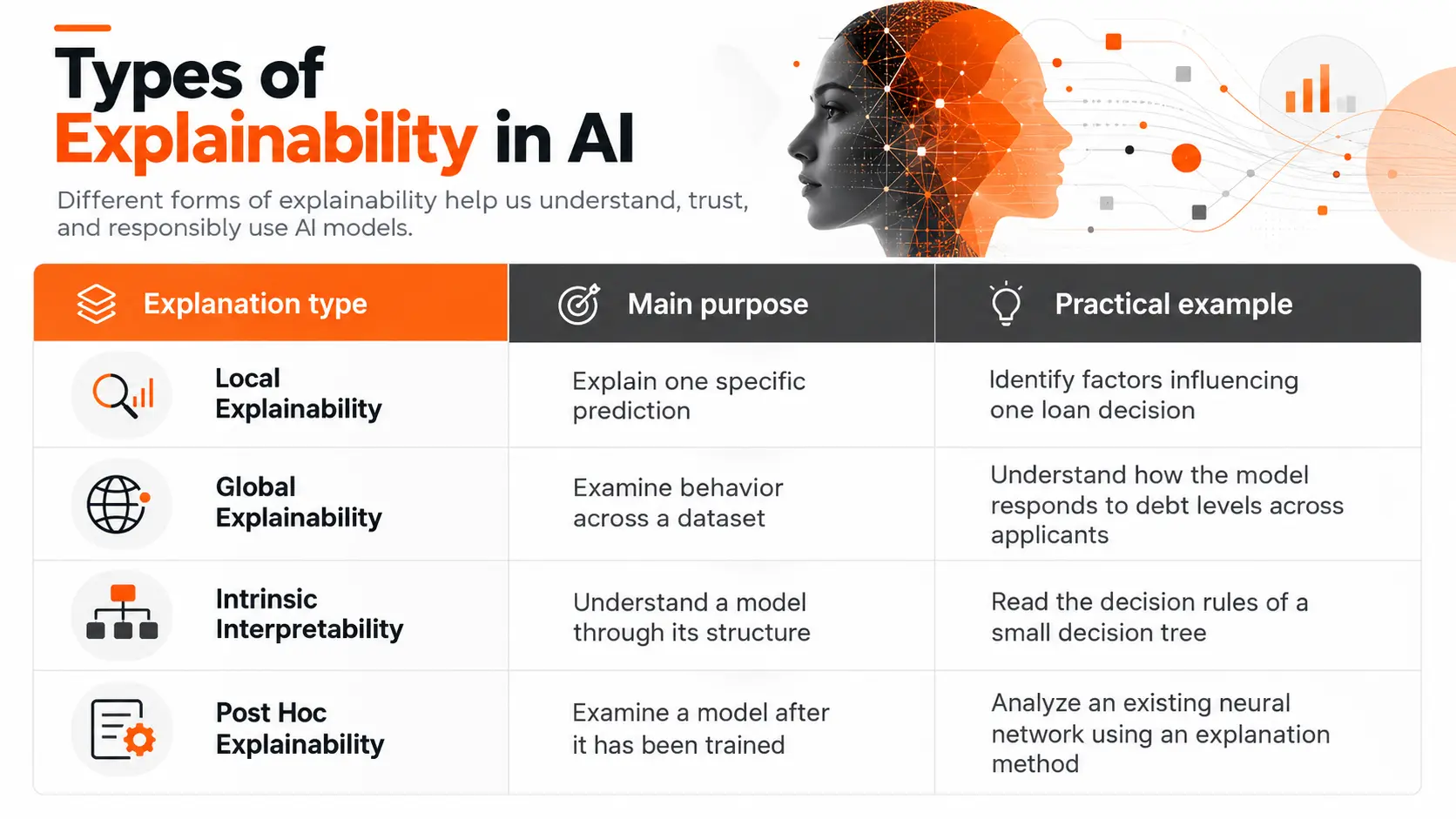
These categories are not mutually exclusive. A method can produce local explanations for a model that is otherwise difficult to interpret.
Another distinction concerns whether a technique works across different model architectures.
A model agnostic technique examines predictions without requiring a specific internal architecture. A model specific technique depends on properties of particular model families.
For a product team, these differences matter because access to the model, the type of data, and the intended audience determine which explanations can be generated.
Explainable AI Techniques and Methods
Different Explainable AI methods answer different questions about a model. Some identify the influence of individual features, while others examine broader prediction patterns or construct alternative scenarios.
Feature Attribution and Local Explanations
SHAP Values use a framework based on Shapley values from cooperative game theory to assign contributions to input features. These contributions describe how features move a model output away from a defined reference prediction.
In the loan example, a feature attribution explanation can show which applicant characteristics increased or decreased the model's predicted score.
LIME Explainable AI takes a different approach. It constructs an interpretable approximation of the original model around a selected prediction.
This allows developers to inspect the behavior of a complex model within a limited region of the input space. The explanation depends on how that local region is sampled and how accurately the approximation represents the original model.
Both approaches support investigation of individual predictions, but their calculations and assumptions differ.
Alternative Outcomes and Feature Relationships
Counterfactual Explanations identify changes to model inputs that would produce a different prediction.
For the rejected loan application, a counterfactual analysis could identify a different debt amount that would move the applicant's predicted score above the approval threshold, with other inputs held fixed.
That result describes the model's behavior. It is not a guarantee of loan approval or a statement that the proposed change is realistic, affordable, or permissible.
Partial Dependence Plots examine how a model's average prediction changes as selected input features vary across a reference dataset.
A financial technology company could use this method to investigate how predicted repayment risk changes across different debt levels.
The analysis requires particular care when features are strongly correlated. Testing unrealistic combinations of input values can produce misleading results.
Model Performance and Neural Network Attribution
Permutation Feature Importance measures how a model's predictive performance changes when the values of a selected feature are shuffled.
This provides an estimate of how much the model depends on that feature for the measured task. It does not establish whether increasing the feature will increase or decrease an individual prediction.
Integrated Gradients provides feature attributions for differentiable models by accumulating gradients along a path between a reference input and the input being explained.
For an image classification system, this approach can identify areas of an image that contribute to a selected model output.
The choice of reference input is part of the explanation and can materially affect its interpretation.
Choosing the Right Explainability Method
The best explanation depends on the question being investigated.
When choosing an approach, I would begin with the decision the team needs to make rather than selecting a technique because it is widely used.
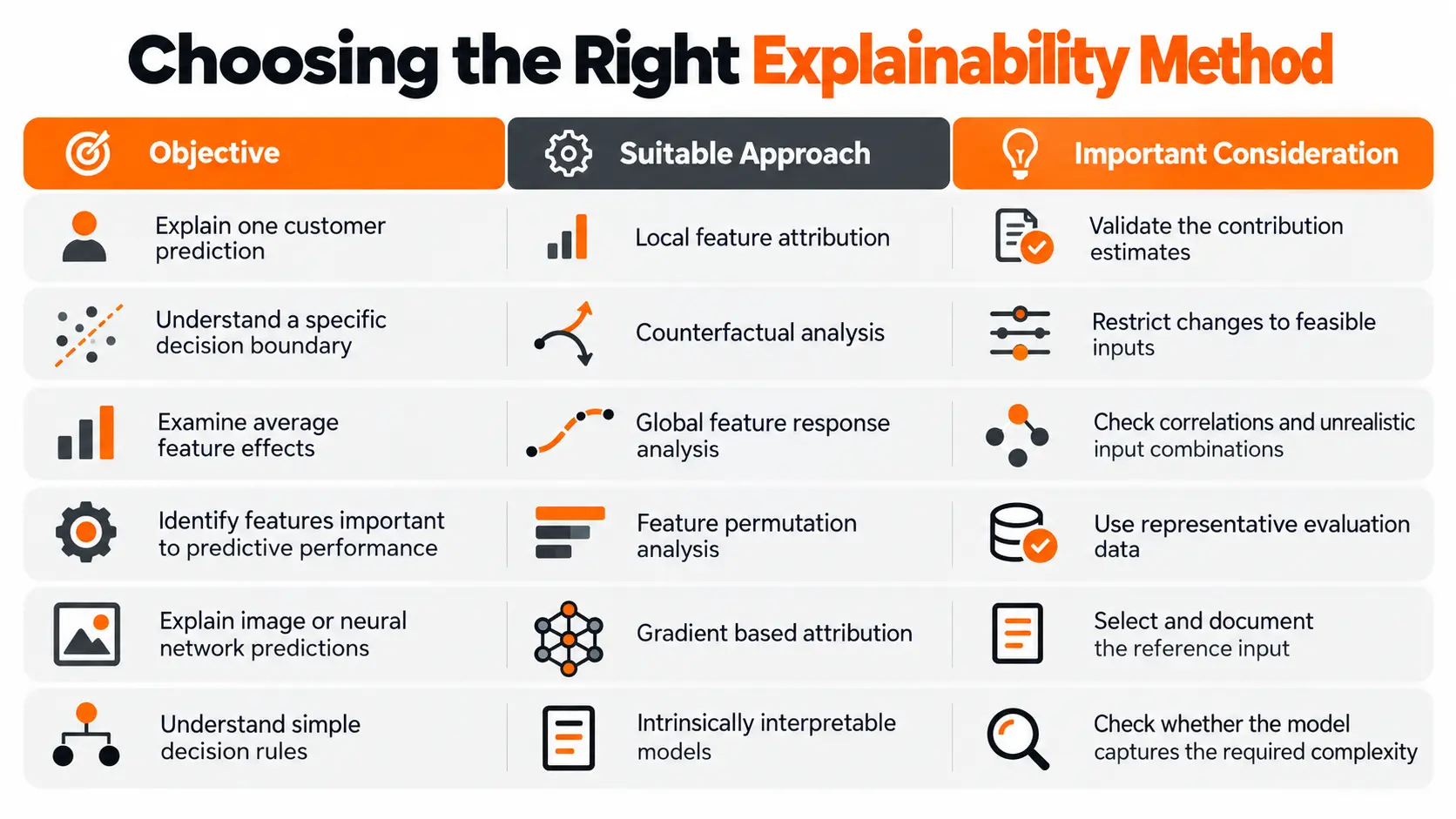
For example, a product team investigating why a specific customer was rejected needs a different explanation from a data science team investigating how the model behaves across thousands of applicants.
I would also treat a feature's importance as a property of the selected model, data, and explanation method. It should not be presented as evidence of a causal relationship unless additional analysis supports that conclusion.
Real World Applications of Explainable AI
The importance of explainability increases when AI outputs affect people, business operations, or decisions with significant consequences.
Financial Services
Banks and financial technology companies use predictive systems in credit assessment, fraud detection, and risk analysis.
Explainability helps analysts investigate the factors associated with individual decisions and examine whether a model relies on unexpected relationships.
For a startup developing an automated credit product, this information can support internal review and the design of customer explanations.
However, an attribution chart alone does not establish compliance with financial regulations or provide every explanation required by applicable law.
Healthcare
Machine learning can support medical imaging analysis, risk estimation, and clinical decision support.
An explanation method can highlight image regions or patient characteristics that influence a prediction.
For example, a medical imaging system can produce a visual attribution map showing areas that contributed to a classification.
That map must be assessed against clinical evidence. Highlighting an image region does not establish that the region contains the medical condition being predicted.
Retail and Customer Analytics
Retail companies use machine learning to estimate customer churn, recommend products, and forecast demand.
Explainability can help analysts understand which customer characteristics or behavioral patterns influence model outputs.
Consider a subscription business that predicts a customer is likely to cancel.
A local explanation can identify the information influencing that prediction, while global analysis can reveal how the model behaves across different customer groups.
These findings support investigation and product decisions, but they should be tested before being interpreted as evidence that a particular intervention will improve retention.
Industrial Systems
Predictive maintenance models analyze equipment measurements to estimate failure risks.
Explainability can show which temperature readings, vibration patterns, or operating conditions contributed to an alert.
Engineers can use that information to investigate equipment behavior and compare predictions with physical measurements.
The explanation supports diagnosis. It does not replace engineering inspection or establish the underlying mechanical cause of a failure.
Evaluating the Quality of AI Explanations
A convincing visualization is not proof that an explanation is correct.
An explanation can be easy to understand while failing to represent the model's behavior accurately.
NIST identifies four principles for Explainable AI: Explanation, Meaningfulness, Explanation Accuracy, and Knowledge Limits.
Together, they emphasize the importance of providing explanations, making them understandable, ensuring they reflect the system, and recognizing the limits of the system's capabilities.
For practical product development, I would evaluate explanations using the following criteria.
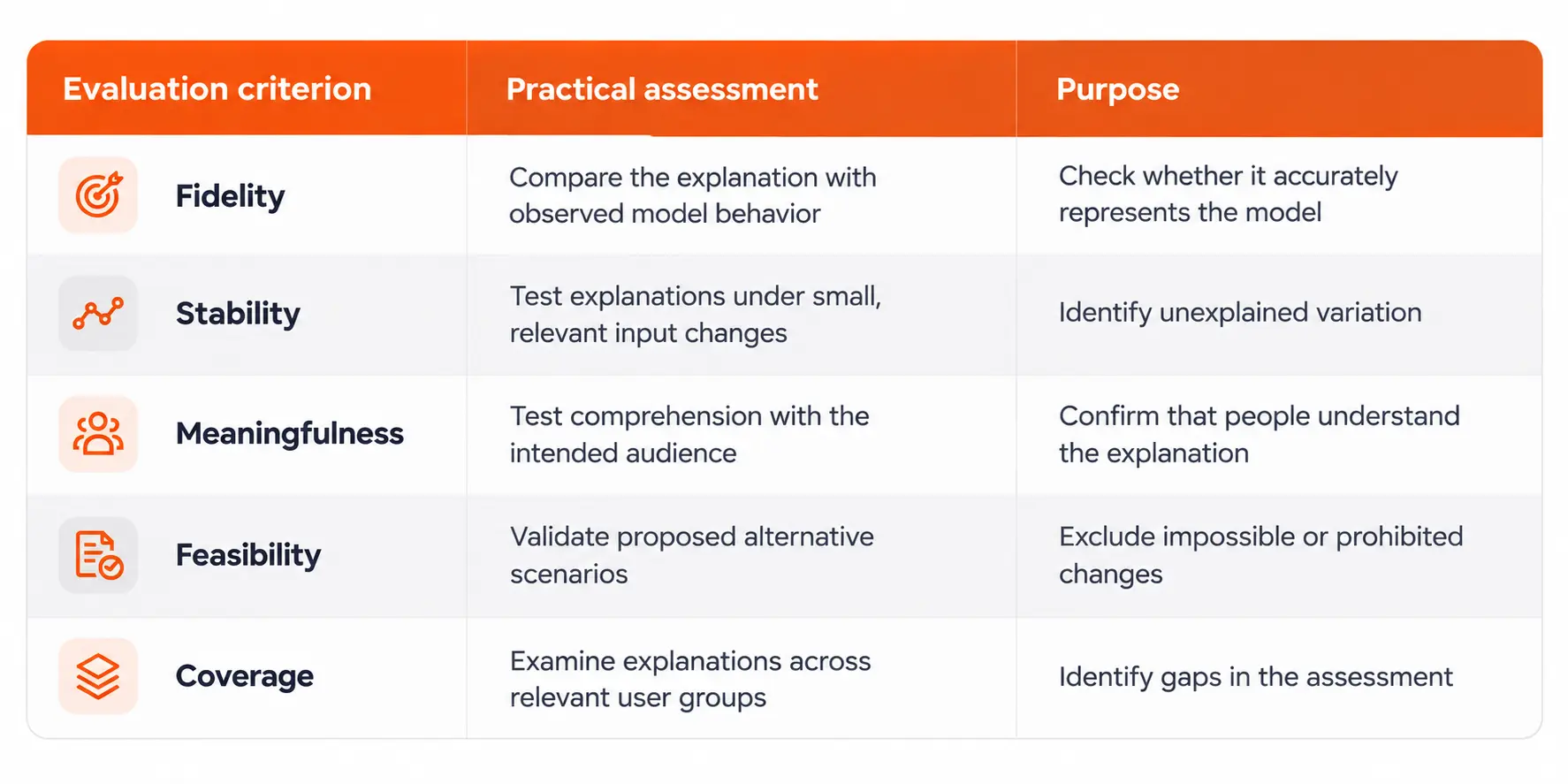
A stable explanation can consistently describe the wrong relationship. A technically accurate explanation can be impossible for a customer to understand.
For the loan application example, the company should validate the attribution results and verify that any customer facing explanation accurately communicates what the model evaluated.
It should also distinguish the model's statistical reasoning from the business rules and legal requirements governing the final decision.
Limitations of Explainable AI
Explainability introduces visibility into model behavior, but it does not make every AI decision reliable.
One limitation is the difference between approximation and exact representation.
Some methods explain a complex model using a simpler approximation. The approximation must be evaluated because it can omit relationships that influence the original prediction.
Another limitation comes from correlated features.
When two inputs contain overlapping information, different explanation techniques can distribute their apparent importance differently. A feature's attribution therefore depends on the method and its assumptions.
Explanations can also be sensitive to the reference data used to calculate them.
Changing the background dataset, the feature representation, or the reference input can change the resulting attribution.
There is a further distinction between explanation and fairness. Understanding which inputs influence a prediction does not establish that the model treats different populations fairly.
Fairness requires separate evaluation using appropriate data and metrics.
Finally, explanations do not automatically reveal the complete internal reasoning of generative AI systems. An explanation of an output, a source citation, and a record of tool activity provide different types of evidence.
A product should describe those forms of evidence accurately rather than presenting them as interchangeable.
Explainable AI in Product Development
Explainability is most useful when it becomes part of product design instead of an analysis added after a model has already been deployed.
For a startup developing an AI based decision system, I would organize the work around five practical decisions.
1. Define the audience. Establish whether explanations are intended for developers, internal reviewers, customers, or external auditors. Each group needs a different level of detail.
2. Identify the decision being explained. Specify the model output, its intended use, and the consequences of an incorrect or misunderstood prediction.
3. Select the explanation approach. Choose methods that are compatible with the model architecture, available information, and required explanation scope.
4. Validate the results. Compare explanations with actual model behavior and test whether the intended users understand them.
5. Integrate explanations into the product. Determine where they appear, who can access them, and how the team will monitor explanation quality after deployment.
In a financial technology product, engineers might need detailed feature contributions and technical diagnostics. Customers need language that accurately describes the decision without exposing irrelevant technical complexity.
The product should not force both audiences to interpret the same visualization.
For startups, this distinction affects interface design, support processes, internal oversight, and the effort required to maintain an AI system.
The Value of Explainable AI
Explainable AI gives developers and organizations a way to examine the behavior of models that influence important decisions.
Its value is not simply making artificial intelligence appear more transparent. It is providing evidence that helps people investigate predictions, assess limitations, and decide whether a system is suitable for its intended purpose.
A useful explanation must reflect the model accurately and communicate the relevant information to the person receiving it.
For teams building AI products, that is the standard worth designing around.
FAQ
Can I use XAI if the AI model belongs to another company?
Yes, provided the available interface gives the explanation method the access it requires. Model agnostic techniques can work through prediction interfaces, subject to technical constraints and provider permissions. Methods requiring internal gradients or model parameters cannot be implemented without the necessary access.
Can I still explain an AI decision from six months ago?
A historical prediction can be reproduced and examined if the required model version, original inputs, preprocessing configuration, and relevant reference data are available. Without sufficient records, reconstructing the original explanation reliably may not be possible.
Will showing customers an explanation expose our model's secrets?
Not necessarily. Organizations can provide carefully scoped explanations without disclosing model weights, source code, or proprietary training data. The disclosure design must still be assessed for information leakage and attempts to infer sensitive model behavior.
Does XAI work with text generated by chatbots too?
Explainability techniques can be applied to language models, but explaining generated text presents distinct challenges. Token attribution, behavioral experiments, retrieved source records, and execution traces offer different forms of evidence. None should automatically be treated as a complete account of why every word was generated.
Who should approve AI explanations before customers see them?
Approval should involve the responsible product owner, technical specialists, and relevant domain experts. Legal, compliance, privacy, and risk teams should participate where the application's consequences or regulatory obligations require their review. The organization should document responsibility for the accuracy and suitability of customer facing explanations.

Fatemeh Jahangard
Technology & AI Writer at PinerookFatemeh Jahangard covers AI, emerging technologies, and digital innovation for Pinerook, focusing on how technology shapes startups and industries.
 Seen first.