
An event contract turns a precisely defined future outcome into a tradable position. A market might ask whether inflation will exceed a specified rate, whether a central bank will cut rates at its next meeting, or whether a company will launch a product by a deadline. In prediction markets, these contracts make expectations tradable, but their settlement depends on written rules, not a general impression of what happened. For anyone reading a market price, the important question is what must occur for the position to pay.
Many event contracts look simple: buy Yes or No, then receive a payout if that side wins. Yet a small difference in wording, a revised statistic, or a delayed announcement can change the official outcome. Understanding the instrument requires following the transaction from the contract terms to its eventual settlement.
What an event contract represents
An event contract is a financial instrument whose value depends on a stated event or measurable result. The familiar binary version offers Yes and No positions. Under a common fully funded structure, a winning share settles for $1 and a losing share for $0. That is a contract convention, not a rule that applies to every product: some markets use ranges, multiple outcomes, or special settlement terms. Holding an event contract does not give the buyer ownership in the business or asset mentioned in the question.
The contract is narrower than the headline. Consider “Will the annual inflation rate be at least 3.0% in the first official release for June?” A result of exactly 3.0% satisfies “at least”; a contract asking whether inflation is “above 3.0%” would treat that same reading differently. The specified release also matters. A later revision might change the economic story without changing the result of a contract that explicitly uses the initial figure.
Yes and No prices, costs, and payouts
Suppose Yes shares trade at $0.42 each. The price is often described as implying roughly a 42% chance of the event occurring. This is a useful shorthand for market expectations, not a calibrated probability or a promise of accuracy. Prices also reflect participants’ willingness to trade, liquidity, and execution costs. The last traded price may differ from the quote a new buyer can actually obtain.
Now suppose a trader buys 100 Yes shares at $0.42. The purchase costs $42 before fees. If Yes wins and each share settles at $1, the trader receives $100 and earns $58 before fees and taxes. If No wins, the shares settle at $0 and the $42 purchase price is lost. The buyer may also sell before resolution when trading is still open and another party is willing to transact.
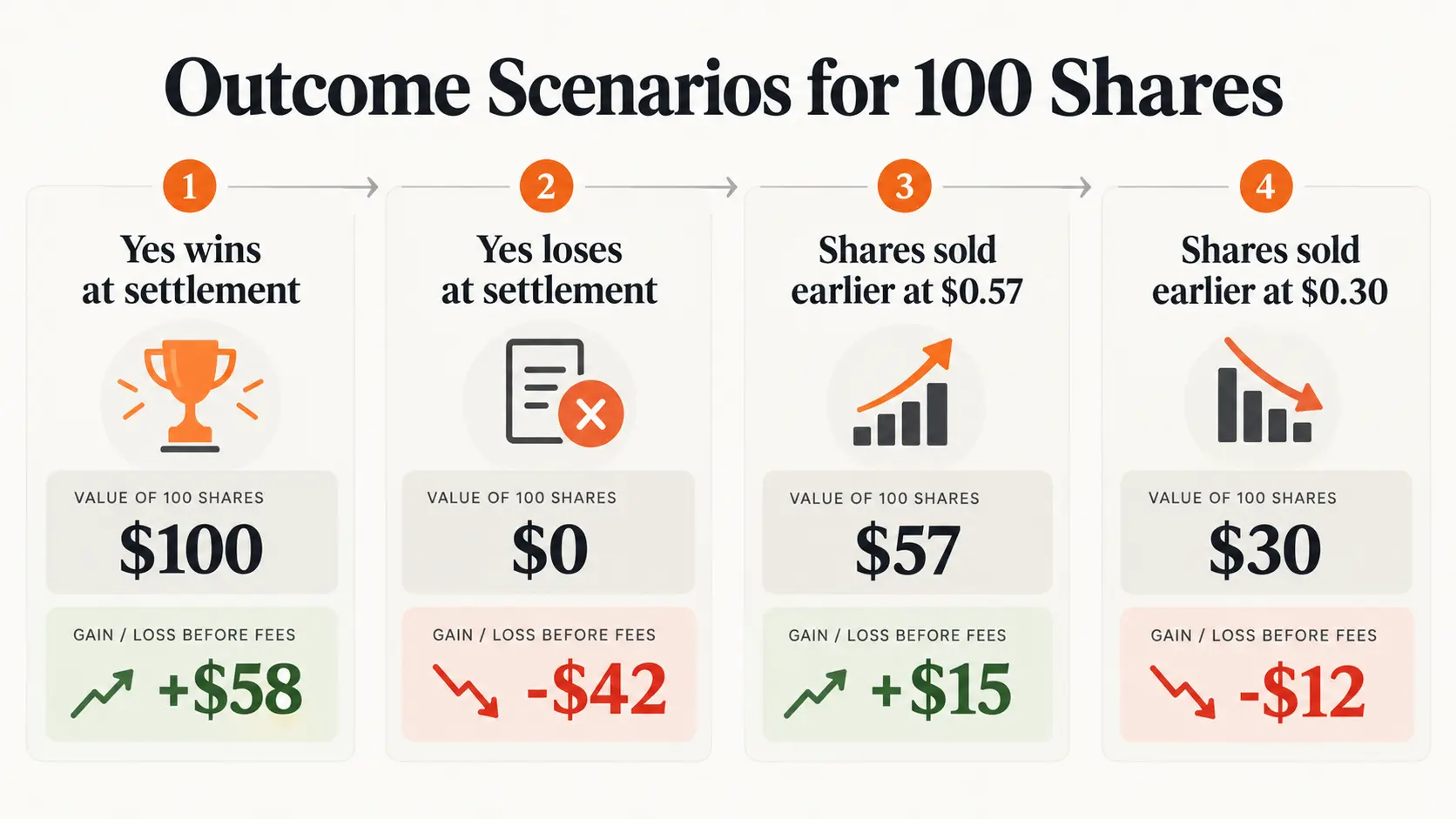
Based on 100 Yes shares purchased for $42; excludes trading fees and taxes. An early exit depends on an executable price for the full position.
Yes and No are opposite exposures to the same specified outcome, but displayed trading prices do not always add neatly to $1. Bid ask spreads, fees, and differing quotes can create a gap. Anyone comparing the two sides needs to evaluate the actual purchase or sale price rather than infer a guaranteed opportunity from rounded screen quotations.
Trading close, resolution, and settlement
Three moments matter. Trading close is the cutoff after which the position can no longer be bought or sold on that market. Resolution is the determination of which outcome satisfies the contract rules. Settlement is the subsequent processing of the contract’s cash payout. These steps can happen close together, but they are not automatically simultaneous, and each market can set its own schedule.
Imagine a contract tied to a government economic release. Trading could close just before the scheduled announcement. If the agency postpones the report, the contract may remain unresolved until the named data become available. After the official result is checked, the platform completes settlement under its rules. Some venues make a centralized determination, while others use an oracle based challenge process. In either case, the relevant question is whether the designated evidence satisfies the published contract terms.
The rules that decide the winning side
A contract title is a summary; the resolution criteria establish what counts. The key terms are the precise threshold, deadline and time zone, authoritative source, data version, and handling of exceptions. A market asking whether a product launches “by September 30” may settle No if the launch happens on October 2, even if the product ultimately performs well. Likewise, an inflation statistic rounded in a news headline may not match the precision required by the contract.
Exceptional events create the greatest room for misunderstanding. The original source may issue a correction, two reports may conflict, a scheduled announcement may be canceled, or an event may be impossible to assess on time. Depending on the product, rules may provide for delayed resolution, a challenge, cancellation, or a special settlement procedure. There is no universal assumption that a canceled or disputed event automatically returns the purchase price. The written terms should explain which process applies.
Risks behind a simple binary payoff
A $1 or $0 settlement structure can make the maximum purchase loss easy to calculate while concealing other risks. The most obvious is outcome risk: the event resolves against the position. Liquidity risk appears when few participants are willing to trade and an early sale requires accepting a much worse price. Definition risk comes from reading a headline but overlooking the source, date, or exact wording. Settlement risk includes procedural delays, disputed evidence, and platform specific operational conditions.
Legal access and costs also vary by market and jurisdiction. A position that seems attractive at its headline price can deliver a different net return once transaction fees or restrictions are considered. An event contract should not be confused with a perfect hedge: a startup’s costs might rise even when an inflation related contract resolves No. The outcome of the specified event and the business’s actual exposure are not identical.
How founders can interpret event contract signals
A startup founder may find event contract prices informative without placing a trade. A contract on a rate decision or inflation release offers a time specific view of how market participants are positioning around uncertainty. If that view shifts materially, a company can revisit its assumptions about borrowing costs, customer demand, or its funding timeline. The price provides context for planning, not an instruction to change strategy.
A practical reading starts with the full event question, its resolution criteria, and the timestamp of the observed price. It then considers the bid ask spread and the activity behind the quote. A thinly traded market can display a precise looking number that represents limited evidence. For operating decisions, the signal should sit beside customer data, cash flow forecasts, and alternative scenarios not replace them.
FAQ
Are event contracts the same as prediction markets?
Not exactly. A prediction market is a venue or mechanism for trading views about outcomes. An event contract is a specific instrument that defines the payoff tied to an outcome. Not every prediction system uses cash settled event contracts.
Can an event contract be sold before the result is announced?
Often, yes, if the market remains open and there is an executable buyer or seller. The exit price can differ from the original entry price, and low liquidity can make the trade difficult or costly.
What happens if the official outcome is later revised?
The contract’s written terms control the answer. Some products use the first official release, while others rely on a later version or include correction procedures. A revision does not automatically reopen a settled result.
Ultimately, an event contract is only as clear as the question and rules behind it. The market price conveys expectations; the contract defines the financial result. Reading both is essential before interpreting a quote as information or accepting the risks of a position.

Masoumeh Jahangard
Markets & Economy Writer at PinerookMasoumeh Jahangard covers markets, economic trends, and business conditions for Pinerook, focusing on how they affect startups and growing companies.
 Seen first.