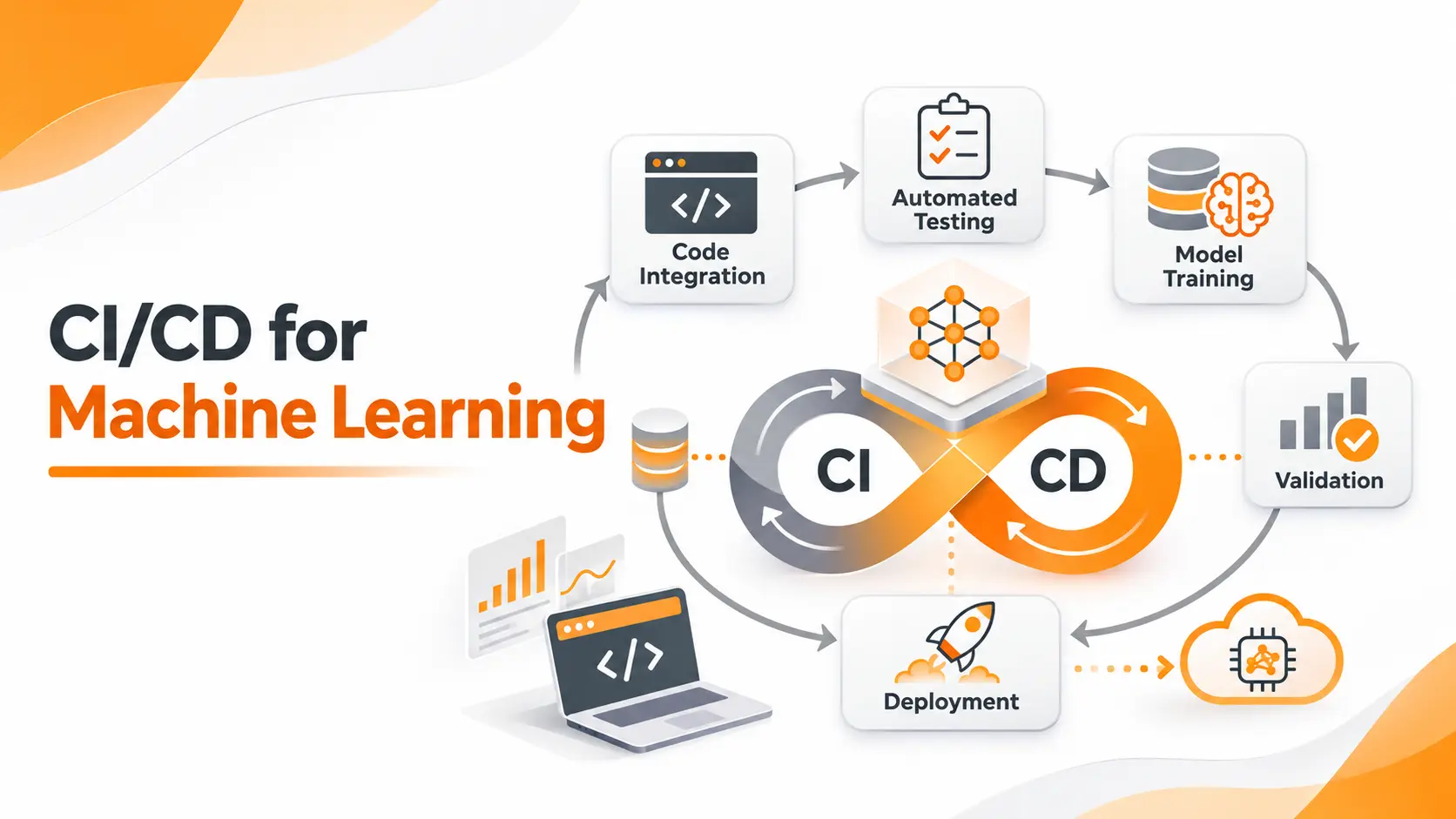
CI/CD for Machine Learning automates the testing, validation, and release of machine learning systems. Instead of manually checking every code change, training result, and model version, teams use a pipeline to verify changes and prepare approved artifacts for production. The goal is not simply to release models faster. It is to prevent unreliable changes from reaching users.
Machine learning introduces a challenge that traditional software pipelines do not fully address: a model can run without errors and still produce poor predictions. This makes data validation, model evaluation, and release controls essential. Within MLOps, CI/CD provides a structured process for testing changes, validating model performance, and ensuring that only approved versions progress toward production.
CI/CD Pipeline for Machine Learning
An ML CI/CD pipeline connects version control, automated testing, model evaluation, and release management. Its purpose is to make every change traceable and every release dependent on defined checks rather than individual judgment alone.
A practical workflow follows six stages:
Source Control: A developer submits changes to the training code, feature transformations, configuration, or pipeline components.
Continuous Integration: Automated checks verify the code, dependencies, data contracts, and pipeline behavior.
Candidate Training: A training job creates a candidate model when the workflow requires a new model version.
Model Evaluation: The candidate is evaluated using approved datasets, metrics, and acceptance criteria.
Artifact Registration: Validated outputs are stored with their code, data, configuration, and evaluation records.
Continuous Delivery: Approved artifacts are prepared for release, tested in the target environment, and deployed according to the release policy.
Not every code change requires a full training run. A modification to a logging function should not automatically consume hours of GPU processing. Lightweight checks can run during Continuous Integration, while expensive training jobs execute through a separate workflow.
This separation keeps feedback fast without weakening the controls applied before a model is released.
Continuous Integration, Delivery, and Training
The terms CI, CD, and CT describe different responsibilities. Treating them as interchangeable makes it difficult to identify which process should execute after a change.
Continuous Integration
Continuous Integration verifies that changes can be safely combined with the existing project.
For machine learning, that means more than running Python tests. The workflow also checks feature transformations, input schemas, pipeline interfaces, and the compatibility of model components.
A passing CI run confirms that the tested components meet their defined checks. It does not establish that a new model is suitable for production.
Continuous Delivery
Continuous Delivery prepares validated software, pipeline components, or model artifacts for release.
The workflow packages approved artifacts, checks deployment compatibility, and makes the release available through a controlled process.
Continuous Delivery differs from Continuous Deployment. In Continuous Delivery, a human approval step can remain before production release. Continuous Deployment automatically releases changes after all required controls pass.
For applications with significant business or safety consequences, explicit approval can remain part of the release process without sacrificing automated testing.
Continuous Training
Continuous Training, or CT, automates the process of creating new model versions.
A training workflow can respond to newly available data, a schedule, an approved configuration change, or a signal from production monitoring.
Training produces a candidate, not an automatic authorization to deploy it.
The candidate still needs evaluation and approval. If it fails the acceptance criteria, the existing production model remains in place.
ML CI/CD vs. Traditional Software CI/CD
Traditional software CI/CD primarily validates changes to application code and its dependencies. Machine learning pipelines must account for another source of change: the data that influences model behavior.
A software function can pass its unit tests while a model trained on different data produces worse predictions.
Machine learning releases therefore need controls for three distinct assets: the implementation, the training data, and the resulting model.
The tests are different as well. A unit test can verify that a preprocessing function returns the correct output. It cannot establish whether the trained model maintains sufficient recall, whether its predictions meet latency requirements, or whether performance has deteriorated for an important customer segment.
These questions require model evaluation and operational checks.
Another distinction is the release artifact. A CI/CD workflow can release a new training pipeline without releasing a new model. A Continuous Training workflow can also produce a new model without changing the pipeline code.
Keeping these two release paths separate makes it easier to understand exactly what changed.
Automated Testing for ML Pipelines
Automated testing should follow the dependencies of the machine learning system. Code must work correctly, data must satisfy its contract, and model outputs must meet the application's requirements.
Code and Pipeline Tests
The first checks cover transformation functions, configuration parsing, component interfaces, and integration between pipeline stages.
For example, a test can verify that a categorical encoding function produces the expected columns and handles missing values according to the approved transformation rules.
Pipeline tests also check whether components produce the expected artifacts and whether downstream stages can read them.
These tests should run before expensive training begins.
Data Validation
Data validation checks whether incoming datasets match the assumptions made during model development.
Essential checks include required columns, data types, allowed value ranges, missing value rules, unique identifiers, and the availability of target labels.
For a customer churn model, a missing account identifier should stop the workflow before training. An unexpected category in a subscription field should also be handled according to an explicit rule rather than silently accepted.
Distribution checks provide additional evidence when the new dataset differs materially from the approved reference data.
A changed distribution does not automatically mean that training data is invalid. It means the workflow needs a defined decision rule based on the feature and the application's requirements.
Model Evaluation
Model validation focuses on prediction quality.
The workflow evaluates a candidate against an appropriate dataset that has not been used to fit the model. The selected metrics must reflect the business problem.
For churn prediction, accuracy alone can hide poor performance on customers who actually leave. Recall, precision, and the number of customers the retention team can contact provide a more useful basis for evaluation.
The candidate must also satisfy operational requirements, including input compatibility, resource consumption, and prediction latency.
Statistical evaluation requires careful interpretation. A small improvement on a single dataset is not proof that a model will perform better across future production traffic.
Model Quality Gates
A Quality Gate is an automated decision point that determines whether an artifact can advance to the next stage.
The most useful gates evaluate specific evidence and produce an unambiguous pass or fail result.
ML CI/CD Release Checklist
The following table summarizes the checks that matter most before an ML pipeline or model version progresses toward production.
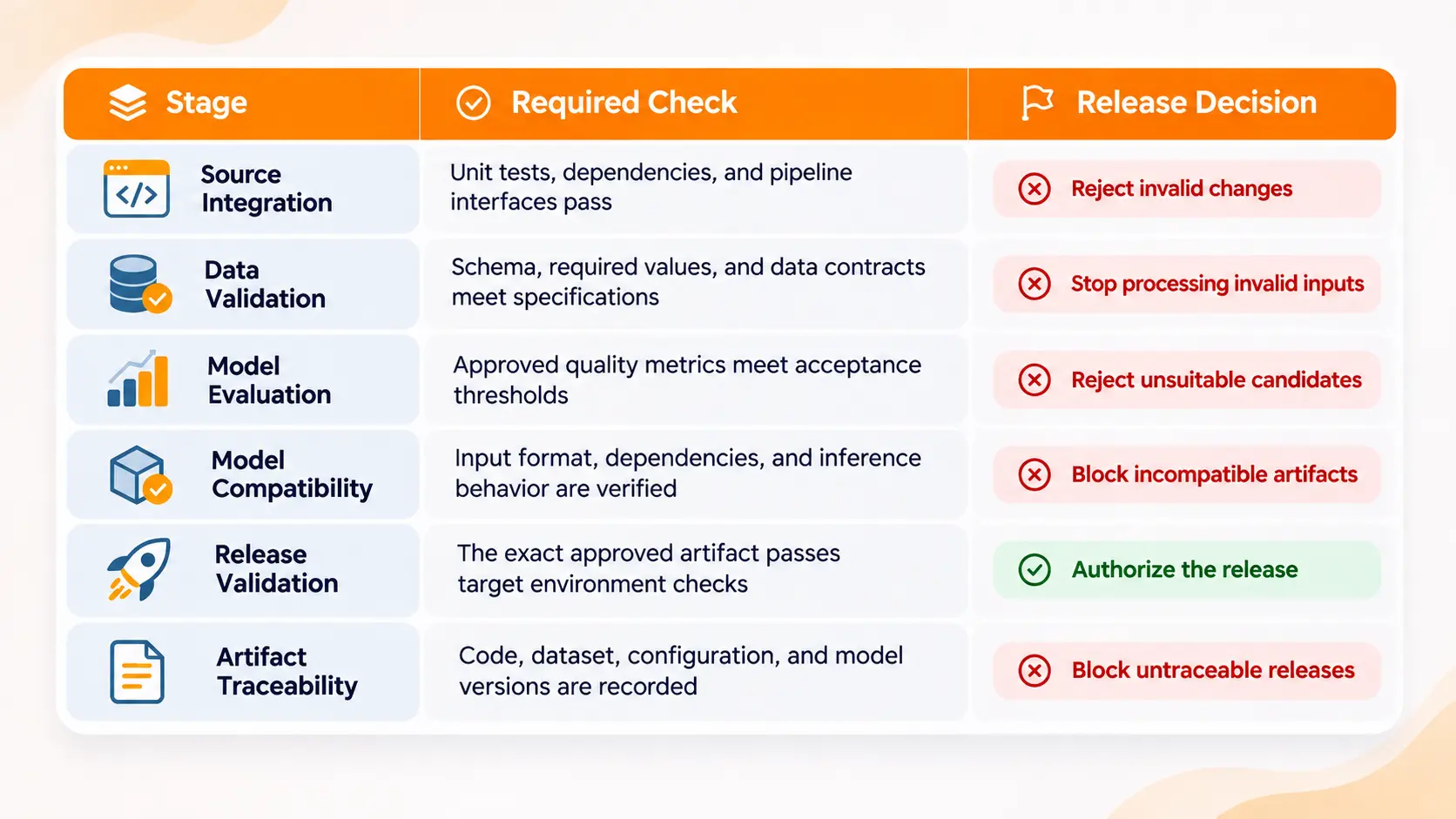
The important distinction is between creating a model and approving it. Training can complete successfully while the model fails its evaluation gate.
Acceptance criteria should be established before candidate evaluation. Repeatedly adjusting thresholds to approve a preferred candidate defeats the purpose of automated validation.
The release process must also use the artifact that passed the checks. Retraining after approval creates a different artifact and invalidates the assumption that the tested model is the one being deployed.
CI/CD Pipeline Triggers
A pipeline trigger determines when automation starts. Different events should launch different workflows.
Code changes should trigger integration tests and checks covering the modified components. Pull requests provide a natural point for reviewing failures before changes are merged.
New training data can trigger validation and a training workflow when the dataset meets the requirements for a new training run.
Scheduled execution is appropriate when an organization has a defined training cycle and the necessary data is available.
Performance alerts can initiate an investigation or an approved retraining workflow when the deployed model no longer meets operational expectations.
Manual approval remains useful for controlled releases and exceptional maintenance activities.
The trigger should match the event that actually requires action. New data does not justify rebuilding application code, just as a documentation update does not justify retraining a model.
Separating these responsibilities reduces processing costs and makes pipeline failures easier to diagnose.
CI/CD for Machine Learning in Practice
Consider a subscription business using a machine learning model to predict customer churn.
The model processes customer activity, subscription history, and support interactions. Its predictions help the retention team identify customers who need attention.
The engineering team changes the feature transformation responsible for calculating recent customer activity.
Validating the Change
The developer opens a pull request containing the updated transformation.
Continuous Integration runs unit tests and verifies that the transformed data matches the expected schema. A small representative dataset is processed to confirm that downstream pipeline components can consume the new features.
If a required feature disappears or changes type unexpectedly, the workflow fails before the change is merged.
This provides immediate feedback without starting a full training job.
Training and Evaluating a Candidate
After the change is approved, the training workflow uses an authorized dataset snapshot and the updated pipeline implementation.
It creates a candidate model and evaluates it against the current approved model using the same evaluation protocol.
Suppose the existing model achieves an F1 score of 0.76 and the candidate achieves 0.78 on the selected evaluation dataset.
That improvement is useful, but it is not sufficient by itself.
The candidate must also satisfy the agreed recall requirement for customers at risk of leaving, remain within the application's prediction latency budget, and pass checks on important customer segments.
If the candidate improves the overall score but fails a required segment threshold, the release gate rejects it.
These numbers illustrate the decision process. Production thresholds must be established from the organization's own requirements and evaluation evidence.
Registering and Releasing the Model
Once the candidate passes every required gate, its artifact is stored with the corresponding code revision, dataset reference, training configuration, and evaluation results.
This record connects the model to the evidence used for its approval.
The release workflow retrieves that exact artifact and verifies its compatibility with the target environment.
After any required human approval, the model can be released through the organization's deployment process.
If a gate fails, the approved production version remains unchanged.
The key outcome is a reproducible decision. The team can identify which model was approved, which tests it passed, and which inputs produced it.
CI/CD Tools for Machine Learning
A machine learning CI/CD setup combines tools with different responsibilities. A single platform does not need to handle every part of the workflow.
GitHub Actions and GitLab CI/CD execute automated tests, builds, and release workflows in response to repository events.
DVC helps teams track dataset versions and reproducible pipeline dependencies alongside source control.
MLflow provides experiment tracking and model management capabilities, making it possible to associate model artifacts with training runs and evaluation results.
Kubeflow Pipelines supports orchestration of machine learning workflows that involve multiple processing and training components.
Azure Machine Learning, Amazon SageMaker, and Google Cloud Vertex AI provide managed capabilities for building, executing, and operating machine learning pipelines.
For a smaller project, a CI service combined with versioned datasets and an artifact store can cover the essential requirements.
More complex workflows benefit from dedicated orchestration when they need distributed training, shared computing resources, multiple pipeline branches, or detailed execution management.
The choice should follow the workload rather than the number of features offered by a platform.
Implementing an ML CI/CD Pipeline
The first step is to make the existing training process repeatable.
Training code, configuration, data references, dependencies, and evaluation logic need to be controlled so another run can reconstruct the same experimental conditions. Exact numerical reproducibility also depends on the selected algorithms, hardware, and computational settings.
Next, introduce automated checks before training. Unit tests and data validation provide fast feedback and prevent invalid changes from consuming expensive resources.
Then create a dedicated evaluation stage with clearly defined metrics and release thresholds.
The evaluation results should be stored alongside the model artifact. The release workflow must reference the approved version rather than train a replacement model.
After these controls work reliably, automate the packaging and delivery process. Maintain separate permissions for testing, artifact approval, and production release.
This separation prevents a development workflow from gaining unnecessary authority over production systems.
Measuring Pipeline Reliability
A CI/CD pipeline needs its own operational measurements.
Track the time between submitting a change and receiving test results, the number of failed executions, the duration of training jobs, and the time required to prepare an approved release.
Also track how frequently releases require correction and whether failures are detected before or after production deployment.
These measurements expose bottlenecks in the delivery process without confusing pipeline performance with model prediction quality.
The objective is not to maximize the number of model releases. It is to make approved changes easier to validate, reproduce, and deliver.
Reliable Automation for Machine Learning
CI/CD for Machine Learning connects engineering changes to a controlled release process.
Continuous Integration verifies implementations and their dependencies. Continuous Training creates new model candidates when training is required. Continuous Delivery prepares approved artifacts for production.
The central principle is straightforward: a successful training run is not a successful release.
Reliable automation requires evidence that the data, implementation, model behavior, and release artifact satisfy their defined requirements.
With those controls in place, teams can update machine learning systems without rebuilding the entire validation process for every change.
FAQ
What if a training job takes longer than the CI runner allows?
Long training jobs should execute through a dedicated training service or orchestration platform. The CI workflow can submit the job, record its execution identifier, and receive its final status through an approved integration. This prevents runner time limits from interrupting training while preserving the validation requirements.
Can we use private training data with GitHub Actions?
Yes, provided the runner environment, credentials, network access, and data handling policies satisfy the organization's security requirements. Sensitive datasets should remain in approved storage rather than being copied into public repositories or exposed through workflow logs. Self hosted runners or private execution environments provide additional control over where processing occurs.
Can different ML models share the same CI/CD pipeline?
Yes. Shared workflows can accept model specific configuration, dataset references, evaluation rules, and resource requirements. Each execution must retain separate artifact identifiers and approval records to prevent one model's output from replacing another's. Reusable workflow components should not force unrelated models to share the same quality thresholds.
What if production labels arrive weeks after predictions?
The evaluation process must account for label availability. Predictions should be retained with the identifiers and timestamps required to join them to outcomes when labels become available. Performance evaluation can then use completed observation windows. Operational health checks can run earlier, but they cannot replace outcome based evaluation when the required labels are missing.
Can we release a code update without retraining the model?
Yes, when the change does not alter the trained model or invalidate its expected inputs and behavior. The updated application still requires compatibility, integration, and inference tests using the approved model artifact. Changes to preprocessing, feature definitions, or model loading behavior require additional validation because they can affect predictions even when the stored model weights remain unchanged.

Fatemeh Jahangard
Technology & AI Writer at PinerookFatemeh Jahangard covers AI, emerging technologies, and digital innovation for Pinerook, focusing on how technology shapes startups and industries.
 Seen first.


