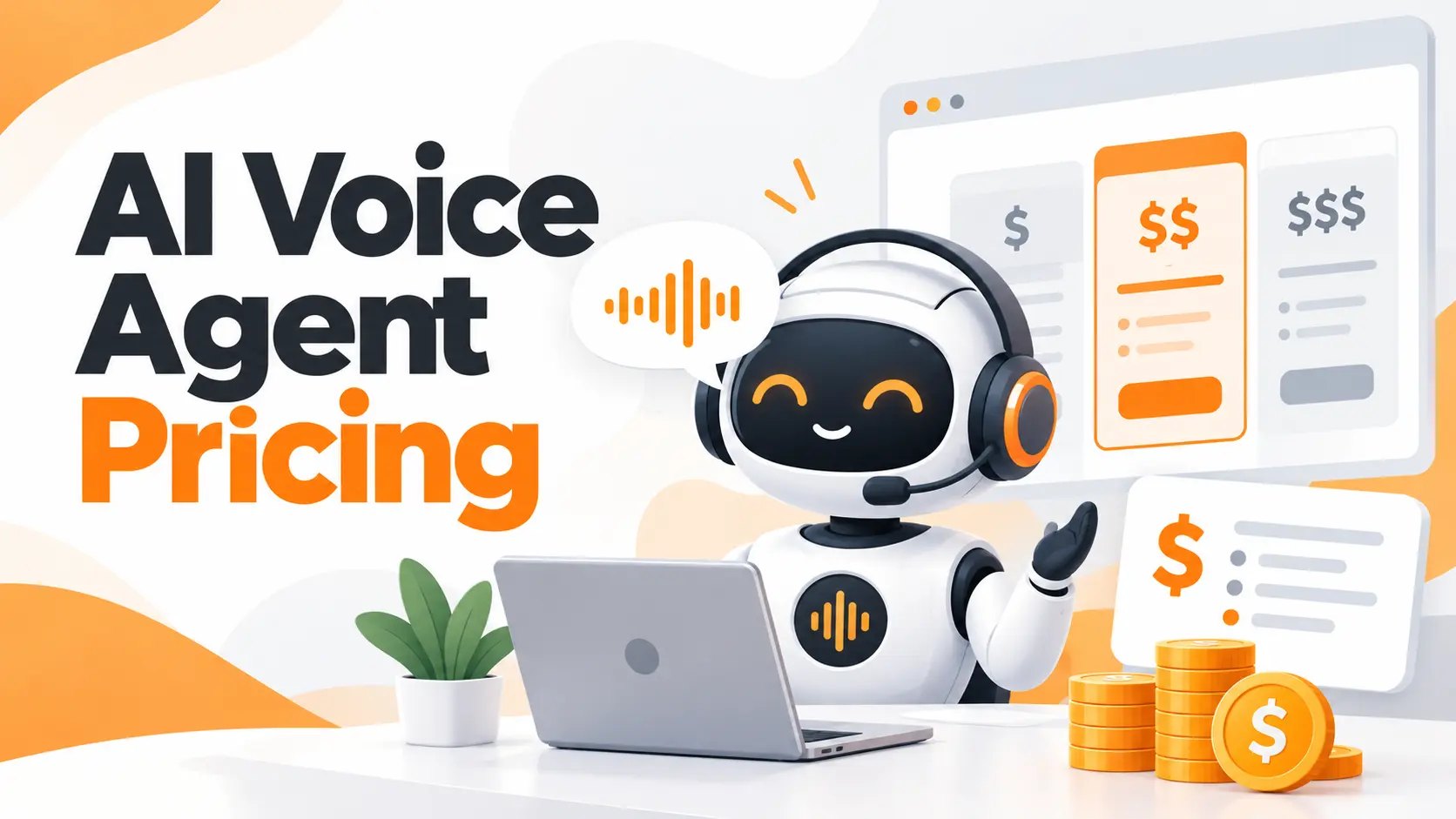
AI voice agent pricing starts at $0.05 per minute for Vapi hosting, while Retell AI advertises 0.07–0.31 per minute and Bland AI starts at $0.14 per minute. But those figures don't cover the same services. Some providers charge separately for language models, speech generation, and phone calls, while others bundle the core AI components into one rate.
For a business handling thousands of calls, that difference can significantly change the monthly bill. I would compare the total cost of operating an agent, not the lowest number displayed on a pricing page.
This guide breaks down current platform rates, billing models, additional charges, and the calculations needed to choose a service based on actual call volume.
AI Voice Agent Pricing Comparison
The following prices come from the providers' published pricing information, reviewed on October 17, 2026.
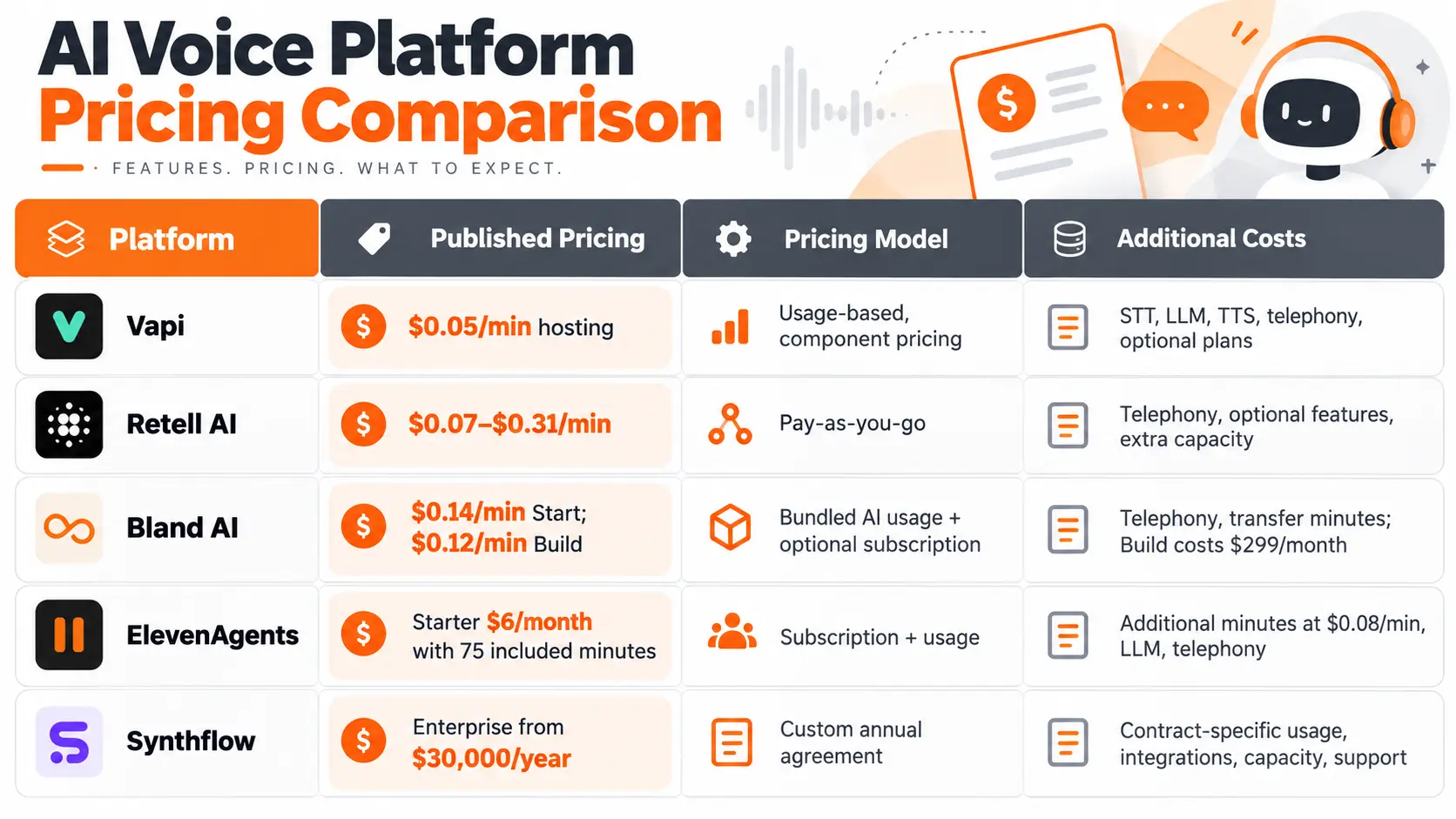
These are published starting prices and plan structures, not equivalent all-inclusive quotes.
Vapi's $0.05 rate covers hosting. Bland's published minute rate includes the LLM, speech recognition, and speech generation. ElevenAgents includes a monthly allowance but passes through applicable LLM and telephone costs.
I would never compare those numbers directly without accounting for what each rate includes.
Vapi Pricing
Vapi charges $0.05 per minute for voice agent hosting under its usage-based offering. The selected transcription service, language model, speech synthesis provider, and transport are charged separately.
This gives developers flexibility when selecting components. It also means the final cost depends on the configured technology stack.
Vapi offers optional support packages, including Core at $29 per month, while larger deployments can use custom arrangements.
I would evaluate Vapi when independent model selection and component-level cost control are important.
Retell AI Pricing
Retell AI advertises pay-as-you-go voice agent pricing from $0.07 to $0.31 per minute, depending on the selected configuration.
Its pricing includes separate components for voice infrastructure, language models, and speech generation. Telephone usage and optional features can increase the final amount.
The platform includes 20 concurrent calls in its pay-as-you-go offering, with additional capacity available at published rates.
For a business that wants a configurable voice agent without a mandatory annual contract, Retell provides a useful pricing structure to evaluate.
The actual comparison should use the selected model, voice, telephone provider, and required additional services.
Bland AI Pricing
Bland AI offers a more bundled approach.
Its Start plan costs $0.14 per minute with no monthly platform fee. The Build plan reduces the call rate to $0.12 per minute but adds a $299 monthly platform fee.
The published minute rates include the core LLM, STT, and TTS services. Telephone and transfer-related charges need separate consideration.
I would compare Bland's plans against expected monthly usage before choosing the lower minute rate.
A cheaper per-minute price does not automatically produce a lower monthly bill when a fixed subscription is added.
ElevenAgents Pricing
ElevenAgents combines monthly subscriptions with included call minutes.
The Starter plan costs $6 per month and includes 75 call minutes. Its other plans offer larger allowances and higher concurrent call limits.
Additional standard call minutes cost $0.08 per minute, while applicable LLM and telephony costs are charged separately.
Its pricing structure makes included minutes, overage rates, and concurrency limits important parts of the calculation.
I would check all three before estimating the cost of a production deployment.
Synthflow Pricing
Synthflow uses an enterprise-focused pricing model, with published contracts starting at $30,000 annually.
Final pricing depends on expected call volume, simultaneous call capacity, telephone infrastructure, integrations, security requirements, and implementation support.
This is fundamentally different from purchasing a few thousand pay-as-you-go minutes.
I would evaluate Synthflow through a complete commercial proposal that specifies annual commitments, included services, additional usage charges, and implementation responsibilities.
AI Voice Agent Cost per Minute
The operating cost of AI Voice Agents depends on how providers charge for voice infrastructure, language models, speech processing, and telephone usage. I would separate these expenses before comparing platform rates, since a $0.05 hosting fee and a $0.14 bundled minute don't represent the same services.
The most important pricing distinction is between a platform fee and the cost of delivering a complete conversation.
A voice agent connected to a telephone line uses several services. Each one can affect the final bill.
Voice Infrastructure
The orchestration platform manages the conversation, coordinates processing, and connects the agent to external systems.
Some vendors charge separately for this infrastructure. Others include it in the main voice agent rate.
For example, Vapi's hosting charge is not the same thing as the total cost of a fully configured AI telephone call.
Speech Recognition and Language Models
Speech-to-Text converts the caller's speech into text in a cascaded architecture.
The language model interprets the request, generates a response, and handles supported tool calls.
Their costs depend on the selected providers, usage units, and model configuration.
A service that bills language models by tokens can produce variable costs across conversations of equal duration.
Long context, repeated model calls, and extensive tool interactions can increase usage.
I would estimate these costs using actual test conversations instead of assuming every minute consumes the same number of tokens.
Text-to-Speech
Text-to-Speech produces the spoken response.
Voice quality, the selected model, and the provider's billing method determine its contribution to the total.
Some platforms include voice generation in the published minute rate, while others pass through the cost of a separate TTS provider.
Using an existing voice provider does not automatically eliminate TTS charges. The provider still needs to process the generated speech.
Telephony
Telephone costs cover connecting and maintaining calls through a carrier or telephony platform.
The final amount depends on the destination, direction of the call, phone number configuration, and carrier agreement.
Domestic inbound calls and international outbound calls should not be priced using the same assumption without checking the applicable rates.
Telephone charges also matter when a call continues after the AI agent transfers the customer to a human representative.
For a browser-only voice assistant, telephone charges may not apply, although audio transport and hosting costs remain relevant.
Voice Agent Pricing Models
Voice AI providers use different billing arrangements. I would choose between them based on expected usage and the degree of control the business needs.
Pay-as-You-Go Pricing
Pay-as-you-go pricing connects the bill to actual usage.
The business pays for the minutes or other units consumed, without purchasing a large monthly allowance in advance.
This structure is useful for a product with uncertain or changing traffic.
The disadvantage is that spending changes with call volume, conversation duration, and additional service usage.
The business should therefore monitor consumption against its budget.
Subscription-Based Pricing
Subscription plans charge a fixed recurring amount and provide a defined allocation of usage or capabilities.
The allowance can include call minutes, concurrent sessions, phone numbers, or support features.
Once the included allocation is exhausted, additional usage can trigger overage charges.
I would compare the recurring fee, included minutes, overage rate, and unused allowance together.
A large subscription that remains underused can cost more than a usage-based arrangement with a higher published minute rate.
Component-Based Pricing
Component-based pricing allows the business to select individual STT, LLM, TTS, and telephony providers.
This gives developers more flexibility to change models and manage individual costs.
However, it requires closer attention to several pricing schedules and technical integrations.
When providers offer bring-your-own-key (BYOK) arrangements, the cost of a component does not disappear. It moves to the account that pays the external service.
Enterprise and Outcome-Based Pricing
Enterprise agreements can include annual commitments, volume discounts, dedicated support, security requirements, and custom infrastructure.
Some commercial arrangements also charge for completed outcomes rather than conversation minutes.
For outcome-based pricing, the contract must define what counts as a billable result.
For example, a resolved support case, confirmed appointment, and completed lead qualification are different outcomes with different verification requirements.
I would examine how each result is measured and which failed or disputed interactions remain billable.
Calculating Monthly AI Voice Agent Costs
The simplest useful estimate begins with call volume and conversation duration.
Monthly AI minutes = Number of calls × Average AI conversation duration
The next calculation applies the relevant usage rate and adds expenses that are not already included.
Monthly cost = AI usage + Additional telephony + Fixed fees + Other billable services
This calculation needs a consistent definition of the AI usage rate.
If the rate already includes telephony, adding the same telephone minutes again would double-count that cost.
If it excludes telephony, the applicable carrier charges must be added.
Call Duration and Volume
A business receiving 1,000 calls per month with an average AI conversation duration of four minutes will consume approximately 4,000 AI minutes.
That estimate provides a starting point, but the team should also look at the distribution of call lengths.
A small number of unusually long conversations can increase the total even when the median call remains short.
I would use recent telephone data and a representative trial to estimate the actual time customers spend with the AI agent.
Fixed and Variable Expenses
Variable costs increase with measured usage.
Fixed expenses can include subscriptions, phone numbers, reserved concurrency, support packages, and hosting commitments.
One-time implementation expenses belong in the project budget but should be distinguished from recurring monthly charges.
For a meaningful comparison, I would calculate both the expected monthly bill and the cost of operating the service during a high-traffic month.
Setup and Integration Costs
The price of a functioning voice agent includes more than an AI platform subscription.
A ready-made agent that handles basic appointment requests requires a different level of implementation work from a system that accesses private customer accounts and changes billing information.
Initial Configuration
Initial work can include conversation design, prompt development, access permissions, telephone routing, voice selection, and testing.
A custom application also requires development of the interfaces connecting the voice agent to existing business software.
The time required depends on the functionality and integration requirements.
I would separate this implementation budget from the monthly usage estimate so the business can see the upfront investment independently.
CRM and Business Integrations
Connecting an agent to a CRM, booking system, or payment platform can introduce additional software and infrastructure charges.
Some integrations are covered by an existing subscription. Others require middleware, external APIs, or custom development.
The cost estimate should include any paid services required to complete the intended workflow.
It should also account for testing and ongoing maintenance when external systems change.
Ongoing Maintenance
A production agent needs monitoring, evaluation, configuration updates, and support for changes to connected services.
If the business relies on custom code, engineering time remains part of operating cost even when the underlying AI usage is inexpensive.
I would budget for maintaining the workflow rather than assuming the launch configuration will remain unchanged.
Billing Rules That Change the Final Invoice
Two providers can advertise similar prices per minute and still produce different bills for the same call volume.
The difference comes from how they measure usage.
Silence and Connection Time
Some voice platforms continue billing while the caller is connected, including periods of silence.
Retell AI states that its connected-call billing covers silence and hold time because the system remains active.
ElevenAgents measures call duration by connection time but applies a substantial discount to qualifying periods of extended silence.
These policies create different charges for calls with the same overall duration.
I would review the billing definition instead of assuming only spoken seconds count.
Rounding and Minimum Charges
Billing precision also affects costs.
Retell tracks accumulated call time to the nearest second rather than rounding each completed call up to a full minute.
Other services can use different minimum durations or rounding rules.
For a business handling many short calls, even a small billing minimum can materially affect the total.
Concurrent Calls
Concurrency describes how many calls the system can process at the same time.
A subscription may include a fixed number of concurrent calls and charge for additional capacity.
Some providers also offer burst processing at a higher rate when the included limit is exceeded.
For example, ElevenAgents publishes a burst rate of $0.16 per minute against its standard additional-minute rate of $0.08.
I would check the busiest calling period rather than estimating concurrency from monthly minutes alone.
Call Transfers
A transfer changes which part of the system handles the conversation.
When a human takes over, the AI processing fee can stop while the telephone connection continues to incur charges.
The receiving support team also has its own operating expenses.
A pricing comparison that ignores transferred calls can understate the cost of resolving complex customer requests.
AI Voice Agent Pricing Example: DeskFlow SaaS
Consider DeskFlow, a fictional SaaS business offering subscription management software.
DeskFlow wants an AI voice agent to answer billing questions, explain subscription plans, and transfer requests that require human intervention.
The business estimates 1,000 AI-handled calls per month, with an average AI conversation duration of four minutes.
For this example, I will use a hypothetical all-inclusive variable rate of $0.15 per AI minute. This is a budgeting assumption, not a quoted price from any provider.
Cost Component
Calculation
Monthly Cost
AI conversations
1,000 calls × 4 min × $0.15
$600
Telephone time after transfers
200 transfers × 3 min × $0.02
$12
Fixed operating charges
Assumed monthly amount
$100
Total Estimated Cost
$712
The $0.15 assumption already includes telephone usage during the AI-controlled portion of each call. The $12 line covers only the additional post-transfer telephone time.
All figures are illustrative and exclude human labor, taxes, and one-time implementation expenses.
For this workload, DeskFlow's estimated monthly AI-system expense is $712.
That figure is more meaningful than looking at the base platform rate because it includes the expenses the business expects to incur.
Cost per Resolved Call
A low price per minute is useful, but it doesn't establish whether the AI agent is economically effective.
The business also needs to know how many customer requests are resolved successfully.
Suppose DeskFlow's 1,000 calls produce 700 AI-resolved requests, 200 transfers to human support, and 100 unresolved interactions.
The estimated AI-system cost per AI-resolved request is:
$712 ÷ 700 = $1.02 per AI-resolved call
This is a partial operational metric. It includes the system costs in the example but excludes the labor involved in human-handled requests and other operating expenses.
To evaluate total support economics, I would also include human support expenses, repeat calls, and the cost of maintaining the service.
A system charging less per minute can become more expensive per resolved request when it creates additional transfers or repeat contacts.
Comparing Subscription Break-Even Points
A lower usage rate can justify a fixed subscription, but only above a sufficient volume.
Bland AI provides a clear example using its published Start and Build rates.
Start costs $0.14 per minute without a platform fee. Build costs $0.12 per minute plus $299 monthly.
The difference is $0.02 per minute.
$299 ÷ $0.02 = 14,950 minutes
At approximately 14,950 billed minutes per month, the $0.02 usage saving offsets the $299 subscription fee, assuming identical billable usage and no other differences.
Below that volume, Start costs less on these two pricing components alone. Above it, Build costs less on the same basis.
However, Build also offers different capacity and plan features. Those requirements can justify selecting it before reaching the cost-only break-even point.
This is the kind of calculation I would use before committing to a subscription.
Choosing the Right AI Voice Agent Pricing Model
I would make the final decision using a realistic monthly workload rather than a provider's advertised entry rate.
For an early-stage startup with unpredictable traffic, usage-based pricing limits fixed commitments and makes experimentation easier.
For a company with stable call volume, a plan with included minutes or negotiated rates can make budgeting more predictable.
For a larger organization, the relevant comparison extends to support guarantees, compliance requirements, integration work, and capacity commitments.
The final evaluation should answer three questions:
Cost visibility: Can the team explain every significant line item on the projected invoice?
Operational fit: Does the plan support the expected call volume, integrations, and peak concurrency?
Economic performance: Does the total cost make sense relative to the number of customer requests completed successfully?
I would run a paid pilot with representative calls before agreeing to a large volume commitment.
The pilot should establish actual conversation length, model usage, transfer rate, task completion, and billed expenses.
Those measurements provide a stronger basis for purchasing than an estimated rate taken from a pricing banner.
Final Thoughts
AI voice agent pricing depends on more than the cost of generating speech.
A complete comparison needs to account for platform charges, language models, voice synthesis, telephone usage, subscriptions, implementation, and the handling of unsuccessful or transferred calls.
I would start with published rates, calculate the full monthly expense using realistic traffic, and then compare the result with the number of tasks the agent completes correctly.
For a startup, the cheapest advertised minute is not the goal. The goal is predictable operating costs and reliable customer outcomes at a price the business can sustain.
FAQ
Can I keep my existing business phone number when switching to an AI voice agent?
Yes, if the selected platform supports the required telephone integration and the existing carrier allows the number to be routed or ported. SIP trunking and call forwarding can provide alternatives to replacing the number. Compatibility and any associated charges must be confirmed with both providers.
Do I pay anything if an outbound AI call never gets answered?
It depends on the provider's billing rules. A platform may not charge conversation minutes for an unconnected call, while a carrier or outbound campaign service can charge for dialing attempts or other events. The contract should identify which charges apply to unanswered, failed, or rejected calls.
Will a multilingual voice agent cost more than an English-only one?
Not automatically. Costs depend on the language model, voice provider, supported languages, and telephone destinations. If multilingual operation requires a different model or a separately priced voice, the applicable rate can change. The selected language configuration should be priced before deployment.
Can I set a spending limit so the agent doesn't exceed my budget?
Some platforms provide prepaid credits, spending controls, usage notifications, or account-level limits. A notification is not the same as a hard billing cap. Businesses requiring a strict limit should verify that their provider can stop or restrict additional usage automatically when the threshold is reached.
Can I get a refund if the AI gives a customer the wrong answer?
A failed conversation does not automatically qualify for a refund. Usage-based providers generally charge for billable resources consumed, while refunds or service credits depend on their contractual terms. Businesses should review dispute procedures, service-level agreements, and any outcome-based billing conditions before purchasing.

Fatemeh Jahangard
Technology & AI Writer at PinerookFatemeh Jahangard covers AI, emerging technologies, and digital innovation for Pinerook, focusing on how technology shapes startups and industries.
 Seen first.