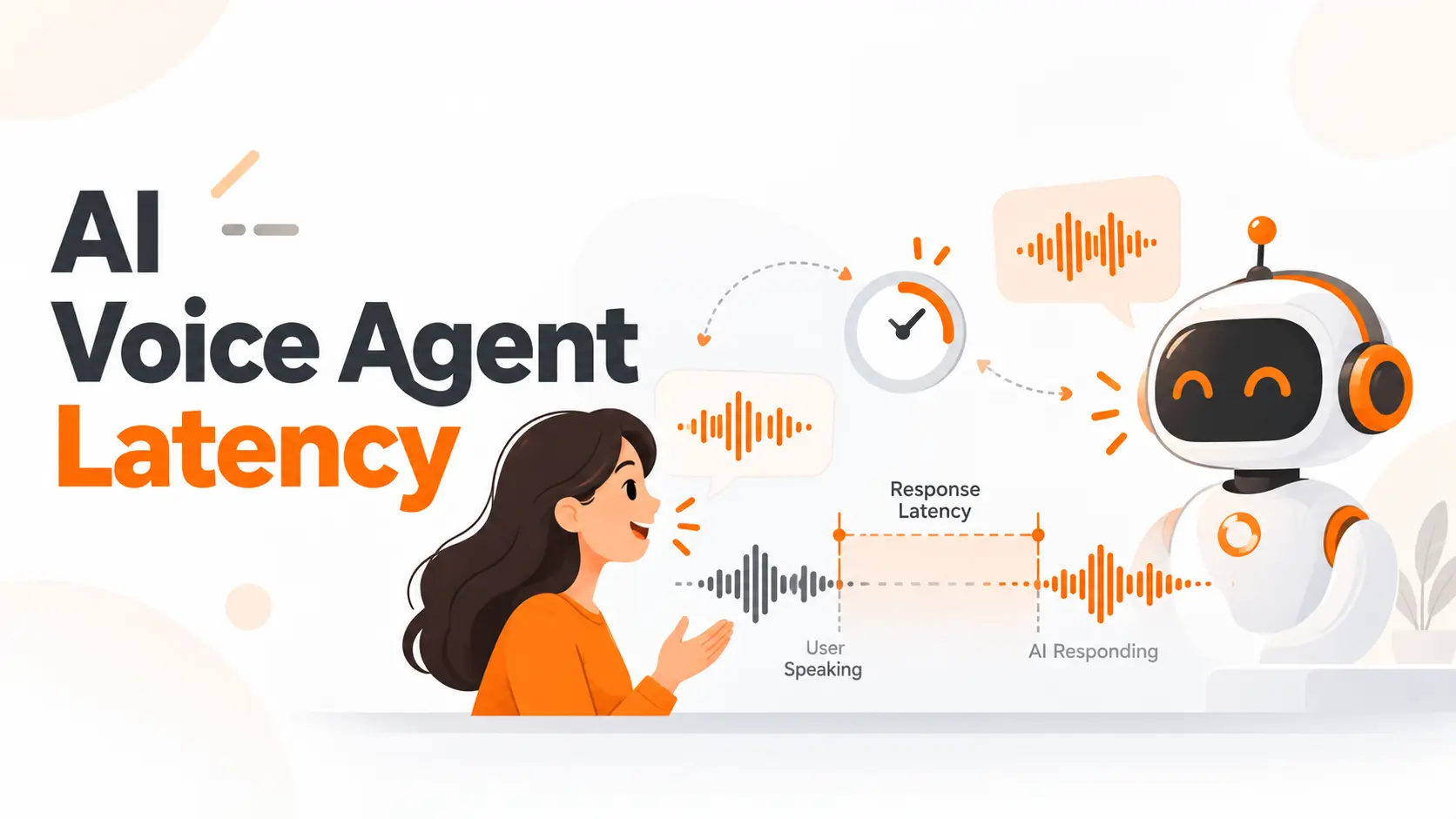
AI voice agent latency is the delay between a person finishing speaking and hearing the agent's response. That pause comes from several stages: detecting the end of speech, processing the request, generating an answer, and delivering audio.
The most effective way to reduce latency is to measure each stage separately, identify where the delay occurs, and optimize that component. A faster language model won't solve a slow conversation if the system spends most of its time waiting for silence or retrieving customer information.
For a voice application handling real customer calls, I would start with the time the caller actually experiences rather than the response speed advertised by an individual AI model.
Reducing AI Voice Agent Latency
The first thing I would do is separate unnecessary waiting from the processing time the application actually needs.
A voice agent should recognize when a caller has finished speaking, begin preparing the response, and deliver audio without waiting for every stage to finish completely.
Several adjustments can shorten that process:
Reduce unnecessary end-of-turn waiting. Review how long the system waits before deciding that the caller has finished speaking.
Use streaming speech recognition. Process incoming audio as the caller speaks instead of waiting until the entire recording is available.
Start generation earlier when it is safe. Stable transcription results can allow the application to prepare a response before every turn-detection step finishes.
Stream language model output into speech generation. Begin synthesizing complete phrases while the model continues producing the rest of its response.
Remove avoidable network delays. Review connections between the voice platform, model providers, application servers, and audio playback system.
Investigate external API calls separately. A slow customer database can delay a response even when the speech models are fast.
These changes address different bottlenecks. Applying all of them without measuring the current system makes it difficult to determine which adjustment actually helped.
I would first collect a baseline, change the component responsible for the largest delay, and repeat the same evaluation.
There is also a limit to how aggressively a system should respond. Reducing waiting time is useful only if the agent still understands complete requests and handles interruptions correctly.
Measuring Voice Agent Response Time
Latency measurements are only useful when their starting and ending points are clearly defined.
For customer-facing AI Voice Agents, I would use the interval between the caller's last spoken word and the first audible response as the primary conversational latency metric.
This is often described as the mouth-to-ear turn gap.
It includes more than the processing time reported by an AI model.
End-to-End Latency
End-to-end latency measures the delay experienced by the caller.
It begins when the person finishes speaking and ends when the agent's response becomes audible.
For a telephone application, this includes processing inside the voice system and the time required to deliver the audio through the communication network.
That makes it a more useful measure of the customer experience than model inference time alone.
Time to First Token
Time to First Token (TTFT) measures how long a language model takes to produce its first output token after receiving a request.
A lower TTFT helps the system begin preparing a spoken response earlier.
However, TTFT does not include every delay in the voice interaction.
The application still needs to identify the end of the customer's turn, provide the required context, convert the response into audio, and deliver it.
If a model generates its first token quickly but the speech pipeline remains blocked, the caller will still experience a delay.
Time to First Audio
Time to First Audio (TTFA) requires careful interpretation.
At the TTS level, it can mean the interval between requesting speech synthesis and receiving the first audio output.
At the complete application level, it can refer to the delay until the caller hears the first part of the agent's response.
These measurements should not be treated as interchangeable.
I would label them separately in performance reports:
TTS First Audio: Time spent waiting for the speech synthesis service to produce its first audio chunk.
Caller-Perceived First Audio: Time between the end of the caller's speech and the first audible agent response.
This distinction prevents a fast TTS result from hiding delays elsewhere in the pipeline.
End-of-Turn and Transcription Delay
Two additional measurements help identify problems before language generation begins.
End-of-Turn Delay measures the time required to decide that the user has finished speaking.
Transcription Delay measures how long the application waits for a usable or final transcription.
In systems such as LiveKit, end-of-utterance metrics already include transcription delay. Adding those measurements together again would overstate the total.
I would use the exact definitions supplied by the selected framework and correlate the measurements with the same conversation turn.
For an accurate end-to-end measurement, timestamps must also account for the audio delivery path and clock synchronization between systems.
Identifying Latency Bottlenecks
A long pause doesn't reveal its cause.
I would inspect the sequence of events for a slow conversation and compare it with a successful one.
This table provides a starting point for identifying the likely source.
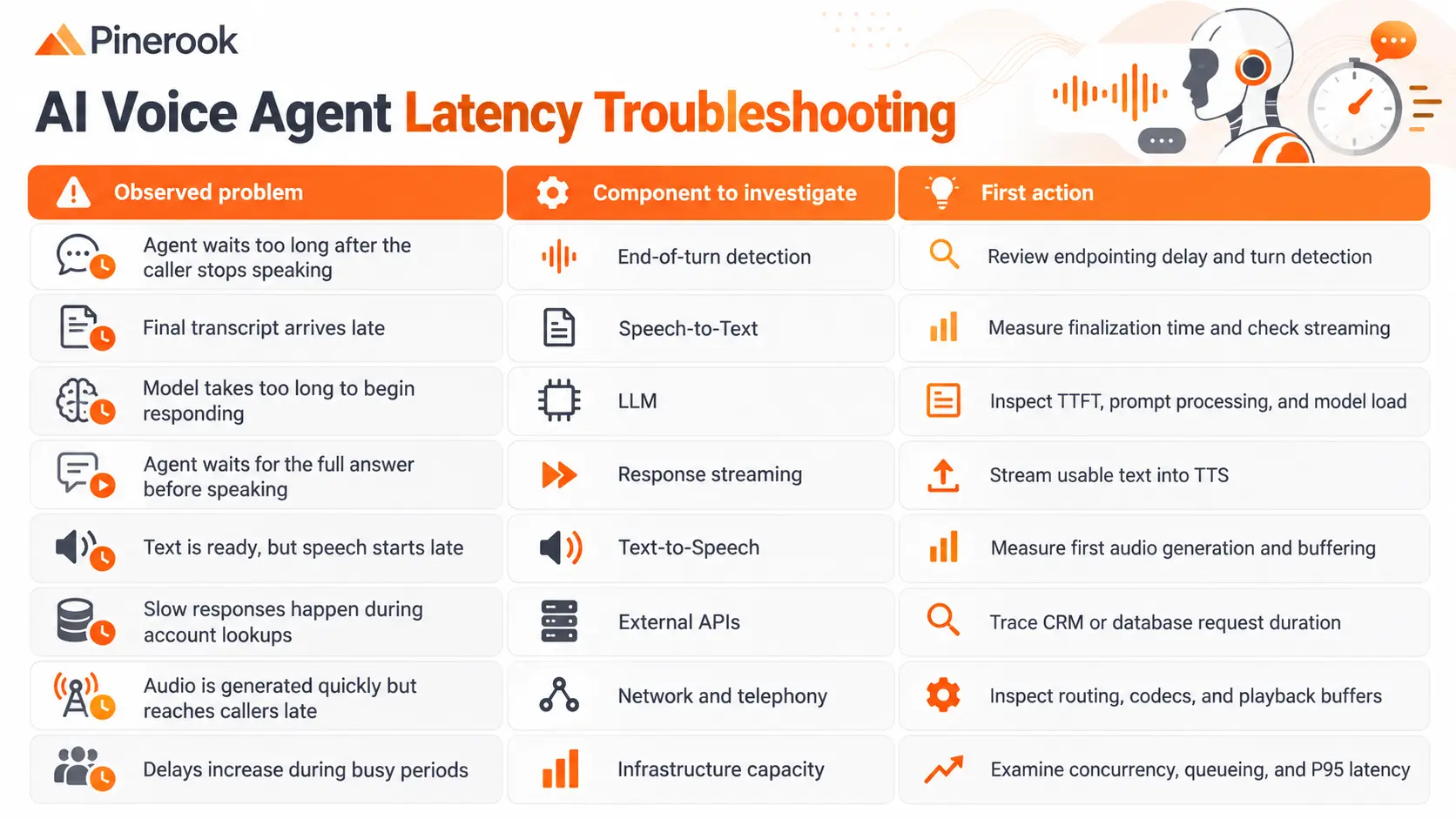
These are diagnostic starting points, not confirmed explanations for every slow call.
The next step is to validate the suspected bottleneck using timestamps from the corresponding services.
For example, if transcript processing finishes quickly but the agent waits before beginning language generation, I would investigate turn completion or application orchestration before replacing the transcription model.
If the model responds quickly but the first playable audio arrives late, speech synthesis and playback deserve attention.
The objective is to connect a measurable delay with a specific component.
Optimizing End-of-Turn Detection
A voice agent cannot respond appropriately until it has enough evidence that the person has completed their turn.
In a silence-based system, the application waits for a configured period without speech before treating the request as complete.
That waiting period contributes directly to latency.
Reducing it can make responses start earlier, but an excessively short interval can cause the agent to interrupt natural pauses.
Consider a customer saying:
"I need to change my subscription to... the Business plan."
The pause is part of the request. If the system decides the customer has finished speaking too early, it can begin answering before receiving the plan name.
Silence-Based Detection
Silence-based detection uses speech activity and a configured waiting interval to establish a potential turn boundary.
I would examine the delay between the detected end of speech and the decision to complete the turn.
If that delay dominates the trace, shortening the endpointing interval is worth testing.
However, the change must be evaluated using conversations containing hesitations, incomplete sentences, background noise, and interruptions.
A faster response that repeatedly cuts off customers is not an improvement.
Semantic Turn Detection
Semantic turn detection considers additional information about whether an utterance is complete.
Instead of relying only on silence duration, it can use speech content and conversational signals to estimate whether the person has finished their thought.
This can help distinguish a completed question from a hesitation.
The trade-off is that a system may wait longer when completion is uncertain.
I would compare the resulting response latency with the rate of premature interruptions rather than choosing a setting based on speed alone.
For applications with explicit push-to-talk controls, releasing the button can provide a direct turn-completion signal without waiting for a silence timer.
Reducing LLM and Tool Call Latency
After a turn has been recognized, the next source of delay is the work required to determine and prepare the response.
This includes model processing and any external operations requested by the application.
Language Model Processing
A language model's response time depends on its input, model configuration, serving conditions, and generation workload.
For a voice application, the time until the first usable response matters because the agent does not need to finish generating an entire paragraph before beginning to speak.
I would examine TTFT under the actual conversation workload.
If prompt processing is the bottleneck, the application should review how much context it sends to the model.
An agent answering a subscription question doesn't need unrelated conversation history or entire product manuals in every request.
Relevant context should be preserved, while unnecessary input can be removed.
Model selection also deserves evaluation. A larger model is not automatically the right choice for a narrow, well-defined customer service workflow.
I would compare candidate models using the same requests and measure response accuracy alongside TTFT.
Streaming LLM Output
Streaming allows the application to receive generated text incrementally.
The speech system can then begin preparing an initial phrase while the language model continues producing later content.
The important detail is where text is divided into spoken segments.
Sending every token directly to speech synthesis can produce awkward interruptions and pronunciation problems.
Waiting for the entire response defeats the purpose of streaming.
I would test phrase-level or sentence-level boundaries that allow early synthesis without sacrificing natural speech.
The implementation must also handle cancellations when the caller interrupts or the response changes.
External API Requests
A voice agent connected to business software can experience long delays outside the language model.
For example, a customer asking about an invoice may trigger requests to a billing platform, CRM, or account database.
If one of those services responds slowly, the overall task takes longer.
I would record tool execution times separately from model processing.
For independent read-only requests, concurrent execution can reduce total waiting time when the application's authorization and data dependencies permit it.
For operations that change account information, I would preserve the required verification, confirmation, and execution sequence.
It is not worth saving a few milliseconds by performing an irreversible action before the customer has authorized it.
Improving TTS and Audio Delivery
Speech synthesis determines when the generated answer becomes audible.
A model can finish producing text before the customer hears anything if the TTS system waits to process the entire response.
Streaming changes that behavior.
Streaming Text-to-Speech
A streaming TTS service produces audio incrementally.
As soon as the first usable audio segment is generated, the application can begin delivering it while subsequent speech continues to be synthesized.
This reduces the time spent waiting for the complete recording.
I would measure the delay between the first usable text segment being submitted and the first audio chunk being returned.
If this stage is slow, the selected voice model, streaming configuration, or service connection needs investigation.
The fastest voice configuration is not automatically the best choice.
Speech clarity, pronunciation, and conversational naturalness remain part of the product experience.
Audio Buffering
Audio playback systems buffer data to maintain continuous speech when network delivery fluctuates.
A larger buffer can reduce interruptions and audible gaps, but it also increases the delay before playback begins.
A smaller buffer can improve responsiveness while increasing the risk of choppy audio under unstable network conditions.
I would adjust buffering based on actual network performance and listen to complete responses during testing.
A system that starts speaking earlier but repeatedly stutters has not delivered a better experience.
Network and Telephony Latency
The network can contribute substantial delay even when the AI processing stages perform well.
For a browser-based voice application, audio travels between the user, realtime communication infrastructure, application servers, and model providers.
A telephone application introduces additional telephony infrastructure.
Each network boundary can add transport time, buffering, or audio conversion overhead.
Service Placement
The geographical location of infrastructure influences network round-trip time.
I would review the path connecting the caller's media endpoint, the voice application, and the services used for AI processing.
Keeping tightly coupled services in suitable regions can reduce unnecessary network travel.
The closest server to the application is not automatically the closest server to its users. Both sides of the audio path matter.
Audio Formats and Transcoding
Different telephony and realtime audio systems support different codecs and sample rates.
Converting between formats introduces processing work and additional components into the media pipeline.
I would inspect where transcoding occurs and eliminate unnecessary conversions when the connected services support compatible formats.
Audio quality must remain sufficient for accurate speech recognition and intelligible responses.
Reducing bandwidth at the expense of transcription accuracy can create more failed conversations, even if transmission becomes faster.
AI Voice Agent Latency Example in a SaaS Application
Consider a fictional SaaS company called DeskFlow.
Its voice agent answers questions about subscriptions and billing.
A customer calls and asks:
"Why was I charged twice this month?"
The agent needs to recognize the request, retrieve the customer's billing information, and explain the charges.
The company notices that some callers experience an extended silence before the agent responds.
Rather than replacing the language model immediately, I would inspect the full conversation trace.
Finding the Initial Delay
Suppose an illustrative trace shows the following non-overlapping intervals:
End-of-turn processing takes 720 milliseconds, the model's first output takes another 260 milliseconds, TTS startup takes 130 milliseconds, and delivery to the caller adds 120 milliseconds.
That produces a total first-response delay of 1,230 milliseconds.
These figures are hypothetical and demonstrate how to interpret a trace, not measured performance from an actual DeskFlow system.
The largest identified delay is end-of-turn processing.
I would investigate that stage before investing time in changing the speech synthesis model.
If the system uses a fixed silence interval, I would test a shorter interval or a compatible semantic turn detector.
The next evaluation would measure both response time and premature interruptions.
In a streaming implementation, overlapping stages must be accounted for directly; adding every recorded stage duration can double-count shared time.
Investigating the Billing Request
Now consider the next part of the conversation.
The agent tells the customer that it will check the account, then requests the billing records.
The customer hears an acknowledgment quickly, but the actual explanation takes much longer.
The trace shows that the billing API is responsible for the extended wait.
This is a different problem from slow speech generation.
I would investigate the API response time, database dependencies, and whether the application requests unnecessary information.
The agent should not invent the billing explanation while waiting for the service.
If the result cannot be retrieved, it should communicate that limitation and follow the approved support procedure.
Measuring the Result
After changing the relevant configuration, I would rerun the same conversation scenarios.
The comparison should include the time to first audible response and the time to a meaningful answer.
These are separate measurements.
An agent that says "Let me check" immediately but takes several seconds to provide the actual information has improved acknowledgment speed, not necessarily task completion time.
For DeskFlow, the goal is to give customers accurate billing information with less unnecessary waiting.
Latency Benchmarks and Performance Targets
There isn't one latency threshold that establishes acceptable performance for every voice agent.
A simple greeting, a technical troubleshooting conversation, and a request requiring several authorized database operations place different demands on the system.
A useful target must specify what is being measured.
For example, a benchmark measuring the time between a customer's last spoken word and the first audible response cannot be directly compared with a benchmark measuring only model inference.
Published vendor benchmarks can provide reference points, but they are not substitutes for measurements from the application's own deployment.
P50 and P95 Latency
I would track at least two latency percentiles.
P50 represents the median response time. Half of the measured interactions are at or below that value.
P95 represents the threshold at or below which 95% of measured interactions fall.
P50 describes the typical interaction, while P95 helps expose slow responses experienced by a smaller portion of callers.
An agent can have a good median response time and still deliver frustratingly slow responses during busy periods.
That makes both measurements necessary.
Setting a Latency Budget
A latency budget assigns a performance target to the complete conversational response.
The team can then examine how much of that budget is consumed by turn detection, model processing, speech synthesis, and network delivery.
In a sequential pipeline, these delays accumulate.
In a streaming pipeline, several stages overlap, so the observed end-to-end duration must be measured rather than calculated by blindly adding every component metric.
I would establish separate targets for ordinary conversational turns and requests requiring external tools.
Otherwise, slow account lookups can distort the evaluation of the core speech pipeline.
Testing Latency Under Production Load
A voice agent that responds quickly during an isolated demonstration can slow down when several callers use it simultaneously.
Production testing should reflect the conditions the application is expected to handle.
Concurrent Conversations
Concurrent sessions place demand on model providers, application infrastructure, and external services.
When capacity is exhausted, requests can queue before processing begins.
I would test the expected number of simultaneous conversations and examine how P50 and P95 change as the load increases.
The test should also measure failed requests and timeouts.
Low latency is not meaningful if the system achieves it by rejecting a large percentage of calls.
Realistic Audio Conditions
Clear studio audio does not represent every customer conversation.
A production voice application needs to work with background noise, changes in speaking volume, regional accents, interruptions, and unstable connections.
I would include these conditions in testing because they affect transcription, turn detection, and audio playback.
A configuration that performs well with clean audio should be evaluated again before being used for noisy telephone calls.
Comparing Changes Reliably
Every optimization needs a baseline.
I would keep the same test questions, deployment conditions, and measurement definitions when comparing two configurations.
If the team changes multiple components at once, the evaluation cannot isolate which modification caused the improvement.
For a production service, response speed should also be checked against task completion, transcription accuracy, and interruption behavior.
The purpose of optimization is to improve the complete customer interaction, not a single performance metric.
Final Thoughts
AI voice agent latency is a system-level performance problem.
The delay a caller experiences reflects turn detection, speech recognition, language processing, connected services, audio generation, and network delivery.
I would begin with a reliable measurement of the first audible response, trace the contributing stages, and improve the largest verified bottleneck.
For a startup, the objective is a voice agent that responds promptly while understanding complete requests and delivering correct information.
The strongest improvement is one that makes the conversation faster without sacrificing the quality or reliability of the task being completed.
FAQ
Why is my voice agent slow only on the first call?
The first request can include initialization work that later requests do not repeat. This may involve loading models, establishing connections, starting application workers, or initializing audio components. Measuring the first request separately from subsequent requests helps identify cold-start delays. Deployment-specific warm-up or capacity settings can then be evaluated.
Can I cache spoken responses to make my agent faster?
Yes. Pre-generated or cached audio can reduce speech synthesis work for fixed, approved messages such as greetings or standard notices. Dynamic responses containing customer information, changing prices, or account-specific details require appropriate freshness and access controls. Cached audio must not cause the system to deliver outdated or unauthorized information.
Will supporting multiple languages make my voice agent slower?
Multilingual performance depends on the selected recognition and speech generation models, language-detection strategy, and application configuration. Supporting additional languages does not establish a fixed increase in latency. The application should measure response times separately for each required language and test conversations that switch languages during a session.
What should I do if an API call gets stuck during a conversation?
External operations should have defined timeouts and failure-handling behavior. When a request exceeds its permitted duration, the agent should stop waiting, provide an accurate status, and follow an approved fallback or escalation process. For operations that modify data, the system must verify transaction status before retrying to avoid duplicate actions.
How quickly should my agent stop talking when I interrupt it?
Interruption responsiveness is a separate measurement from first-response latency. It covers the interval between detected user speech and the end of audible agent playback. The system must stop or cancel queued audio as appropriate and update the conversation state. The acceptable target should be established through testing that includes genuine interruptions, short acknowledgments, and background speech.

Fatemeh Jahangard
Technology & AI Writer at PinerookFatemeh Jahangard covers AI, emerging technologies, and digital innovation for Pinerook, focusing on how technology shapes startups and industries.
 Seen first.


