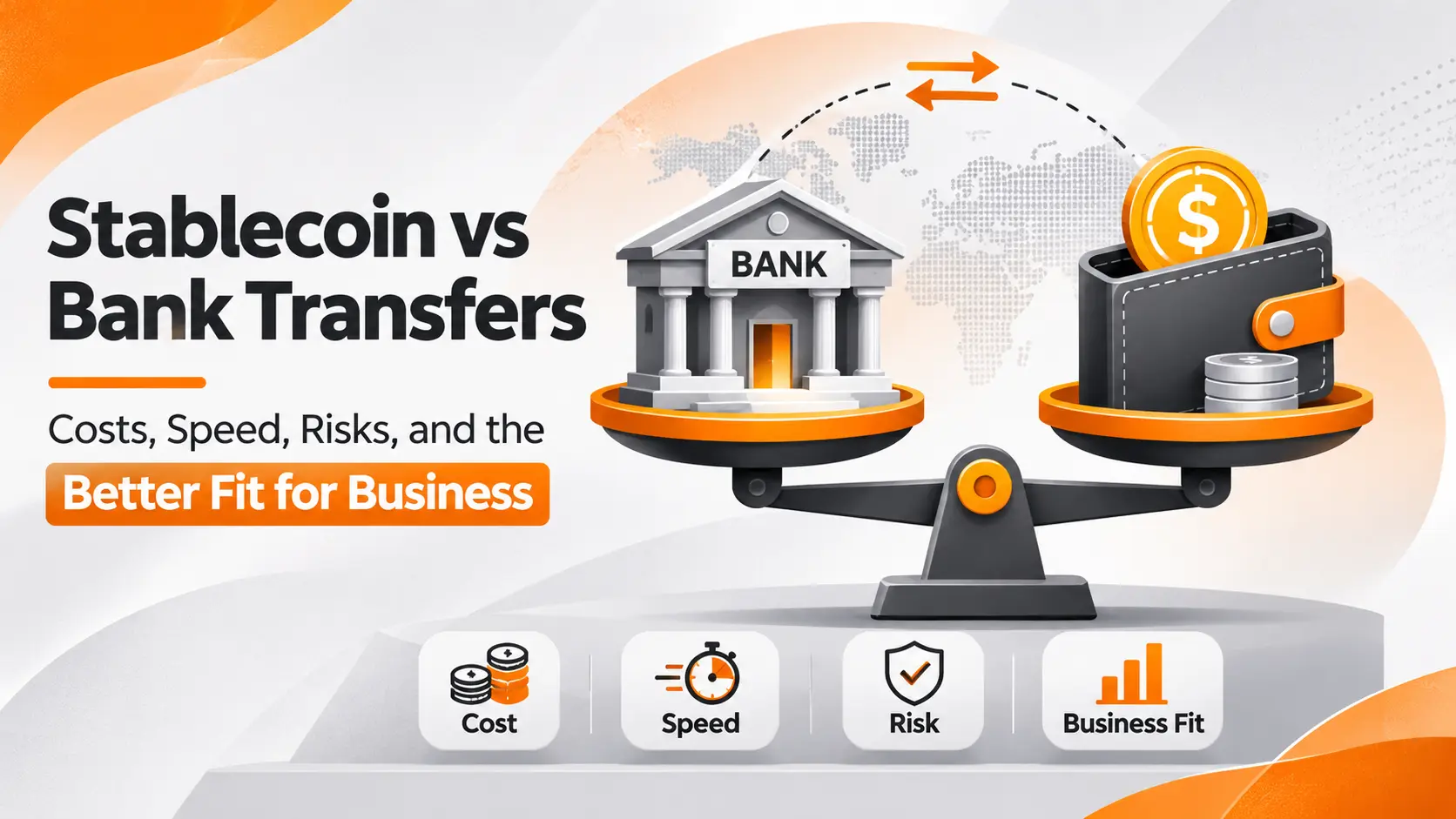
When a company needs to pay a supplier, contractor, or overseas partner, the question is no longer simply whether to use a bank. A stablecoin payment may move across a blockchain at any hour, while some bank networks can also deliver funds in seconds. The useful comparison is not the technology behind each route. It is the amount the recipient can actually use, the time that takes, and the risks the company must accept.
The broader Stablecoins for Business discussion covers payment applications, treasury and regulation. This guide focuses on the narrower decision between a stablecoin transfer and a bank transfer. It shows where each can work better, how to compare quotes fairly, and when an apparently fast or inexpensive option may be the wrong choice for a business obligation.
The Short Answer for Business Payments
A bank transfer is often the simpler option when both parties have supported bank accounts, the recipient needs ordinary currency, and the existing route provides predictable delivery and records. Domestic instant payment systems can make this especially compelling. A stablecoin route becomes worth testing when the business faces a specific obstacle, such as a costly international corridor, unavailable banking windows, or a recipient who already accepts the relevant token.
Neither route wins automatically. A stablecoin may confirm quickly on a blockchain but take longer to become usable local currency. An international bank payment may reach the beneficiary bank quickly but wait for local processing before the supplier can spend it. The practical winner is the route that completes the same payment with acceptable cost, timing, control, and reliability.
How Each Payment Route Reaches the Recipient
Bank transfers move account balances
A domestic bank payment can use a local clearing or instant payment network. An international transfer may involve the sending bank, correspondent banks, foreign exchange conversion, and the receiving institution. Swift generally provides financial messaging rather than holding the funds itself. The payment is complete for the supplier only when the receiving account is credited and the money is available according to the applicable banking arrangements.
Not all bank transfers operate on business day schedules. In the United States, participating institutions can use FedNow to send eligible instant payments continuously. The RTP network also supports round the clock settlement through participating institutions. These services do not mean every bank account or international corridor can receive an instant transfer, but they invalidate the assumption that all bank payments take several days.
Stablecoins move tokens, sometimes between two banks
A direct stablecoin payment begins when the sender obtains a supported token and transfers it to a compatible recipient wallet. If the recipient is happy to hold or spend that token, the transaction may end there. If the recipient needs euros, pesos, or another bank balance, an exchange or payment provider must convert the token and complete a local payout.
A managed provider can conceal most of this complexity. The sender may pay from a bank account and the recipient may receive money in a bank account, even though a stablecoin is used between intermediaries. That is a different operational model from a business buying tokens and controlling its own wallet. Comparing the two without examining custody, conversion, and payout responsibility can produce misleading results.
Stablecoin vs Bank Transfers at a Glance
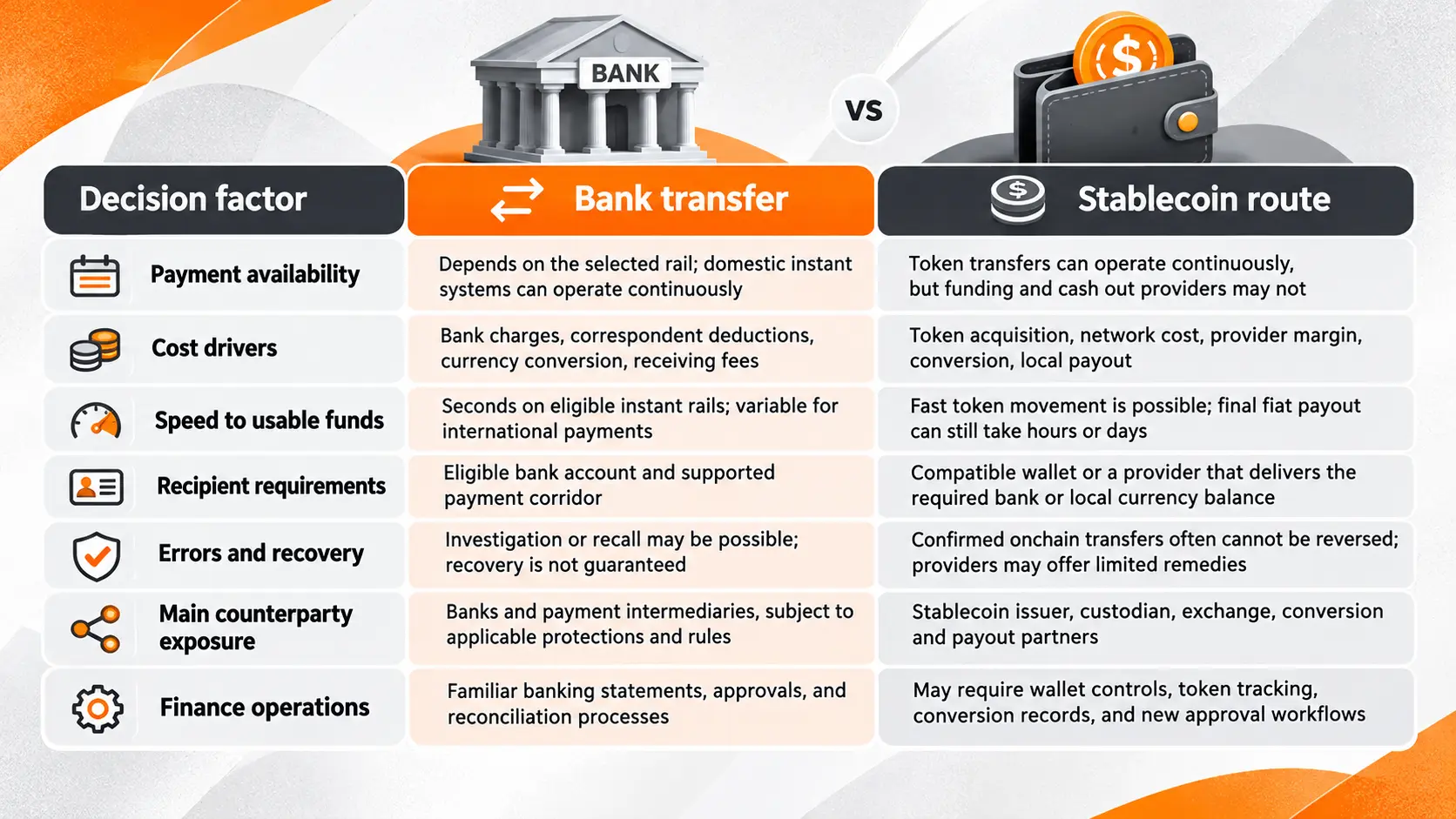
The table describes common arrangements, not universal rules. A bank wire, an instant domestic payment, a direct wallet transfer, and a managed stablecoin payout have different legal and operational characteristics. Always compare the exact services available to the sender and recipient.
Comparing the Total Cost Rather Than the Advertised Fee
A bank might quote a small outgoing wire charge while recovering additional revenue through the currency exchange rate. A stablecoin provider might advertise a negligible blockchain fee while charging to acquire the token, convert it into local currency, or withdraw it to a bank. In either case, the headline fee can be a poor description of what the recipient ultimately receives.
Consider a hypothetical company paying the equivalent of $25,000 to an overseas supplier in the supplier's local currency. A bank route charges $35 to send, $190 through its exchange rate, and $15 at the receiving bank. The total estimated payment cost is $240. A stablecoin route charges $30 to acquire tokens, $2 for network movement, $165 for conversion, $28 for local payout, and $20 for provider administration. Its total is $245.
These figures are illustrative calculations, not quoted market prices. In this example the bank route is $5 cheaper, even though the stablecoin network fee is only $2. If a provider changes its exchange spread or the payment size changes, the result can reverse. Both quotes must deliver the same final currency and amount, with costs assigned consistently, for the comparison to be fair.
A separate test is needed when the supplier agrees to keep the stablecoin rather than convert it. That arrangement removes some immediate payout costs but changes what the supplier receives. A digital token is not interchangeable with a local bank deposit merely because both display a similar nominal value.
An October 2026 Bank for International Settlements working paper compared banks, financial technology transfer providers, and stablecoin routes. It found that specialized money transfer providers can substantially undercut conventional bank wires, while stablecoin conversion and withdrawal costs can erode blockchain savings. For a finance team, this suggests a third option deserves attention: an established nonbank transfer service may outperform both the existing wire and a newly introduced token route.
Settlement Speed and the Difference Between Arrival and Access
Bank transfers are sometimes described as inherently slow, but the picture is more nuanced. Swift reports that 75 percent of payments travelling over its network reach beneficiary banks within ten minutes. That is not the same as saying the recipient can use the money within ten minutes. Local bank procedures, cutoffs, screening and account crediting can extend the final stage.
With stablecoins, the reverse misunderstanding is common. Blockchain confirmation is not necessarily payment completion. A supplier who receives tokens on Saturday may still have to wait until Monday for a supported provider to deposit fiat currency into its bank account. An onchain transfer may be technically final while the commercial invoice remains unresolved because the wrong asset or network was used.
A July 2026 Banca d'Italia experiment assessed small stablecoin remittances across selected routes and found no consistent cost advantage. End to end completion depended heavily on local payment infrastructure. Those were consumer style transfers of 200 USDC, not a benchmark for every corporate invoice, but they illustrate why last mile access matters more than a blockchain stopwatch.
For a fair test, record three timestamps: when the sender authorizes the payment, when the receiving provider or account acknowledges it, and when the recipient can actually spend the required currency. A service that moves a token in one minute but takes a day to deliver usable funds should not be described as a one minute business payment.
Comparing Risk, Recovery, and Financial Controls
Payment errors and dispute handling
A bank may be able to investigate a mistaken beneficiary instruction or seek a recall, depending on the payment rail and the receiving institution. A recall is not a guaranteed refund, especially after a final payment has been credited. Instant bank payments can also be difficult to reverse. A confirmed blockchain transfer to the wrong address or network is often even harder to recover without the recipient's cooperation or intervention by a service provider.
A business should independently verify beneficiary details and require approval for changes to payment instructions whichever rail it chooses. For a new wallet route, the company should also verify the token contract and network. Neither method removes invoice fraud, impersonation, or the need for segregation of payment duties.
Custody, issuer, and bank exposure
Bank balances are claims against banking institutions under the rules of the relevant jurisdiction. Some deposits may qualify for deposit insurance within legal limits, but this should not be generalized to every account or payment provider. Stablecoins have different legal structures: the token's value and redemption depend on the issuer, its reserves, the holder's rights, and available intermediaries. A token linked to the dollar is not automatically an insured dollar deposit.
Direct custody creates separate risks involving signing keys, authorized personnel, and wallet access. Managed stablecoin services may reduce those burdens but replace them with dependence on a processor, exchange, or custodian. Businesses should identify who holds customer funds at each step and who is responsible when a transfer is blocked, frozen, delayed, or incorrectly routed.
Regulatory access and business records
A payment service must be eligible for the relevant countries, currencies, companies, and transaction types. Technical access to a blockchain does not establish legal permission to send a particular payment. Sanctions, identity verification, financial crime controls, foreign exchange restrictions, and record keeping requirements may apply to both routes through different providers.
A bank statement is often straightforward to connect to an invoice and accounting ledger. A stablecoin payment may need a wallet record, blockchain transaction identifier, conversion statement, exchange rate, and proof of the supplier's final receipt. A finance team should choose the route it can reliably approve, reconcile, and audit, not only the route with the fastest visible transfer.
Choosing the Right Route for Common Business Situations
Domestic supplier payments and payroll
A business paying employees or local vendors in a country with a reliable bank payment system should begin with that system. Existing bank workflows may already integrate approval chains, payroll records, and accounting software. If both banks support an instant service, the cost and speed argument for an additional stablecoin route may be weak. Payroll, taxes, and other regulated obligations can also have specific payment requirements that should be verified before changing methods.
International suppliers that require local currency
This is a useful comparison only after the recipient's actual destination is known. Obtain the bank quote, any available specialized transfer service quote, and the stablecoin provider's complete price for delivering the same local currency amount. Check conversion liquidity, local bank availability, compliance processing, and what happens if the payout fails. A token route is useful only if the supplier receives the promised result, not merely evidence that tokens reached an intermediary.
Contractors and partners who already accept stablecoins
A compatible recipient may prefer a stablecoin because it can receive value outside ordinary banking hours or hold a currency linked asset temporarily. This arrangement can reduce the need for immediate off ramp conversion. The business should still agree on the invoicing currency, valuation time, transfer network, fee responsibility, and proof that the debt has been settled. Recipient preference is a legitimate factor, but it does not cancel issuer and custody risks.
Large recurring payments and treasury operations
A company making high value or frequent transfers should consider limits, funding needs, liquidity depth, operational resilience, and whether a failed transaction would disrupt its obligations. The savings from a successful pilot should be tested at multiple transaction sizes. A low fee on a $200 test does not guarantee a similar exchange rate on a $200,000 payment. It is often sensible to retain a bank fallback even when an alternate route consistently performs well.
A Five Part Decision Test for Finance Teams
Before approving a new stablecoin route, the finance team should document the existing payment and answer five questions.
1. What must the recipient receive? Specify the exact currency, account or wallet, amount, and deadline. A token receipt and a local bank deposit are not the same outcome.
2. What is the full delivered cost? Include funding, foreign exchange, sending, conversion, payout and any material handling charges for every route being compared.
3. When can the recipient use the funds? Record real access rather than the timestamp when a bank message or blockchain transaction first appears.
4. Who bears the failure risk? Identify the institutions, issuer, custodians, recovery process, approved signatories, and legal restrictions for the transaction.
5. Can finance reconcile and repeat it? Test invoice matching, transaction records, staff workload, support response, and a fallback method before scaling up.
For the pilot, choose a willing counterparty and a payment size small enough to limit damage if something fails. Repeat the same corridor under different timing conditions and document all charges and delays. Approve the new method only where its measured benefits exceed the extra controls, operational work, and risk exposure it creates.
The Best Choice Is Often a Mixed Payment Policy
The useful business question is not whether stablecoins will replace banks. It is which route should handle which obligation. A company may retain ordinary bank accounts for payroll, taxes, and domestic vendors while testing a managed stablecoin route for an international supplier with poor banking access. It may also discover that an established transfer provider achieves the same improvement without introducing wallet custody.
A sound payment policy matches each route to a documented purpose, cost limit, deadline, authorized recipient, and recovery procedure. Technology matters, but only as part of that operating decision. The most defensible choice is the one that delivers spendable funds dependably and leaves the business able to explain every payment to its supplier, finance team, and auditor.
Frequently Asked Questions
Are stablecoins cheaper than bank transfers?
Not always. Stablecoin network fees can be small, but token purchase, conversion, withdrawal, and provider charges may outweigh them. Domestic bank payments may already be inexpensive. Compare the complete cost of delivering the same amount in the same currency to the same recipient.
Are stablecoin transfers faster than bank wires?
The blockchain step may be fast, but converting tokens and paying out to a bank can take longer. Some domestic bank systems operate instantly, and many international bank messages reach recipient banks quickly. Measure the time until the supplier can use the money, not the time of network confirmation alone.
Can a stablecoin payment be reversed?
A confirmed blockchain transfer generally cannot be cancelled like an unprocessed payment instruction. A provider might assist in limited circumstances, but recovery is not assured. Bank recalls are also not guaranteed, particularly for final or instant transfers. Independent beneficiary verification remains essential.
Can a company use stablecoins without opening a wallet?
Yes, some providers can accept bank funded payments and use stablecoins internally, then deliver fiat to the recipient. The company must confirm service availability, provider authorization, charges, settlement terms, and who assumes custody or conversion risk.
When should a business keep using bank transfers?
Bank transfers are often preferable when the recipient requires a bank deposit, current fees and delivery are satisfactory, finance systems are already integrated, or stablecoin redemption and local payout access are uncertain. The decision should reflect a real payment problem rather than the appeal of a newer technology.

Masoumeh Jahangard
Markets & Economy Writer at PinerookMasoumeh Jahangard covers markets, economic trends, and business conditions for Pinerook, focusing on how they affect startups and growing companies.
 Seen first.