For a merchant, receiving a stablecoin is not the same thing as completing a sale. A customer might send 200 USDC, but the merchant still needs to verify the token, the blockchain network, the amount, and the transaction status. It must then decide whether to retain the tokens or convert the proceeds into its operating currency. These steps are what make stablecoin payment processing a business service rather than simply a wallet address on a checkout page.
The wider financial case, including treasury decisions and issuer risk, belongs to Stablecoins for Business. This guide concentrates on the operational question: how can a company accept a stablecoin payment, recognize it against an order, settle the proceeds, and support the customer when something goes wrong?
What Is Stablecoin Payment Processing?
Stablecoin payment processing is the combination of technology and operational controls that allows a business to accept a stablecoin, verify the payment, match it to a sale, and record or settle the proceeds. A payment processor may provide the checkout experience, wallet connections, transaction monitoring, conversion into traditional currency, payout reporting, and customer support tools. Exactly which services are included depends on the provider and product.
The distinction matters because a blockchain confirms transfers, not purchase orders. If 75 USDC reaches an address, the network does not know whether it was intended for invoice 1842, whether the buyer sent the approved token, or whether a refund is owed. A merchant needs payment software and business rules to make those judgments.
A well designed system answers four questions before fulfillment: Was the correct asset received? Did it arrive on an accepted network? Is the payment sufficiently confirmed under the provider’s policy? Has the amount been matched to the correct order? The processor then supplies a fifth answer: what balance, in which currency, can the merchant actually use?
How Does a Stablecoin Payment Work From Checkout to Settlement?
1. The merchant creates a payment request
At checkout, the system associates the order with an amount, an accepted token and network, and a payment reference. Some processors generate a dedicated deposit address or checkout session. Others connect to a customer's wallet and prepare a transaction. The amount may be quoted in a stablecoin or derived from a price in dollars or another currency, subject to the provider's conversion rules.
Merchants should never assume that a stablecoin with the same ticker on two networks is interchangeable at the same destination. A checkout must identify both the asset and the supported network clearly.
2. The customer authorizes the transfer
The buyer selects a supported wallet, checks the receiving information, and approves the transaction. Network fees may be paid separately, depending on the chain, wallet and provider arrangement. The buyer may also encounter a wallet balance that is too low, a blocked transaction or an unsupported chain. These are checkout issues that need understandable error messages, not just a blockchain explorer link.
3. The processor detects and verifies the payment
A processor monitors the relevant blockchain and checks the incoming transfer against the requested amount, token, network and destination. It waits for the confirmation or finality threshold required by its system before marking the payment as completed. The appropriate threshold is not identical on every network.
A broadcast transaction is not the same as confirmed payment. Showing an order as paid when a wallet merely reports that a transaction was sent can expose the merchant to failed, delayed or misdirected transfers.
4. The payment is matched to the order
The payment must be associated with an invoice or checkout session. The system also needs policies for small underpayments, excess payments, duplicate transfers, and payments received after a quote expires. These cases may be uncommon in a simple demo but matter considerably once a business handles hundreds of orders.
The finance team should receive a durable record containing the order identifier, received token and amount, network, transaction reference, confirmation time, processing charges and eventual settlement value. A blockchain transaction identifier is useful evidence, but by itself it is not a complete accounting record.
5. The merchant receives a usable settlement balance
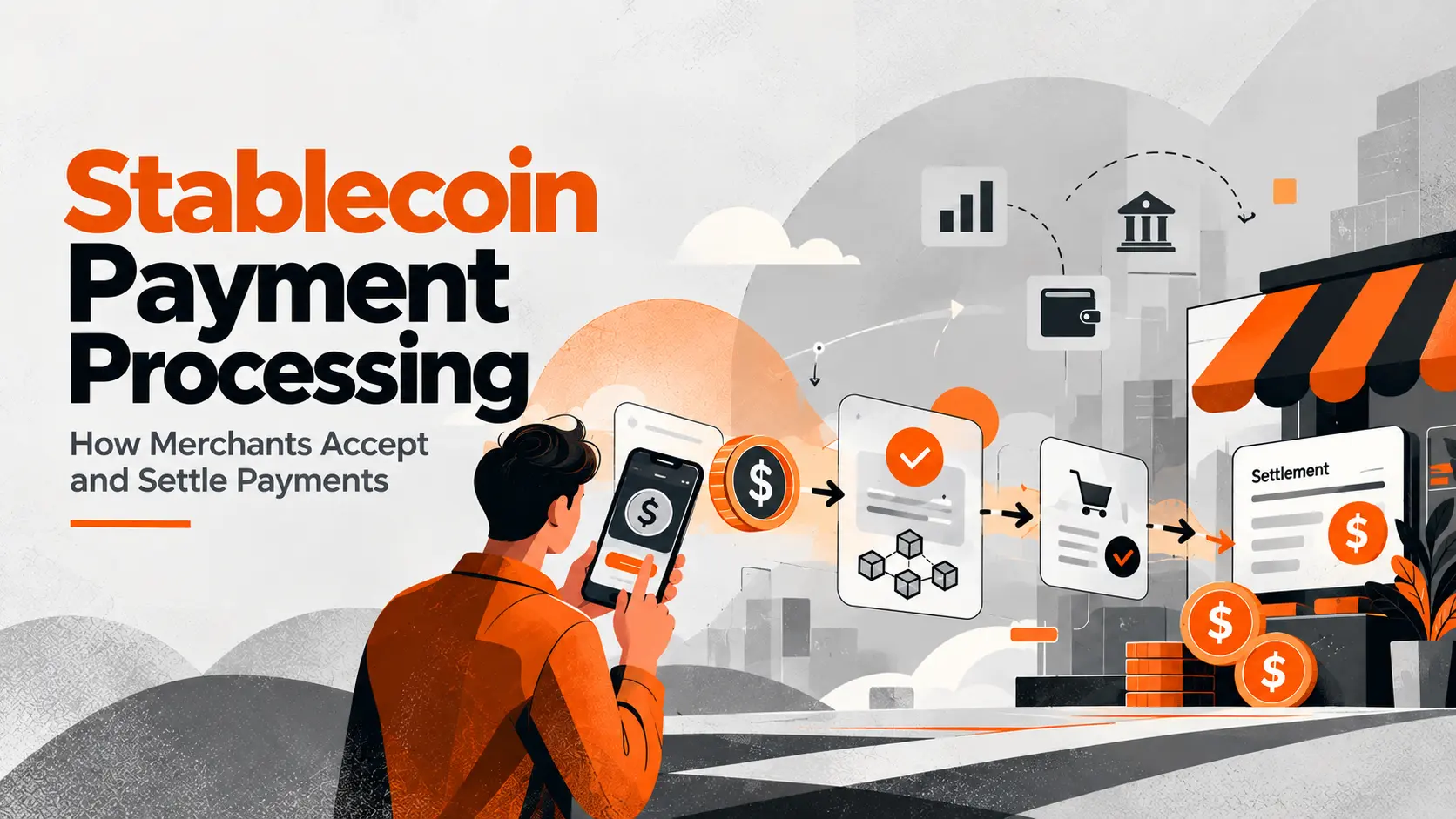
The merchant may receive stablecoins in a business wallet, or the processor may convert them and settle traditional currency to a bank or payment account. The blockchain transfer can be confirmed well before a later fiat payout becomes available. That payout may depend on banking hours, verification, conversion arrangements, local regulations or provider reserves.
This distinction prevents a common misunderstanding: fast blockchain confirmation does not guarantee equally fast access to money in the merchant's bank account.
Three Ways Businesses Can Accept Stablecoin Payments
The right operating model depends less on whether a company likes cryptocurrency and more on what its staff must manage after the sale.
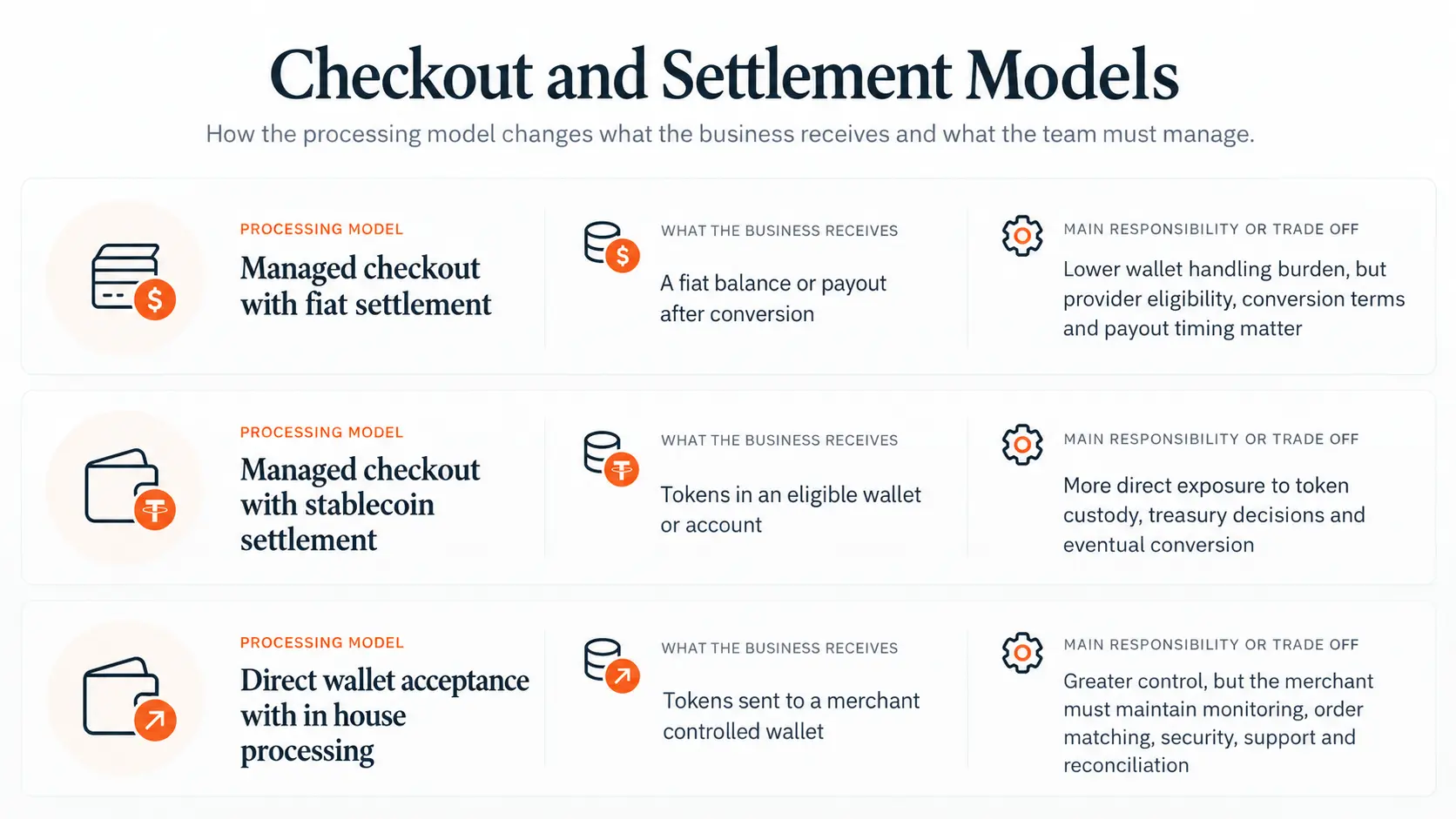
A small online store with ordinary payroll and suppliers might prefer fiat settlement. A digital platform with legitimate stablecoin obligations may have reasons to retain tokens. Direct acceptance can be appropriate for technically capable teams, but saving a processor charge is not automatically a saving if reconciliation, fraud review and incident response must be built internally.
Neither a custodial nor a merchant controlled arrangement removes the need to evaluate the token issuer, operating jurisdictions, sanctions controls and provider reliability.
What Should a Merchant Check Before Choosing a Processor?
Customer experience and supported payments
Start with the actual customer base. Do buyers have compatible wallets and a reason to pay this way? Confirm the accepted stablecoins and blockchain networks, checkout languages, device compatibility, minimum transaction values and any location restrictions. An option that only a tiny share of customers can complete may add support work without increasing successful orders.
A useful test is the percentage of initiated checkouts that become correctly matched, confirmed payments. Technical uptime alone cannot reveal confusing wallet prompts or unsupported networks.
Settlement, custody and availability
Ask whether the business receives fiat, stablecoins or a choice, and who holds the funds between collection and payout. Document the normal payout schedule, delays, withdrawal restrictions, conversion method and what happens during a depeg or provider outage. A provider's ability to collect a token is not proof that it can pay out to every merchant bank account or country.
The finance team should distinguish three timestamps in its reporting: the customer initiated payment, the network confirmed receipt, and the merchant received spendable proceeds.
Refunds, failed payments and customer support
Stablecoin transfers generally cannot be reversed by a card network. A refund typically requires a separate transfer or a processor managed payout mechanism. Merchants need a way to verify the correct destination, handle changed wallet addresses, define refund currency and amount, and prevent repeated refunds. The precise workflow varies by provider.
Other exceptions deserve documented answers. What happens when a customer uses the wrong network? Is an underpayment rejected or left pending? How are expired quotes handled? When does the merchant, rather than the processor, bear a loss? A processor with a simple checkout but weak exception support can become expensive in staff time.
Reporting, controls and total operating cost
A useful integration exports order level data that fits the merchant's existing finance system. It should support reconciliations, role based permissions, audit history and clear records of any conversion. Eligibility checks, identity verification, sanctions controls and tax obligations must be evaluated for the actual markets served; the processor does not necessarily assume every legal responsibility of the merchant.
The price comparison should include processing fees, network costs, conversion spreads, payout fees, support time, failed payments and required security work. These costs are not universal, so a headline percentage is less useful than a written quote for the business's typical transaction profile.
A Practical Example: An Online Store Receives 240 USDC
Consider a software company that invoices an overseas customer for $240 and offers USDC as an alternative payment method. The checkout produces a request for 240 USDC on a supported network. The customer signs the transfer, and the processor detects an incoming payment.
If the transfer is still pending, the company should not automatically grant permanent access based only on the customer's wallet screen. Once the processor applies its confirmation policy, matches the payment to the invoice and reports success, the company can fulfill the order under its normal rules.
Now assume that the merchant selected fiat settlement. The provider converts the receipt under its agreed terms and credits the merchant's payment balance, with any applicable charges recorded separately. The exact amount and payout time depend on the actual contract. A notification that 240 USDC arrived on chain does not establish that the bank has already received $240.
If the customer later requests a refund, the business initiates the provider's refund workflow. It should not simply treat the original blockchain transfer as reversible. For an operationally reliable system, the order, payment, settlement and refund must remain connected in one auditable record.
This example also shows why the merchant's first decision should be about the desired settlement outcome, not the brand of wallet used at checkout.
How Is Stablecoin Processing Different From Card Processing?
Card networks usually separate authorization, clearing and settlement, and their rules may support disputes or chargebacks. Stablecoin transfers rely on blockchain confirmation and do not provide the same automatic reversal mechanisms. Some processors add customer service and refund tools, but these are separate services rather than a guarantee built into the transfer itself.
Stablecoins can be useful for customers who already hold them and for payment routes where traditional options are constrained. They are not necessarily faster, cheaper or easier for every domestic shopper. Card payments may provide better consumer familiarity, subscription behavior, fraud tools and recourse. The relevant comparison is completed purchases and usable net proceeds, not network speed alone.
Businesses should also avoid confusing stablecoin acceptance at checkout with stablecoin settlement behind a conventional card transaction. In the latter arrangement, the customer may pay normally while financial institutions use stablecoins between themselves. The merchant experience and contractual risks can be entirely different.
Common Processing Failures and How to Limit Them
Wrong token or network. Make supported assets explicit, validate destination details and show a clear recovery policy. Recovery may be unavailable, so prevention matters more than a promise to retrieve funds.
Payment confirmed but order remains unpaid. Use unique payment references and reliable notifications, and investigate unmatched transfers through a controlled queue rather than manual guesses.
Duplicate or partial payment. Establish rules for shortfalls, overpayments, expired sessions and repeat transfers. Every adjustment should be documented against the original order.
Unusable merchant proceeds. Verify conversion and payout capabilities in advance. A token balance that cannot be withdrawn, redeemed or converted where the business operates does not solve a cash flow problem.
Operational or regulatory disruption. Test access controls, incident procedures, custody terms, and country level restrictions. Stablecoin prices and issuer arrangements can change, while payments may be paused by providers for compliance or risk reasons.
How to Run a Small Merchant Pilot
A sensible launch begins with a narrow use case rather than a company wide checkout change. Choose one eligible customer segment, one supported token and network, and a defined settlement currency. Confirm that legal, finance, engineering and customer support teams agree on the refund policy and success criteria.
For the first pilot, track successful completion rate, time from customer initiation to confirmed payment, time to spendable funds, unmatched transactions, refund resolution time, total cost per completed order and support contacts. Compare these with the payment method customers would otherwise use. If stablecoins do not improve an important outcome, there is little reason to expand them merely because the technology is available.
Only after reconciliation and exception handling work consistently should the business consider additional networks, currencies or markets. This phased approach is usually safer than launching wide support and discovering after the fact that finance cannot close the books.
Stablecoin payment processing works when a business can connect a customer's token transfer to a real order and a usable settlement balance with the same discipline it applies to other payment methods. Checkout design, confirmation, reconciliation, refunds and operational controls are as important as the blockchain itself. The strongest implementation is not the one with the most supported tokens; it is the one customers can complete reliably and the finance team can audit without uncertainty.
FAQ
Do merchants need their own crypto wallet to accept stablecoins?
Not always. Some processors manage the on chain acceptance and convert proceeds into fiat before payout. Businesses choosing direct token settlement or self managed acceptance may need appropriate wallet and custody arrangements.
Can a stablecoin payment be reversed after confirmation?
An ordinary confirmed blockchain transfer is generally not reversed like a card chargeback. Refunds typically require a new transfer or a provider operated refund process, with its own policies and checks.
Does a confirmed transaction mean the merchant has received cash?
No. It can confirm token delivery, while conversion and bank payout may occur later. Merchants should verify the status of the settlement balance separately from the on chain transaction.
Is accepting stablecoin payments cheaper than accepting cards?
It depends on transaction size, customer behavior, payment provider, network, conversion, payout route and support costs. A fair comparison uses total cost per successfully completed order, not just the advertised transaction fee.

Masoumeh Jahangard
Markets & Economy Writer at PinerookMasoumeh Jahangard covers markets, economic trends, and business conditions for Pinerook, focusing on how they affect startups and growing companies.
 Seen first.