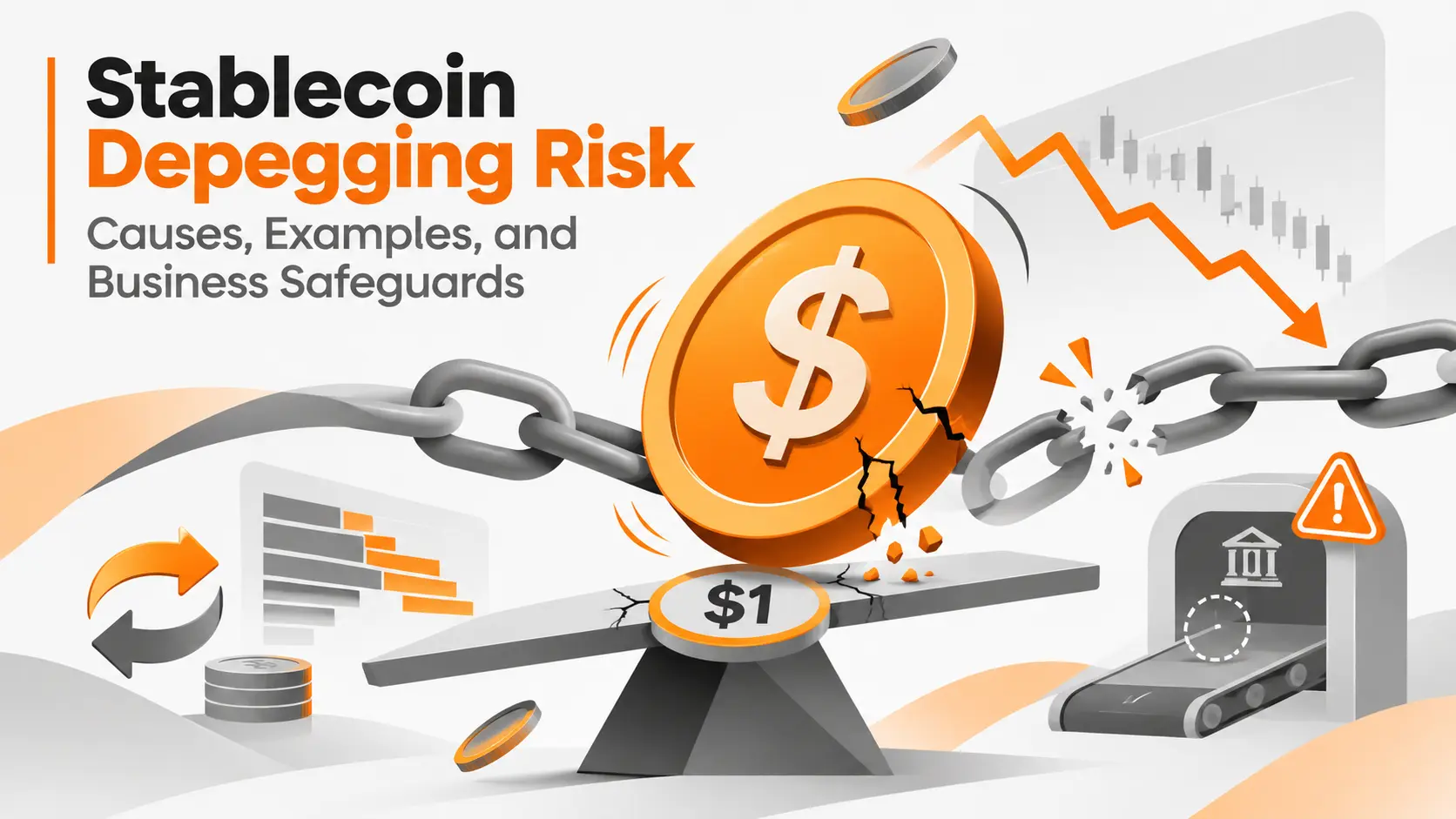
A stablecoin is designed to maintain the value of a reference asset, usually one US dollar. That target makes it useful for certain business payments, but it does not eliminate price risk. If market participants lose confidence in the issuer, cannot redeem tokens promptly, or cannot find enough buyers, the token can trade below its intended value. For a company expecting to pay suppliers or staff, even a short disruption can turn a seemingly predictable payment into an urgent liquidity problem.
Companies evaluating Stablecoins for Business need to distinguish transfer speed from recoverable value. A token that arrives on a blockchain in seconds may still be difficult to convert into bank money at the expected rate. This guide explains what stablecoin depegging risk means, the mechanisms behind it, the warning signals finance teams can monitor, and the practical decisions involved when a peg breaks.
What Is Stablecoin Depegging Risk?
Depegging occurs when a stablecoin trades meaningfully away from the value it is intended to track. A dollar referenced stablecoin quoted at $0.97 is trading three cents below its target, while a quote of $1.02 is above it. A price difference on an exchange is not necessarily the exact redemption value available to every holder. The issuer may offer a different process, and some holders cannot access that process directly.
The core risk is not the existence of every small price fluctuation. It is the possibility that a business cannot obtain the amount of usable money it expected, at the time it needs it. A short lived deviation caused by thin weekend trading is different from a persistent shortfall in backing assets. Both warrant attention, but they imply different decisions about selling, waiting, routing a payment, and protecting upcoming obligations.
Two Historical Examples That Explain Different Risks
USDC and the Silicon Valley Bank disruption in March 2023
In March 2023, Circle disclosed that approximately $3.3 billion of the reserves backing USDC were held at Silicon Valley Bank when the bank failed. The uncertainty, combined with disruption in redemption channels, led USDC to trade below its dollar target on secondary markets. Other stablecoins with exposure through collateral or trading relationships also experienced price pressure. The peg recovered after US authorities announced measures protecting deposits at the failed bank and confidence improved.
The lesson is more precise than saying that a dollar backed stablecoin is unsafe or that every deviation will recover. Reserve concentration, access to banking partners, and the availability of redemption determine how an external financial shock reaches token holders. A business may be solvent on paper but still unable to convert tokens quickly during a banking weekend. The distinction between a temporary market discount and a permanent loss cannot always be established at the moment a crisis begins.
TerraUSD in May 2022
TerraUSD relied on an algorithmic relationship with another crypto asset, LUNA, rather than a conventional portfolio of dollar reserves. In May 2022, heavy withdrawals and collapsing confidence overwhelmed that mechanism. The prices of both assets entered a self reinforcing decline, and TerraUSD did not return to a reliable dollar peg. This illustrates a different failure mode from the temporary USDC episode: the stabilization design itself can break down under stress.
These cases should not be treated as forecasts for any particular token. They show why the legal redemption promise, reserve structure, market liquidity, and dependency on other assets must be reviewed separately. For a company, the relevant question is not whether a familiar ticker has historically stayed near one dollar. It is how the value can actually be recovered if conditions become unfavorable.
How a Depeg Can Affect a Business Payment
Consider a company holding 100,000 tokens that normally target a dollar. At parity, the balance appears to represent $100,000. If the executable market price falls to $0.94, selling the full amount at that assumed price would produce $94,000 before fees, a $6,000 shortfall against the target value. This is an illustrative calculation, not a forecast or an assumption that enough buyers would exist at $0.94 for the entire trade.
The company could choose to wait rather than sell, but the payment it owes may be due now. An accounting valuation loss and an actual realized loss are also different: selling crystallizes the difference, while continuing to hold leaves the company exposed to further changes. If its supplier requires $100,000 in bank money today, the finance team must identify an accessible alternative funding source rather than rely on a price rebound. Settlement urgency, redemption eligibility, and the available depth of market all affect that decision.
Depegging also creates operational complications. A merchant that received a stablecoin payment may need to decide whether to accept the token, how to record the value at receipt, and whether the customer has fully discharged an invoice. A payroll or supplier payment can fail commercially even if the blockchain transfer succeeds technically. Contracts, payment processor terms, and the currency in which the obligation is denominated determine which party bears the difference.
Early Warning Signals Worth Monitoring
An isolated quote below one dollar does not prove insolvency. A useful monitoring process combines market information with issuer disclosures, redemption access, and actual execution conditions. The table below translates common signals into questions a finance team can investigate, rather than pretending that a single price threshold predicts failure.
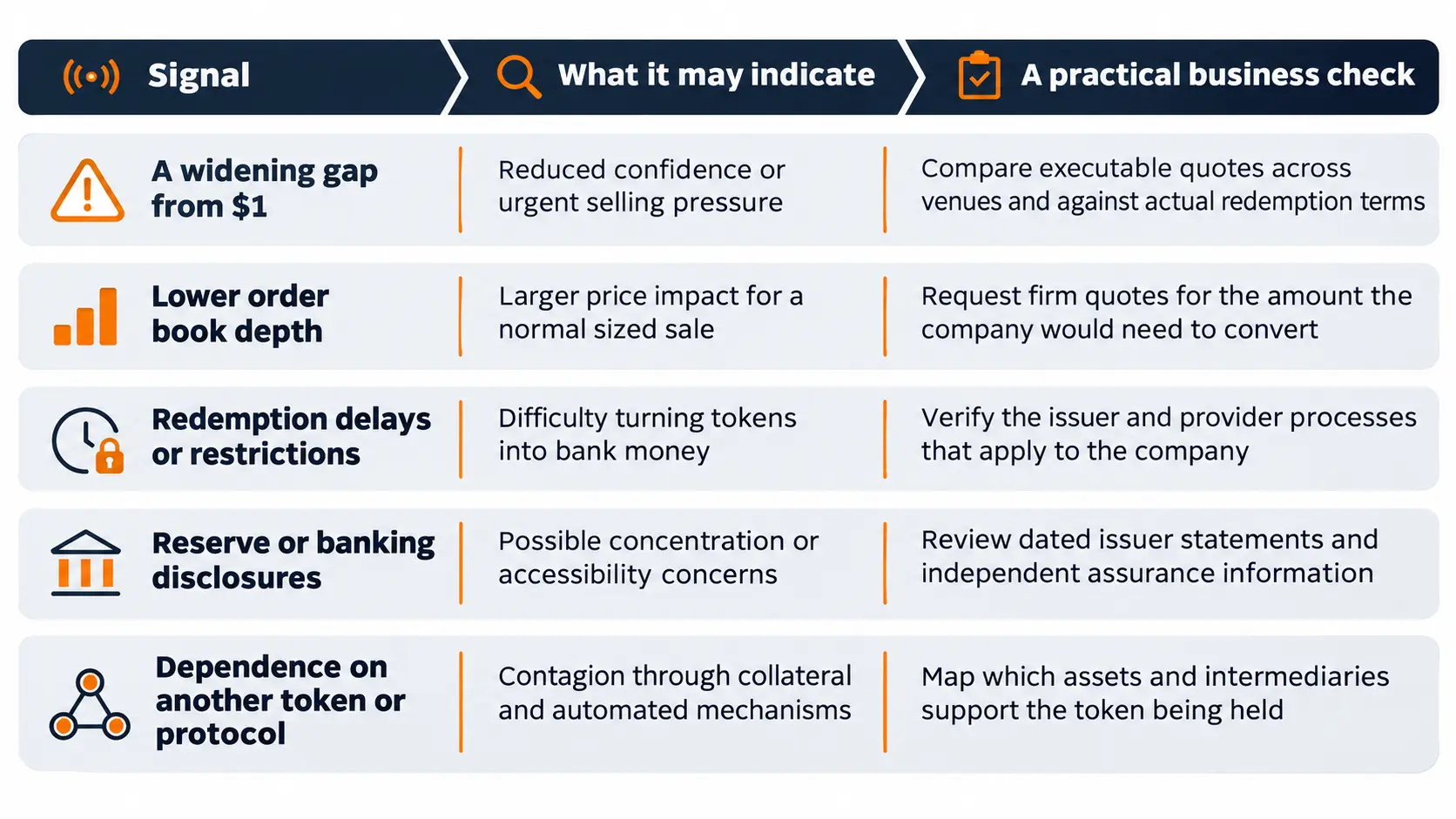
A single exchange price and social media commentary are not substitutes for verified evidence. Teams should record when each quote, statement, or status notice was collected because conditions can change rapidly. A price feed that looks normal may also be stale, while a brief low price on an illiquid venue may not describe the market available to a particular company. Monitoring works best when tied to an actual decision that the finance team is authorized to make.
What to Do When a Stablecoin Begins to Depeg
Confirm the exposure and the source of the price
Start with the number of tokens held, the wallets or custodians involved, and the business obligations funded by them. Check more than one reputable venue, but distinguish displayed prices from quotes executable at the relevant size. Determine whether the issuer has issued a verifiable update about its reserves or redemptions. A response based on incomplete information can cause unnecessary losses, just as ignoring a genuine liquidity problem can delay essential payments.
Protect payments that cannot wait
Rank obligations by urgency, including wages, taxes, contracted supplier payments, and customer refunds. Where necessary, use prearranged bank balances or an approved alternative payment rail. Pause new exposure if the company’s risk policy calls for it, while keeping contractual obligations and operational continuity in view. Do not route funds through unfamiliar counterparties simply because they advertise an immediate conversion at par.
Assess the available exit routes
Direct issuer redemption, conversion through a regulated intermediary, and secondary market sales may produce different outcomes. Some are unavailable to certain holders or jurisdictions; others require documentation or have time limits. Ask for the cash amount likely to arrive after fees, slippage, and processing time, not only the percentage shown on an exchange screen. A decision to hold, redeem, or sell should be made by an authorized person under a documented risk process, not by an assumed recovery timeline.
Document decisions and communicate clearly
Record prices, quotations, approval times, executed transactions, and reasons for each decision. If a payment amount or timing changes, notify the relevant counterparty with the facts known at that time. Finance and legal teams may need to assess contract terms and the reporting treatment of any realized or unrealized change in value. Clear records are especially important when several departments use the same stablecoin provider.
How Businesses Can Limit Depegging Exposure Before a Crisis
The strongest controls are established before the first significant price break. A business can limit how much working capital it keeps in a stablecoin, shorten holding periods to the time actually required for payments, and maintain a separate source of funds for essential obligations. These choices reduce dependence on any single issuer or payment partner without requiring the company to forecast the next crisis.
Due diligence should cover the issuer’s legal identity, published reserve information, banking and custody dependencies, eligible redemption counterparties, and the ability to obtain bank money in the company’s jurisdiction. An issuer may publish an assurance report, but such a report has a date, scope, and limitations; it is not a guarantee against future liquidity stress. Providers also need to be evaluated for account controls, incident communication, transaction limits, and the reliability of their off ramps.
A simple stress test can reveal weaknesses. Suppose a company plans to send $80,000 through a stablecoin on Friday, but the market price temporarily falls to $0.95 and the chosen conversion provider stops processing until Monday. Finance should calculate the potential market value of $76,000 before fees, identify whether a fallback payment can cover the original $80,000 obligation, and record who can approve that fallback. The figures are illustrative; the purpose is to make the response operationally specific, not to prescribe a universal exposure limit.
Where several currencies, chains, or providers are involved, teams should map concentrations rather than assume that multiple tokens automatically provide diversification. Two different tokens may share the same reserve custodian, collateral asset, or liquidity provider. Any threshold for pausing new payments or escalating a valuation decline should reflect the company’s risk tolerance and payment needs. There is no universal percentage that guarantees when to buy, sell, or wait.
What a Depeg Does Not Automatically Tell You
A price under one dollar does not by itself prove that an issuer is insolvent, and a return to one dollar does not erase the disruption experienced by businesses that had to sell earlier. Similarly, an issuer stating that tokens are redeemable at par does not mean every holder can redeem immediately or through the same channel. Reading these distinctions correctly can prevent a finance team from confusing a market observation with a legal entitlement or an operational capability.
Businesses should evaluate stablecoin depegging as one component of payment and liquidity risk, alongside bank availability, counterparty exposure, fraud controls, and currency conversion. In some situations a conventional bank transfer will be the more dependable route; in others, a stablecoin service may still be useful with limited balances and tested controls. The decision depends on the full pathway from holding the token to receiving usable money, particularly when markets are stressed.
Stablecoin depegging risk is the risk that an intended stable value cannot be converted into usable money at the expected price and time. It can emerge from reserve concerns, redemption bottlenecks, market liquidity shortages, or a failing token design. Businesses are better protected when they verify how redemption actually works, monitor credible signals, and plan how obligations will be paid if the peg does not hold. A stable price on an ordinary day is a useful feature, but a tested recovery and payment plan is what makes the feature operationally dependable.
FAQ
Can a fiat backed stablecoin lose its peg?
Yes. Even when a stablecoin has reserves, doubts about reserve access, banking partners, or redemption timing can push its secondary market price below the target. The reserve arrangement and the price available to an individual holder are not always identical.
Does every stablecoin depeg become permanent?
No. Some deviations have been temporary, while others have ended in a fundamental collapse. Recovery depends on the cause, credible backing, access to liquidity, and the design of the token. Past recoveries do not guarantee that the next depeg will reverse.
Can a business redeem a depegged stablecoin for one dollar?
Possibly, but not automatically. Access depends on the issuer’s terms, the holder’s eligibility, the state of the redemption service, and the currency or banking channels available. Businesses should verify those conditions before counting the balance as immediately usable cash.
Is a small price movement always a warning of failure?
No. Brief deviations can reflect spreads, trading hours, or limited market depth. Larger and persistent discounts accompanied by verified redemption problems or reserve concerns may deserve more urgent investigation. The decision should be based on several independent signals.
How can a startup reduce the impact of depegging?
A startup can keep stablecoin holding periods short, maintain fallback liquidity, verify redemption access, set exposure limits appropriate to its obligations, and test alternative payment arrangements. The objective is not to remove every possible price move but to prevent one disrupted token from stopping essential business payments.

Masoumeh Jahangard
Markets & Economy Writer at PinerookMasoumeh Jahangard covers markets, economic trends, and business conditions for Pinerook, focusing on how they affect startups and growing companies.
 Seen first.